Bible Translations

In the English language today we are blessed with dozens of translations of the Scriptures all aiming to convey the meaning of the original texts in our world in our language.

It’s not as easy as it sounds because it’s not just a matter of plugging equivalent words from Greek or Hebrew into their closest English meaning. That’s before you even start to consider underlying meanings and assumptions people in a given place and time make. For example how would you translate the expression “I’m flat out like a lizard on a rock” into normal English let alone another language? Just imagine the lep you have to make across 2000 years or more of history and life experience.

What made me think about this was a reading that Margaret Baxter shared on Sunday morning from Acts 2:42-47 from the New Living Translation:

42 All the believers devoted themselves to the apostles’ teaching, and to fellowship, and to sharing in meals (including the Lord’s Supper[a]), and to prayer.

43 A deep sense of awe came over them all, and the apostles performed many miraculous signs and wonders. 44 And all the believers met together in one place and shared everything they had. 45 They sold their property and possessions and shared the money with those in need. 46 They worshipped together at the Temple each day, met in homes for the Lord’s Supper, and shared their meals with great joy and generosity[b] 47 all the while praising God and enjoying the goodwill of all the people. And each day the Lord added to their fellowship those who were being saved.

What tripped me up there was the mentioning of the Lord’s Supper twice. I was looking at it and thinking “that’s not there” even as I was reading the words.

The New International Version puts it this way:

42 They devoted themselves to the apostles’ teaching and to fellowship, to the breaking of bread and to prayer. 43 Everyone was filled with awe at the many wonders and signs performed by the apostles. 44 All the believers were together and had everything in common. 45 They sold property and possessions to give to anyone who had need. 46 Every day they continued to meet together in the temple courts. They broke bread in their homes and ate together with glad and sincere hearts, 47 praising God and enjoying the favour of all the people. And the Lord added to their number daily those who were being saved.

The NIV doesn’t mention the Lord’s Supper or Communion at all. The Greek merely talks about breaking bread, which means sharing a meal together, but in the Christian context also means sharing Communion together. So the NIV is closer to the literal meaning, but the NLT is perhaps closer to what the first christians understood by the phrase.

I think what Luke is trying to convey here is the wonderful sense of community amongst the church. They were always hanging out together, doing ordinary things but also worshipping, listening to the apostles teaching and so on. There was no distinction between “church” and “secular” or “home” stuff.

I like the way the Contemporary English Version expresses it:

42 They spent their time learning from the apostles, and they were like family to each other. They also broke bread and prayed together.
43 Everyone was amazed by the many miracles and wonders that the apostles worked. 44 All the Lord’s followers often met together, and they shared everything they had. 45 They would sell their property and possessions and give the money to whoever needed it. 46 Day after day they met together in the temple. They broke bread together in different homes and shared their food happily and freely, 47 while praising God. Everyone liked them, and each day the Lord added to their group others who were being saved.

Both the NLT and the CEV have footnotes to indicate that the term “breaking bread” means sharing a meal and Holy Communion, but how many read the footnotes?

Does it matter that much? I don’t know.

I am sometimes frustrated when I realise that a particular verse in a particular version doesn’t mean what it seems to say. I guess we need to be thankful that we have so many translations to choose from  and  get on with the job of reading one of them and living out all that God shows us in His word.

Reflection on Acts 19:1-7

Scripture

When Paul placed his hands on them, the Holy Spirit came on them, and they spoke in tongues and prophesied.

Observation
Paul travels to Ephesus where he finds some disciples. He asks them if they received the Holy Spirit when they believed, but they reply that they hadn’t even heard of the Holy Spirit. Perplexed, he asks them what baptism they received to which they reply that they received John’s baptism.

Paul explains that John’s baptism was about repentance to prepare for the coming of Jesus. He then baptises them into the name of Jesus. When he lays hands on them they receive the Holy Spirit, prophesying and speaking in tongues.

Application
Baptism isn’t just about repenting of our sins. It is about dying to our old nature and entering fully into the resurrection life of the Lord Jesus Christ.

Part of this experience is receiving the Holy Spirit. For some reason there is often a separation between salvation, baptism in water, and baptism in the Holy Spirit.

God’s intention is that we receive it all- eternity, grace and power in the Holy Spirit.

Once they understood correctly and entered into the full baptism of Christ, the believers in Ephesus received the full baptism in the Holy Spirit, This should be our experience also.

Prayer
Release your Spirit in me, Lord Jesus. May the promise of my water baptism become the fullness of Spirit baptism. Amen.

Reflection on Acts 2:1-21


Pentecost-of-many-tongues

Scripture

All of them were filled with the Holy Spirit and began to speak in other languages, as the Spirit gave them the ability.

Observation

The disciples are together on the Day of Pentecost. Suddenly there is a sound like a rushing wind and fiery tongues c


Reflection on Acts 1:6-14


ascension

Scripture

He replied, “It is not for you to know the times or periods that the Father has set by his own authority. But you will receive power when the Holy Spirit has come upon you, and you will be my witnesses in Jerusalem, in all Judea and Samaria and to the ends of the earth.”

Observation

The disciples ask Jesus if He is about to restore Israel. But Jesus replies that this is not for them to know. They must wait for the Holy Spirit who will give them the power to be witnesses even to the ends of the earth.

Then Jesus is taken up to heaven. Two angels appear and tell the disciples that Jesus will return in the same way that He has left.

After this, they return to the city to the room where they are staying. There they continue to pray and wait.

Application

Jesus’ words here remind us of the danger of theological speculation. It isn’t wrong to wonder about the future kingdom, but it can distract us from the main job which if to be witnesses to Jesus under the anointing of the Holy Spirit.

Jesus will return, but in the meantime there is a gospel to preach to the nations.

There is an order to this. We must first receive the Holy Spirit and then go out. No Spirit- no power.

Prayer

Holy Spirit come and fill me. Lead me to those people who need to know Jesus and speak through me.

Amen.

Reflection on Acts 17:16-31

athens

Scripture

The Lord who made the world and everything in it, he who is the Lord of heaven, does not live in shrines made by human hands, nor is he served by human hands, as though he needed anything, since he himself gives to all mortals life and breath to all things.”

Observation
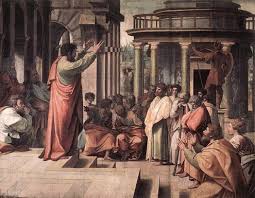
In Athens, Paul is distressed by all the idols he sees everywhere. He argues with Jews in the synagogue and debates with Gentiles in the marketplace.
Paul says to them that he can see that their religious practices including an altar to an unknown god. Paul says that this unknown god is too big to be housed in a shrine and does not need humans to serve Him. He made the earth and all people and will judge them for their sins. But salvation is found in the man whom God appointed and raised from the dead.
Some scoff at the idea of the resurrection, but others become believers.

Application
Religion is hopeless to save people.
The Athenians were amongst the most religious people in the world with idols and shrines all over the city, but they still needed a Saviour.
Today people are religious in all kinds of ways and about all kinds of things Muslims, Hindus, New Agers, crystal devotees.
Religion will not forgive your sins.
But Jesus will.

Prayer
Thank you Lord for your salvation. Eternity does not depend on me being good enough, but only on the Blood of Jesus. Hallelujah!

Reflection on Acts 7:55-60

Carracci,_Annibale_-_The_Stoning_of_St_Stephen_-_1603-04

Scripture

But Stephen, full of the Holy Spirit, gazed steadily into heaven and saw the glory of God, and he saw Jesus sitting in the place of honour at God’s right hand.

Observation

Stephen stands before the Sanhedrin. At the end of his testimony, the Jewish leaders are enraged. Stephen, full of the Holy Spirit, sees the glory of God. He tells them, “I see the Son of Man at God’s right hand.”

The leaders drag Stephen off to be stoned. The accusers give their coats to Saul to be minded.

As they stone him, Stephen calls out to Jesus to receive his spirit and then, as he dies, for mercy for his killers.

Application

The gospel upsets people for all kinds of reasons. Some don’t want to be confronted by sin, others don’t want to be confronted by grace, and still others fear that the gospel will somehow stop them from making money from sin.

While we should not go looking for opposition or persecution, we should not be surprised when it comes.

Even so, we need to remain gracious to those who oppose us, seeking to bring them to a knowledge of Jesus.

Prayer

Father, give grace to all who are facing death or violence because of their love for you. May their tormentors be moved by your love. Amen.

Ray Ortlund- It multiplied

It multiplied


So the church throughout all Judea and Galilee and Samaria had peace and was being built up.  And walking in the fear of the Lord and in the comfort of the Holy Spirit, it multiplied.  Acts 9:31

I’m not against strategic plans.  I’m for them.  They have their place, as a matter of wise stewardship.  But they cannot generate the astonishing outcomes described in the book of Acts.

I remember hearing Michael Green at the Lausanne Congress on World Evangelization in 1974.  He asked us, Why don’t we see anywhere in the book of Acts a man-made strategic plan for evangelizing the world?  His answer: They didn’t have one.

What then did they have?  Two things, for starters: the fear of the Lord, and the comfort of the Holy Spirit.

In the fear of the Lord, they were teachable, they were humble, they were listening to the gospel, they were open and grateful and easily bendable.  They did not have a spirit of self-assurance.  They were eager to learn and grow and change in any way the Lord wanted them to.

In the comfort of the Holy Spirit, they were gladdened, they felt forgiven, they were reconciled to God and reconciling with one another.  They saw their sins and failures, but they also saw the far greater reality of Jesus crucified for them.  To put it in a secular way, they couldn’t believe their luck.

Openness in a know-it-all world, comfort in an angry world – that ancient world simply could not resist these heaven-sent powers.  So the church didn’t just grow, it multiplied.

Those early churches had no master plan for their future.  But they were walking in the fear of the Lord and in the comfort of the Holy Spirit, and it worked.

Church growth takes planning.  Let’s do it.  But church multiplication takes miracle.  Let’s be open to what only God can do.


Reflection on Acts 2:36-41

JanStyka-SaintPeter

Scripture

Peter replied, “Each of you must repent and turn to God, and be baptised in the name of Jesus Christ for the forgiveness of your sins. Then you will receive the gift of the Holy Spirit.”

Observation

While preaching to the crowd, Peter tells them that Jesus whom they crucified is in fact the Messiah. People are cut to the quick and ask Peter what they should do. Peter tells them they need to repent and turn to God.

The promise of the Holy Spirit is for everyone, even the Gentiles.

Peter continues to urge them to receive the gift of salvation. After all this, 3000 people repent and are baptised.

Application

Our sins- MY sins- crucified Jesus. I am responsible for Christ’s death on the cross.

His promise is still available to all who turn to Jesus- salvation the the fullness of the Holy Spirit.

My sins are my responsibility before God. So is my salvation! Everyone must ask Jesus to forgive them.

Nobody is too far from God’s grace to be saved. Nobody is too hard, too sinful or too evil to be accepted by God.

Prayer

Thank you Father for your great salvation and for your love poured out for me. Amen.

Reflection on Acts 2:22-32

acts_waterdrop

Scripture

“God raised Jesus from the dead, and we are all witnesses of this.”


Observation

Peter addresses the crowd on the Day of Pentecost, after the Holy Spirit has been poured out on all the disciples.

Jesus’ miracles were a sign that God was leading Him. Sinful people, both Jews and Gentiles, had Him crucified. But God raised Him back to life, for death could not keep hold of Him.

David had written about this in the Psalms- not about himself but prophetically about Jesus.

Now God has raised Jesus from the dead and Peter and all the followers of Jesus are witnesses of this.


Application

The resurrection of Jesus Christ is one of the cornerstone facts of the faith. Jesus’ death and resurrection were part of God’s plan for dealing with sin and allowing us to be reconciled to Him.

God raised Christ from the dead, and in doing this proved He is stronger than death.

The victory is won, and all we have to do to share in it is to receive the free gift of Jesus Christ,


Prayer

Christ is risen! Hallelujah!

Death is conquered! Hallelujah!