Reflection on Acts 28:1-16

Scripture

The people waited for him to swell up or suddenly drop dead. But when they had waited for a long time and saw that he wasn’t harmed, they changed their minds and decided he was a god.

Observation

The people on the island, which turned out to be Malta, welcome the shipwreck survivors and build a fire on the shore for them.

Paul gathers some sticks to lay on the fire, and a snake bites him on the hand. The locals decide that he must be a murderer to be punished like this. When he fails to show any ill effects, they decide he must be a god.

Paul and his companions go to the estate of Publius, the chief official of the island. Publius’s father is very ill, so Paul lays hands on him and heals him. All of the sick people on the island then come to Paul and all are healed.

Application

When Paul is bitten by the snake, the people of Malta assume that he must have done something bad to deserve it. But when Paul survives, they change their minds and declare him to be a god.

People are very quick to judge others when something bad befalls them. That judgement can be fickle as it was in the case of Paul.

We know that God is gracious and wants everyone to repent. He will pour out amazing quantities of grace to win over the worst of sinners.

Jesus reminds us that God sends sunshine and rain to both the righteous and the unrighteous alike. We cannot assume anyone’s state of holiness or favour with God by what is happening in their life at any time.

Prayer

Father, please forgive me for assuming things about those who are suffering and those who are prospering. Please help me to see all people as you see them. Amen.

Reflection on Acts 27:13-44

Scripture

“For last night an angel of the God to whom I belong and whom I serve stood before me , and he said, ‘Don’t be afraid, Paul, for you will surely stand trial before Caesar!’’

Observation

Gale force winds blow, and the sailors are not able to control the ship’s direction. They begin throwing the cargo overboard hoping to save the ship.

After many days, all hope is lost. Paul tells the crew to take courage. Paul says an angel came in the night to assure him that nobody on the ship would die, although they would be shipwrecked.

About midnight on the fourteenth day of the storm, it appears that the ship will be driven onto rocks. Some of the sailors try to abandon the ship, but Paul tells the commanding officer that they will all die unless the sailors stay on board. The soldiers then cut the rope to the lifeboat.

At dawn, they see a likely landing place, but the ship hits rocks. Everyone heads to shore and they all survive.

Application

While everyone was afraid, Paul was at peace. He knew that God was with him, even before the angel gave him the encouraging report.

When we are at the centre of God’s will, we can know peace that the world cannot understand. When we have a mission from the Lord, even the greatest of storms will not pull us down.

There is peace in the presence of the Lord.

Prayer

Thank you Lord for your peace, your shalom. Help me to walk at the centre of your will so that when the storms of life threaten to overcome me, I will not be afraid. Amen.

Reflection on Acts 27:1-12

Scripture

“Men,” he said, “I believe there is trouble ahead for us if we go on- shipwreck, loss of cargo, and danger to our lives as well.”

Observation

Finally, Paul and his companions board a ship headed for Italy. As a prisoner, Paul is in the custody of a Roman officer.

As they travel, they face increasingly stormy weather. Paul tells the officers that if they continue, they face shipwreck, loss of cargo and threat to lives.

The officer in charge of the prisoners listens to the ship’s owner and the captain rather than Paul.

Application

It is clear from the narrative that the ship faces adverse weather conditions. It is possible that this is not just a physical phenomenon but a demonic opposition to Paul’s journey to Rome.

Paul tried to warn the officer guarding him and the other prisoners that the consequences of carrying on would be disastrous, but the officer would have thought that Paul was just trying to delay his trial in Rome.

On the natural level, it is understandable that a person would pay more attention to the people of the status of ship’s owner and captain rather than a prisoner.

This is where discernment comes in. Christians have the gift of the Holy Spirit, and if we take time to listen to the Holy Spirit, we can go beyond what is natural and, instead, move in the wisdom of God.

Too often we judge by whatever our eyes and reason tell us rather than listening to the voice of the Holy Spirit.

We need to learn to listen and trust the “still small voice.”

Prayer

Holy Spirit, teach me how to listen to you, how to discern the difference between godly wisdom and human wisdom. Let me walk in your grace always. Amen.

Reflection on Acts 26:1-32

Scripture

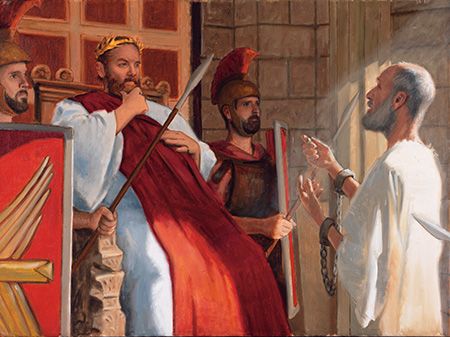
Paul replied, “Whether quickly or not, I pray to God that both you and everyone here in this audience might become the same as I am, except for the chains.”

Observation

Paul now speaks before King Agrippa. He argues that his faith in Christ is totally in accordance with Jewish beliefs. He was raised a Pharisee, zealous for the faith, and persecutor of christians.

Paul tells the story of his encounter with Jesus on the way to Damascus. Jesus commissioned him to testify to the world and to rescue the Gentiles from the power of satan.

Paul asserts that he is being opposed by the Jewish leaders because he has preached the Good News to the Gentiles.

Agrippa asks Paul if he thinks he can be persuaded to be a christian so quickly. Paul responds that he prays that everyone there will come to know Jesus whether quickly or slowly.

Agrippa and Festus agree together that Paul has done nothing illegal, and that if he had not appealed to Caesar they would have released him.

Application

It is a fact that some people turn to Jesus the first time they hear the gospel, but many people take much longer.

It has been estimated that on average it takes a person eleven times of hearing the gospel before they say “Yes” to Jesus.

Whether it is the first time or the hundredth, it doesn’t matter. But we do need to pray regularly and over a prolonged period for people to receive Jesus.

As Paul says in his speech, people everywhere are in the darkness and under the control of satan. This battle can only be won by prayer; by faithful prayer perhaps over years.

Let us join together in praying for friends and family members who do not yet know Jesus.

Prayer

Holy Spirit, enlighten the hearts of the people who do not yet know about Jesus. Open their eyes to the truth. Amen.

Reflection on Acts 24:1-27

Scripture

As he reasoned with them about righteousness and self-control and the coming day of judgement, Felix became quite frightened. “Go away now,” he replied. “When it is more convenient I will call for you again.”

Observation

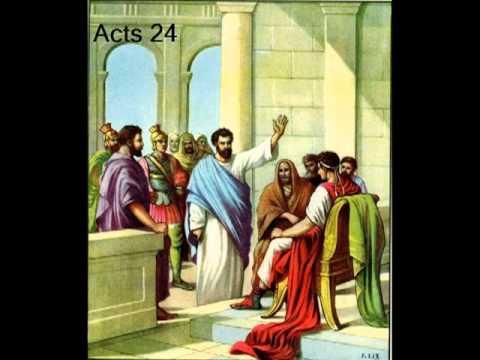
Ananias arrives in Caesarea with some elders and a lawyer to prosecute the case against Paul.

The lawyer Tertullus alleges that Paul is a trouble maker who stirs up riots among the Jews, and that he tried to desecrate the Temple.

In his defence, Paul says that he was at the Temple to worship not to desecrate it. The only time he caused any trouble was when he shouted in the council that he was on trial because he believed in the resurrection of the dead.

Felix orders Paul held in the prison in order to gain favour with the Jews. Every so often he summons Paul and talk with him, hoping to gain a bribe. This goes on for two years.

Application

Felix was a politician and was motivated by ambition. He changed his actions to suit what was more politically expedient at the time.

He had very mixed motives:

  • he wanted to placate the Jews so he held Paul in prison
  • he wanted to hear Paul but was too frightened to listen
  • he was hoping for a bribe from Paul in order to release him

When people act out of self-centredness, they are not in a position to respond to the gospel. We can pray and talk all that we are able, but they have to be in a place where they are willing to either take on the truth with all its implications or to worship God regardless of the cost.

Repentance and faith are gifts from God.

Prayer

Thank you Lord for saving me. I pray that my friends and family who do not yet know you will receive your gift of salvation. Amen.

Reflection on Acts 23:1-25

Scripture

Gazing intently at the high council, Paul began, “Brothers, I have always lived before God with a clear conscience.”

Observation

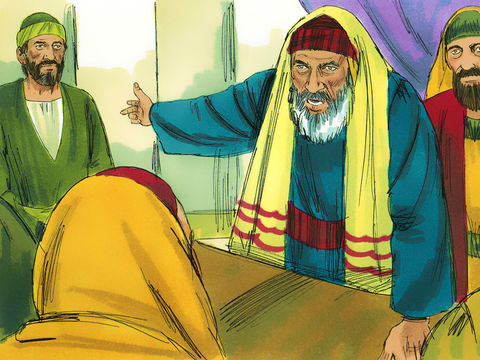
Paul stands before the council in Jerusalem. As soon as he begins to speak Ananias the High Priest orders someone to slap him.

Paul realises that some of the council members are Pharisees and others are Sadducees. He claims that, as a Pharisee, he is on trial for his belief in the resurrection. This causes a great dispute between the two factions.

The next morning, a group of Jews conspires to kill Paul. Pail’s nephew hears about it and warns Paul and the Roman officers about what is happening. The commander has Paul sent to Caesarea to Felix, the Roman governor, for Paul’s safety.

Application

It is a good thing to be able to claim, as Paul did, that we have always lived before God with a clear conscience.

Most of us are not perfect, so we cannot make this claim, at least not from our own ability. We all sin and fall short of God’s glory.

The consequence of sin is that we live separated from God and will die separated from Him. Unless our sin is dealt with, we are headed for eternal torment in hell.

Praise God! He has supplied us with the answer for sin.

Jesus has paid the price for our sin. When He died in the cross, every sin of every person was laid on his shoulders and He took the punishment that was due to us.

Now, in order to be forgiven, we just out it all on Jesus’ account. We ask God to forgive our sins, and they are forgiven.

We can all live, as Paul did, with a clear conscience before God.

Prayer

Lord Jesus, I invite you into my life. Thank you for taking away my sins. Help me to live for you as your disciple. Amen.

Reflection on Acts 22:17-30

Scripture

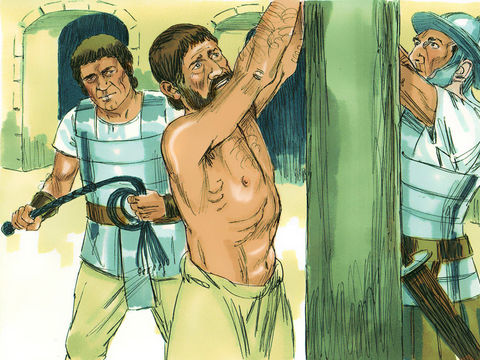
When they tied Paul down to lash him, Paul said to the officer standing there, “Is it legal for you to whip a Roman citizen who hasn’t even been tried?”

Observation

Paul continues to address the crowd in Jerusalem.

He tells how, after his conversion, he returned to Jerusalem. While praying, he went into a trance, and Jesus told him to leave Jerusalem and go far away to the Gentiles.

The crowd erupts on hearing the word Gentiles. The commander is at a loss to understand what is happening, at least in part due to the fact that he doesn’t speak Aramaic. The commander takes Paul inside and orders him to be whipped until he explains the situation.

Paul then tells the officer that he is a Roman citizen, and it is illegal to punish him without a court hearing. The commander summons the Jewish high council to have Paul stand before them.

Application

There are times when it is right to submit to authorities, and there are times when it is right to stand up for our rights.

In this case, Paul respectfully demands that his rights as a Roman citizen be recognised by the commander. Roman citizens were not allowed to be punished without a trial, so Paul uses that privilege.

Apart from his own personal well being, Paul saw that a trial before the Sanhedrin would be an opportunity to share the gospel. As a respected Jewish scholar, they would have to acknowledge his authority on the the claims of Jesus to be the Messiah.

When we come into conflict with local powers and authorities, we need to ask ourselves whether we are acting from selfish motives or godly motives. Is the Holy Spirit directing my attitudes and actions? If it is the Holy Spirit leading, then we need to pray carefully about the way forward. If we are acting from the flesh, we need to repent and again seek God’s guidance.

Everything I do should be Spirit directed.

Prayer

Lord God, please hep me to be surrendered to you in every detail of my life. When I conflict with those in authority over me, please grant me your wisdom. Amen.

Reflection on Acts 22:1-16

Scripture

“What are you waiting for? Get up and be baptised. Have your sins washed away by calling on the name of the Lord.”

Observation

Paul is addressing the mob in Jerusalem in Aramaic, their own language.

He briefly tells the story of how he was a zealous Jew, persecuting the followers of Jesus. He had an encounter with the Lord on the way to Damascus. Paul was blinded by a bright light from which the voice of the Lord confronted him about his persecution of christians. The Lord tells him to go to Damascus where he will receive further instructions.

Paul is led by the hand, and finds a believer called Ananias who restores his sight. Then Ananias tells him to get up, be baptised and be forgiven by the Lord.

Application

The Way of the Lord is not difficult- there are not hundreds of rules and rituals to be followed. It is simple- be baptised and receive God’s forgiveness.

In several places in the Bible the simple promise is repeated- “Everyone who calls on the name of the Lord will be saved.”

This is not a religious test in which we repeat a formula or prayer that gets us forgiven. No! To call on the name of the Lord is to admit that you are lost and need saving. It is an expression of trust that God alone can save us.

What are we being saved from? In a word, hell.

Every person has a choice of where they will spend eternity. We can either receive God’s grace and spend eternity in heaven, or we can receive God’s judgement on our sins and go to hell. We either live in joyful relationship with our loving Creator, or we suffer separation from God for ever.

The choice we make in this life affects the destination in the next life.

The promise of God is that if we give our lives to Him, trusting Him to forgive us, then our sins will be wiped away, and our soul will be saved.

Prayer

Thank you Father for your great love. I receive your forgiveness in the name of Jesus. Amen.

Reflection on Acts 21:18-40

Scripture

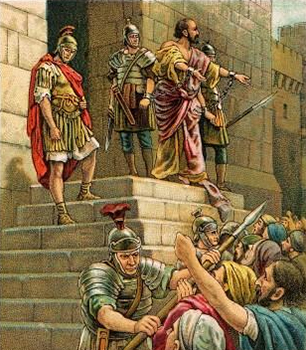
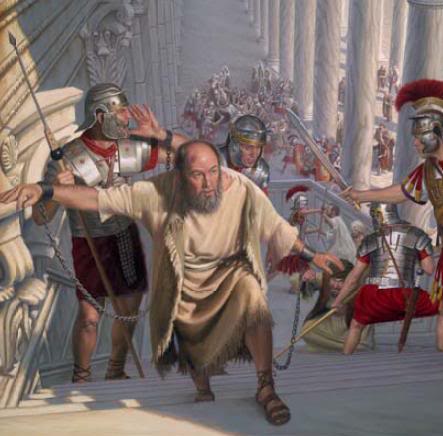
As Paul reached the stairs, the mob grew so violent the soldiers had to lift him to their shoulders to protect him.

Observation

Paul goes to see James and the elders of the Jerusalem church. He tells them everything that happened on his missionary journeys.

The elders report that in Jerusalem some of the Jews there have been telling the believers that Paul has been telling Jewish believers that they no longer have to follow the Law of Moses. To correct this misinformation, they arrange for Paul to go to the Temple with four believers who have completed a vow.

When they arrive at the Temple, some agitators start a riot over Paul’s presence. The Jews start beating Paul. Word reaches the Roman military leader, and he dispatches a platoon to quell the riot.

Unable to find out the cause of the trouble, the commander orders Paul to be taken to the fortress. As they arrive there, Paul asks for permission to address the crowd.

Application

It seems that wherever Paul went trouble soon started. This is not because of anything that Paul did that was inherently wrong. It was from jealousy and fear that people started to become violent.

The riots were started by the same kinds of people who start riots in our own day. There were two factors explicitly mentioned here.

1. False information. Information was spread about Paul’s ministry to both Jews and Gentiles. They claimed he was telling Jewish believers to abandon their traditions and customs. This was not true.

False information is often a flash point for violent behaviour.

2. False accusations. The agitators claimed that Paul had brought a Gentile into the Temple. People made assumptions about Paul’s actions.

It is easy to manipulate people by feeding them false information and then making false charges.

Jesus is the Way, the Truth and the Life. Satan is the father of lies. Follower of Jesus must make sure that we always speak truth rather than lies.

Prayer

Holy Spirit speak your truth into my heart. Give me discernment so that I can always distinguish truth from deception. Amen.

Reflection on Acts 21:1-17

Scripture

When it was clear that we could not persuade him, we gave up and said, “The Lord’s will be done.”

Observation

Paul and his companions resume their travel, heading for Jerusalem.

In Tyre, the believers prophesy by the Holy Spirit, imploring Paul not to go to Jerusalem.

In Caesarea, they stay at the home of Philip. A man named Agabus comes from Judea and performs a prophetic act. He declares that Paul will be bound by the Jewish leaders in Jerusalem and handed over to the Gentiles.

Everyone pleads with Paul to not go on, but he is determined. He is willing to be imprisoned, even to die, for the sake of the Lord Jesus.

Finally they arrive in Jerusalem where they are warmly welcomed by the brothers and sisters.

Application

Paul had such a strong conviction that he needed to go to Jerusalem, under the direction of the Holy Spirit that nothing, not even a series of prophetic words and actions, would deter him.

Sometimes we can think that if we get a prophetic word spoken over us or directed towards us then we have to follow that word.

In this case, the prophecies were only confirming what Paul knew was the way ahead. He knew that jail, possibly death, awaited him in Jerusalem. The prophecies along the way only served to confirm what God had already told him.

Prophecy and the other gifts of the Holy Spirit are nor meant to be prescriptive. They should not tell us definitively what to do. They are just part of the information that God gives us to help us follow Him.

The response to prophecy always has to be left to the individual, guided by the Holy Spirit.

Prayer

Lord, I thank you for all the gifts of the Holy Spirit, including prophecy. Help me, Lord, to have wisdom in understanding and applying prophecy. Amen.