Reflection on Acts 20:13-35

Scripture

“My life is worth nothing to me, unless I use it for finishing the work assigned to me by the Lord Jesus- the work of telling others the Good News about the wonderful grace of God.”

Observation

Paul and his companions travel to Miletus. Paul is determined to travel to Jerusalem in time for Pentecost.

While in Miletus, Paul calls for the elders from Ephesus to come and see him. He recounts how he worked among them, sharing the Good News about Jesus and encouraging people to repent.

Paul is bound for Jerusalem, not knowing what to expect there. The Holy Spirit has told him that suffering and jail lie ahead. He encourages the elders to guard their flock and to be on the lookout for false teachers who will come in like vicious wolves.

They all pray together, crying in sadness at the knowledge that they will not see one another again.

Application

Paul considered his life as worthless, unless he completed the task to which he had been assigned, that is telling people the Good News about salvation.

For people without a knowledge of eternity, it makes sense to live life to its fullest and enjoy life as they can. For christians, this is folly because we know that we must give an account to the Lord of how we spend our lives.

Not everybody is a Paul- an apostle called to travel the world sharing the gospel and planting churches. Not everybody is called to be in a full time paid ministry position.

We are all called to serve the Lord and to give our lives as an offering to Him. We need to find from Him what is our calling, our assignment in the Kingdom.

We are not here to live for our own pleasure. God has a unique role for every one of His people to fulfil.

Prayer

Thank you Lord for the knowledge that you have made me for a purpose. Please help me to walk in that purpose today and every day. Amen.

Reflection on Acts 20:1-12

Scripture

On the first day of the week, we gathered with the local believers to share the Lord’s Supper. Paul was preaching to them, and since he was leaving the next day, he kept talking until midnight.

Observation

After the uproar in Ephesus, Paul resumes travelling through Greece and Macedonia, ending in the city of Troas.

While there, he meets with the local believers. He preaches right through the night. A young man named Eutychus falls out of his seat on the window sill and dies. Paul picks him up and tells the others he is alive.

Application

People often wonder what worship was like in the early church. From this passage, and others in the New Testament, we can infer at least three things.

Firstly, the church met on the Lord’s Day, that is Sunday, from very early on. That is in contrast to the Jews who met on the Sabbath, that is Saturday.

There are many explanations put forward for this, but the simplest is that it seemed appropriate to set aside the day of the Resurrection as the special day for christian worship.

Secondly, they shared the Lord’s Supper. The Lord’s Supper, or Holy Communion, is a focal point for worship. The early church celebrated the Lord’s Supper every Sunday to remember the central distinctive message of the gospel that Jesus died for our sins.

Thirdly, preaching was very important. Maybe we shouldn’t preach all night as it can be fatal. The proclamation of the Good News and the teaching of Scripture is vital. We live in an era where people have short attention spans, but we should not dismiss the power of the spoken word.

Prayer

Lord teach me how to worship you and hoe to listen to the preaching of your word. Amen.

Reflection on Acts 19:21-41

Scripture

“But as you have seen and heard, this man Paul has persuaded many people that handmade gods aren’t really gods at all. And this is not only here in Ephesus but throughout the entire province.”

Observation

Paul feels compelled by the Holy Spirit to go on to Macedonia, and so he sends Timothy and Erastus to prepare the way for him.

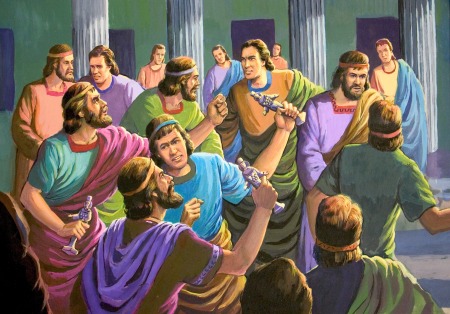
In Ephesus a riot breaks out because the silversmiths are seeing their businesses decline due to people following Jesus rather than the local “god” Artemis. The mob seizes some of Paul’s companions and takes them to the amphitheatre.

Eventually the mayor convinces them to disperse and take Paul and his friends to the local court if they think a crime has been committed.

Application

In these riots, as in the current ones happening in the United States, people can be convinced to join in for very different reasons (sometimes no reason at all). A grievance can be twisted or co-opted by outside forces.

Some people were concerned about their loss of income from the decreased demand for idols. Others were concerned because the honour of Artemis is being undermined by Paul’s preaching.

Christians can become a threat to vested interests, whether religious or financial, and even find themselves being targeted because of the changes the gospel brings.

In Australia, it is easy to see how a revival might reduce the demand for alcohol and illegal drugs. It is possible that people who profit from these things might become violent towards christian leaders.

What an honour it would be if we could get to a place where the church is so effective in its mission that we are a threat to harmful businesses. What an honour it would be to see society- wide change happening because of the gospel.

This is happening in many parts of the world today. We pray that it will happen here also.

Prayer

Lord it is awesome to think that christians can multiply so quickly that they become a threat to some people. Send revival to this land, Lord, so that we might be a part of such a great movement of your Spirit. Amen.

Reflection on Acts 19:1-20

Scripture

Then, when Paul laid his hands on them, the Holy Spirit came upon them, and they spoke in other tongues and prophesied.

Observation

Paul travels to Ephesus, where he meets some believers. He asks them if they received the Holy Spirit. They had not even heard of the Spirit and had only been baptised in John’s baptism. Paul baptises them in the name of Jesus, and they receive the Holy Spirit, speaking in tongues and prophesying.

Paul starts teaching in the synagogue, but is rejected there, so he holds daily meetings in a Greek philosophy hall. He also performs many miracles.

Some Jews who try to use Paul’s and Jesus’ names to cast out demons are beaten up be a demonised man. The spirits say, “We know Paul and we know Jesus, but we don’t know you.”

Many people are saved. A great bonfire of books of sorcery is lit to celebrate the change of heart of many pagans.

Application

Some believers who had been taught by Apollos are found by Paul to have not received the Holy Spirit. Their teaching and their conversion were deficient.

How did Paul know there was a problem? Perhaps he exercised the spiritual gift of discernment. Perhaps there was something about the way they spoke or prayed.

Paul baptises them in water in the name of Jesus and lays hands on them to receive the Holy Spirit. They then speak in tongues and prophesy.

When we receive the baptism in the Holy Spirit, there will always be a manifestation, a sign of the Spirit’s presence. The gift of tongues is given as a sign of the Holy Spirit as well as a language for prayer. This was one of the first signs on the Day of Pentecost that the Holy Spirit had been poured out.

Some christians still fail to experience the fullness of the Holy Spirit because they have not been taught correctly. This is not to say that they are unsaved; they are living a less than ideal life.

Prayer

Come Holy Spirit and fill every part of me. Let my speech be surrendered to you in tongues, in prophecy, and in testimony. Amen.

Reflection on Acts 18:18-28

Scripture

He had been taught the way of the Lord, and he taught others about Jesus with an enthusiastic spirit and with accuracy. However, he knew only about John’s baptism.

Observation

Paul moves on from Corinth to a number of other places. He leaves Priscilla and Aquila at Ephesus before returning to Antioch.

Meanwhile a Jewish believer named Apollos arrives in Ephesus. He is a gifted and enthusiastic teacher. He teaches the others about Jesus, but he knows only about John’s baptism. Priscilla and Aquila take Apollos aside and explain the way of God more accurately.

Apollos moves on to Achaia with the blessing of the Ephesian believers. There, he is used mightily by God.

Application

It does not matter how much you know about the Lord, you do not have all the truth. There is always more to be gleaned.

The good news is that the Lord uses us regardless of our level of knowledge. Apollos was a gifted teacher, and he was enthusiastic. So the Lord used him in every place he went.

We don’t have to wait until we know it all to serve the Lord. We just need to love Him and love people. If we are keen to serve Him, the Lord will open up the path for us.

Apollos apparently understood John’s baptism- a baptism of repentance. However he did not know about the baptism of Jesus- a baptism into the Holy Spirit.

The lack must have been obvious to Priscilla and Aquila. Apollos loved the Lord and had enthusiasm and energy, but he lacked the Holy Spirit. When they explained the baptism of the Holy Spirit to him, he took off in his ministry.

We cannot serve God adequately without the Holy Spirit. This is not to demean what anyone does from raw talent offered in love to the Lord. When we submit to the power of the Holy Spirit, it is much more effective.

Prayer

Holy Spirit, fill me, baptise me, anoint me. Take my life and let me be an offering poured out in service to you. Amen.

Reflection on Acts 18:1-17

Scripture

One night the Lord spoke to Paul in a vision and told him, “Don’t be afraid! Speak out! Don’t be silent! For I am with you, and no one will attack and harm you, for many people in the city belong to me.”

Observation

Paul moves to Corinth where he meets Priscilla and Aquila, Jewish believers from Rome. Paul testifies to the Jews about Jesus, but many of them oppose him. He decides then to leave the Jews and focus on the Gentiles.

One night, Paul has a vision of the Lord in which He tells him to not be afraid, but to continue speaking out. Paul then stays in Corinth for the next year and a half.

A change of governor emboldens the Jews. They bring Paul to him for judgement, but he expresses no interest in the case.

Application

The Lord’s exhortation to Paul is a word we should take note of.

“Don’t be afraid!” We can so easily be intimidated by opposition or disagreement. Satan is the author of fear. We must not allow fear of people to hold us back.

“Speak out!” It is not enough to let our lifestyle be our witness. Our testimony is in the words we speak. Our actions must be consistent with the gospel, but people need to hear the message. Faith comes by hearing.

“Don’t be silent!” We must not stand by and see injustices and crimes go unpunished. We must not be silent when people slander the church or the name of Jesus. Silence is an easy option, but should not be the option for christians.

The Lord encouraged Paul with the assurance that there were many followers of Jesus in that city. This sounds like the words of the Lord to Elijah when he thought that he was the only person in Israel still faithful to the Lord.

When we feel like we are alone in standing up for Jesus, it is good to be reminded that we are not alone.

Prayer

Lord please help me to be bold and speak your message, even when I feel isolated or alone. Amen.

Reflection on Acts 17:16-34

Scripture

“God overlooked people’s ignorance about these things in earlier times, but now he commands everyone everywhere to repent of their sins and turn to him.”

Observation

In Athens, Paul follows his normal practice of visiting the local synagogue to talk about Jesus with the Jews. He also debates with the philosophers.

He is taken to the town council to address them. He talks about God’s purpose for the nations and urges them to repent of their sins. The councillors are bemused by Paul’s talk of the resurrection.

A few people become believers, despite the generally negative response.

Application

Even when people are hostile or apathetic about the gospel, we are still responsible to proclaim the message.

Paul did what he could to express the gospel in the language that the leaders in Athens could relate to. He spoke to philosophers and city leaders, and just a few responded positively.

But those few started a congregation, a faith community. Those few would not have been saved if Paul had not shared the gospel.

In Australia we face a very similar situation. People generally are apathetic or even hostile to the gospel. It does not fit into their world view. People are comfortable in their sins and see no reason to change.

Regardless of this, Paul’s warning is still true. God has ignored people’s sins in the past, but that does not mean He will always withhold judgement. We need to continue to warn people that they must repent of their sins and turn to God.

We need to make sure also that we are living lives of repentance, continually turning to God. Our lives must confirm the truth of our words.

Prayer

Lord I pray for my friends and family today. May they come to know your grace, turn away from their sins and follow you. Amen.

Reflection on Acts 17:1-15

Scripture

The people of Berea were more open-minded than those in Thessalonica, and they listened to Paul’s message. They searched the Scriptures day after day to see if Paul and Silas were teaching the truth.

Observation

Paul and Silas travel to Thessalonica. Paul attends the synagogue service for three Sabbaths, explaining that the Messiah must suffer and rise from the dead, and that Jesus is the Messiah. Some of the Jews believe the message, but others become jealous and start to attack the believers.

Paul and Silas move on to Berea. Here, the Jews search the Scriptures, and many receive the gospel. Some of the Thessalonian Jews hear that Paul is preaching in Berea, so they go there to stir up trouble. Paul is then sent to Athens.

Application

The people in Berea listened to Paul’s message and checked out his teaching against the Scriptures. Consequently, many of them became christians.

All christians should be like the Jews of Berea- reading the Word, and checking all teaching against scripture.

The practice of daily devotions or quiet time is invaluable. It is like food for the spirit. Read a passage and ask God to speak to you through His Word. Write down any thoughts or revelations that come to you.

Reading the Bible in a more systematic way is also important. There are any number of plans to read the Bible in a year. The advantage of doing this is that it enables you to read the full context of Scripture, so that it becomes more than a collection of isolated verses.

Memorising Bible verses is important also. The Holy Spirit can use those verses, when necessary, to encourage or rebuke us, or to share with other people who might need spiritual help.

The people in Berea searched the Scriptures day after day, meaning it was an ongoing practice. When we put the Bible into our daily schedule, then we grow as disciples, no longer being blown around by every trendy teaching that emerges.

Prayer

Lord God, please help me to read and absorb more of your Word. So that I can become strong in the faith. Amen.

Reflection on Acts 16:25-40

Scripture

Around midnight, Paul and Silas were praying and singing hymns to God, and the other prisoners were listening.

Observation

Paul and Silas are in jail in Phillipi, having been beaten severely. They pray and praise God in this time.

There is an earthquake that leaves all the prison doors open and the prisoners unchained. The jailer prepares to kill himself, but Paul calls out to him that nobody has escaped.

The jailer then asks him how he can be saved. Paul tells him to believe in the Lord Jesus, which he and his whole household do.

The next morning the officials send a message that Paul and Silas should be released. But Paul refuses to go until the officials themselves come. The officials then come and apologise to them.

Application

Like the other apostles, Paul and Silas consider it an honour to suffer for Jesus.

At the time of their great suffering, imprisoned for their gospel preaching, Paul and Silas turn to the Lord.

They pray firstly. I doubt that their prayers were just for their own situation. They would have been praying for the city of Phillipi, the work of evangelists and apostles, the church, their fellow prisoners, and so on. The verse says the other prisoners were listening, so they would have got a good idea about the concerns of these men and their heart for other people.

They were also singing hymns. It is always good to praise the Lord. Singing songs of joy and love for God expresses the hope that we have in Christ.

In the midst of this, God sends an earthquake that frees them from the prison. This is a good metaphor for the situations in our own lives. Sometimes we can feel like we are locked into a prison with no way out. If we dedicate our selves to praying and praising the Lord, He will provide an escape route.

Prayer

Lord, please help me to turn to you regardless of the circumstances of my life. Amen.

Reflection on Acts 16:11-24

Scripture

This went on day after day until Paul got so exasperated that he turned and said to the demon within her, “I command you in the name of Jesus to come out of her.” And instantly it left her.

Observation

Paul and his companions move on to Phillipi, a Roman city in Macedonia. On the Sabbath they go to the river bank, expecting a prayer meeting there. They meet some women there, including Lydia who accepts the message straight away.

On another day, as they are going to the place of prayer, a demonised slave girl starts following them. The evil spirit had given her the power to tell fortunes which made a lot of money for her owners. She starts shouting out that Paul and the others have come to tell people how to be saved. Paul becomes exasperated and commands the demon to leave.

Her masters’ business plan is wrecked, so they drag Paul and Silas to the authorities, who order them beaten and thrown into prison.

Application

Not every testimony is helpful. Testimonies from demons are definitely counter-productive.

On the surface, it seems that the demonised girl was stating the truth- the men were there to tell people how to be saved. But if the words were the same ones repeated over and over, or the volume was too loud, then it would have detracted from the message that Paul was trying to speak. The text does not tell us about the tone of voice the demon was used. It could have been sarcastic or mocking, contradicting the intent of the words.

Over the years, I have heard some testimonies that just did not ring true. The person was saying one thing, but living an entirely different kind of life. I have heard testimonies that used the right words, but left the hearer confused about what it all meant.

For me, the responsibility is to make sure that my life is as good as my testimony; in other words my actions must match my words.

Prayer

Holy Spirit, I invite you to bring conviction to my heart about unconfessed sin and any other action that would detract from the activity of Jesus Christ in my life.