Jo Nova: South Pole has coldest winter ever, but it’s just “a blip”

Jo Nova points out something that the climate establishment, including the green media, doesn’t want you to hear.

South Pole has coldest winter ever, but it’s just “a blip”

The sun has just risen on South Pole after the coldest six month period on record since 1956. The last winter there was suddenly 2.2 degrees Celsius colder than the average for the last 30 years.

Remember when Polar Amplification meant Antarctica was melting?South Pole Sunrise from the coldest winter ever.
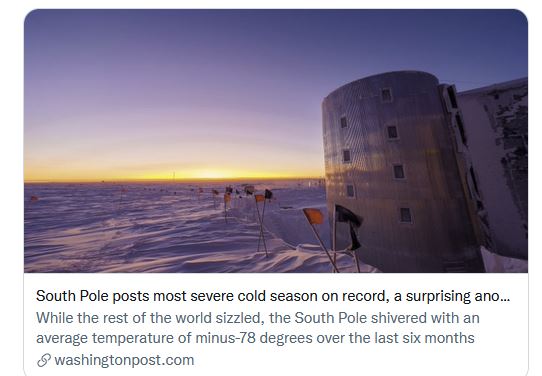
Thanks to NoTricksZone

South Pole Sees Record Cold Winter, Smashing 1976 Record …“Chill Was Exceptional”

Jason Samenow and Kasha Patel, Washington Post

The chill was exceptional, even for the coldest location on the planet.

The average temperature at the Amundsen–Scott South Pole Station between April and September, a frigid minus-78 degrees (minus-61 Celsius), was the coldest on record, dating back to 1957. This was 4.5 degrees lower than the most recent 30-year average at this remote station, which is operated by United States Antarctic Program and administered by the National Science Foundation.

One hot weekend in Miami is Climate change but the coldest six months in Antarctic records is a blip:

While impressive and unexpected, scientists characterized this record as a mere blip and curiosity as both Antarctica and the planet continue to rapidly warm amid escalating extreme weather.

Antarctica has been cooling for a thousand years (or maybe 2,000). That’s a long blip.

Cooling for a thousand years.

Climate change has been making Antarctic summers cooler too. Blips are everywhere.

Surface Air temperature over East Antarctica (presumably in summer) from Hsu et al 2021.

And the ocean around Antarctica is cooler too:

The extreme cold over Antarctica helped push sea ice levels surrounding the continent to their fifth-highest level on record in August, according to the National Snow and Ice Data Center.

As usual, scientists didn’t predict the record cold — but they knew why it happened:

“Basically, the winds in the polar stratosphere have been stronger than normal, which is associated with shifting the jet stream toward the pole,” Amy Butler, an atmospheric scientist at NOAA, wrote in a message. “This keeps the cold air locked up over much of Antarctica.”

No climate story is complete without the cult litany:

Scientists stressed that the record cold over the South Pole in no way refutes or lessens the seriousness of global warming. Antarctica is notorious for its wild swings in weather and climate, which can run counter to global trends.

At minus 60C even the planes don’t go:

Matthew Lazzara, Antarctic scientist said “At these temperatures, it is difficult to operate aircraft,” he wrote in an email. “[B]etween -50°C and -58°C you put the aircraft at risk with the hydraulics freezing up or fuel turning into a jelly.”

Click here to read the full article
It’s Colder Than We Thought

Amidst all the hype about global warming that continues amidst 20 years of no change in temperature, scientists have found that some places are colder than we could imagine.

In Antarctica scientists have measured the lowest temperature yet recorded on the planet. -98C which is down 5 degrees from the previously measured record of -93. To get that low, clear skies and low humidity must persist several days. 

It is believed that it is theoretically possible for temperatures to go to -100C.

So the next time the ABC tells us Antarctica is melting, remember that this is not the full story, and that it is still a very very cold place.

Read the full article here

Jo Nova On Warming In The Antarctic

You may have head on the ABC about how the Antarctic is losing its ice cover and one day will be ice free. Scientist Jo Nova puts that into context

Antarctic Ice Loss Tripled, from near zero to an extremely tiny number! (Nobody mention those volcanoes)

Quick — tax the magma

It’s another round of Antarctic Doom about next to nothing. In April Antarctica’s ice was melting five times faster than usual. Now it’s losing ice three times faster in the last five years than the 15 before that! What you won’t hear is how the Antarctic ice cap has 29 million cubic kilometers of ice and has been there for 30 million, mostly warmer, years. You also won’t hear how Antarctica was warmer in Roman Times, or that the  Antarctic Peninsula has cooled by almost 1 degree.

You also won’t hear a word about any volcanoes

The new paper has zero mentions of the word. But other scientists have published plenty of papers describing how the West Antarctic zone is being warmed from below by 1200 degrees of magma. According to scientist Dustin Schroeder and co,  it is as if the Thwaites Glacier in West Antarctic is sitting on a “stovetop burner”.[1]  His words. Thwaites Glacier,, smack in the middle of the warming is being melted from below by geothermal heat. Then there is the large blob of superheated rock 60 miles below West Antarctica. The researchers use the phrase “like a blow-torch”….  Capping it off, only last year 91 new volcanoes were discovered 2km underneath the West Antarctic Rift. That’s new, as in, we didn’t know they were there.

Follow the reasoning, either a trace gas 10 kilometers up is causing some spots of Antarctica to warm and other parts to cool, or hot magma at 1,200C is. What’s more likely?

Antarctic ice, warming, melting, map, graphic, location of volcanoes, geothermal heat.

Antarctic ice is warming in West Antarctica and the Peninsula, but not over most of East Antarctica.


From the new paper we get the same old pattern. The biggest part of Antarctica is East Antarctica and it’s not melting — even in this alarming new paper.

I thought there was CO2 there as well?

Antarctic Melting, 2018. Graph

The battle of Big Meaningless Numbers

From the abstract we find tiny fractions are written up as big numbers of small units with no real context. Then they extrapolate a 6 year trend on an ice mass that’s been around for millions of years.  Adding up the losses, in this “worst of the worst” scenarios Antarctica might be losing 187 billion tonnes of ice per year (give or take a lot). That’s 187 cubic kilometers of ice, which sounds like a lot until we look at the size of the Antarctic Ice Sheet (29 million kilometers cubed). At this new “accelerated” rate the total loss is one 155,00oth of the total mass. Expressed another way, it’s 0.0006%. At this rate Antarctica will be entirely melted 155,000 years from now.

This agrees quite well with the April round of Antarctic Doom which implied it would melt in 118,000 years. Lucky us, we have 30,000 years to spare now.

The first line in the paper’s introduction:

“The ice sheets of Antarctica hold enough water to raise global sea level by 58m.”

Handy to know what people in 155,000 A.D. will be facing. Now that’s forward planning….

Jo Nova- 91 Volcanoes in Antarctica Found Under The Melting Glaciers

Who would have thought it? Volcanoes, not CO2 melting the Antarctic Ice

Jo Nova writes

Antarctica – 91 volcanoes coincidentally found under glaciers warming “due to climate change”

It’s possibly the densest concentration of volcanoes in the world, some as high as 4km and we didn’t even know these existed til recently.  Despite that overwhelming ignorance, we’re 97.00% certain that all the warming in Antarctica is due to your car and airconditioner. Robin McKie, The Guardian writer, talks about the recent discovery of so many volcanoes under the ice. Not surprisingly, we have no data on how active these volcanoes are. However because we *know* climate change is definitely wrecking Antarctica, it follows that your car, air conditioner and pet dog could melt more ice, take the pressure off the tectonic plate and set one off. Then things will really get out of hand.

Anyhow, it’s just a coincidence that all the warming in Antarctica is where the volcanoes are.

Antarctica, Warming, Climate Change, volcanoes, West Antarctic, glaciers melting.

Warming in Antarctica   |    New volcano discoveries

Spread the hagtag #allvolcanosmatter.

From The Guardian: Scientists discover 91 volcanoes below Antarctic ice sheet

Scientists have uncovered the largest volcanic region on Earth – two kilometres below the surface of the vast ice sheet that covers west Antarctica.

The project, by Edinburgh University researchers, has revealed almost 100 volcanoes – with the highest as tall as the Eiger, which stands at almost 4,000 metres in Switzerland.

Geologists say this huge region is likely to dwarf that of east Africa’s volcanic ridge, currently rated the densest concentration of volcanoes in the world.

These newly discovered volcanoes range in height from 100 to 3,850 metres. All are covered in ice, which sometimes lies in layers that are more than 4km thick in the region. These active peaks are concentrated in a region known as the west Antarctic rift system, which stretches 3,500km from Antarctica’s Ross ice shelf to the Antarctic peninsula.