Many a great battle is won, and many a strong evil disempowered in the quiet place of an apostle’s late nights and early mornings, or together with others in the prayer meetings of a holy Christian community. John Alley
#apostles #church #prayer
Many a great battle is won, and many a strong evil disempowered in the quiet place of an apostle’s late nights and early mornings, or together with others in the prayer meetings of a holy Christian community. John Alley
#apostles #church #prayer
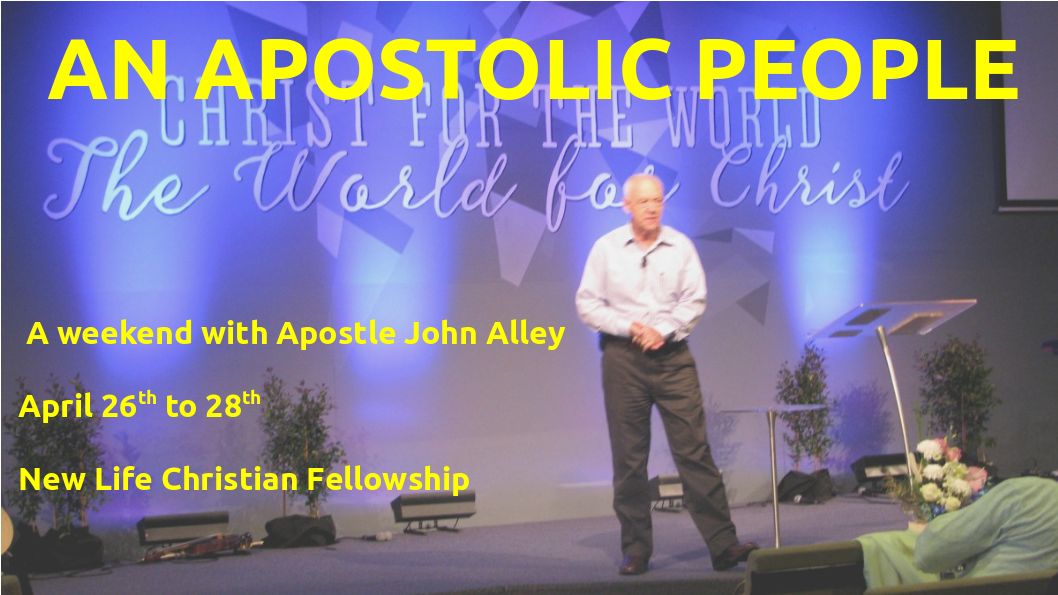
John Alley’s messages given at the Apostolic People seminar are now available from the New Life web page.
Click here to see the list, and to download or listen to the talks.

The announcement last week that Brian Houston was withdrawing his Hillsong church network from the Australian Christian Churches denomination cane as a surprise to people on the outside, but it was inevitable.
 Pastor Brian Houston is a very successful church leader and founder of the original Hillsong megachurch. For a number of years he also served as state and national president of the ACC. Many ACC churches, large and small, have sought to emulate the style and success of Hillsong.
Meanwhile, Hillsong has planted churches around the world and has changed from being an Australian church with overseas churches to being a globally based organisation in its own right.
The movements have parted ways, on respectful and friendly terms. Hillsong will continue to relate to the ACC, but it is not clear how that relationship will progress.
Here are the reasons why I believe that Brian Houston is a true apostle:
I believe that the new Hillsong denomination is a part of the restructuring that the Holy Spirit is bringing to the church. Authority is increasingly flowing through personal relationships rather than man-made structures. We still need the structures but it is the father and son relationships that will increasingly mark the church of the 21st century.

The book of Ephesians 4:10-16 teaches us that the ministry gift of apostle will continue to function so that Christ can fill all things (every realm of society) until we come to full maturity in Christ as a church. Obviously these two things have not yet happened. So the question arises: What would the ministry of apostle look like in today’s world?
Without qualifying all my statements due to the brevity of this article, the following are some observations and opinions I have related to this ministry in context with today’s world. There have been many wonderful books written on the subject of the fivefold ministry (my favorite is Kevin Conner’s The Church in the New Testament). Thus, there is no need for me to repeat content found in these other fine books.
Those walking in the apostolic ministry have a strong leadership gift (Romans 12:7)
They are not primarily followers who conform to the mainstream but are willing to go against culture and carve out a countercultural movement that is based on the reign of God on earth as it is in heaven (read Acts 4:19-31). Thus, they are willing to lead a strong movement even in spite of religious and political opposition.
Contemporary apostles need to be able to preach the gospel and lead countercultural movements that can deal with postmodernism (that there are no absolute truths that can be known in this world) and a post-taboo world (a classical Greek-Libertarian approach in which we live and let live; people can engage in any behavior they want with legal protection, for example same-sex marriage, abortion, euthanasia) in a manner that does not make Christians come off as ignorant, uneducated biblicists but in a cogent, compelling manner that utilizes logic, godly wisdom, current events, statistics, and artful subtlety with the power of the Word and Spirit of God.
Apostolic leaders have the ability to manage whole networks of people, congregations and ministries that are relevant to and thrive in the midst of cultural complexities because they can adapt their methods and message based on the culture in which they labor.
For example, Paul established complex apostolic networks in over 30 diverse cities in the Roman world. He had to speak messages and build churches relevant to Jews (Acts 9, 21, 28), intellects (Acts 17:16-34) and people steeped in carnality and debauchery (First and Second Corinthians). He was not just an evangelist who blessed people and then left town; he was a master builder (1 Corinthians 3:10-14) who had a long-term plan to build communities of faith in the main cities of the Roman world (Ephesus, Philippi, Corinth, Colossae, Rome, Thessalonica) so they would eventually alter the culture and turn the world upside down (Acts 17:6; 19:21-41).
In today’s world, God is still using global leaders in India, Africa, Latin America, the USA, Asia and other places to start non-denominational complex apostolic networks that are driving missions across the earth.
Apostles develop new emerging leaders
When Paul met Timothy he immediately perceived that he was someone worth investing in to develop as a leader (Acts 16:1-3). Scripture teaches us that Paul’s intuition was correct; we read that Timothy turned out to be Paul’s best protégé (Phil. 2:19-25).
Perhaps the most important calling of apostles is to see and develop the leadership potential in others.
In today’s contemporary, fatherless world apostolic leaders are going to have to learn how to be fathers who can re-parent and bring healing to the fatherless, so potential leaders will have the internal affirmation necessary to become great leaders.
Apostles are humble and broken, not superstars in their own minds (2 Corinthians 12:1-7)
Scripture teaches us that Paul ministered out of his weakness, not his strength. In today’s world, I am skeptical of the superstar celebrity leaders who are always bragging about their ministries and accomplishments. Today we need authentic, transparent apostolic leaders who minister out of their weakness, as Paul did, so the glory and power are from Christ alone and to Him alone!
Apostles have seen Jesus
In Acts 1 we see the 11 apostles attempted to choose a person that had walked and talked with Jesus personally to take the place of Judas Iscariot who fell away from his calling and committed suicide. In 1 Corinthians 9:1 and Acts 22:14 an important part of Paul’s calling to the apostolic was that he had seen Jesus personally. Whether this was in the body or just a vision we don’t know (2 Corinthians 12). But the main idea is that Paul had a powerful life-changing encounter with Jesus that rooted and grounded him in the faith and gave him an intimacy with Christ that sustained him through all his trials and tribulations.
Contemporary apostles, like Moses and Paul, need to know the Lord face-to-face as a man knows his friend (Deut. 34:10) so they can clearly hear His voice and have faith to walk in great exploits, and so they are not walking in presumption and embarrass themselves and the gospel.
Apostles move in signs, wonders and miracles (Romans 15:18-20; 2 Corinthians 12:12)
Paul and the other New Testament apostles regularly moved in miraculous signs, wonders and miracles which included gifts of healing, working of miracles and casting out demons.
In contemporary times, this is not only related to the aforementioned supernatural signs, but the signs of God’s providential favor being at the right place at the right time, supernatural doors opening up, financial provisions miraculously coming for ministry projects, and great faith to see God do supernatural things in the hearts and minds of people so the great apostolic vision God has given them can be accomplished.
Apostles speak in principle what prophets prophesy by revelation
The apostolic leaders I know, like John Kelly (ICA), speak in principle words of wisdom that constantly flow out of them, even in ordinary spontaneous conversations. This is unlike many prophetic people who depend upon the Spirit to come upon them and prophesy to give a word of wisdom. Both are effective; that’s why prophets and apostles complement one another and give each other balance.
Apostles are great problem solvers and strategists
Apostolic leaders are able to look at a project and think of all contingency plans (and even have a plan A, B, C based on what happens) like no other leaders! They can take the complex and make it simple for all to understand. They are master builders who can come into a disorganized church or ministry and bring great order within a short period of time. While others see reality in bits and pieces, apostolic leaders can put all the pieces of the puzzle together; they plan ahead, see life at light speed, and see all of life like a chess player who plans ten moves ahead.
Apostles are great fundraisers and operate in the gift of faith for new territories
Apostolic leaders, like Paul, are great visionaries who can motivate people and churches to give to the things of the kingdom (read 2 Corinthians 8, 9).
I have never met a true apostle who didn’t have great vision as well as faith and strategy to believe and receive provision for the vision. This is one of the main ways to distinguish between true and false apostles. False apostles may have apostolic teaching and revelation, and call themselves apostles on their business cards, but they have never built anything of substance. True apostles not only talk but walk the walk with provision for the vision so they can build great works for the Kingdom of God. This is because they have learned to trust God to meet their needs as well as to touch the hearts of potential donors who can fund the vision.
Apostles usually don’t focus on minutia but see the big picture
Apostolic leaders usually miss the tree because they see the forest. They usually do not have much patience for one-on-one counseling unless it is with a high-level leader they are mentoring or covering. This is not because they do not have compassion but because God has wired them to focus on the big picture. Apostolic leaders are “high D” doers and are satisfied more in accomplishing tasks. If they had grace for minutia and hand-holding they would spend most of their time doing those things and would not have the emotional and spiritual energy left for the larger picture of the vision God has assigned to them. Thus, apostolic leaders have learned to nurture pastoral leaders who do the counseling, coaching and hand-holding that the congregation needs.
In closing, we need to greatly value the gift of apostle in our midst. God says this gift is so important that when He starts a work He first sets in an apostle to lay the foundation before any other office or function is established, thus ensuring that the whole building will have the proper foundation (read 1 Corinthians 12:28).
From Charismamag.com, J. Lee Grady warns of toxix “apostles.” I’m glad my apostle is the real deal and is the opposite of this.

I’ve just spent two weeks in South America, where the Holy Spirit is moving in unprecedented ways. Churches are growing and average Christians are sharing their faith passionately. One recent Pew Research study showed that 1 in 5 Latin Americans now identifies as an evangelical Christian—and a majority of these are Pentecostals.
But this growth is not without problems. While there are certainly many healthy Christian movements in the region, other churches are suffering from a lack of trained leadership. And untrained, untested leaders often result in spiritual abuse, false doctrines and financial corruption.
I’ve become more concerned lately with leaders who declare themselves “apostles” when they have no business wearing that label. I believe true apostolic leadership is needed today, but a small army of imposters is threatening to damage the work of God. It is time to heed the apostle Paul, who warned of “false apostles” and “deceitful workers” who were “disguising themselves as apostles of Christ” (2 Cor. 11:13).
Discerning the difference between a true and false apostle is not complicated. Since Scripture clearly tells us that Paul is our apostolic model (see 1 Cor. 4:16), we can use his surrendered life as our standard. Here are six signs that a man or woman who claims apostolic leadership is actually a dangerous influence in the church.
Read the full article here

One of the results of being in a truly apostolic church is that the New Testament experience of community is being restored. One of the main anointings of an apostle is that of fathering; an establishment of authority based in relationships rather than legalism, position or denominationalism.
As denominations slowly (or in some cases, rapidly) crumble, the growth of true apostolic networks is becoming more real and more important. In the “good old days” when someone moved away, whether to go into some kind of ministry or just for employment or family reasons, they could be released knowing that the denominational covering would look after them.
Because of the deep relationships being developed within congregations that have discovered apostolic grace, it is vital that people enter into the community of faith correctly and that they leave correctly. If this is ignored there will be a tearing of relationships, a breaking of hearts, and a rupture of community.
There are four words that help describe the dynamic of apostolic community, none of them popular in our self-centred individualistic culture.
In order to enter into the Kingdom of God, and hence into community, we have to surrender everything to Christ. In some ways this is a life-long process; as we grow closer to the Lord we discover more and more parts of our lives that have to be handed over or surrendered to Christ. The Bible calls this process sanctification.
Sins have to be repented of and stopped. Relationships have to be healed. And the thousand and one idols we carry in our hearts that we secretly depend on to give us strength have to be handed over to Him.
People who have an attitude that they are OK with God on their terms rather than His terms will never fit into the community of faith. That’s not because you have to be perfect to be acceptable. No, not at all! It’s quite the opposite really; the people who fit most into the rag-tag army that is the church are those who recognise that they will never in this life be perfect or good enough, except by the grace of God.
Surrender to God is a process of constantly letting go until the only thing we cling to is Christ.
In Ephesians 5:21 Paul exhorts us to “submit to one another out of reverence for Christ.”
The soul infected with the virus of rebellion or self-empowerment will shrink from these words. But those whose hearts are alive with the concept of community will embrace it.
The apostolic revelation is that everyone needs to be a spiritual son (or daughter) to a spiritual father (not a gender-specific term). I’ve written at length about this, as have many others, so I won’t labour the point here.
Community happens when we submit our own personal preferences and desires to the direction of the community. We willingly allow others to speak into our hearts for encouragement and correction with the desire that together we grow closer to Christ.
To submit means that we allow our hearts to be knitted with others. It means we give up our own rights to self-determination, but we gain the love, support and grace of a true body of Christ.
Again this is a gradual process as we take baby steps of trust.
Somewhere along the path of surrender and submission we discover that we belong. This is my community, these are my people.
Belonging is a two way street. In a sense the congregation “owns” me, but equally I “own” the congregation.
Our hearts have become united in the love of Christ.
Our focus no longer is on what I get out of church, but on the mission and ministry of us, the people of God.
One of the ways you know that you belong is that other places, conferences and events no longer hold the same appeal as they might have once. Margaret and I rarely go to other churches when we are away because we know that no matter how good the church, no matter how great their community is, it’s not where we belong. That’s not a judgement that other places are inferior; we just do not belong there so our experience is not what we expect.
One of the dangers of “belonging” is that we can become a closed community that implicitly excludes the outsider. The true community of faith is constantly reaching out and inviting others to join in and journey to belonging.
The word apostle comes from the Greek word apostello which means to send. Apostles are people who have been sent on a mission and have the grace to send others on their behalf. This flows from their fathering anointing.
When a person has been in an apostolic faith community, the time may come when it is right for them to leave. It is important that the community then exercises its apostolic grace to send them.
We have seen that people often decide to go somewhere without reference to what the community, pastors or group leaders think. They determine “This is what I am doing,” and off they go.
Two things happen when this occurs.
What is the difference between leaving and being sent? The heart of community is submission one to another, that is of open hearts. If someone is a part of a community, the issues need to be discussed openly in the community, before the decision is made. Pastors and cell leaders should be aware of and invited into the decision. This could be as simple as asking a cell group to pray with a family as they consider a job offer that would take them away; but it must have the option of the group saying “We think this is a bad direction.”
Being sent means that we give the community a chance to pray and to bless us as we go. That simple step means that we go with blessing and favour and have God’s grace with us rather than having to go in our own strength.
Surrender, submit, belong, sent. These four words are the cornerstones on which apostolic community is built.
There’s a rich root of revival in Los Angeles—and women were a key part of it.
Assemblies of God history tells us the Azusa Street Revival brought women’s ministries to the fore. Indeed, Jennie Evans Moore who married Daddy William Seymour in 1908, was a key figure. Her name is not as well known as Seymour’s but she was in the revival trenches with him, along with Lucy Farrow and Julia Hutchins. These virtually nameless and faceless, yet faithful, women helped keep the fire burning.
Maria Woodworth-Etter was a mother figure in early Pentecost—John G. Lake called her “Mother Etter.” Her trance-marked ministry helped pave the way for the Azusa Street outpouring and ultimately the birth of a movement that changed the world.
Bold women like Aimee Semple McPherson and Kathryn Kuhlman followed in Mother Etter’s footsteps. McPherson’s Angeles Temple is still standing in Los Angeles today. I stood behind her pulpit in her home, which the Foursquare denomination she started preserved for historical purposes.
JOIN JENNIFER ON FACEBOOK FOR SPIRITUAL COMMENTARY AND ENCOURAGEMENT. CLICK HERE.
While in Los Angeles, I felt mantles being released; mantles for healing, mantles for miracles—and mantles for apostolic women. I began to prophesy these words:
The time is now, says the Lord. The time is now, says the Lord. The time is now, says the Lord, for apostolic women to arise and indeed they are arising even now. The time is now for apostolic women to arise and take their places in their church and take their places in the marketplace and take their places in their families, in their homes.
The time is now for apostolic women to release the revelation that I’ve shared with their hearts in the secret places. The time is now for apostolic women to arise and bring forth the revelation of days gone by. The time is now for apostolic women to build upon the revelation, to speak forth, to build, to build, to build and plant in the name of Jesus with the authority of the Lord Jesus Christ backing them; with all of heaven standing with them; with the ministering angels building and working alongside of them.
The time is now for apostolic women to arise in this city and in this region and in the nation and in the nations of the world. For many years apostolic women have sat in the background waiting for permission to prophesy, waiting for permission to take their places and their God-given roles in the body of Christ. And the time is now for apostolic women to come to the fore, working alongside apostolic men and prophetic believers and evangelists, pastors and teachers who have a heart to build, who have a heart to see awakening, who have a heart to see revival impact this land and who have a heart to see the glory of My Spirit go forth in the nations and cover the earth as the water covers the sea.
The time is now. Apostolic women, the Lord says you have permission to rise up, even own and carry the mantle of Aime Semple McPherson, and carry the mantle of Kathryn Kuhlman, and carry the mantle of Maria Woodworth-Etter, and carry the mantle of those great women from generations past who were nameless and faceless.
The time is now. Rise up, says the Lord.
Full article here


 New Life Narrabri