
From God Reports
By Michael Ashcraft –
Coins don’t lie.
The historical data from coins can’t be altered, obscured or rationalised.
Coins from the emerging Arab Empire tell a frightening story (it’s only frightening for those who believe in Islam).
The story they tell undermines the standard Islamic narrative.
“The earliest history of Islam is questionable at all levels,” remarks Al Fadi, on a CIRA International video. “The so-called Islamic coins debunk Islam itself.”
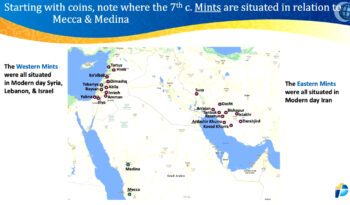
First off, there are no coins minted in Mecca or Medina during the 7th Century (when Arabs arose). According to Islam’s narrative, Mohammad and his followers rose out of Mecca and Medina to conquer the world with the powerful sword of Allah.
But NONE of the earliest coins minted by his followers emanated from either Mecca or Medina. (The coins have the city of minting on them.)
They were minted hundreds of miles to the North in Jordan and Lebanon: Illya, Yubna, Amman, Jerash, Baysan, Abila, Tebariya, Dimashq, Ba’albak, Hinis, Tartus.
(This survey excludes coins from Yemen and Oman, from the Byzantine Empire based in Modern Turkey and the Zoroastrian coins from around Modern Iran and Kuwait.)
Since rulers minted coins from their homebase, this tells us that none of the early Caliphs were based where they were supposed to be in the Hejaz (of Medina and Mecca).
In fact, according to ancient maps, Mecca didn’t even exist.
This is troubling for Muslims because if their history is questionable, logically everything they believe is likewise questionable.
But it gets worse for the standpoint of their historical narrative.
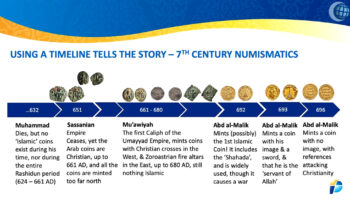
The earliest coins of Arab rulers show they were Christian, according to Dr. Jay Smith.
Coins from the Sassanians (651-660) have crosses on them, showing they were Christian (as opposed to Zororastrian coins which had an emblem of fire altars on them). According to the SIN, the Sassanians were Muslim.
The first Umayyad Caliph, Mu’awiyah (661-680) put three crosses on his western coins, a nod to the Trinity. According to the SIN, Mu’awaiyah was Muslim.
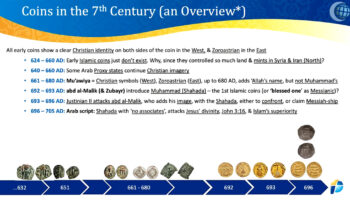
“If Mohammad died in 632, we’re 50 years later, the coins are either Christian or Zoroarastrian,” Dr. Smith says. “There is nothing at all that is close to Islam.”
The first hint of Muslim doctrine comes in 692 when Abd al-Malik announces his leadership to the world with a coin that says: “There is no god but Allah and MHMD is his prophet.”
This is the proto-shahada proclamation that Muslim use to make converts (their version of a Christian’s “sinner’s prayer.”)
Dr. Smith puts forth an intriguing theory that Abd al-Malik may NOT have even been a Muslim, but rather a Christian anti-Trinitarian.
“It’s attacking Byzantine Christianity,” Dr. Smith contends.

 New Life Narrabri
