Ephesians 2:14

Here is my commentary on Ephesians 2:14. I am publishing these once or twice a week, but you can read all of the available articles at our web-site, http://www.new-life.org.au

Ephesians 2:14

“For he is our peace, who is made us both one, and has broken down the dividing wall of hostility”

Christ is our peace. He is the source of all peace in the world, just as satan is the source of all enmity.

Peace is a major idea in Hebrew thinking, in fact it is a desire in many human hearts. The Hebrew people, and their language, elevated peace to a highly desirable quality- in the same way that Western democracies emphasise freedom as a basic human right.

The Romans had their Pax Romana, a peace obtained across the Empire by military might. It could be said that while Roman citizens enjoyed peace, their subjects often did not.

We may think of peace as an absence of conflict or hostility, but peace is more than that.

the Hebrew word for peace is shalom, which at its heart understands peace as about harmony or fitting together.

To fond true peace, we need to have:

1. Harmony with God. We live in a world scarred by sin and alienated from God. There can be no peace in our lives until we are reconciled to the Father .
2. Harmony with others. We need to be fitting in well with our family, neighbours, village, and nation. Unless a group of people knows peace with God, there can be no peace for individuals within the group. Lawlessness is perhaps the biggest sign of disharmony within a community.
3. Harmony with creation. We need to recognise that we are a part of the created world, and that our our activities either help to improve the creation or they help to destroy the natural harmony within creation which God declared to be good.
4. Harmony within. We are complex beings with body, mind and spirit. Our sins and hurts from the past may tend to pull us in directions that displease God or which setup warring factions within our own being. We cannot function as peaceful people while we are facing internal battles.

Christ is our peace. He restores the situation that hostility and conflict steal away from us. It does this by firstly restoring our harmony with the Father, and then, over time, showing us areas in our lives that need to be healed or repented of. He also gives us the grace to be peace makers where needed.

Others may rely on military might, diplomatic skills, force of personality, or other human qualities, but Christ is our peace.

To know peace, true peace, we must stay close to the source of peace, that is Christ. We need to listen to him, obey him and walk closely to him in order to live in his peace .

Christ has broken down the dividing wall of hostility between Jews and Gentiles , making both one people. He did this on the cross, offering God’s forgiveness to all who receive it, and extending his kingdom to all nations.

The division between Jews and Gentiles is no longer relevant. The wall that had previously separated the two groups is now irrelevant in the light of the revelation of God’s grace.

Jews and Gentiles, at least those in each group who are being saved, are all children of the living God. It is therefore wrong for a Gentile believer to disrespect a Jewish believer. This would be dishonouring the Father of both, and saying that the sacrifice of Christ is not important.

We can apply this to every group that sets itself as superior to other groups. A white christian has a responsibility to love an aboriginal believer and vice versa. The sufferings of each group in conflict is nothing to the suffering of Christ. If he has forgiven, then so must we.

We are the people who walk-in shalom because Christ is our peace. Wherever there is a failure of shalom, it is a failure of us to see Christ in the other.

Key points in this verse

• Christ is our peace
• The peace that Christ brings is not just an absence of fighting. It is all encompassing.
• This peace can overcome deep hostility if only we will let Christ rule.
• We must not allow flights with Christian brothers and sisters to stand .
• As christians we are called to be peace carriers and peace makers .
Reflection on Acts 26:1-32

Scripture

Paul replied, “Whether quickly or not, I pray to God that both you and everyone here in this audience might become the same as I am, except for the chains.”

Observation

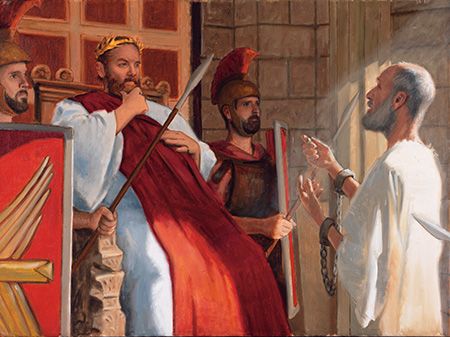
Paul now speaks before King Agrippa. He argues that his faith in Christ is totally in accordance with Jewish beliefs. He was raised a Pharisee, zealous for the faith, and persecutor of christians.

Paul tells the story of his encounter with Jesus on the way to Damascus. Jesus commissioned him to testify to the world and to rescue the Gentiles from the power of satan.

Paul asserts that he is being opposed by the Jewish leaders because he has preached the Good News to the Gentiles.

Agrippa asks Paul if he thinks he can be persuaded to be a christian so quickly. Paul responds that he prays that everyone there will come to know Jesus whether quickly or slowly.

Agrippa and Festus agree together that Paul has done nothing illegal, and that if he had not appealed to Caesar they would have released him.

Application

It is a fact that some people turn to Jesus the first time they hear the gospel, but many people take much longer.

It has been estimated that on average it takes a person eleven times of hearing the gospel before they say “Yes” to Jesus.

Whether it is the first time or the hundredth, it doesn’t matter. But we do need to pray regularly and over a prolonged period for people to receive Jesus.

As Paul says in his speech, people everywhere are in the darkness and under the control of satan. This battle can only be won by prayer; by faithful prayer perhaps over years.

Let us join together in praying for friends and family members who do not yet know Jesus.

Prayer

Holy Spirit, enlighten the hearts of the people who do not yet know about Jesus. Open their eyes to the truth. Amen.

Reflection on Acts 24:1-27

Scripture

As he reasoned with them about righteousness and self-control and the coming day of judgement, Felix became quite frightened. “Go away now,” he replied. “When it is more convenient I will call for you again.”

Observation

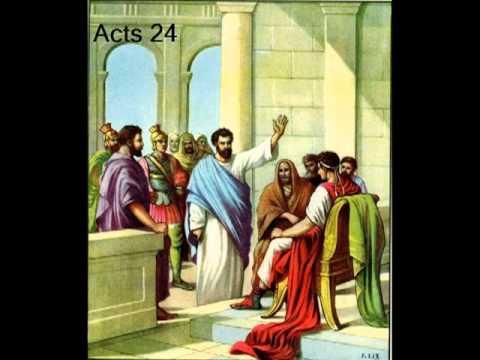
Ananias arrives in Caesarea with some elders and a lawyer to prosecute the case against Paul.

The lawyer Tertullus alleges that Paul is a trouble maker who stirs up riots among the Jews, and that he tried to desecrate the Temple.

In his defence, Paul says that he was at the Temple to worship not to desecrate it. The only time he caused any trouble was when he shouted in the council that he was on trial because he believed in the resurrection of the dead.

Felix orders Paul held in the prison in order to gain favour with the Jews. Every so often he summons Paul and talk with him, hoping to gain a bribe. This goes on for two years.

Application

Felix was a politician and was motivated by ambition. He changed his actions to suit what was more politically expedient at the time.

He had very mixed motives:

  • he wanted to placate the Jews so he held Paul in prison
  • he wanted to hear Paul but was too frightened to listen
  • he was hoping for a bribe from Paul in order to release him

When people act out of self-centredness, they are not in a position to respond to the gospel. We can pray and talk all that we are able, but they have to be in a place where they are willing to either take on the truth with all its implications or to worship God regardless of the cost.

Repentance and faith are gifts from God.

Prayer

Thank you Lord for saving me. I pray that my friends and family who do not yet know you will receive your gift of salvation. Amen.

Reflection on Acts 23:1-25

Scripture

Gazing intently at the high council, Paul began, “Brothers, I have always lived before God with a clear conscience.”

Observation

Paul stands before the council in Jerusalem. As soon as he begins to speak Ananias the High Priest orders someone to slap him.

Paul realises that some of the council members are Pharisees and others are Sadducees. He claims that, as a Pharisee, he is on trial for his belief in the resurrection. This causes a great dispute between the two factions.

The next morning, a group of Jews conspires to kill Paul. Pail’s nephew hears about it and warns Paul and the Roman officers about what is happening. The commander has Paul sent to Caesarea to Felix, the Roman governor, for Paul’s safety.

Application

It is a good thing to be able to claim, as Paul did, that we have always lived before God with a clear conscience.

Most of us are not perfect, so we cannot make this claim, at least not from our own ability. We all sin and fall short of God’s glory.

The consequence of sin is that we live separated from God and will die separated from Him. Unless our sin is dealt with, we are headed for eternal torment in hell.

Praise God! He has supplied us with the answer for sin.

Jesus has paid the price for our sin. When He died in the cross, every sin of every person was laid on his shoulders and He took the punishment that was due to us.

Now, in order to be forgiven, we just out it all on Jesus’ account. We ask God to forgive our sins, and they are forgiven.

We can all live, as Paul did, with a clear conscience before God.

Prayer

Lord Jesus, I invite you into my life. Thank you for taking away my sins. Help me to live for you as your disciple. Amen.

Reflection on Acts 22:17-30

Scripture

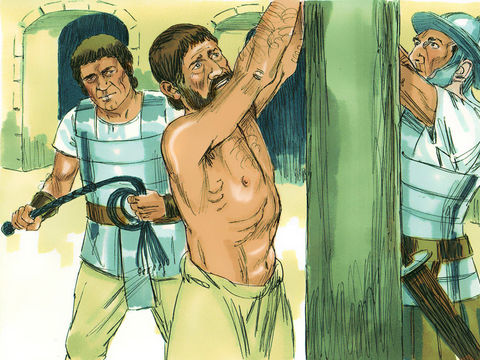
When they tied Paul down to lash him, Paul said to the officer standing there, “Is it legal for you to whip a Roman citizen who hasn’t even been tried?”

Observation

Paul continues to address the crowd in Jerusalem.

He tells how, after his conversion, he returned to Jerusalem. While praying, he went into a trance, and Jesus told him to leave Jerusalem and go far away to the Gentiles.

The crowd erupts on hearing the word Gentiles. The commander is at a loss to understand what is happening, at least in part due to the fact that he doesn’t speak Aramaic. The commander takes Paul inside and orders him to be whipped until he explains the situation.

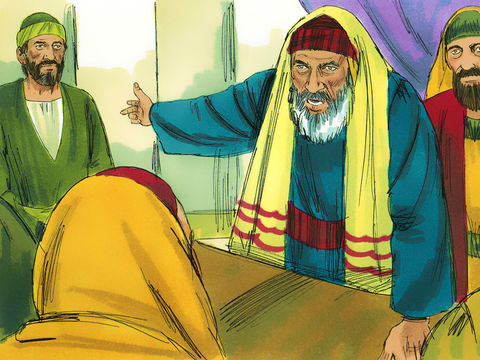
Paul then tells the officer that he is a Roman citizen, and it is illegal to punish him without a court hearing. The commander summons the Jewish high council to have Paul stand before them.

Application

There are times when it is right to submit to authorities, and there are times when it is right to stand up for our rights.

In this case, Paul respectfully demands that his rights as a Roman citizen be recognised by the commander. Roman citizens were not allowed to be punished without a trial, so Paul uses that privilege.

Apart from his own personal well being, Paul saw that a trial before the Sanhedrin would be an opportunity to share the gospel. As a respected Jewish scholar, they would have to acknowledge his authority on the the claims of Jesus to be the Messiah.

When we come into conflict with local powers and authorities, we need to ask ourselves whether we are acting from selfish motives or godly motives. Is the Holy Spirit directing my attitudes and actions? If it is the Holy Spirit leading, then we need to pray carefully about the way forward. If we are acting from the flesh, we need to repent and again seek God’s guidance.

Everything I do should be Spirit directed.

Prayer

Lord God, please hep me to be surrendered to you in every detail of my life. When I conflict with those in authority over me, please grant me your wisdom. Amen.

Ephesians 2:11-12

Here is my commentary on Ephesians 2:11-12. I am publishing these once or twice a week, but you can read all of the available articles at our web-site, http://www.new-life.org.au

Ephesians 2:11-12

“Therefore remember that at one time you Gentiles in the flesh, called “uncircumcised” by those who call themselves “the circumcision” (that done in the body by the hands of men) – remember that at that time you were separated from Christ, excluded from citizenship in Israel, and foreigners to the covenants of promise, without hope and without God in the world.”

We were once Gentiles, outside of God’s people. We were called uncircumcised by those who called themselves “ the circumcision.”

Those of us who were born outside of the Jewish tribal system were outside of God’s covenant people. The world was divided into two camps – the people of Israel and the Gentiles

Israel had been established by God to be a light to the nations ( literally to the Gentiles). This action was intended to show the world what a whole nation surrendered to God’s purposes could look like. Of course they failed in this, so much so that God allowed them to be conquered by multiple enemies, including lastly Rome.

Rather than being an open, inclusive, witnessing community, the Jewish people, at times, could be very exclusive. They would not mix with the Gentiles for fear of being made unclean.

They established a claim for their exclusivity calling themselves “ the circumcision”. They focused on a sign of the covenant rather than the covenant itself in order to feel better about themselves.

In doing this, they ignored their prophets who had spoken of the circumcision of the heart which was far more important. God wanted to change them from the inside and not just on the outside.

Human beings have an infinite capacity for looking at outward appearances, trusting in external rituals and behaviour. God looks at the heart, and it is the affections and thoughts He changes first, not just the outward signs.

We Gentiles were once far off from God. We were separated from Christ. There was a chasm that separated us because we were born as foreigners. We were outside the nation of Israel. Relationship with God could only be attained by birth in the faith community. We were born outside the people of God.

We were foreigners to the covenants of Promise. God promised wonderful things for His people Israel. but we were left out. How could we ever hope to experience God’s favour? How could we aspire to eternal life?

We were without hope because there was no way for us on the outside of grace to get inside. Yes there were ways to become a convert to J Judaism, but many did not know. They lived lives of quiet desperation.

We were far from God – “without God”. Unable to reach the one true God, the Gentiles invented their own lesser gods. Unable to see him, they bowed down to idols made by human hands.

In the joy of fellowshipping with God, it is easy to forget who we once were. We become complacent, even self-righteous and prone to judgmentalism.

We are in God because of God’s grace; He did it all for us. The cross was God’s idea. The desire to see all men and women saved was born from God’s love.

This was not our own doing – we just happen to have been smart enough to put out our hand to receive the gift of salvation.

It is like riding a train. I did not build the tracks or the train. I do not know how to drive the train or how the signals work. How the train is powered is a mystery. But I know that if I get on to that train it will take me to the place I need to get to.

Jesus Christ is like the train. I don’t know how it works, but I know his death liberated me from sin and raised me to a new life in Him. It all comes as a gift from God to all who receive it.

Key points in this verse

  • We, the Gentiles, were called the uncircumcised.
  • It is common for people to devise names that make us feel superior.
  • Christians have no reason to be self-righteous
  • We were once without hope and without God, but He brought us into His kingdom.

Reflection on Acts 22:1-16

Scripture

“What are you waiting for? Get up and be baptised. Have your sins washed away by calling on the name of the Lord.”

Observation

Paul is addressing the mob in Jerusalem in Aramaic, their own language.

He briefly tells the story of how he was a zealous Jew, persecuting the followers of Jesus. He had an encounter with the Lord on the way to Damascus. Paul was blinded by a bright light from which the voice of the Lord confronted him about his persecution of christians. The Lord tells him to go to Damascus where he will receive further instructions.

Paul is led by the hand, and finds a believer called Ananias who restores his sight. Then Ananias tells him to get up, be baptised and be forgiven by the Lord.

Application

The Way of the Lord is not difficult- there are not hundreds of rules and rituals to be followed. It is simple- be baptised and receive God’s forgiveness.

In several places in the Bible the simple promise is repeated- “Everyone who calls on the name of the Lord will be saved.”

This is not a religious test in which we repeat a formula or prayer that gets us forgiven. No! To call on the name of the Lord is to admit that you are lost and need saving. It is an expression of trust that God alone can save us.

What are we being saved from? In a word, hell.

Every person has a choice of where they will spend eternity. We can either receive God’s grace and spend eternity in heaven, or we can receive God’s judgement on our sins and go to hell. We either live in joyful relationship with our loving Creator, or we suffer separation from God for ever.

The choice we make in this life affects the destination in the next life.

The promise of God is that if we give our lives to Him, trusting Him to forgive us, then our sins will be wiped away, and our soul will be saved.

Prayer

Thank you Father for your great love. I receive your forgiveness in the name of Jesus. Amen.

Reflection on Acts 21:18-40

Scripture

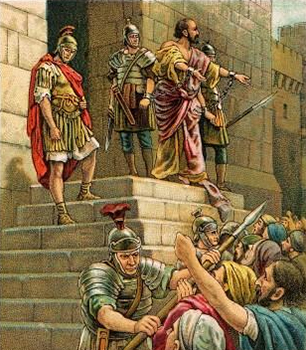
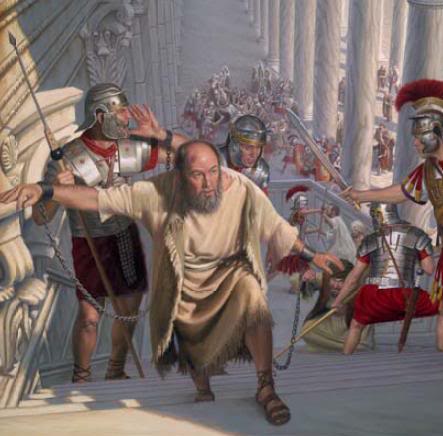
As Paul reached the stairs, the mob grew so violent the soldiers had to lift him to their shoulders to protect him.

Observation

Paul goes to see James and the elders of the Jerusalem church. He tells them everything that happened on his missionary journeys.

The elders report that in Jerusalem some of the Jews there have been telling the believers that Paul has been telling Jewish believers that they no longer have to follow the Law of Moses. To correct this misinformation, they arrange for Paul to go to the Temple with four believers who have completed a vow.

When they arrive at the Temple, some agitators start a riot over Paul’s presence. The Jews start beating Paul. Word reaches the Roman military leader, and he dispatches a platoon to quell the riot.

Unable to find out the cause of the trouble, the commander orders Paul to be taken to the fortress. As they arrive there, Paul asks for permission to address the crowd.

Application

It seems that wherever Paul went trouble soon started. This is not because of anything that Paul did that was inherently wrong. It was from jealousy and fear that people started to become violent.

The riots were started by the same kinds of people who start riots in our own day. There were two factors explicitly mentioned here.

1. False information. Information was spread about Paul’s ministry to both Jews and Gentiles. They claimed he was telling Jewish believers to abandon their traditions and customs. This was not true.

False information is often a flash point for violent behaviour.

2. False accusations. The agitators claimed that Paul had brought a Gentile into the Temple. People made assumptions about Paul’s actions.

It is easy to manipulate people by feeding them false information and then making false charges.

Jesus is the Way, the Truth and the Life. Satan is the father of lies. Follower of Jesus must make sure that we always speak truth rather than lies.

Prayer

Holy Spirit speak your truth into my heart. Give me discernment so that I can always distinguish truth from deception. Amen.

Reflection on Acts 21:1-17

Scripture

When it was clear that we could not persuade him, we gave up and said, “The Lord’s will be done.”

Observation

Paul and his companions resume their travel, heading for Jerusalem.

In Tyre, the believers prophesy by the Holy Spirit, imploring Paul not to go to Jerusalem.

In Caesarea, they stay at the home of Philip. A man named Agabus comes from Judea and performs a prophetic act. He declares that Paul will be bound by the Jewish leaders in Jerusalem and handed over to the Gentiles.

Everyone pleads with Paul to not go on, but he is determined. He is willing to be imprisoned, even to die, for the sake of the Lord Jesus.

Finally they arrive in Jerusalem where they are warmly welcomed by the brothers and sisters.

Application

Paul had such a strong conviction that he needed to go to Jerusalem, under the direction of the Holy Spirit that nothing, not even a series of prophetic words and actions, would deter him.

Sometimes we can think that if we get a prophetic word spoken over us or directed towards us then we have to follow that word.

In this case, the prophecies were only confirming what Paul knew was the way ahead. He knew that jail, possibly death, awaited him in Jerusalem. The prophecies along the way only served to confirm what God had already told him.

Prophecy and the other gifts of the Holy Spirit are nor meant to be prescriptive. They should not tell us definitively what to do. They are just part of the information that God gives us to help us follow Him.

The response to prophecy always has to be left to the individual, guided by the Holy Spirit.

Prayer

Lord, I thank you for all the gifts of the Holy Spirit, including prophecy. Help me, Lord, to have wisdom in understanding and applying prophecy. Amen.

Ephesians 2:10

Here is my commentary on Ephesians 2:10. I am publishing these once or twice a week, but you can read all of the available articles at our web-site, http://www.new-life.org.au

Ephesians 2:10

For we are his workmanship created in Christ Jesus for good works, which God prepared beforehand, that we should walk in them.

In the previous verse, Paul stated unequivocally that we are not saved by good deeds, but now he tells us that we are saved for good deeds. Salvation comes first, then the good deeds, God’s deeds.

There is a certain strand of Christianity that constantly emphasises the sinfulness of people, even those who are born again. It is important that we recognise that even as followers of Jesus we can sin. The problem comes when we start to take on board the message that we are not good enough, that we will never make it.

Here is the amazingly good news. We are God’s workmanship. Literally the Greek term means a masterpiece. The word is poiema from which we get the word poem.

Before we were saved we were created in God’s image. We were knitted together inside our respective mothers. We are, just in terms of our physical construction, an amazing creation. Then add in our awesome mental capabilities and our ability to make wise decisions and our moral judgement- you are a work of art! Sin messed things up, like oil poured over a Rembrandt. But God has now cleaned that up and restored us to the original state.

Even better than that, God has restored you into a pre- sin state and marked you with His Holy Spirit. What an amazing work of art!

People speak of their awe at seeing the Sistine Chapel with all its art surrounding on every side. As a redeemed child of God, you are a work of art, a masterpiece of Gods creation.

We are Gods masterpiece, created in Christ Jesus. Being born again means that we are created anew. The part of us that was dead has come to life. the part of us that was stained by sin has been recreated. The overwhelming, never-failing grace of God, passed on by Jesus makes us a new creation.

We get to have a new start, a purpose in living that should galvanise us and put a spring in our step every day.

We are created in Christ for the good works that God has prepared for us.

it’s not about “pie in the sky when you die.” It’s not about basking in the glory until we are promoted to Heaven.

No, we have been born again for God’s good works. We are God’s workmanship created to do his work.

We are not created to do good works generally, although there is no harm in that. God has created us in Christ for His good works. We are created for a mission, for God’s mission.

Some people are activists who will support any cause that they think is a good thing. They run themselves ragged doing good works, but they may not be doing God’s good works.

Each disciple needs to ask God, “What is my purpose in being created and recreated in Christ?” He has a specific purpose for us. Everything else is just punching at the air .

Each of us has been created for good works that were prepared for us long ago. Before we were born, God had a plan of what He was wanting us to do. He moulded us and shaped us for these deeds.

We often get this the wrong way round. We think that there are things we can do, missions or community work that is already there. We were not created to fill a gap. There are deeds created for us to do, prepared before the beginning of time. Our job is to find these deeds, not volunteer to do good things.

God’s pre-prepared deeds give our life purpose. We must not get distracted by everybody else’s life purpose and so miss out on the thing God has prepared for us to do.

The idea of walking in these deeds suggests a long-term commitment. Each of us has a vocation or calling that determines our reason for being. When we find that vocation, we cannot do anything other than walk in it or stick with it.

Each of us has a different vocation. That is why the church is called a body. When everyone uses their spiritual gifts and their natural talents to fulfil the good deeds that God has created for them to do, then the church explodes with energy and vitality. Every member of the church is working together in their own mission in order to collectively fulfil the mission of the church.

Key points in this verse:

  • You are God’s masterpiece
  • We are saved for good deeds and not by good deeds
  • God has prepared a mission for each one of us
  • We are most fulfilled when we are walking in the mission God has called us to
  • When every believer walks in their calling together, the mission of the church becomes highly effective