Cell Ministry in the 21st Century

Not long after we moved to Narrabri, a town of 7000 people in the wheat belt of Eastern Australia, the Lord started talking to us about a “new thing” that He wanted to do with us in this place. We weren’t sure what this new thing was, but in 1996, we stepped out in faith and left our denomination to start New Life Christian Fellowship.

About that time, I read Ralph Neighbour’s book, “Where Do We Go From Here?” which documents in great detail the decline of the evangelical churches in the USA since the glory days of the 1950’s. That trend has only increased into the current century, as leaders have recognised that a whole generation has left the church.

This decline has also been felt in Australia, perhaps more so. Since I became a christian in 1976, churches generally have lost their influence in the community and many people are suspicious, even hostile, towards any expression of christian faith.

Ralph goes on to describe the new- old cell church paradigm for churches that was far more effective than the Program Based Design. While PBD churches add never-ending programs to meet the expressed needs of special groups in the church, the cell church disciples everybody in small groups designed to grow disciples and reach out to the local neighbourhood.

In the traditional style of church, Bible Studies were optional extras for the committed members, but in the cell church the cell was the primary expression of the church. Later on, Ralph would coin the phrase “Christ’s Basic Bodies” to describe the primacy of cell groups.

This description of cell church hit me as a revelation of what Jesus intended the church to be. I was so excited to be planting a church at the same time that I was seeing what we needed to do.

Over the last 24 years I have devoted my time and energy as a Pastor to encouraging my cell leaders and equipping them for their task. Of course we gather on Sunday morning for worship and preaching of the word, but my thoughts are always about growing our cell groups. At times it has been exhilarating, at other times disappointing. Regardless of my feeling at the time, we know this is the path God has set for us.

When we started out, I believed that we would eventually grow to be a church of 1000 people. When I prayed into that, I would envisage a large auditorium filled with a huge crowd of people. Now I see 100 cell groups spread across the town and the surrounding farm lands, shining the light of Christ into the darkness.

Following a television promotion some years ago, our town was crowned “The Sportiest Town in Australia,” but by God’s grace I hope that one day it will be “The Godliest Town in Australia” as our cell groups take seriously the commission to make disciples.

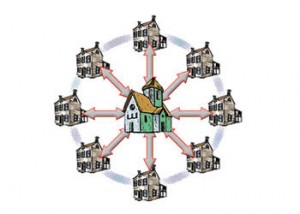
Cells And The New Testament

I love the fact that Cell Church is not a recent invention, but has always been at the heart of the way God’s people have discipled one another.

The Great Commission that Christ gave the church was to “Go and make disciples of all nations” (Matthew 28:19). Evangelism is an important part of the process, but it is only the start, in the same way that child birth is just the start of parenting. Maturity is the goal in both cases.

Just as Jesus ministered to both “the crowds” and the Twelve, the church has often recognised that effective ministry has to operate as both celebration and cell.

In the New Testament we are given many commands that end in “one another.” These are the practical daily keys to growing in maturity as followers of Christ.

The most well known of these commands is Jesus’ command: “A new command I give you: Love one another. As I have loved you, so you must love one another.” (John 13:34). Love is a personal thing. You cannot love a thousand people in a large group. It is possible to love one another in a much smaller group where there is space to get to know one another and to share deeply.

In Romans 12:16, Paul tells us to “Live in harmony with one another.” I live in a town of 7000 people. We don’t need instruction to live in harmony with one another. As long as we show consideration for one another, remember to drive on the correct side of the road and don’t make too much noise at night, everyone is happy. When you need instruction to live in harmony with one another, that suggest that people are close up and personal and needing to make adjustments to their words and actions. We call that love in action.

Paul tells the church at Colossae (and us also), “Let the message of Christ dwell among you richly as you teach and admonish one another with all wisdom through psalms, hymns, and songs from the Spirit, singing to God with gratitude in your hearts. (Colossians 3:16). There is a measure of openness here that cannot be seen in a big group. Admonishing is counselling or exhorting someone to a course of action. That is very uncomfortable in a medium or large sized group. But it is what groups of 6 to 12 people do very well.

As you search through the Scriptures and find so many “one another” commands, you realise just how intimate and caring relationships in the church are meant to be.

We are called to live together in an open community where deep and loving relationships develop, but which encourages new members to feel included.

Key Principles of Cell Churches: Ralph Neighbour

Here is an article about Cell Church that I rediscovered on our web-site. Apart from the Triad Principle we have very effectively grown intho these principles over the years.

Key Principles of Cell Churches

by Ralph Neighbour

Back in 1987, as we prepared to prepare pastors from all over the world who knew nothing about the Cell Church, a group of us met for two days to discuss the core values that would be mandatory for cell group churches. Here is what we prepared:

Every Member is a Minister

The Priesthood of all believers is pointedly taught in scripture. A priest touches a person with a need with one hand and touches the Lord with the other hand and becomes a channel for Christ to manifest His Presence to meet that need.

Further, Ephesians tells us that the apostle, prophet, evangelist, pastor and teacher are to be equippers of every member to minister. If leaders are equippers, every member will be prepared for ministry. This is the exact reverse of how a traditional church sees things: they see the FiveFold as the ministers and the members as offering support.

Equipping Will Be Done in Cells

Learning how to minister is not done in classrooms. It is done in the context of ministry situations. The activity of priests is done in the cell as all confess their crises and others receive the anointing to share spiritual gifts.

Thus, the cell itself is the place for equipping. When the member must minister, only then will the anointing required be manifested. Priestly ministry is not taught—it is caught.

Evangelism Will be Done through Cells

I Corinthians 14:24-25 along with verse 3 explains that if the Power and Presence of Christ is being revealed as all prophesy, the searching unbeliever will fall on his face and repent. This is “Body Life Evangelism,” where Christ Himself is the One who draws all men to Himself.

There Will be Clear Accountability

In the cell, we gather first as Triads: I John 2 explains it: the “Little Child” is mentored by the “Young Man,” who in turn is mentored by the “Father.”

Like the slogan of the U.S. Marines, each member says to another, “I’ve got your back!” The constant care and trust between the people of God allows them “to work out their salvation with fear and trembling, for God is working in them.”

Legalistic accountability is replaced by a desire to look after other’s interests with agape love.

There Will Be No Competition with Cells

The priestly life is focused on life together in community and penetrating the households of new believers. All the focus of the cell is directed toward fulfilling the task the Father assigned to His Son when He was returned to earth to occupy His next body, the ecclesia. There is no need for the precious time of the priests to be diverted to running and attending endless church programs. The Cell Church is an equipping and ministering organism, not an organization.

Networking For Cell Leaders

Here is a post I have written for Joel Comiskey’s blog.


Cell Networking

I pastor a non-denominational church in a small town that is a long way from a large city. Of the nine congregations in my town, ours is the only one consciously using the cell church model. It has been many years since I was able to attend a cell church conference.

There are many reasons why it would be easy to just remain isolated and try to do my own thing. But to stop getting into the wrong habits I need to keep checking that I am on the right track by interacting with other people.

Modern technology makes it easier to connect even when we are separated geographically. It’s not quite the same as meeting face to face, but it does help me when I read what other people around the world are doing in their cell ministries.

I love this blog at joelcomiskeygroup.com and I regularly read the posts by Joel Comiskey and his team. The web-site at smallgroupchurches.com is a treasure trove of resources for group leaders.

On facebook I administer a cell churches group (https://www.facebook.com/groups/cellchurches/) which was started to help cell church leaders share with one another and encourage one another. With over 300 members from around the world it has a wealth of knowledge and experience. While it has been a little slow lately, this group does have great discussions from time to time.

I love reading books by people like Joel Comiskey, Ralph Neighbour, Scott Boren and others. They help to remind me of the goal of our groups (to make disciples who love God, love people and make disciples) They also throw up ideas that I have not thought of before.

Sometimes just meeting with our own cell leaders or visiting different cell groups gives me insight into the various ways that other leaders run with the overall vision of cell ministry. A few weeks ago we dedicated our cell leaders meeting to prayer. I was blown away by the enthusiasm and bold praying of this group of ten people and encouraged in my own prayer life.

Of these different sources of encouragement and connection, what works best for you?

Empowering People

empowered

I have noticed something very exciting happening in my church lately- people don’t need my permission to do things.

Other pastors try to encourage, cajole, pressure their people to talk about their faith with their friends, but I just hear stories of how it is happening naturally. There is no training programme, 40 Days of Purpose, Evangelism Explosion or visiting evangelist.

One of the great benefits of being a cell church, that is a church which honours both large groups and home-based small groups as important expressions of the Body of Christ, is that leadership is dispersed and not just embodied in one person. (See our web site for articles on the cell church). Everyone gets to share in ministry under the guidance of mature christians, and so it is not a big leap for people to think they can do stuff.

People will find their own calling and their own ways of doing things. One lady in our church who is a teacher is inviting some teacher friends to her home to watch the movie “The War Room.” One of our men who travels big distances finds opportunities to talk to customers about Jesus and daily texts encouraging scriptures to his friends. Others find ways to encourage and support one another in informal ways.

This takes a lot of pressure away from the Pastor. I don’t have to try to do everything because the church is being the church- every member learning how to embody Jesus in their normal every day life.

At the heart of this is the core value that christians grow best when they meet together intentionally in cell groups. Our Sunday gathering gives me the place to provide oversight and good teaching as well as providing a focus for the unity of the congregation. The weekly cell groups provide fellowship and encouragement together with a base for outreach.

I praise God for what He is doing with our people.