The sermon from Christmas Eve is now available on the New Life web-site.
Click here to listen in your web browser, here to download the mp3
Scripture
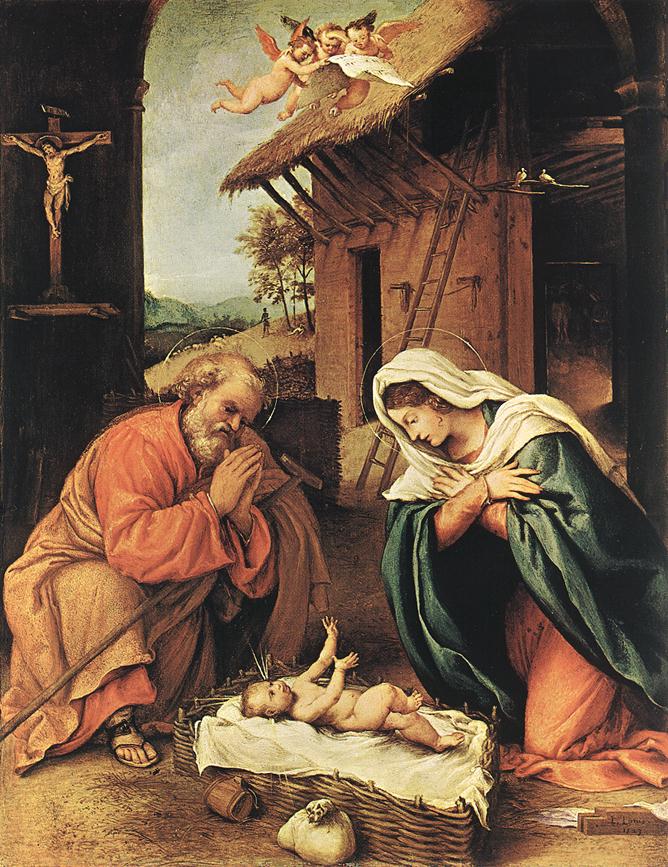
And while they were there, the time came for her baby to be born. She gave birth to her first-born child, a son. She wrapped him in strips of cloth and laid him in a manger because there was no lodging available for them.
Observation
The Roman Emperor Augustus decrees that a census must be taken across the Empire. Everyone must go back to their ancestral town to be registered. Joseph and Mary travel to Bethlehem, the city of David.
While they are there, Mary’s baby is born. She wraps him in strips of cloth and lays him in a manger.
Application
God’s plans never pan out as we might expect them to. Even a theological degree is no guarantee of insight into the ways of the Lord. The scribes and all the learned men of Israel knew the prophecies about the Messiah, but even they missed Him.
Jesus, the Son of God, becomes flesh and He establishes His Kingdom in the world. This Kingdom is nothing like the kingdoms and empires of this world.
There is a hint of this in the fact that His birthplace seems to be dictated by the whims of the Emperor. In this first power play between Jesus and the world, it seems that the world is stronger- until you remember the ancient prophecy that the Messiah would be born in Bethlehem.
Mary and Joseph did the parenting thing as parents have done for millennia. It is all so humble and ordinary.
How could this baby in a manger possibly be the Son of God who defeats all the kingdoms of the world and even the power of evil?
Prayer
Lord, you chose to come to us in weakness and humility, as a child. The all-powerful God comes in such a tiny package. Holy Spirit, please help me to understand the mystery of Christmas. Amen.

It’s generally accepted that early Christians adopted December 25th as the day of Christ’s birth to co-opt the pagan celebration of the winter solstice. Some believe this fact undermines Christianity.
But according to Professor William Tighe, this “fact” may actually be a myth.
Based on his extensive research, Tighe argues that the December 25th date “arose entirely from the efforts of early Latin Christians to determine the historical date of Christ’s death.” He also goes so far as to claim that the December 25th pagan feast of the “’Birth of the Unconquered Sun’… was almost certainly an attempt to create a pagan alternative to a date that was already of some significance of Roman Christians.”
Tighe explains…
In the Jewish tradition at the time of Christ, there was a belief in what they called the “integral age”—that the prophets had died on the same days of their conception or birth. Early Christians spent much energy on determining the exact date of Christ’s death. Using historical sources, Christians in the first or second century settled on March 25th as the date of his crucifixion. Soon after, March 25th became the accepted date of Christ’s conception, as well.
Add nine months—the standard term of a pregnancy—to March 25th, and Christians came up with December 25th as the date of Christ’s birth.
It is unknown exactly when Christians began formally celebrating December 25th as a feast. What is known, however, is that the date of December 25th “had no religious significance in the Roman pagan festal calendar before Aurelian’s time (Roman emperor from 270-275), nor did the cult of the sun play a prominent role in Rome before him.” According to Tighe, Aurelian intended the new feast “to be a symbol of the hoped-for ‘rebirth,’ or perpetual rejuvenation, of the Roman Empire…. [and] if it co-opted the Christian celebration, so much the better.”
As Tighe points out, the now-popular idea that Christians co-opted the pagan feast originates with Paul Ernst Jablonski (1693-1757), who opposed various supposed “paganizations” of Christianity.
Of course, to Christians, it really doesn’t matter that much whether or not they co-opted December 25th from the pagans, or vice versa. The Christian faith doesn’t stand or fall on that detail. But it’s nevertheless valuable for all of us to give closer scrutiny to shibboleths—such as that of the pagan origins of Christmas—which are continually repeated without being examined.
This post The Myth of the Pagan Origins of Christmas was originally published on Intellectual Takeout by Daniel Lattier.
“‘Immanuel, God with us.’ It is hell’s terror. Satan trembles at the sound of it. . . . Let him come to you suddenly, and do you but whisper that word, ‘God with us,’ back he falls, confounded and confused. . . . ‘God with us’ is the laborer’s strength. How could he preach the gospel, how could he bend his knees in prayer, how could the missionary go into foreign lands, how could the martyr stand at the stake, how could the confessor own his Master, how could men labor if that one word were taken away? . . . ‘God with us’ is eternity’s sonnet, heaven’s hallelujah, the shout of the glorified, the song of the redeemed, the chorus of the angels, the everlasting oratorio of the great orchestra of the sky. . . .
Feast, Christians, feast; you have a right to feast. . . . But in your feasting, think of the Man in Bethlehem. Let him have a place in your hearts, give him the glory, think of the virgin who conceived him, but think most of all of the Man born, the Child given.
I finish by again saying, A happy Christmas to you all!”
C. H. Spurgeon, The Treasury of the Old Testament (London, n.d.), III:430.


Last Sunday we had our “Messy Christmas” celebration, the latest edition of our Messy Church services.
Messy Church started in England as a way to bridge the gap between ageing congregations and the families in their neighbourhood. We’ve tweaked the concept a little, and it is just a brilliant way to make special worship events for the whole family. We are planning to take the Messy Church format to various places around town as an evangelism project.
The theme was “Jesus Is My Superhero” which featured a play in which Batman, Superman and Wonderwoman hear rumours of a new superhero in town who threatend to take away their jobs. The play was inspired by this meme:

We included craft activities, Christmas Tree decoration and even science experiments relating to sound, because of the ways God spoke to people in the Christmas story.
We finished with lunch together, because a shared meal is central to the Messy Church experience.
It might be a month or two before we revisit Messy Church. We have school holidays next month and Family Camp in February. But we will be doing it before Easter!