Messy Christmas

messychristmas_logo_l

Last Sunday we had our “Messy Christmas” celebration, the latest edition of our Messy Church services.

Messy Church started in England as a way to bridge the gap between ageing congregations and the families in their  neighbourhood. We’ve tweaked the concept a little, and it is just a brilliant  way to make special worship events for the whole family. We are planning to take the Messy Church format to various places around town as an evangelism project.

The theme was “Jesus Is My Superhero” which featured a play in which Batman, Superman and Wonderwoman hear rumours of a new superhero in town who threatend to take away their jobs.  The play was inspired by this meme:

thats-how-i-saved-the-world.jpg

We included craft activities, Christmas Tree decoration and even science experiments relating to sound, because of the ways God spoke to people in the Christmas story.

We finished with lunch together, because a shared meal is central to the Messy Church experience.

It might be a month or two before we revisit Messy Church. We have school holidays next month and Family Camp in February. But we will be doing it before Easter!

Tom Brown: Should Christians Celebrate Christmas?

December marks the annual festival of religious people saying that Christians should not celebrate Christmas. Here’s a great article by Tom Brown that debunks that nonsense.


Should Christians Celebrate Christmas?
Today’s Question: Being that the season of Christmas is upon us, we as Christians have come to celebrate the reason for the season. My brother and I have been debating this issue lately. Even though he is Christian also, he is hard to convince that we should celebrate the birth of Christ, not the commercialism that the world imposes on us. He still maintains that through his research and studying on the issue of Christmas, that the pagans around Jesus’ time celebrated the giving to a “Sun God” of some kind on the same day that we celebrate Christmas. I don’t know where he got his sources on that, but of course I’ve vehemently opposed the notion, and had to remind him that we don’t know the actual time of year of Jesus’ birth, but we as Christians have come to honor it on December 25.

Is there any specific references that I can direct him to within the Bible that will alleviate his skepticism?

Jeff Eisert

Bible Answer: I cannot promise that anything I say will change your brother’s view. I really do not think this is an important matter. If he does not want to celebrate Christmas, then he should not celebrate it. As for my church, family and me we love celebrating it and will continue to do so. It has been a time where people who would not normally go to church will attend. Anything to get people to go to church is a good thing.

Concerning Christmas not being in the Bible, that is true as far as the name “Christmas” which means “Christ-Mass”. The name is not in the Scriptures but the event that the name represents is definitely in the Scriptures. The story of the birth of Christ and the circumstances surrounding it is very much emphasized in the Bible. Mathew and Luke both go into detail describing Christ birth, including the shepherds and eventually the wise men giving gifts to Christ. That is all in the Bible. Without His birth, there is no salvation.

Someone might argue that since we are not commanded to celebrate Christmas we should ignore it. Well, we are not commanded to celebrate the resurrection as a holiday either, so does your brother want to give up that holiday simply because the name “Easter” is of pagan origin? He needs to forget the name or the source of the name. Many names and words have pagan origins (see my article on Nike Man as an example.), but we do not give up using those words or names. We would not have a language without the use of pagan words and names.

Someone may argue against Christmas that it is a non-biblical holiday and since Christmas in not celebrated in the Bible, we should not celebrate it, either. First of all, the birth of Christ is biblical, so you cannot make a case by calling Christmas non-biblical, but I suppose you can say that Christmas is extra-biblical. That is, there is nothing in the Bible against it, and there are things in the holiday that is based on the Bible, but there is no command to celebrate the birth of Christ, so it is an extra-biblical holiday.

Here is how I approach this argument: Jesus Himself celebrated an extra-biblical holiday that corresponds to Christmas. People are usually surprised to find this out. Yes, Jesus celebrated Hanukkah, and Hanukkah is not in the Old Testament.

Then came the Feast of Dedication at Jerusalem. It was winter, and Jesus was in the temple area walking in Solomon’s Colonnade. (John 10:22-23)

There is no Old Testament Feast of Dedication. There are several feasts mentioned in the Bible, but not Dedication. What feast is Dedication? That is Hanukkah. Hanukkah is a celebration of the victory of the Maccabees and the rededication of the Jerusalem Temple. It also commemorates the miracle of oil that burned for 8 days. This event took place after the last Old Testament prophet had written the scriptures. The scriptures were closed before this event, and thus, this Feast is extra-biblical. And Jesus was in the temple area where the feast was celebrated. He participated in Hanukkah.

Today, Christmas is celebrated next to Hanukkah. So the question you can propose to your brother who refuses to celebrate Christmas is this: If Jesus celebrated a holiday that was not in the Bible, why can’t you enjoy Christmas as well and give gifts just as the Jews today give many gifts during Hanukkah?

Your brother mentioned that giving gifts was based on giving to the “Sun-God”. Whether or not that is true can be debated, but I have always felt that giving gifts was based on the wise men giving gifts to Christ. Even if it were true that Christmas came out of the pagan practices of giving to the “Sun-God”, the truth is the “Son-of-God” is worthy of greater gifts, and giving gifts is simply a loving way of showing your appreciation to others you love. Sure, many people get in the commercial spirit than the true spirit, but that is no reason to get rid of Christmas or to avoid the holiday.

Your brother did not mention it, but others have complained that Christmas is really pagan because the Christmas tree is pagan. I’ve heard people say that Jeremiah 10:3-5 is a reference to the Christmas tree:

For the customs of the peoples are worthless; they cut a tree out of the forest, and a craftsman shapes it with his chisel. They adorn it with silver and gold; they fasten it with hammer and nails so it will not totter. Like a scarecrow in a melon patch, their idols cannot speak; they must be carried because they cannot walk. Do not fear them; they can do no harm nor can they do any good.”

These people argue that the tree is adorned with silver and gold, a supposed reference to tinsel around a tree. But look carefully at the passage and it will be clear that Jeremiah referred to an idol made out of the tree. A craftsman shaped the tree out of the forest with a chisel. Who has ever seen a craftsman use a chisel to shape a tree into a Christmas tree? Of course not. This is a reference to craftsmen making idols that resembled man and animals, like a scarecrow. Yet Jeremiah says, “They cannot speak and walk.” So obviously this is not a Christmas tree, for Christmas trees do not have mouths and legs.

Is Christmas Christian?

nativity

Every year at about this time, a bunch of religious zealots get on their high horses telling us how Christmas is a pagan festival and God has a special fire waiting for all those who dare to pollute true faith with these things.

There is, of course, some truth in these claims. Many of the traditions that have become enmeshed into Christmas do stem from different pagan cultures, but that doesn’t mean we have to forsake Christmas altogether. It doesn’t mean that those traditions cannot be redeemed.

The celebration  of Christmas itself was a subversion of pagan customs. When people were celebrating the solstice and praying for the return of the sun, Christians were saying the true light of the world has come. When pagans were worshipping evergreen trees as gods because they seemed to be the only life in the depths of winter, Christians were pointing them to the true source of all life, the ever-living Father.

There are some cultural artefacts around Christmas I would like to exterminate, such as the veneration of snowmen which seems odd on a blazing hot summer day, or the character in a fur-trimmed red suit. I would like to see an end to the treadmill of Christmas parties and the drunkenness that our culture says should accompany them.

We overcome those things by showing people a better way, the way of the Kingdom of God, not by railing against practices which people think are good and pleasurable.

To the people who think Christians should withdraw completely from Christmas let me ask you some questions:

  • When did it become wrong to celebrate the coming into the world of the Saviour?
  • When did it become wrong to honour people by giving them gifts?
  • When did it become wrong to redeem pagan revelry by telling people about the true God?

Christians have nothing to fear from Christmas traditions, whatever their source. What matters is that we honour our Lord in everything.

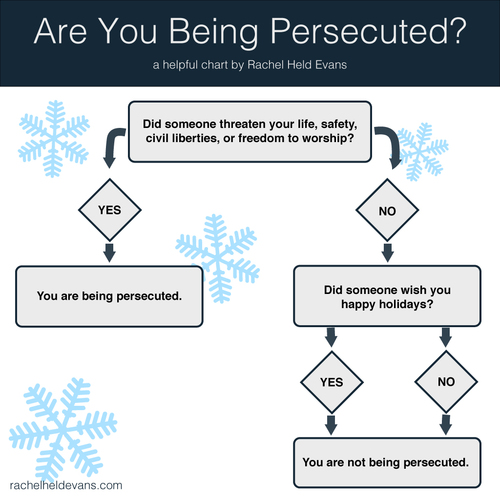
Are You Being Persecuted?- Rachel Held Evans

A very thoughtful piece from Rachel Held Evans. I especially like this “The whole story of Advent is the story of how God can’t be kept out. God is present. God is with us. God shows up”


Are you being persecuted?

There is a pernicious rumor that resurfaces every Advent season and spreads across social media faster than a cold in a kindergarten class. 

It’s the rumor that God can be “kept out” of Christmas. 

You may have heard it from Kirk Cameron or an anchor at Fox News or an army of culture warriors who have once again worked themselves into a frenzy over the “War on Christmas.” Galvanized by fear, they storm checkout counters to demand that clerks issue them a “Merry Christmas” instead of “Happy Holidays” and cry persecution when inflatable manger scenes are moved from public courthouses to private property. They pine after the good-old-days when Christians could force Jewish kids to sing Christmas carols at school and they demand that every gift purchased, every mall opened late, every credit card maxed out must be done so in Jesus’ name or else Christ will be “kept out” of Christmas. They do it because someone told them that God needs a nod from the Empire to show up, forgetting somehow that the story of Advent is the story of how God showed up as a Jew in the Roman Empire.

In a barn.  

As an oppressed minority. 

To the applause of a few poor shepherds.

The whole story of Advent is the story of how God can’t be kept out. God is present. God is with us. God shows up—not with a parade but with the whimper of a baby, not among the powerful but among the marginalized, not to the demanding but to the humble. From Advent to Easter, the story of Jesus should teach us that God doesn’t need a mention in our pledge or on our money or over the loudspeaker at the mall to be present, and when we fight like spoiled children to “keep” God in those things, we are fighting for idols. We’re chasing wind. 

Full article here


Right For the Job

img_7344

I lashed out and bought a new bike on Monday.

For the last couple of years I’ve been riding a mountain bike. It’s a fine bike and will definitely get you places. We’ve spent many hours together, and even shared one nasty spill.

No matter how I practised, though, there was a limit to the speed I could consistently ride at on the open road. No matter the conditions or my fitness level, it seemed that over a longer distance about 20 km/hr was the limit, and more often my average was 18-19 km/hr.

Maybe I could have refined my technique or strengthened my leg muscles. But there was no escaping the fact that my bike was not designed for speed on the open roads. It was designed for strength and traction on dirt tracks.

So I bought a road bike.This bike is light- under 10 kg. It has ridiculously thin wheels and tyres with no tread to reduce the friction with the road. The tyres are inflated to 120 psi, again to reduce friction. It has dropped handlebars to allow you to lean into the wind and minimise air resistance. The gears are optimised for normal road conditions. Everything is engineered for the purpose of efficient riding over long distances.

Just riding this bike in a gentle way, just getting used to it, I achieved speeds close to 30 km/hr and an average of 25 km/hr over a distance of 21 km. I know I can go faster and farther on this bike. Riding in a three day, 300 km charity ride suddenly seems realistic.

My new bike does better on the road because it was designed for that purpose. It wouldn’t last 5 minutes if I took it into the bush, because that’s not what it was designed for.

You and I were designed for relationship with God. We work best in that environment. Talking to God, listening to God, reading His Word, finding His purpose for our life- that’s how humans work best.

The trouble is that we all want to do it our own way without reference to God. We want to ride our road bikes through the bush and wonder why the tyres are shredded and the frame is bent.

Take a look at the world- race riots in the U.S., ISIS running amok through Iraq and Syria, Boko Haram in Nigeria, crime and destruction, relationships breaking down, lawless children, drugs, hurting people, grieving people… the harvest of suffering just goes on and on because people refuse to live their lives in relationship with the Creator.

Christmas is coming, the awesome celebration of a God who came into the world to redeem a lost people. If you don’t know Him, go and find Him.

Life is so much better.

How December 25th Became Christmas

How December 25 Became Christmas


A blanket of snow covers the little town of Bethlehem, in Pieter Bruegel’s oil painting from 1566. Although Jesus’ birth is celebrated every year on December 25, Luke and the other gospel writers offer no hint about the specific time of year he was born. Scala/Art Resource, NY


On December 25, Christians around the world will gather to celebrate Jesus’ birth. Joyful carols, special liturgies, brightly wrapped gifts, festive foods—these all characterize the feast today, at least in the northern hemisphere. But just how did the Christmas festival originate? How did December 25 come to be associated with Jesus’ birthday?


The Bible offers few clues: Celebrations of Jesus’ Nativity are not mentioned in the Gospels or Acts; the date is not given, not even the time of year. The biblical reference to shepherds tending their flocks at night when they hear the news of Jesus’ birth (Luke 2:8) might suggest the spring lambing season; in the cold month of December, on the other hand, sheep might well have been corralled. Yet most scholars would urge caution about extracting such a precise but incidental detail from a narrative whose focus is theological rather than calendrical.


The extrabiblical evidence from the first and second century is equally spare: There is no mention of birth celebrations in the writings of early Christian writers such as Irenaeus (c. 130–200) or Tertullian (c. 160–225). Origen of Alexandria (c. 165–264) goes so far as to mock Roman celebrations of birth anniversaries, dismissing them as “pagan” practices—a strong indication that Jesus’ birth was not marked with similar festivities at that place and time.1 As far as we can tell, Christmas was not celebrated at all at this point.

Read the full article here