Since the news broke that the Supreme Court may be poised to overturn Roe v. Wade, some pro-abortion activists have responded by vandalizing Catholic churches and disturbing Masses. While the threats to disrupt worship en masse and even burn the sacramental elements seem to be overblown so far, the backlash against religion is surely a sign of the times. Most obviously, the sartorial choices of some of the activists (dresses inspired by a sermonizing Margaret Atwood novel) speak to the infantilism of our age. Clearly, there is no issue so profound—not even the mystery of the creation of new life—that cannot be reduced to sophomoric silliness. But if the idiom has been that of puerile performance, the focus on churches indicates that desecration is becoming a default strategy for the political class in the modern West. And that bodes ill for some of our most basic freedoms.
In striking at the Catholic Church at worship, the protesters have identified an obvious player in the history of anti-abortion activism. The Catholic Church, and many Catholics, from high-profile figures such as Robert George to countless unknown laypeople who help at crisis pregnancy centers or engage in fundraising work, have been the beating heart of the pro-life movement for decades. And the Catholic judges on the Supreme Court are the key ingredient in the impending decision. But there is surely more to the targeting of churches than the mere fact of Catholic involvement in current events. The protesters target churches because they want to profane the sacred.
Abortion is desecration. That is why it raises such passionate emotions on both sides of the debate. Sex and conception create new life and that means they possess—or should possess—a mysterious aura of the sacred. Attitudes about them therefore go to the heart of what, if anything, society thinks it means to be human. But the case for abortion teaches that new life is simply a biological process that adds a new part to a woman’s body, and that this can be removed when convenient. Terminating a pregnancy is therefore of no more significance than clipping a damaged fingernail or cauterizing an unsightly wart.
Our society intuitively knows that this is nonsense. That is why the law considers an assault leading to the loss of a fingernail or a wart to be far less heinous than one that ends in rape or miscarriage. In such extreme circumstances, the law acknowledges by escalated penalties that sex and procreation cannot be reduced to merely one more biological function or recreation. These things involve the mystery of life itself and place us on the threshold of the sacred. But a culture of abortion desecrates this mystery, at least as far as such desecration serves the purposes of perceived human autonomy and control.
That is one reason why pro-abortion activists have targeted church services. The church service is not simply a convenient place to intimidate pro-life campaigners. To attack a worship service is not simply to annoy the participants. It is to profane the sacred. It is to enact that which abortion itself represents. It is to spit on the very identity of those worshipping and thus upon the God whom they worship. It is to strike at the very heart of what Christians believe it means to be human, a dependent creature in the presence of a holy God. It is to strip away the aura that shrouds the mystery of life. It is to attempt to make ridiculous that which reminds us we are creatures defined first and foremost by obligations to others—to God and to those dependent upon us, such as the unborn child in the womb. It is an act of intentional amnesia. More than that, it is an act of descration.
5 Subconscious Lies of Our Therapeutic Age that Can Deceive Christians
As we shed our traditional Judaeo-Christian values, our worldview has radically changed, including our expectations of life, of others, and what we base our identity upon. Feelings trump reason and suffering is unacceptable.
Over 200 years ago, a revolution was launched across the West.
Or rather, revolutions. Western societies began to move away from Christianity. They moved slowly at first — like a crawling baby. But as that baby grew, it became less and less Christian, shaking off its religious beliefs.
Fast forward to 2022, and this child (to continue the metaphor) has a radically different view of reality and humanity than 200 years ago.
We’re now a society where our feelings are critical to our existence. Or, in the words of sociologist Philip Rieff, we live in the ‘therapeutic age’: we’re driven and defined by our feelings in ways utterly foreign to our ancestors. And this has spawned all sorts of beliefs that shape us and our view of the world.
What’s more, these beliefs are mostly subconscious:
We don’t consciously choose to accept them. Instead, we ‘catch’ them as we swim in the sea of Western culture. Whether through the media we consume (e.g. Disney, Hollywood), our workplaces, social media, or friends.
And because these beliefs are unbiblical, they can wreak havoc on people’s lives.
Here are 5 of those beliefs:
1) Our Feelings Determine Who We Are
This belief is the bedrock of our therapeutic feeling-based age.
You see it everywhere, from Disney (‘just follow your heart’) to the transgender movement (your internal feelings about gender trump your physical biology). Genuine ‘authenticity’ now means living out your inner feelings, no matter what they are (and woe to anyone who tells you otherwise). [1]
But when anyone — including Christians — adopts this belief, it shapes us in strange and ungodly ways:
We can let our feelings trump our given identity in Christ. We can let our emotions drive our moral decision-making. And we can judge our Church not on its faithful teaching and living, but on how it serves our felt needs.
2) True Freedom Means Defining Your Own Existence
If our feelings determine our identity, then true freedom means society giving us space to express that identity.
This view of freedom is a bedrock belief that sustains the abortion rights movement across the West. As the US Supreme Court wrote in a ruling about abortion rights:
‘At the heart of liberty is the right to define one’s own concept of existence, of meaning, of the universe, of the mystery of human life. Beliefs about these matters could not define the attributes of personhood were they formed under the compulsion of the State.’ [2]
With freedom thus redefined, oppression is also redefined: oppression now includes anything — any belief, any law — that prevents people from expressing their own view of existence (the Biblical sexual ethic, anyone?). And so, Christians have moved from being the ‘moral guys’ to being the ‘bad guys’.
While Christians feel this pressure externally, from society, it’s also a belief that shapes us internally:
We’re less willing to submit ourselves to others, like church leaders and religious institutions. We’re less likely to see submission as good. We don’t want others telling us what to do.
And if we’re in positions of leadership, we’re less likely to want to enforce rules like church discipline, as it feels a little unfair.
3) Always Trust Your Feelings
Because feelings are essential to who we are, they now hold authority like never before.
If something or someone makes you uncomfortable, then the problem is always the other person and never your feelings. Your interpretation of reality (which leads to those feelings) is always right because we are our feelings.
We see this in the rise of cancel culture, where any person or belief that causes people to feel offended is attacked and shut down. There’s little engagement or understanding with what the other person might mean or why they might hold to that view — let alone whether that view is true or not.
4) We’re Meant to Have Good Feelings, So Avoid Anything That Makes You Feel Bad
The aim of life in a therapeutic age has moved from having good character to having good feelings.
Feeling good becomes a moral duty: the big question we ask ourselves is no longer ‘what’s the right thing to do?’, but rather ‘how will it make me feel?’. And so, as a culture, we avoid anything that makes us feel bad:
We avoid the difficult person at Church because they don’t make us feel good.
We avoid having those hard but important conversations because they make us feel uncomfortable.
And we avoid conflict like it’s an out-of-fashion pair of jeans.
We use people and things to help us feel good: life becomes increasingly self-centred.
Of course, this has all sorts of problems because constantly feeling good is an unrealistic goal. We’ll regularly feel frustrated. Yes, we might feel good for a while — when we get that new phone, friend, or partner. But it never lasts.
More perniciously, life lived for self-centred feelings and avoidance of difficulty can leave a trail of damaged relationships.
(Ask almost any celebrity.)
5) Suffering Serves No Good Purpose
If life is all about feeling good, then suffering is all bad: it serves no purpose.
Suffering gets in the way of my feeling good. And I’ll do anything to avoid it. There’s no ‘higher purpose’ to my suffering.
But we can’t avoid suffering in a fallen world.
It’s part of our human condition (no matter how much we try to avoid it). Adopting a therapeutic view of suffering leads to anger and even despair when suffering hits us. We’ll feel discombobulated and fearful, worrying about the next bout of suffering that might come our way.
These 5 beliefs, these lies, are deeply embedded in Western Culture. But in an upcoming post, we’ll explore how we can respond to each of them in a way that frees us from their grip.
___
[1] It’s worth mentioning there are still culturally accepted limits to what desires people can live out: e.g. pedophilia is still unacceptable.
[2] Planned Parenthood of Southeastern Pennsylvania v. Casey, 505 U.S. 833, 851 (1992). Quoted in Carl Trueman, The Rise and Triumph of the Modern Self – Cultural Amnesia, Expressive Individualism, and the Road to Sexual Revolution (Wheaton, Illinois: Crossway, 2020), 303.
Brian Houston has resigned as Global Senior Pastor of Hillsong Church following a finding that he had breached the church’s code of conduct for pastors in two instances of inappropriate conduct towards women.
The move was announced in a letter to church members released by the Hillsong global and Australian board on Wednesday.
“We would like to advise you that Pastor Brian Houston has resigned as Global Senior Pastor of Hillsong Church and the board has accepted his resignation,” the email reads.
“We understand there will be much emotion at this news, and we all share these feelings. Irrespective of the circumstances around this, we can all agree that Brian and Bobbie have served God faithfully over many decades and that their ministry has resulted in millions of people across the world being impacted by the power, grace, and love of Jesus Christ.
“Hillsong Church was birthed out of Brian and Bobbie’s obedience and commitment to the call of God and we are extremely grateful for all that Brian and Bobbie have given to build His house. We ask that you continue to pray for them, and the entire Houston family, during this challenging time.”
“We acknowledge that change is needed.” – Hillsong Australian and global board
The email acknowledged that there was still much to be done by the church leadership, which continues to seek God’s wisdom as they set the course for the future.
“We acknowledge that change is needed. We have committed to an independent review of our governance structure and processes, understanding that this is a time of humble reflection and we are committed to doing what is necessary to ensure God is honoured, and our eyes are fixed on Jesus.”
On Sunday, Hillsong’s interim Global Senior Pastor Phil Dooley issued an emotional apology to the two women who had made complaints against Houston over the past ten years.
This followed an email sent to Hillsong Church members on March 18 by the church’s global board, which detailed the two complaints of inappropriate conduct against Houston.
Houston had entered the hotel room of an unidentified woman for 40 minutes while “disoriented” after mixing alcohol with a higher-than-prescribed dose of anti-anxiety medication during the church’s annual conference in 2019.
It remains unclear if Houston and the woman had sex. Houston doesn’t recall having sex, and the woman has not said if they had sex.
The earlier incident involved an “inappropriate text message” Houston sent to a staff member in 2013, which Dooley said was “along the lines of, ‘If I was with you I would like to give you a kiss and a cuddle or a hug.’” The woman resigned soon afterwards and Houston personally paid her the equivalent of two months’ salary.
I was watching one of “those” movies the other day. In this case, the space ships were flying and the ground troops were storming the asteroid. Suddenly reinforcements for the axis of evil show up and the good guys have to regroup and retreat to fight another day. Except one of the ground troops was pinned down on the asteroid and the next twenty minutes or so of the movie was spent making sure there was no man left behind.
Leave No One Behind
Every branch of our military includes this commitment to its troops. It’s a sacred honor promise that marines, soldiers, sailors, and airmen swear an oath to. As a former Air Force sergeant, I totally support the concept … for our military. But that kind of sentiment has crept its way into the church in ways that even Jesus himself wouldn’t (and didn’t) embrace.
Over the years, I’ve noticed that Cultural Christianity has increasingly adapted to make itself as palatable to society as possible – because we don’t want to leave anyone behind. Many of the church’s adaptations have been made in response to flagging attendance and dwindling giving numbers. Who can blame them?
In a consumeristic culture, it’s counterintuitive to be countercultural, right? It’s important to fit in and work to get everyone to like you, right?
It’s not just that we have a story to tell to the nations, we’ve a story to sell to the nation – as in convincing people why being a Christian and a church member are good things. And if they’re not buying, and by-and-large they haven’t been, then we have to adapt the product. Right?
It’s an episode straight out of Shark Tank. If the consumer doesn’t like what you’re presenting, then offer something else … because we don’t want to leave anyone behind. That’s not just a commitment, that’s a sacred vow.
Funny thing, though. I don’t see any of that in the New Testament. And the times I see it happening in the Old Testament, it doesn’t go well for those who had “adapted” the Law to suit the culture. In fact, when it comes to the whole “no one left behind” concept, Jesus seems to be the worst of the worst.
Case in point. The Rich Young Ruler in Matthew 19:16–22. He comes to Jesus and clearly wants to be a part of the in-group. “What must I do?” So Jesus spells it out for him and …
When the young man heard this, he went away sad, because he had great wealth.
Matthew 19:22
This story is retold in Mark 10 and Luke 18 – and all three versions record Jesus’ response to the wealthy young man who walks away. Instead of Jesus chasing him down to negotiate, compromise, or offer a better deal, he uses the incident as a teaching moment about how difficult it is to become one of his disciples. Jesus’ response is almost cavalier, even though Mark’s account says that Jesus loved him.
It is so easy to forget that we are called to make disciples. This is especially true when the pandemic has forced many of us into survival mode for much of the last two years.
The Lord has been really talking to me about this over the last month. A little over two years ago we had decided that this year would be a year to recover our focus on outreach, but people were burnt out and just tired from the stresses of the last two years.
I was despairing about how to encourage our cell leaders and I emailed Joel Comiskey to ask for his advice. Joel wisely reminded me that our call to evangelise is part of discipleship. We share the Good News in response to the call of Christ. This takes the pressure off, because we are only responsible for speaking and not for results. We sow, He grows.
To be effective in our call to make disciples, we need to be effective in all parts of the church
• As pastor, I need to re-engage in the community. I realised that I have unwittingly become cut off from unbelievers. I need to “Go” and make more friends.
• In the congregation, we will specifically devote the month of February to the topic of making disciples. Additionally the second Sunday of every month we will have a message with a definite salvation message, so that people will know that this will be a service they can bring people who are close to salvation.
• In cells, I have asked every cell leader to develop a 10 week plan  in which they work towards a prayer list for unsaved friends and family members and then plan an outreach event. Each cell should then be mobilised for 3 or 4 outreach activities in the year.
• Individuals will be encouraged to talk to their friends about how their faith helps in their daily life.
People who do not feel that they have the ministry gift of evangelism can be overwhelmed by the expectation to produce converts. The idea of fishing with nets as a team means that we are all working together, sharing our various gifts to bring the catch in.
As our congregation pivots towards outreach I am very excited about what God may do in us.
Now is the time to insist that churches be re-opened. For everyone: vaccinated and unvaccinated.
With the harsh, prolonged lockdowns in Australia’s two most populous States, there has been much spruiking of “online church” over the last eighteen months. Churches in the city of Melbourne have been prohibited from physically meeting for some 50 weeks cumulatively—including 40 consecutive weeks between March and November 2020.
While they have been unable to get together physically in any way, shape, or form, Christians have resorted to interacting via Zoom and Skype, and watching live or pre-recorded church “services” on platforms such as YouTube and Facebook.Fight Censorship! Join Our Mailing List Today
“Virtual church” is again being endorsed in light of State Government plans to segregate Australian society on the basis of Covid vaccination status. The “fully vaccinated” will soon be able to re-enter real-life church, along with restaurants, shops, cinemas, gyms, hairdressers, camping grounds, galleries, and stadiums.Advertisement
Some Christians are arguing that the exclusion of the not-fully-vaccinated from church is acceptable, in light of the fact that such people will still be able to “attend” church online, and online church is an adequate (if perhaps not ideal) substitute for real-life church.
These sentiments about “online church” could not be more wrong, and here are ten reasons why:
1. The Meaning of “Church”
The Biblical word for “church” is ekklesia, which means a physical assembly of people. The ancient ekklesia was a Parliament-like civic assembly of Greek citizens in Athens. “Online ekklesia” is thus an oxymoron, a contradiction in terms, like “peaceful war” and “ordered chaos”.
Perhaps Christians are becoming comfortable with Orwellian uses of language because governments have been encouraging such things throughout the coronavirus pandemic:
2. Church in the Old Testament
The first ekklesia in the Bible was not on the Day of Pentecost. It was not in the upper room. It was more than a millennium earlier, in the wilderness of Sinai, when Israel (over half a million men plus women and children) physically assembled to receive the Law of God.Advertisement
This is he that was in the church [ekklesia] in the wilderness with the angel that spake to him in the Mount Sinai, and with our fathers: who received living oracles to give unto us (Acts 7:38).
Physical assembly of the people remained important throughout the Old Testament. All Israel were required to gather physically for worship at designated times in the year (Deuteronomy 16:16)—an onerous requirement when travel was mostly on foot. The most important of these events was of course Passover.
The people of Israel assembled at other great moments, such as at the dedication of Solomon’s temple (1 Kings 8), and at times of national repentance and renewal (eg. 2 Kings 23; Ezra 10; Nehemiah 8-10). The inconvenience of bringing together well over a million people (cf. 2 Samuel 24:9) into one place cannot be understated. Yet it was considered a necessary part of relating correctly to God, and to one another as the people of God.Advertisement
3. Church in the New Testament
From the very beginning, a hallmark of the New Testament church was its regular, physical gatherings to partake in “the apostles’ teaching and the fellowship, the breaking of bread and the prayers” (Acts 2:42).
The epistles of the New Testament were written to churches, with the assumption of a regular physical assembly. For example, in 1 Corinthians 5:4, Paul instructs that the discipline of the sinner must occur “when you are assembled in the name of the Lord Jesus and my spirit is present, with the power of our Lord Jesus”.
When Paul rebukes the Corinthians’ corrupt practice of the Lord’s Supper, he is addressing the circumstances “when you come together as a church [ekklesia]” (1 Corinthians 11:17-20, 34). Paul’s later instructions about spiritual gifts and collection of money likewise pertain to the physically assembled church (1 Corinthians 14:26; 16:2).
4. Church is Physical Togetherness and Physical Contact
Even if you want to argue that information can be communicated via letter or email, church is not a mere transfer of information. Church requires physical contact with other believers. It is very significant that in Acts 2:42 the breaking of bread is included along with the other practices of the gathered church.
Because many Protestant Christians tend to have a low view of the sacraments, it can seem somewhat odd to them that Luke includes bread-breaking alongside teaching and prayer, but that is indeed what he does and it is important for us to grasp the theological significance of this (see also Acts 20:7; 27:35).
It is impossible to partake in the sacraments via Zoom. The whole point of partaking in the “one bread” which is broken and distributed is to underline our corporate unity (1 Corinthians 10:17). Having bread and wine at home while watching a screen is no more an authentic practice of Lord’s Supper than getting in a bathtub at home while watching a screen is an authentic baptism.[1]
The New Testament repeatedly references the practice of “laying on of hands” (e.g. Hebrews 6:2). Christians are repeatedly commanded to “greet one another with a holy kiss” (eg. 1 Corinthians 16:20). When a member of a church is sick, the New Testament speaks of elders “praying over” him and anointing him with oil (James 5:14).
Physical contact with other believers is integral to church life. The concept of “online church” does serious dishonour to the sacraments, and to all other references to physical contact in the New Testament.
5. Humans Are Flesh
The fact that church requires physical contact is not surprising if we remember that humans are physical beings with physical bodies. Adam was created from the dust of the Earth. Eve was created from Adam’s own flesh and bones (Genesis 2:23). Jesus, in order to save us, had to become incarnate in “flesh and blood” (Hebrew 2:14) and he was raised bodily from the dead, flesh and bones (Luke 24:39). The apostles were not convinced that Jesus had been raised until they touched him physically (John 20:27).
Without our physical bodies, we are not fully human. Disembodied human existence is not authentic human existence (2 Corinthians 5:1-4), and likewise, disembodied human relationships are not authentic human relationships.
In order for members of a church to relate properly to one another, we must be able see one another in the flesh. We must be able to look one another directly in the eye (cf. 2 John 1:12). We must be able to touch one another—to shake hands, kiss and embrace. Being the physical creatures that we are, prolonged separation from one another is a cause of grief (cf. Acts 20:37-38; 1 Thessalonians 2:17-18).
6. “Online Church” is Gnostic
Those who have been advocating for the adequacy and legitimacy of “online church” are in fact promulgating Gnostic theology. Gnosticism is one of the earliest (if not the earliest) Christian heresies, and throughout church history it has been one of the most reviled.
Gnosticism teaches that the physical world, including our physical bodies, is unimportant, and indeed worthless and corrupt. Gnostics seek to escape from physicality. They believe that we should pursue an existence as spirit-beings. Many sections of the New Testament were written in opposition to early forms of Gnostic thinking, including Colossians 2:18-23 and 1 Timothy 4:1-5.
The epistles of John are the parts of the New Testament that most directly counter early Gnosticism. Such was Gnostic hatred for physicality that they taught that Christ was a spirit-being who only temporarily inhabited the body of the man Jesus. Thus, John attacks those who deny that Christ had come in the flesh, denouncing them as Antichrist (1 John 4:2; 2 John 1:7).
The login name, the digital profile, the avatar of “online church” is equivalent to the spirit-being of Gnosticism. It is an entity that lacks flesh. It thinks and “talks”, but it does not eat, it does not feel pain, it does not walk, it does not touch. It is cold. It has no tears. It has no sweat. It is a stream of zeros and ones transmitted along cables and stored on magnetic disks.
Please understand this: if you are someone who would argue that “online church” is church, you have joined yourself doctrinally to the people who John labelled as “Antichrist”.
7. Church Is a Family
If there is anything that the New Testament teaches consistently, it is that church is a family. The church is “the household of God” (1 Timothy 3:15). Timothy is instructed to encourage an older man in the church “as you would a father, younger men as brothers, older women as mothers, younger women as sisters” (1 Timothy 5:1-2).
The practice of calling fellow believers “brothers” and “sisters” is a startling one, and it spans the entire New Testament. After 2000 years it has become second nature to us, but to do such a thing in the ancient world was so unusual that early Christians were accused of practising incest.
In the cruel lockdowns imposed in Australia, governments have at least had the decency to allow most nuclear families to continue living together in the same homes. I say “most” because there have been exceptions.
It would be unthinkable to expect husbands and wives, parents and children, to carry on their relationships for any significant length of time via YouTube and Zoom. If the church is truly a family as the Bible so persistently teaches, then it would likewise be unthinkable to expect brothers and sisters in Christ to carry on their relationships for any significant length of time via YouTube and Zoom.
8. Church Is a Body
It is not only individual human beings who are bodies. According to Scripture, churches themselves—local assemblies of believers—are bodies. “Now you are the body of Christ and individually members of it”, writes Paul to the Corinthians (1 Corinthians 12:27).
In a healthy body, the constituent members will serve and strengthen one another with their various gifts (Romans 12:4-8; Colossians 2:19). The members of the body also share deeply with each other in trials and joy: “If one member suffers, all suffer together; if one member is honoured, all rejoice together” (1 Corinthians 12:26).
Paul’s “incarnational” description of the church is not something to be sneezed at. It is simply impossible for the kind of intimate fellowship described in Scripture to be replicated via the NBN.
9. Church Discipline and Accountability Require Physical Presence
I will not dwell on this point, but a church that has relegated itself to online interactions cannot exercise proper discipline. Just as a father cannot meaningfully discipline his son via Facebook, a pastor cannot meaningfully discipline wayward members of his flock via the internet.
It is significant that New Testament texts which deal with discipline speak of the church being assembled physically, and rebellious members being physically banished from fellowship (Matthew 18:15-20; 1 Corinthians 5:4-5; 2 John 1:10).
It is far easier to commit sin when you do not need to front up regularly to your church leaders and other members of your church family who hold you accountable for your thoughts and behaviour.
10. Church History Firmly Rejects It
The final reason that “online church” is not real church is that church history rejects it. As this essay demonstrates, the church throughout its 2000 year history has given utmost priority to its regular, physical gatherings. The church has continued to gather under circumstances far more dangerous than the coronavirus pandemic of 2020-21—both circumstances of persecution and circumstances of contagious plague.
It is true that the church has adapted its gatherings to mitigate risk in times of danger. No responsible Christian would advocate in favour of conducting meetings in ways that expose people to unnecessary risk.
Nevertheless, it must be underlined: the church in history has never so prioritised “safety” that it has neglected its duty to continue assembling for the preaching of the Word and administration of the sacraments for long durations. Months-long closures, as we are experiencing today, are thoroughly unprecedented.[2]
Conclusion: Churches Must Re-Open
I am disappointed that I have had to write this article. Every Christian leader who has been through seminary will be fully aware of the theology and Biblical teachings I’ve outlined. Prior to 2020, they would have taught these things in precisely the same way I have laid them out here.
Indeed, our Christian leaders still believe all of these truths—in theory. The only problem is that various pragmatic factors have caused them to falter in the application of these truths. Foremost among these pragmatic factors are:
1. Governments have disallowed churches from meeting, and therefore doing so would require acts of civil disobedience with potentially costly consequences.
2. Many Christians, both clergy and lay, sincerely perceive Covid to be a dire threat to physical health and safety.
3. Many Christians, both clergy and lay, are afraid of a hostile reaction from the secular public if they were to act contrary to official advice and re-open.
On the flip side, the enormously positive reaction to the Ezekiel Declaration indicates that there is a massive groundswell of “grassroots” opposition to the prolonged closure of churches in 2021. While the Ezekiel Declaration is concerned primarily with the monumental social evil of Vaccine Passports, based on the fact that the declaration also condemns the prolonged, harsh lockdowns of society we can infer that most of the 25,000 people who have signed it would be strongly in favour of churches re-opening.
In addition, we can confidently say that in September 2021, every older and medically vulnerable Australian has had an opportunity to obtain a Covid vaccine, thereby relieving their anxieties about the risks posed by infection with Covid.
I would contend therefore that now is the time for Christians to call on their leaders, loudly, to heed the words of Scripture, and to put into practice what we believe about what it means to be the Church, the ekklesia, of Jesus Christ.
Now is the time to insist that churches be re-opened. For everyone: vaccinated and unvaccinated.
If you believe that church should re-open, please sign The Moses Statement today!
[1] There are of course extreme situations where the church resorts to “uber eats” communion, such as when a member of a church is very ill and unable to move from their bed. It should be noted that when this practice occurs, pastors usually endeavour to bring bread to the communicant which has been broken off the “one loaf” (and, depending on denominational theology, appropriately “consecrated”).
[2] Based on information available to me, churches in some American cities suspended their services for a period of approximately one month between October and November of 1918, during the Spanish Flu.
‘We’re seeing the world look at evangelical Christianity as an absolute joke’
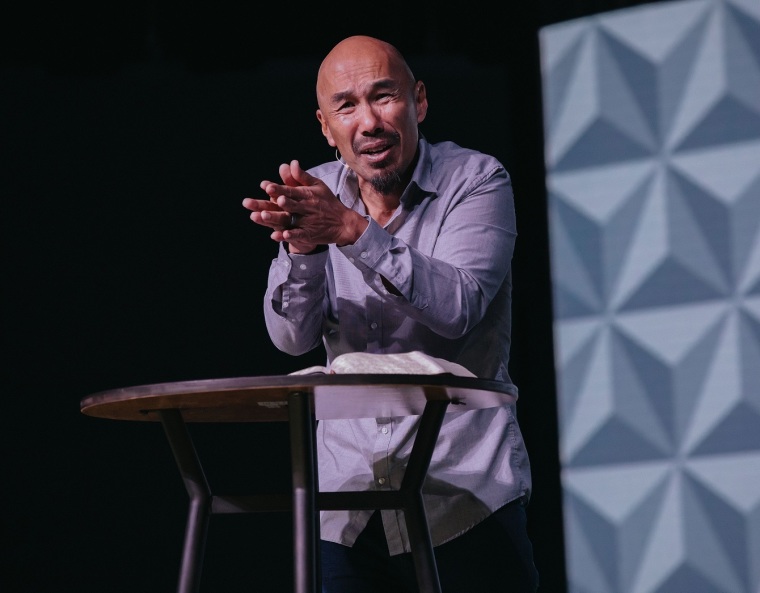
Pastor and author Francis Chan delivers remarks as part of the Q Commons event, broadcast internationally on Thursday, Oct. 24, 2019. | Courtesy of Q Ideas/Parker Young
As more and more people publicly walk away from the Christian faith, pastors must urge their congregations to have deep, personal encounters with God and bring “sacredness” and “reverence” back into worship, according to pastor and author Francis Chan.
“I am seeing so many people, friends of mine who were in ministry, who are just saying they don’t believe, or they’re walking away; ‘I don’t know if I believe that anymore,’” Chan said during Exponential’s Reset Summit this week. “And I just think that’s crazy. We’re seeing people that we look up to, leaders fall. We’re seeing the world look at evangelical Christianity as an absolute joke right now … it’s every day you can just jump on Instagram … and someone is saying, ‘I’m not a Christian anymore.’”
TheUntil Unityauthor lamented that there’s a “lot of Isaiah 29:13” going on in churches and denominations across the country today. The verse reads, “These people come near to me with their mouth and honor me with their lips, but their hearts are far from me. Their worship of me is based on merely human rules they have been taught.”
“In other words, it wasn’t an encounter [with God],” he said, explaining that true, lasting faith doesn’t come from simply hearing a message, but spending intentional, one-on-one time with God.
“Don’t get away from your own encounter with God,” he said. “We have to make sure we get people to encounter Him, and that their fear of God is not just a commandment that was taught to them by us.”
“This is a new season. And all of this, people walking away and fighting and angry about everything and so opinionated, is because they’ve spent too much time in our presence, and in our evangelical talk, talk, talk, talk presence and not enough time before a Holy God and sacred and reverent, silence and awe and just recognizing their oneness with Him.”
To have more unified horizontal relationships in the church, there must be a deeper, vertical relationship with the Father, Chan stressed.
“The world is going to get worse; persecution is going to get worse. And when they’re alone with Him, is there enough of this awe and enjoyment of Him, and a fear of Him that they can survive anything?” he asked.
“I think this pandemic showed us that there’s just way too much of this horizontal going on. And now we’re trying to keep these people with us, and it’s more like we have to direct people to Him. We have to do a better job of bringing sacredness back into our worship.”
A recent study found that 43% of millennials stated they either don’t know, don’t care or don’t believe God exists, and 16% of millennials believe that when they die, they will go to Heaven only because they confessed their sins and accepted Jesus as their savior. Yet, 57% of millennials still call themselves Christian.
In an interview with The Christian Post, Michael Youssef, pastor of the 3,000-member Church of The Apostles in Atlanta, Georgia, warned that more and more pastors are “falling into the trap” of woke culture because it’s “popular and appeals to the flesh.”
“Bowing to woke culture allows you to avoid rejection by culture and society,” he said. “It’s a very, very popular message that is now being preached from many evangelical pulpits; traditionally Bible-believing, Gospel-preaching churches. We have gone so far that it just grieves me to the point that I literally sometimes just weep tears.”
“I’ve always believed, as goes the pulpit, so goes the pew. As goes the pew, so goes the culture,” he continued. “As a pastor, I put the full blame on us, right in our laps, because we want to be liked, loved, and followed on social media by millions of people. Pastors are the culprits. We need to be about Jesus, not about being liked, because that is deadly as far as the Gospel of Jesus Christ is concerned.”
Youssef urged those who love Jesus to be “encouraged and motivated to stand up and not to be afraid,” and compel those “teetering” to find the strength and courage to stand for the truth of the Gospel.
“We must take charge,” he said. “Christians have abandoned so many areas of society, from media and the classroom. Instead of withdrawing, we need to go and invade these areas and take them for Christ and not be afraid. We are on the right side. We have read the last chapter, and it says we will win.”
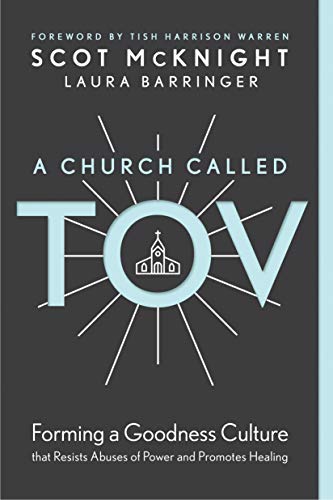
The word tov is Hebrew for “good”. In Genesis 1, after each day of creation we are told “God saw that it was tov.” In numerous places we are told that the Lord is tov, and that Jesus is tov. “Goodness” is listed as one of the fruit of the Holy Spirit.
The church is the Body of Christ, the visible representation of God in the world. The church therefore needs to develop a culture that embodies God’s character, that is tov.
Instead, the church often borrows concepts and qualities from the business world to build empires on human values. These churches quickly become toxic because they have been built on the wrong foundations. Often the toxicity comes to the surface when women accuse the celebrity pastor of sexual misconduct, bullying or other disrespecting behaviour. Then the institution turns into self-defence mode, trampling over its vulnerable members.
The authors list 7 practices that help churches to become “tov”:
Nurture empathy
Nurture grace
Put people first
Tell the truth
Nurture justice
Nurture service
Nurture Christlikeness
This is a well-written book, an easy read that will help the church to refocus on its true calling as followers of Christ.
At times it is confronting to think about how our churches might betray Christ, and how easy it is when challenged to lash out at accusers. We are called to a higher calling, and even at our hardest times, we must remain obedient to Jesus. We do this best when we work to build our churches on these principles of “tov.”
The Church is at a major crossroads in her multi-millennial sojourn through time upon this earth. She has some very big decisions to make. But most of us are not aware of the change that is in the Wind. For church, as we know it is over.
.
The Church, (the one being built by Jesus, not this monstrosity of a system we incorrectly call the Church), will move on with the gentle sound of His voice. The Church He is building will not need an earthquake, a hurricane, or pixie dust floating in the air to get her attention. His sheep hear His voice and follow Him because they follow His voice. This will be a big test of who we really are and whose kingdom we are really building. If it is His Kingdom, we will leap at the sound of His voice and go where he leads us. If we are building the counterfeit, we will not be so inclined to move very quickly. For there is much to lose and much to risk in responding to Him whilst building anything of our own.
.
The charismatics, the Pentecostals and the revivalists are all crowding at the river Jordan. The Holy Spirit is urging, calling, leading them to cross, but few have the faith to cross because few have the faith to risk what they have built. Maybe that is the problem…we have built it and it is OURS. We must protect what is ours at all costs, even at the cost of moving on with the Lord. It is always so easy to camp along the river rather than risk the dangers of fording the rapids, even when you have the voice of the Lord drawing you on. So, we invent, discover, and imagine all kinds of histrionics to keep everyone satisfied where they are, on the wrong side of the river.
.
We go around the things He has shown us again and again. We devise newer and more complicated ways of saying and doing the things we have known for years. Oh, we will occasionally look longingly across the river, wondering if there really is more over there, but the safety is always here.
.
Few will admit that we have lost the faith, the daring, and the adventure of our earlier days. Although denominationalism is anathema to us, we gather around the same things and build the same walls and defend our position with the same conviction and piety as all those who have gone before us.
.
But those who do not cross the river do not change the world. It is true, they do not rock the boat, but they do not see anything new, experience anything deeper than what has been “felt and telt” many, many times for many, many years.
.
God does not talk in circles. He has a definite destination in mind and He fully intends to have people that are willing to be led by the deepest
reservoirs of His love and the very fullness of His life.
.
Church as we know it is over…
He is about to wrestle control of His own church from the carnal hands of insecure, angry, controlling, and legalistic men and women, to build His own church, just as He promised He would.
.
Church as we know it is passing away. The thing we have called church is but a dim shadow of the life-giving, empowering wholeness of that for which Jesus died, rather, rose from the dead to lavish upon mere mortal men.
.
We have asked for wealth when He wanted to give us nations. We focused on our healing when He wanted to make us healers. We have searched for mercy and compassion when He has called us to carry those same treasures to a dying world. We are self – examining when He wants us to be pouring ourselves out so others can find Him.
.
There is no doubt. The self-centered, need-oriented, program-driven, growth-addicted destiny-snatching, dream-killing counterfeit is about to be replaced by His church; a company of loosely connected people held together only by the bonds of love. This people are the Christ-centered, Kingdom-declaring, light-shining heart throb of God Himself. His people hear His voice and respond with joy and anticipation, not fear and uncertainty. They are a devil-ignoring, life-giving, God-honouring group of worshipers whose greatest fulfillment in life is to be called to His service by the gentle sound of His voice. This church understands that the hands Jesus will stretch out to heal will be their hands. They know they are His hug; His smile, His encouraging word, and the world’s only hope of glory. The solution is clear… You are the church that Jesus Himself, is building! .
It was the day after the Sabbath. The new padded church chairs had arrived from Antioch. The tasteful gray tones of each identical chair matched well with the muted shades of the carpet and fabric-covered acoustic wall panels.
Strolling to the front row, the two apostles looked forward to seeing their own new church chairs with their names scripted tastefully on the backrest, but otherwise denoting a pure spiritual humility in that the chairs were identical to all the others.
They had learned this from the Master, who had decided it best to no longer sit in His huge and decorative platform throne but down among the little people in a regular chair. And His new chair was a regular chair like all the rest, of course, except for being gold-plated, just a tad larger, with His name embossed, and with special wiring and comports to facilitate better communication and access to His laptop.
The usual comforting din of low voices and polite conversation had ceased momentarily as the two great men took their seats on either side of the big chair in the center of the first row like all the rest. Church was about to begin. All was in good order.
The church song leader and choir director strode to the front. Also known as Pastor of Music, he was beaming. Some thought it was because his new contract increased his salary to match that of the top 5% of mega church song leaders and choir directors across the land. But others whispered something about a new friend. The congregation had always admired his polished taste in manner and clothing, as well as his unashamed emotive expressions and being able to cry so easily at the moving of the Spirit. He always worked very hard at putting forth an excellent expression of taste and unity toward the outside community. He handpicked and/or created the choir robe fabrics, wall hangings, platform arrangements (though he abhorred the term “platform”), and all else associated with his music and performance. He believed that God deserved the very best and was thankful for the generous monetary outlays which allowed him to give God the very best.








 New Life Narrabri