The True Meaning of the Church by Ralph Neighbour

An excellent article by Ralph Neighbour about the true nature of the church
coaches_ralphNThe True Meaning of the Church

by Ralph Neighbour

When the average Christian hears the word “church” the immediate mental image is either a building or a large room in a religious structure with a platform and a preacher. Example: people say, “Are you going to church today?” This is a typical illegitimate use of the word. The question refers either to the building or the public gathering conducted there.

“Church” is not a Bible word. It comes from the German Kirk, defining a religious edifice. It is a bastard term birthed in the fourth century to define religious structures. Adolf Schlatter (1852–1938), Evangelical theologian and professor at Greifswald, Berlin and Tübingen, refused to use the term in any of his books, substituting “Community” for the word.

Jesus introduced the word ecclesia in Matthew 16 and then in chapter 18, used it for the second and last time. In the first reference, He described its mission: kicking down the gates of hell. In the second reference, he instructs how an ecclesia would deal with disputes between its members. Two members should settle issues together or invite a trusted third person into the negotiation. If that were to fail, it was to be presented to the ecclesia as the Supreme Court for a decision. The term ecclesia must refer to a community small enough for close fellowship to exist between all members.

That is why Christ’s body should be viewed “Cell” by “Cell.” Each is a basic Christian community where the intimacy Jesus described is present.

I had not earlier in my ministry grasped the size of “church” Jesus had in mind! How large could the gathering be Jesus used in Matthew to refer to ecclesia? It was obviously small enough for each member to be intimately connected with two persons in conflict.

I began to see that the 12 disciples were actually the prototype size for Jesus’ ecclesia. Twelve is approximately the number of people who can relate intimately to one another.
“Cell” defines the “Basic Christian Community,” the ecclesia, not the word “church.”

Jesus taught the ecclesia to “love (agape) one another.” 52 more times in the New Testament, we are called to consider how to connect to “one another.” The expression of dismembered body parts, sitting in rows, is described by the word “church.” The authentic “one another” life is found in the “cell.” The first word is cold, impersonal. The second word denotes what Paul called for in Philippians 2: “Look not only to your own interests, but also to the interests of others.”

The biblical description of life together in the ecclesia demands an intimate family of God, not an impersonal assembly of God. The destruction done to the authentic ecclesia by the use of the word “church” to describe it is massive! Let us join Schlatter and refuse to use it!

From joelcomiskey.com
Ray Ortlund- “Himself”

“Then the cloud covered the tent of meeting, and the glory of the Lord filled the tabernacle.”  Exodus 40:34

In Exodus 40:16-33, Moses assembles the tabernacle.  He does so carefully, thoroughly, obediently.  The paragraph begins with a prospective summary in verse 16 and ends with a retrospective summary in verse 33, emphasizing the completeness of Moses’ obedience.  In between, seven times the text records that his work was “as the Lord commanded.”  What more could one hope for?

But the book doesn’t end with “So Moses finished the work” (verse 33).  There is still another, better paragraph to go.  In that final paragraph, verses 34-38, we read of what only God can do.  God’s glory comes down and covers the completed tabernacle.  After all, that was the whole point to begin with: “Let them make me a sanctuary, that I may dwell in their midst” (Exodus 25:8).

Our aim as pastors is not only that our churches will be well assembled, thoughtfully and carefully and biblically obedient in their doctrine and structures.  That is important.  But it is not ultimate.  We desire the dwelling of the risen Christ among us.  We desire his felt presence.  We desire him.

If we are not experiencing his glory coming down upon us, we need to ask if we have been disobedient in any aspect of what we have built or failed to build.  But even if we have built well, we need to ask if we have settled for mere constructional obedience.  The Lord has more for us than that.  He has himselfto give!

From The Gospel Coalition blog

The Glory Has Departed

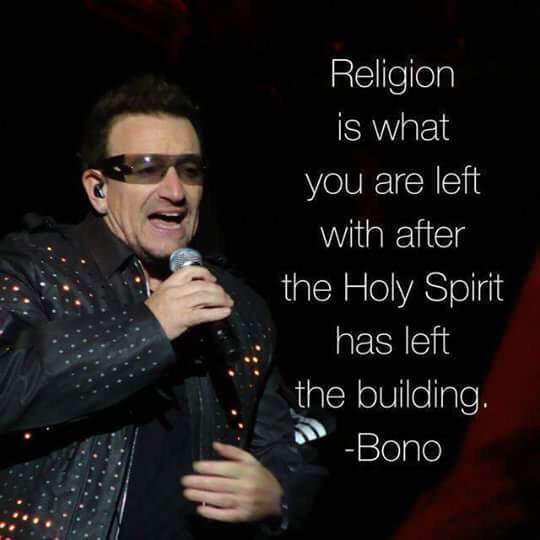
bono

I recently attended a church service at a church that had once been described as “the jewel in the crown” of its denomination. A generation ago it had been a leader in evangelism, youth ministry, children’s ministry and in renewal. It had been a vibrant place to be, with people expecting that God could do anything in their midst.

The service was pleasant enough, and I have no doubt about the salvation or the commitment of the people leading it. But all through the service I kept thinking “The Holy Spirit has left the building.”

I have had this experience a few times over the years in various circumstances, and it always makes me feel sad. It also makes me more determined not to repeat the same mistakes in my own ministry.

Here are some of the factors that I think contribute to the fading of the glory of a church or a group of people. These are not always all present in any particular group, but some of them are invariably factors.

  • Failure of a new generation to own the faith for themselves. Each individual needs to be filled with the Holy Spirit in order to build on the inheritance handed down to them.
  • A spirit of control amongst one or more of those in leadership, causing the group to be led by human wisdom rather than by Holy Spirit
  • Reliance on the denomination’s teaching or leadership or on the traditions of the church.
  • Seeing worship as a duty to be performed rather than an opportunity to approach God.
  • Lack of prayer- corporately and individually
  • A spirit of individualism in which people think they should be free to do what they want rather than submitting to genuine godly authority.
  • Rebelliousness at one crucial time when it is clear (or should be clear) where the Holy Spirit is leading but the people refuse.

Is there hope for revival amongst such churches or people groups? Yes, of course, with God all things are possible. He can make dead bones live. But it takes a level of repentance and surrender that many find difficult. Often it takes a new generation to rise up and discover the power of the gospel.

In the meantime we pray.

Sarah Bessey: Go ahead, wave your flag

I just love Sarah Bessey’s writing about the special weirdness of christians.

Go ahead, wave your flag

On the weekend, I did one of the most Vineyard-y things I’ve ever done in my life: I took two of my tinies to a worship flagging workshop. Like, it was a class about great big coloured flags and how to wave them well during church as part of the worship service.

So we have flags. We wave flags.

I know.

It’s weird to outsiders, and I get that. But I guess I can admit now that most of what we do as Christians is a bit weird to outsiders and so just roll in the weird altogether.

I’m not a flagger myself but I have an unreasonable love for people who wave the flags. I’ve reached the point in my story when I want all the crazy. All of it. I want the sloppy prayers and the hope and the flags and the unreasonable and embarrassing expectations for the voice of God to break through my life and the unprofessional dancers and the praying in tongues and the Eucharist and the Book of Common prayer being read aloud like it’s slam poetry in an old warehouse. I want anointing oil in my purse and ashes on my forehead.

Part of my own story is that I went for a big wander outside of my my mother Church, encountering different and new and ancient ways of experiencing and knowing and being changed by our big and generous God as if I were encountering occasional cups of water while in the desert, drinking each one down as if they were sustaining me for the next leg of the journey. But at the end of the story – or at least at the point of the story where I am right now, who can say if this is the end? I came home.I came home to the school gyms and the folding chairs, the humble people of God also thirsty for the inbreaking of the Holy Spirit, imperfect and sometimes disappointing and unabashedly sincere and utterly beloved to me. 

Read the rest of the article here

Should Adulterous Pastors Be Restored?

Here is a thoughtful article from “Christianity Today”  about how the church should handle pastors who fall from grace. The author makes the strong distinction between forgiveness and restoration to ministry. I don’t know that I agree with everything in the article but it’s worth a read.

“Genuine forgiveness does not necessarily imply restoration to leadership,” former CT editor Kenneth Kantzer once wrote after the moral failure of several prominent evangelical leaders. Yet the impulse to link forgiveness with restoration to ministry remains strong. Here two pastor-theologians argue for the importance of keeping separate the restoration to the body of Christ and restoration to pastoral leadership.

The North American church is seriously vexed by the question, “What shall we do with an adulterous pastor?” Over the past decade, the church has been repeatedly staggered by revelations of immoral conduct by some of its most respected leaders. How do we respond to those who have sexually fallen and disgraced themselves, shamed their families, and debased their office?

The typical pattern goes like this: The pastor is accused and convicted of sexual sin. He confesses his sin, often with profound sorrow. His church or denominational superiors prescribe a few months, or often one year, in which time he is encouraged to obtain professional counsel. Then he is restored to his former office, sometimes in another location. He is commonly regarded as a “wounded healer,” one who now knows what it means to fall, to experience the grace of God profoundly.

While each situation must be handled with pastoral wisdom, and some fallen pastors indeed might someday be restored to leadership, we believe this increasingly common scenario is both biblically incorrect and profoundly harmful to the well-being of the fallen pastor, his marriage, and the church of Jesus Christ. Our Lord Jesus was tempted in all points just as we are, yet it was his testing, not any failure, that made him strong. If we do not think clearly, we may be subtly encouraging people to grievous sin so they might experience more grace and thus minister more effectively. Incredibly, in the present context, some are saying things that imply just this notion.

The Forgiveness Approach

The commonly held view. reasons that a repentant and forgiven minister who was previously qualified for pastoral office remains qualified on the basis of God’s forgiveness. Was he qualified previously? Has he confessed his sin? Has God forgiven him? Then we must also.

This logic rests upon the unbiblical assumption that forgiveness of sin is equivalent to the “blamelessness” (or unimpeachable character) required of pastors in 1 Timothy 3:2 and Titus 1:6. If this thesis is accepted, all God requires is that a fallen pastor be forgiven.

But this confuses the basis of our fellowship with Christ with public leadership and office in church. No one argues that the fallen minister cannot be forgiven. No one should argue that he cannot be brought back into the fellowship of Christ’s visible church. But to forgive a fallen pastor and to restore him to membership in the church is much different than restoring him to the pastoral office.

The “forgiveness approach” is inadequate because it does not deal realistically with two facts: First, adultery is a great sin; and second, pastoral adultery is an even greater sin.

Full article here

How Often Should We Celebrate Communion

John Wesley recommended that Methodists celebrate Communion as often as possible. At New Life we celebrate Communion every Sunday and some times at cell groups.

Here is a good article by Allan Bevere explaining why this is so important.

ON THE DUTY OF CONSTANT COMMUNION: BECAUSE SOME THINGS ARE TOO IMPORTANT TO NEGLECT

July 20th, 2015

John Wesley, the founder of Methodism (along with his brother Charles) participated in the sacrament of Holy Communion at least a couple of times a week. He told his people called Methodists that they should take Communion as often as possible. In his sermon entitled, “The Duty of Constant Communion,” Wesley gives his reasons for constant Communion as well as answering common objections to those who believed the Lord’s Supper could be celebrated too frequently. In response to one objection that I heard often growing up in the church, Wesley writes:

A Third objection against constant communion is, that it abates our reverence for the sacrament. Suppose it did? What then? Will you thence conclude that you are not to receive it constantly? This does not follow. God commands you, “Do this.” You may do it now, but will not, and, to excuse yourself say, “If I do it so often, it will abate the reverence with which I do it now.” Suppose it did; has God ever told you, that when the obeying his command abates your reverence to it, then you may disobey it? If he has, you are guiltless; if not, what you say is just nothing to the purpose. The law is clear. Either show that the lawgiver makes this exception, or you are guilty before him.

In other words, the objection is that if the Lord’s Supper is celebrated too often it will lose its meaning to which Wesley basically responds, So what? If Jesus commands us to do this often and it loses its meaning, does that allow us to break the command? But Wesley continues:

Read the full article here

Stephen Mcalpine: Riotism: A Movement for the post-Christian West

Riotism

Ri/o/ti(s)m

noun:

  1. A subversive church community defined by a singular and holy commitment to Jesus and the faith once for all delivered to the saints as revealed by God through his Holy Word.                                                                                                                           
  2. An exuberant church community defined by a joyful and outwardly-focussed desire to share the gospel of the kingdom in word and deed with those who are lost, dying, hurting and rebellious.

Example of Riotism: These men who have turned the world upside down have come here also….and they are all acting against the decrees of Caesar, saying that there is another king, Jesus. (Acts17:6)

*******************

The western church of the early-mid twenty-first century will be a movement committed to what I call Riotism. It will have to be, or it risks not being a church at all.

Riotism is defined by a traditional understanding of salvation and the Bible, and a shameless assent to the credal statements of the early Church. It is defined by a firm, and courageous rejection of the new morality espoused by the world; a new morality, sadly,  being chased helter-skelter down the street by post-evangelical Christians in a vain attempt to prove just how right-on they are.

So what do I mean by Riotism? Is it worth another neologism in times such as this, when everyone is trying to find something new to say? Here are some thoughts:

Riotism: not Pietism

Riotism is no keep-it-to-yourself club that bunkers down, tips its lid to the world and tries to avoid trouble.  It is no “search within” Christianity that is content to let the world go to hell in a handcart, whilst sitting around the parlour fire reading Pilgrim’s Progress.

Riotism understands full well that wherever Jesus is proclaimed as Lord, the Caesar-du-jour is being challenged.  Riotism, whilst not going out of its way to placard and shout, establishes an alternate community within the wider community whose practices and values are not only strange to that wider community, but hostile in their very implications.  Not hostile in manner or approach, but by the fact they challenge every other Lordship, and refuse to be co-opted to Caesar’s cause.  Riotism should be misunderstood, mistrusted, misinterpreted, mistakenly attributed for evil, and missed  like crazy should it up stakes and leave the neighbourhood.

Read the rest here: Riotism: A Movement for the post-Christian West.

Mexican activists target Catholic cardinal with criminal complaints for opposing gay ‘marriage’

Mexico shows where same sex “marriage” impacts churches and their freedom to preach Biblical values.

From lifesitenews.com

Mexican activists target Catholic cardinal with criminal complaints for opposing gay ‘marriage’

In his weekly video address broadcast on the Catholic television network Mariavision last week and redistributed widely on the internet, the cardinal denounced the definition of marriage embraced by the court as “deviant” and a “perversion” of the true nature of marriage, words that describe the Catholic Church’s doctrine on homosexual acts.  He also lamented the lack of opposition from Catholic bishops, and theorized that the impulse to redefine marriage is an attempt to destroy the institution as part of a larger plan to establish a “new [world] order” and a single global government.

“Anything outside of this divine institution [of marriage] is an attack against it and is an aberration, and cannot be acceptable to a Catholic,” said Sandoval.

In response, a coalition of at least twelve homosexual organizations has filed criminal complaints with two government agencies claiming that the cardinal’s words are “discriminatory” and “incite violence” against homosexuals.

The cardinal “with his declarations is fomenting homophobia and transphobia,” said Carlos Becerra of the Diverse Union (Unión Diversa), one of the groups filing complaints, in an interview with the Spanish news agency EFE.

“The cardinal thinks that marriage between people of the same sex isn’t a matter of human rights, but human rights are for everyone,” he added.

Mexico’s left-wing Milenio newspaper reports  that another homosexualist group, the Cohesion of Diversities for Sustainability (CODISE), plans to file a complaint against Sandoval with the federal Secretariat of Governance, as well as against the seminary of Guadalajara because they “give a talk that incites hatred and discrimination and that generates confusion among heterosexual parents regarding the rejection of their homosexual children, and creates a repressive and suicidal mentality in their homosexual children.”

This is not the first time Cardinal Sandoval and other Catholic prelates and institutions have been threatened with legal action for daring to defend the Catholic Church’s doctrines regarding the immorality of homosexual acts and the nature of the marriage bond.

In August 2010 Sandoval publicly accused Marcelo Ebrard, then the Chief of Government of the nation’s capital, of having “fattened” the Supreme Court with benefits so as to secure rulings in favor of his anti-life agenda, which included abortion and homosexual “marriage.” Ebrard repeatedly threatened and then initiated legal action against Sandoval, using his own personnel to prosecute him on four charges. Ebrard also threatened the spokesman for the archdiocese of Mexico City, Hugo Valdemar, with legal action for stating that the city’s abortion regime was more murderous than narcotraffickers, because it had killed more people. The charges against Sandoval and Valdemar were found to be baseless in a verdict given in 2014, and Ebrard was required to pay all of the legal fees of the archdioceses of Guadalajara and Mexico City.

Stacy Lynn Harp: The American (Australian) Church is a Whorehouse

Some very confronting words here for the American church and the Australian church also. Just change the nationality as you read.

Stacy Lynn Harp writes:

The American Church is a Whorehouse: Tullian Tchividjian Shows Us ThatScreen Shot 2015-06-23 at 12.11.22 PM   

I have many things on my heart as I have thought about writing what I’m about to share, so before I go any further, I’d like to ask that you don’t shoot the messenger and instead consider what I am sharing, then weigh in with your thoughts.


Yesterday the very sad, but not really all that surprising, news broke about the grandson of Billy Graham.  In case you’re not awareTullian Tchividjian admitted to adultery, after he was confronted by some in his church, and he resigned as the pastor of the church.  Note that he didn’t actually do the honorable thing and just resign when he knew he was doing these things, he had to be confronted by those in his church.  I actually think it’s a little miracle the leadership even did that.    The public statement that he released also revealed that his wife had also committed adultery.

I have to say that I remember when Tchividjian first came on the scene as the new pastor of the church because I found it sad that the grandson of Billy Graham was given the pastorate instead of someone who was apart of Coral Ridge at the time.  I remember thinking, “Here we go again, another Christian celebrity with the Graham name.”  I heard him being interviewed all over Christian media and I never understood why.  Why was he so great?  Because he’s related to the famed evangelist?  So what, big deal.

In case anyone hasn’t noticed, the Graham family doesn’t have the most stellar record of righteousness.  There’s been divorce among the children, adultery and even departure from the faith.  Even Anne Graham Lotz has written about her time away from the church because of her husband and her being thrown out of the church.

So, seeing another famous relative of the famed evangelist fall from “grace” as they all say, isn’t all that surprising and in fact, it’s to be expected.

I’m someone who didn’t have a Christian heritage growing up and I used to feel envious of those who were “blessed” to be raised in the church.  I no longer feel envious because most of what we see in this culture of Christian celebrity is nothing but hypocrisy.

The church in America has prostituted herself out for fame, money and personality.  To be even more blunt, the church in America is a whorehouse.  Now maybe that offends a few people and maybe you don’t agree with me, but that’s what I see.  There isn’t a day when there isn’t some news about a pastor “falling from grace” or someone involved in ministry of some type that isn’t caught busted in some “moral failure”.  Those “moral failures” are often sexual in nature, but not always, sometimes it involves money.  Other times it involves abuse of power and personality.

If we want actual revival in America, then it’s time to buck tradition and shut down the whorehouse.

Read the full article here

Sarah Bessey: Happy-clappy

Happy-clappy

lightstock_68414_medium_user_5073617
When I was a child, I sat in the front row of the church. I danced while the guitar played three-chord songs, kicking my feet in front of me, hopping from side to side, skinny arms outstretched. I learned to worship at the community centre, surrounded by misfit disciples who were on a first-name basis with resurrection. I sang the old songs about the blood of Jesus making me white as snow.

The church ladies would bring swaths of airy fabric, about two metres long apiece. I held onto one end and swung my flag. This was no banner for a war; this was a a homemade flag for a kid in a homemade church to wave. Sometimes, sure, I spun that flag around, hoping for people to notice me, to think that I was spiritual and holy, to think that I was beautiful and devoted. It was prideful at times, self-centred, but then there were those moments that broke through my own childish yearning to be noticed, to please the grown-ups, the moments when I felt the Spirit rush through my body and out through the fabric, like we were one, and I would spin like a star in the heavens, and I swear to you now that I felt the smile of God on me like wind, like water, like chains were falling off before they were even forged. I learned to pray with my body, relentless and free.

Then slowly, it seemed as if no one really danced in church anymore. Dancing with flags became something we made fun of, like duelling tambourines and long services and “falling out” in the Spirit and daring to pray for healing. We made fun of it to domesticate it, perhaps, or to heal ourselves from the abuse of it, but something in my thumbs still pricked, the Spirit isn’t afraid of being ridiculous, after all.

I wandered through other church traditions, traditional, contemporary, liturgical, meditative, mystic, seeker-sensitive, emerging, ancient-future, denominational, mega-church, old church, new church, basement church, no church for a while there: you name it, I found my way there and I found the people of God in each place, I did.

But my roots belong where I was first planted, I’ve reconciled myself to that now. I used to think I could travel far from where I began, but instead, I travelled only to find myself home again, like Richard Rohr says, as if I am only now seeing it for the first time.

We are so beautiful.

We sit in folding chairs in a school gym, one of the great cathedrals of my life. The pine benches line the walls, electrical tape holds the wires for the mics down, the stage can be broken down and set back up again every Sunday morning and Saturday night. This is my familiar place to encounter God.


Read the full article here