Climate Crisis? What Climate Crisis

From wattsupwiththat.com

By Andy May

In a new paper by Gianluca Alimonti and Luigi Mariani, they argue that the public needs a proper definition of precisely what a climate crisis is to make rational decisions about how to address potential climate change threats (Alimonti & Mariani, 2025). They propose a set of measurable “Response Indicators” (RINDs) based on the IPCC AR6 Climate Impact drivers (IPCC, 2021, pp. 1851-1856).

Their intent is to switch from subjective perceptions of possible dangers to quantifiable metrics. Potentially this could put climate change debates on track and ensure that both sides are arguing about the same thing as opposed to talking past each other due to each of the debaters arguing from different definitions. It might also lead to real solutions to real problems, rather than flights of ideologically-based fancy.

The IPCC defines climate impact drivers (CIDs) as climate events that affect society. The impact on any affected society can be detrimental, beneficial, or neutral (IPCC, 2021, p. 1770). They define 33 categories of CIDs and have found that most of them have not emerged from the expected range of natural variability.

Alimonti and Mariani examined the EM-DAT disaster database, managed by the Centre for Research on the Epidemiology of Disasters from the year 2000 to the present. In this period, they detected no trend in deaths due to weather-related disasters. Just as important, there were clear improvements in global health over the period, once the growth in population was accounted for.

Temperature-related mortality accounts for 8% of the total weather-related deaths, of these 91% were due to cold and 9% to excess heat. From 2000-03 to 2016-19 cold related deaths decreased by 0.5% and heat related deaths increased by 0.2%, very small changes.

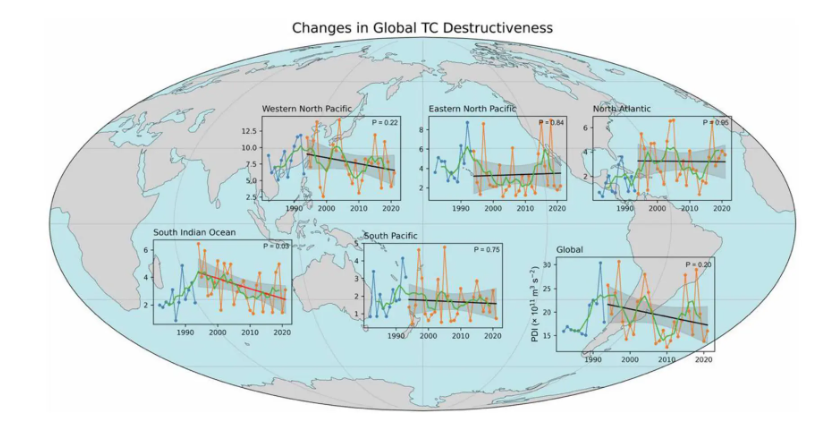
As Alimonti and Mariani’s Table 1 indicates, most measures of their climate change response indicators show no change, including cyclones, drought, floods, and wildfires. They show global GDP is improving, as is food availability.

The paper emphasizes that the reduction in climate-related deaths can be partially attributed to improvements in civil protection systems (levees, seawalls, forest management, etc.) which demonstrates that adaptation to climate change often proves more effective than mitigation. Most objective measures of the human-welfare impact of climate changes show no change, and most of the rest show improvement or an ambiguous impact, rather than detrimental effects.

The paper is worth the time to read; it is time for less subjectivity and more harder objective measures of the impact of climate change.

Jo Nova: UN climate conference drops “fossil fuels” from the draft deal. Activists say “We have nothing left”

It is as if Satan disappeared from the Bible

The sacred fabric of the climate religion is unravelling by the day. The COP30 deal is being hammered out in Brazil — but in the draft any mention of “fossil fuels” has been dropped.

Apparently the rich oil nations have formed a block that objects to a sentence committing countries to stronger, faster, action to reduce their use of fossil fuels. The UK, France and a few other nations have rejected this but the same small island nations that are frightened of drowning have joined the oil block.

Apparently they were offered more money to adapt to climate change.

UN climate summit drops mention of fossil fuels from draft deal

By Georgina Rannard, BBC

All mention of fossil fuels, by far the largest contributor to climate change, has been dropped from the draft deal under negotiation as the COP30 UN climate talks in Belém, Brazil enter their final stretch.

Brazil’s President Luiz Inácio Lula da Silva and some countries including the UK want the summit to commit countries to stronger, faster action to reduce their use of fossil fuels.

An earlier text included three possible routes to achieve this, but that language has now been dropped after opposition from oil-producing nations.

French Environment Minister Monique Barbut said the deal is being blocked by “oil-producing countries – Russia, India, Saudi Arabia, but joined by many emerging countries.” She suggested that small island nations may agree to a weaker deal on fossil fuels if they secured more finance to adapt to the changes in their countries caused by rising temperatures.

It was always about the money

The big question here (if this sticks) is why the oil block didn’t do this years ago?

The even bigger question is whether the oil block have found a way to circumvent The UN Blob? If they are paying the small countries off directly behind the scenes, the UN will miss out on collecting its share of the cash flow. The travesty!

The irony is that if  “man-made climate change” was really a crisis, it makes more sense for the oil giants to pay the islands to build sea-walls  — instead of rearranging the global economy to try to control the clouds and the ocean. But this unthinkable sacrilege cuts out the middlemen Blob-o-crats and stops the whole totalitarian power game.

The UN will not give up its aim to be the One World Government so easily.

The French Environment Minister was not happy:

On France’s position she said:”At this point, even if we don’t have the roadmap, but at least a mention of the fossil fuels, I think we would accept it. But as it stands now, we have nothing left.”

Expect The Blob to fight this all the way. There will be wrangling and then possibly “euphoric joy” about a “historic agreement” ready for cameras on the nine o’clock news.

From Jo Nova

Jo Nova: Prepare the escape pod — Kier Starmer says: “The consensus is gone”

Starship crashed. Fantasy.

Image by ThankYouFantasyPictures from Pixabay

By Jo Nova

The stench of failure is written all over Cop30 in Brazil

The USA, China and India are not attending. The UN has said the 1.5 degrees target is no longer possible. And the OECD admits “policy commitments have fallen from 10% annual growth to just 1%.

The Consensus is not only dead, but no one can hide the body under the rug any longer. Things are decomposing so fast, even Kier Starmer has flown all the way to the COP conference in Brazil to say “the consensus is gone”.

Kier Starmer didn’t even want to go to COP30 lest he look like he’s in the palm of the globalist Blob which would feed his nemesis – Nigel Farage. So he’s put in a last minute appearance and gone out of his way to avoid the usual fire and brimstone devotion by uttering a blasphemy. The consensus, after all, was the holy grail. It was the reason “to believe” and a reason to act even if we didn’t believe. The Blob always said: “We don’t want to fall behind” like being part of the herd was a benefit in and of itself.

For a bunch of Groupthinkers, this is big admission:

[The Guardian]  The UK prime minister told world leaders on Thursday at the Cop30 climate summit in Brazil that the “consensus is gone” on fighting climate change around the world, a decade after the landmark Paris agreement in 2015.

“Ten years ago, the world came together in Paris … united in our determination to tackle the climate crisis,” Starmer said. “The only question was how fast we could go. Today, however, sadly that consensus is gone.”

For Starmer, this might be the best escape route from the Net Zero bomb. As long as the fuse is lit and the carbon-clock is running, the globalist Blob parties face a wipe-out at the next election. But if “the consensus” is over, maybe he can pack the climate-talk away in a box for a few years and curb the fury over electricity prices. It’s what Mark Carney did to win in Canada. He scrapped the carbon tax on his first day in office and de-fanged the opposition. It may even placate the Groupthinking Greens, if he can convince them that no one else is acting and to wait for a better day.

Chris Bowen, the Australian Minister for Weather Control even agrees with Kier Starmer

But in renewable-crazy-land that just means that Australia has to do even more. The Guardian asked him about Kier Starmer’s words and he replied:

“I think that’s fair comment. Yes, it’s a contested space, but that makes supporting action in keeping with the science more important, not less important.

“It makes continued action by governments and industry who get it – that this is a scientific and environmental imperative, but also excellent economics – even more important. And that’s certainly our approach in Australia.”

Unlike the Reform Party in the UK, the opposition in Australia is a Lump of Jello, and doesn’t have a climate policy. So Chris Bowen is free to keep sprouting crazy witchery. He’s not afraid of the opposition because, effectively, there isn’t one.

Indeed, Bowen has to keep waving the flag, because the Australian government wants to host the next loser COP event this time next year. Thankfully, the opposition and the Nationals have both said “Let Turkey have it”. We want our billion dollars.

Even the OECD admits policy commitments have stalled. Globally, they only increased by 1% last year, when previously they would grow by 10% each year.

Global climate action losing momentum: OECD

By Ryann Cropp, The Australian Financial Review

The pace of global efforts to address climate change has ground to a halt, according to a report by the OECD that is likely to turbocharge Coalition wrangling over its commitment to emissions reduction.

The expansion of international climate policy commitments increased by just 1 per cent in 2024, with only 17.7 per cent of global emissions now covered by legally binding net zero pledges, according the Organisation for Economic Co-operation and Development’s annual Climate Action Monitor.

According to the OECD, the slowdown in climate commitments since 2021 contrasts significantly with the prior decade, when average emissions reduction policies expanded by about 10 per cent each year.

They have run out of excuses:

“This slowdown can no longer be explained by the COVID-19 pandemic or economic shocks: it reflects a loss of momentum in implementing effective policies,” the report said.

Now even the UN agrees that we will fail to hit their 1.5 degrees magical target, and that this is a “moral failure”:

It is, of course, our fault:

The failure to limit global warming to 1.5 degrees Celsius is an emergency and nations must now “lead or be led to ruin”, UN secretary-general António Guterres has said as the COP30 climate conference got underway in Brazil’s rainforest city Belém.

He added: “Every fraction of a degree means more hunger, displacement and loss — especially for those least responsible. This is moral failure — and deadly negligence.”

Mr Guterres, being a Blob man and the total socialist, paints this as capitalist greed:

“Too many corporations are making record profits from climate devastation, with billions spent on lobbying, deceiving the public and obstructing progress,” he said. “Too many leaders remain captive to these entrenched interests.”

After all, it’s not like the consensus died because millions of people in the largest economy on Earth were not convinced and voluntarily voted (twice!) for a man who called Climate Change a con and a hoax. Oh no…
Jo Nova: Fossil Fuel Comeback

Fossil Fuel Fightback: The gears shift on the Renewable Crash Test Dummy — Eraring coal lives, wind and solar slump

Australia's Renewable Transition plane,

By Jo Nova

If the whole renewables fantasy was crumbling, it would look something like this

Despite the Labor Government throwing money at unreliable energy, renewables hopes are quietly unraveling. The largest energy retailer in the country just announced a nice 26% profit jump, based on fossil fueled gas, and they also announced they’d be keeping Australia’s largest coal plant open longer. The two year extension for Eraring, is now a four year extension. Despite reaping in gas profits and keeping the planet-destroying-plant operating, the share price promptly leapt 6% to a ten year high.

Significantly, Giles Parkinson at Reneweconomy also noticed that Origin’s annual report includes talk of batteries, but no wind or solar projects, which seems like an important oversight in a nation belting headlong towards the Green Utopia.

Meanwhile, for the first time I can recall, a fossil fuel CEO is daring to defend the industry. The shift in confidence in palpable.  Mike Wirth, the Chevron CEO, is not only saying “oil is not evil” but he clearly isn’t afraid of the Australian government. He’s so unafraid he also delivered a “stinging rebuke” — saying that high costs, red tape and environmental rules have made Australia so uncompetitive, investors are leaving to spend their money in the US and the middle east instead. Indeed, Chevron had a plan to double their Australian gas production but have abandoned that now. Australia used to be the world’s largest LNG exporter but Qatar and the US outpaced us.

In a similar theme, Ampol just surprised the market by spending $1 billion dollars to double the number of petrol stations it owns, making it the largest retailer in the country. The CEO Matt Halliday said the unthinkable: “The transition [to EVs] will take decades, and combustion engines are going to still make up a large chunk of the national car fleet beyond 2050.” It was a very unfashionable and backward thing to say, but shares leapt 8% on the news yesterday.

Australia’s biggest energy retailerhits go slow button on wind and solar, mulling options on Eraring

Giles Parkinson, Reneweconomy

Origin Energy, Australia’s biggest energy retailer, appears to have hit the go-slow button on the rollout of new renewable energy projects, and is still mulling options on the already extended Eraring coal generator, the country’s biggest, which is officially due to close in 2027.

Curiously, in its annual report, the company says: “With the Eraring Power Station’s closure planned for August 2027, failure to deliver our major renewable generation projects may affect Origin’s future supply capacity, financial prospects and reputation.” Yet it has made no commitment to build those projects in that timeframe.

Think of the irony of putting the nations biggest battery next to the nations biggest coal plant, as if it needed back up:

But this is made up entirely of big batteries, including the giant 700 MW, 2,800 MWh Eraring battery being next to the coal generator…

It [the annual report] includes no wind or solar projects. The technologies did not even rate a mention in the results presentation, apart from the giant 1.45 gigawatt (GW) Yanco Delta wind project in the south-west of NSW, which has gained grid access rights but is still to complete environmental approvals.

Read the rest of the article here

Peter Ridd: The Great Barrier Reef Is Doing Fine

My article from The Australian this morning below. But first, AIMS are agreeing that the reef is coming off record highs so the small drop should be viewed in that context. However, much of the media is still reporting the drop as a disaster.

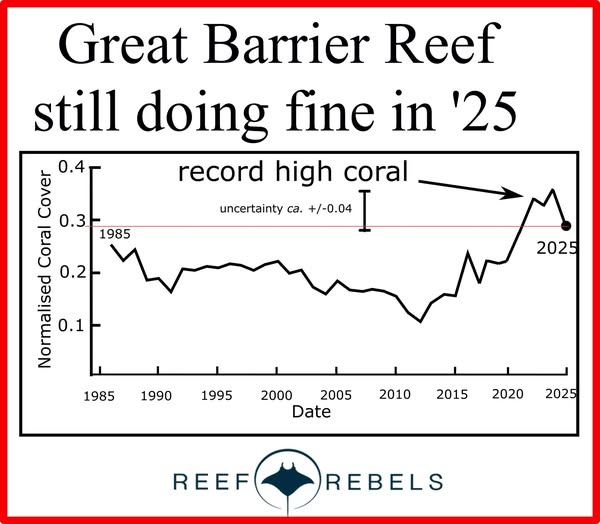
The latest 2025 statistics on the amount of coral on the Great Barrier Reef (GBR) show the reef is still doing fine despite having six allegedly cataclysmic coral bleaching events in the last decade. There should be no coral at all if those reports were true.

The normalised coral cover dropped from a record high number of 0.36 down to 0.29, but there is still twice as much coral as in 2012. The raw coral cover number for all the last five years has been higher than any of the previous years since records began in 1985. However, when one considers the uncertainty margin, the present figures are not significantly different from many of the previous years.

The Australian Institute of Marine Science collects coral data on around 100 of the 3000 individual coral reefs of the GBR. Analysis of the data at smaller scales shows the GBR is doing what it always does – change. There is a constant dynamic as cyclones, starfish plagues and bleaching events dramatically kill lots of coral in small areas, while it quietly regrows elsewhere.

Guess whether the ‘science’ institutions emphasise the death or regrowth.

The institutions often justify this embarrassingly high coral cover as just “weed coral”. But the type of coral that has exploded over the last few years is acropora, which is the most susceptible to hot-water bleaching. How can we have record amounts of the type of coral that should have been killed, again and again, from bleaching? The acropora takes five to ten years to regrow if it is killed.

There are two conclusions that must be drawn. First, not much coral has been killed by climate change bleaching – at least not compared to the capacity of coral to regrow. Second, the science institutions are not entirely trustworthy, and are in need of major reform.

And not just with regard to GBR or climate science. It is well recognised that most areas of scientific study are suffering a problem of reliability, which is damaging the reputation of science itself. It is well accepted that around half of the recent peer-reviewed science literature is flawed. Is there any other profession with such a high failure rate?

This last point has been noted in the United States, where American science is going through a process of genuine revolution. Scientists who were once victimised and ostracised have been appointed to lead science and medical research institutions. Among the more notable and encouraging appointments have been Professor Jay Bhattacharya who famously opposed the groupthink on Covid lockdowns, especially for children. He is now head of the National Institutes of Health and is proposing radical changes in the funding methodology to break the cycle of groupthink. He is also changing funding rules to encourage bright young scientists with new ideas rather than the present system which rewards older scientists who are wedded to conventional wisdom, and often enforce groupthink. In short, Bhattacharya is encouraging dissenters.

The US Department of Energy recently released a report on whether the conventional wisdom on climate change is entirely defensible. It is written by five eminent scientists, all with spectacular careers, who have consistently challenged the view that climate change is an existential threat. Their report includes data about GBR that shows there is little to worry about. Significantly, it systematically addresses many other aspects of Climate-Catastrophe Theory, such as wildfires and deaths from extreme weather events. And it points out the oft-ignored fact that carbon dioxide is a wonderful plant fertilizer which has already increased crop yields and plant growth.

Most importantly, rather than shutting down critics, the report’s writers are actively encouraging criticism, which they will respond to.

Science progresses through argument, logic, and quality assurance systems that make sure debate always takes place. Groupthink kills science, and groupthink is being challenged like never before in the US.

This revolution seems a long way off for Australia. But it will come, simply because US science, and science funding, dominates all other countries.

Imagine if Professor Ian Plimer, Australia’s most famous climate sceptic, was in charge of our climate science funding. Or if I were in charge of the Great Barrier Reef Marine Park Authority. Sounds crazy. But that is what has effectively happened in the US.

Australia’s science agencies would do well to contemplate whether they need to change their ways before the revolution comes to these shores. Better to adapt before the scientific guillotine falls.

Peter Ridd is an Adjunct Fellow at the Institute of Public Affairs.

Fresh Evidence Emerges That Global Vegetation Growth Reaches New Highs Due to Increased CO2 Fertilisation

From wattsupwiththat.com

Global vegetation reached a new greening peak in 2020, continuing a long-term trend since 2000 according to new dramatic findings published by a team of scientists based in the United States. The work helps confirm other recent scientific work that points to massive global plant growth directly related to recent increases in natural and human-caused carbon dioxide. Plants have evolved to grow in an atmosphere much richer in CO2 than current near-denuded levels, and the recent growth and its myriad benefits for humankind should not be surprising. Needless to say, the news is absent from mainstream headlines since the ‘pollutant’ is temporarily being blamed for climate collapse in the interest of boosting the collectivist Net Zero fantasy.

The latest work on the ‘gas of life’ notes that the greening is linked to continuous growth in boreal and temperate vegetation. The scientists also suggest that the increase has been complemented by a tropical vegetation boost due to higher rainfall. Higher growth in northern regions would also have been helped by slightly warmer temperatures which have marginally increased growing seasons. The climate might be collapsing for ill-informed readers of the Guardian and listeners of the BBC, but nature continues to find ways to thrive. The scientists note that there is a “robust resilience and adaptation” of global vegetation in the face of a changing environment. Using a number of remote sensing devises, the year 2020 is pinpointed as an “historic landmark” since it registered as the greenest year in modern satellite records from 2001 to 2020.

This is not the first time that an acceleration in global greening over the last two decades has been observed. Last year a group of Chinese scientists found that about 55% of global land mass had shown an “accelerated rate” of vegetation growth. The Chinese team that included the Eco-Climatologist Professor Tiexi Chen stated that “global greening is an indisputable fact”. Climate change drought is a favourite fear mongering scare with activists but it was found that any water scarcity trend only slowed global greening, “but was far from triggering browning”.

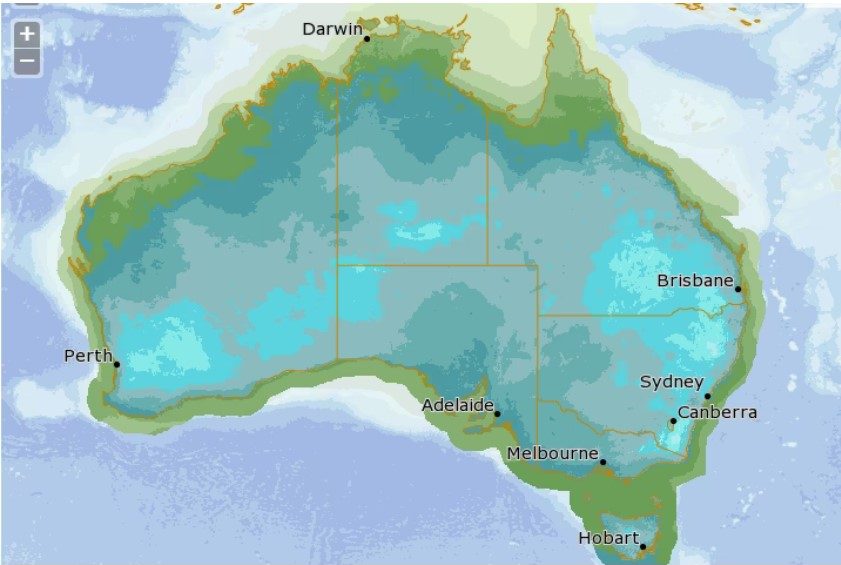
The extent of the recent greening is shown in the map above and along with the latest results from the US team it reveals extensive growth in northern regions. But there has also been obvious de-desertification south of the Sahara and many famine-prone areas in eastern Africa have been given a welcome natural boost to food supplies. 

In addition, these ecological improvements boost wildlife and create healthier eco-systems. They go back further than the turn of the century with evidence of widespread greening stretching back to at least 1980. Some estimates suggest increased levels as high as 14%. In a detailed paper published in 2016 by 32 authors from eight countries, it was noted that there was a “persistent and widespread increase” in growing season greening over 25-50% of the global vegetated area.

In fact, the new greening of the planet is helping to feed the world. The authors of a recent science paper Charles Taylor and Wolfram Schlenker recently stated: “We consistently find a large fertilisation effect; a 1 part per million increase in COequates to a 0.4%, 0.6%, 1% yield for corn, soybean and wheat respectively”. A previous extreme environmentalist scare about rising populations and food scarcity was forced to take a back seat as crop yields soared due to hydrocarbon-produced artificial fertiliser and higher levels of atmospheric CO2. Ironically, a successful Net Zero and a resulting collapse in global food supplies could see the former much-missed scare return to centre stage.

It is difficult to see how the idea that there is a climate ‘emergency’ can continue to be taken seriously given that it lacks any substantial or convincing proof. The trend in almost all extreme weather events is not getting worse and this is accepted by the Intergovernmental Panel on Climate Change (IPCC). Increasingly discredited weather attribution linking individual events to humans conflicts with the IPCC fact-based view. Slightly warmer temperatures have benefited humans, a species that emerged from the sub-tropics and thrives best in warmer climes. Climate ‘refugees’ don’t exist and can’t even be defined. Climate tipping points exist only on the hard drives of climate models as does almost every prediction of Armageddon. Fake predictions heavy with dubious stats and temperature recordings are becoming the butt of jokes, if not in the mainstream media then across the more important social media arena. Meanwhile, corals, polar bears and whales multiply (the latter of course provided they stay away from the killing waters of offshore wind parks).

Screenshot

Even the deserts can’t be trusted to get bigger and create millions, perhaps billions, of climate refugees. According to a recent Yale Environment 360 article, CO2 is “fast tracking” photosynthesis in plants. By allowing them to use scarce water more efficiently, the CO2-rich air fertilises vegetation growth in even some of the driest places, it is observed. You can of course only have so much good news in Green Blob-funded operations like Yale and it also noted, “arid eco-systems matter”. We can but pray that nobody tells the Guardian about all this green encroachment and ruins its day. It recently reported that “desertification is turning the Earth barren” and the expansion of drylands is leaving entire countries “facing famine”.

Chris Morrison is the Daily Sceptic’s Environment Editor

Jo Nova: The Ridiculous Net Benefit of Net Zero

Jo nova writes:

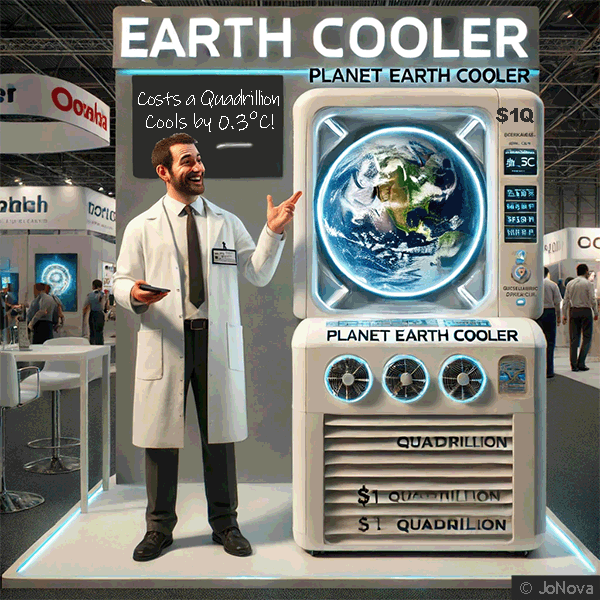
Bargain: Make the whole world “Net Zero”, spend a quadrillion dollars, and cool the world by 0.3 degrees!

Air conditioner for the Earth.


By Jo Nova

The deadliest climate question: How many degrees cooler will that be?

Ask it now, ask it later, before breakfast and while watching “the news”. Teach the children to ask in kindy.

We know the IPCC wildly exaggerates, but pretend they’re right and it still doesn’t make any sense. Richard Lindzen, Will Happer, and William van Wijngaarden took the IPCC at its word and calculate that even if we get to Net Zero by 2050, will only make the world a tiny bit cooler, assuming they’re right (which they’re not) and assuming the rest of the world joins in (which they aren’t).

Say we stop all coal, oil and gas, redesign our energy grids, cull the cows, give up our holidays, our cars and ride bikes to work, fill the oceans with windmills, and turn our thermostats down. We spend a quadrillion dollars on a Moonshot to stuff a perfectly good fertilizer in holes underground, and instead of getting to the moon, the world is barely 0.28 degrees C cooler. That’s a half of one lousy Fahrenheit less that it would have been. This ladies and gentlemen is the best case scenario for the global action plan against the 6th mass extinction.

This is why 100,000 people in private jets meet each year in Egypt, or Doha, or Azerbaijan. (Or so they say).

The whole United States of America could go Net Zero by 2050 and it would, at best, change global temperatures by three one-hundredths of a degree, which we can’t even measure. Rounded to the nearest tenth of a degree that’s a big 0.0°C. And if the Sun does a bit more, then it’s even less.

Net Zero Averted Temperature Increase

R. Lindzen, W. Happer, and W. A. van Wijngaarden

Abstract:

Using feedback-free estimates of the warming by increased atmospheric carbon dioxide (CO2) and observed rates of increase, we estimate that if the United States (U.S.) eliminated net CO2 emissions by the year 2050, this would avert a warming of 0.0084 ◦C (0.015 ◦F), which is below our ability to accurately measure. If the entire world forced net zero CO2 emissions by the year 2050, a warming of only 0.070 ◦C (0.13 ◦F) would be averted. If one assumes that the warming is a factor of 4 larger because of positive feedbacks, as asserted by the Intergovernmental Panel on Climate Change (IPCC), the warming averted by a net zero U.S. policy would still be very small, 0.034 ◦C (0.061 ◦F). For worldwide net zero emissions by 2050 and the 4-times larger IPCC climate sensitivity, the averted warming would be 0.28 ◦C (0.50 ◦F).

Read the entire short paper here at the CO2Coalition: Net Zero Averted Temperature Increase

And Christopher Monckton points out the cost to benefit ratio for this $2 Quadrillion dollar project is every billion dollars we spend cools the world by 20 millionths of a degree.

So let’s keep all the national science institutions that pointed out what a terrible deal this is for all our nations, and shut down the rest —  NOAA, NASA, Hadley, CSIRO, NIWA, BoM, Potsdam, NRC, ARC, and while we’re at it — the ABC, BBC, the CBC because they should have asked better questions, like “how many degrees will that cool us?”

Health of Fish Stocks Contradict Climate Alarmists Predictions

From wattsupwiththat.com

Health of Fish Stocks Contradict Climate Alarmists Predictions

By Vijay Jayaraj

The oceans are still very much a mystery to humankind, with a vast majority of it yet to be explored. Early in my career, I wanted to make an in-depth study of how climate affected marine life. After all, many media reports claimed that “oceans will become empty by 2048.”

So, as a graduate research assistant, I explored the adaptability of marine fish and invertebrates to fluctuations in ocean temperatures. I found that both are highly adaptable to changes in the water around them. That is the way they are made.

Now, evidence emerging from scientific studies shows that marine life may be benefiting from the relative warmth of modern temperatures.

Contrary to the hyperbole of climate reporters, there has been no alarming increase in global sea-surface temperatures. Even if temperatures increase substantially, fish are free to migrate to cooler waters and do, as documented by scientific studies.

Fish also have natural adaptive mechanisms. Since their initial emergence in Earth’s waters, fish have developed genetically in ways that allow them not only to survive but to thrive in a variety of environments. In addition to the generational genetic adaptability, fish also display short-term phenotypic plasticity which allows them to adapt to temperatures and other physical factors. When combined, these mechanisms act as significant protection against the ill-effects of the physical environment.

Despite this, it is not uncommon to see news of fisheries crashing under the weight of a climate crisis. However, real-world data contradict such negative reports, indicating instead that global fish catches will improve in the coming decades.

2016 scientific study “assembled the largest-of-its-kind database and coupled it to state-of-the-art bioeconomic models for more than 4,500 fisheries around the world.” The study found that global fisheries will profit from an increase in marine species. The degree of this commercial success will depend on a range of policy measures, including ones that enable increased catches for individuals and communities.

In 2020, there was a record 214 million tonnes of production from both wild catches and aquaculture. The State of World Fisheries and Aquaculture 2022 report says that this production is expected to grow 14 percent by 2030. Fish are expected to become more affordable and accessible, with prices decreasing between 2024-2029, according to two international bodies: the Organization for Economic Co-operation and Development (OECD) and United Nation’s Food and Agriculture Organization (FAO) that published the data in Agricultural Outlook.

As of 2017, around 65% of fish stocks were biologically sustainable. An index of population health is maximum sustainable yield (MSY), which is the point at which the stock can sustain itself without limits on fishing. The MSY calculation involves collaborative information gathering by marine biologists and fishers.

The 2022 report states that the number of catches from biologically sustainable stocks has been on the rise! This signals that catches can be increased without depleting the stock to levels that neither the species nor continued fishing is at risk. While some concerns remain for a few species, studies show that in regions where we have high-quality population data, the majority of fish stocks are either stable or improving.

In short, any threat to future catches is not “empty” seas but rather the effect of activities such as illegal fishing and overfishing. Fish as an important protein source is likely to remain available in large quantities. Reality contradicts the fallacious climate crisis that dominates popular media and politics.

This commentary was first published in American Thinker on February 10, 2024.

Vijay Jayaraj is a Research Associate at the CO2 Coalition, Arlington, Virginia.  He holds a master’s degree in environmental sciences from the University of East Anglia, U.K.

Jo Nova: Climate experts wrong on Australian frosts, and media say nothing

From Jo Nova:

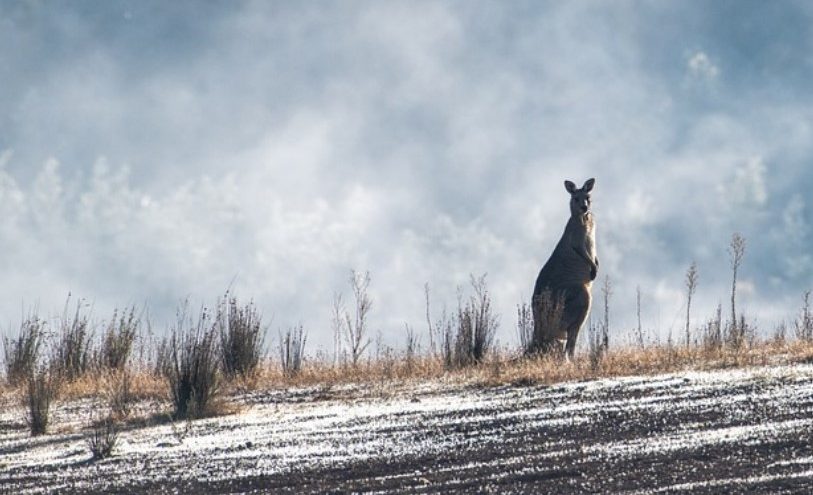
A Kangaroo on the Frost, Australia

Image by Penny from Pixabay

Climate experts wrong on Australian frosts, and media say nothing

The IPCC experts were sure would be less frosts in Australia, but buried in a government funded ABC weather report was the virtually unknown admission that the frost season is actually growing across southern Australia, not shrinking. And in some places by an astonishing 40 extra days a year. What’s more, the researchers have known about this long term trend for years but didn’t think to mention it, and the ABC didn’t have a problem with that either. (It’s not like farmers need to know these things?)

When asked for an explanation for the increase in frosts, the ANU climate expert said “I think this is one of those climate surprises,” as if the IPCC unexpectedly won a game of Bingo, instead of getting a core weather trend 100% wrong.

We note the ABC feigned journalism to cover up for the Bureau of Meteorology and IPCC failures. Where were the headlines: “Climate Change causes more frosts, not less”, or “IPCC models dangerously misleading on frosts?” Did any Australian farmers and investors buy up properties and plant the wrong crops based on the global warming misinformation repeated or tacitly endorsed by the ABC, BoM and CSIRO?

Frost damage costs Australian farmers around $400 million each year. (Perhaps if we sold the ABC we could cover that).

Frost expected across nearly every state and territory in Australia this weekend

By Tyne Logan, ABC Australia

Buried under 450 words of weather, trite caveats, and preamble the ABC journalist finally gets to a new virtually unknown climate trend that affects farmers, investors, researchers, and rural Australia:

The latest Intergovernmental Panel on Climate Change report projected, with high confidence, that frost events would decrease, in general, across southern Australia in the future with climate change.

ANU climate applications scientist Steven Crimp said some parts of New South Wales were now experiencing five more frost events on average each year, compared to 1960.

And he has known for years:

He said this was based on local weather station data between 1960 and 2018, but the trend was unlikely to have changed much in the past five years.

“I think this is one of those climate surprises,” he said.

Scientifically they are not caught unaware because climate models are useless politicized fantasies, it’s because there is more “climate-nuance” around now:

“Despite the sort of overall warming trend in our temperatures, the extremes of our temperatures, be they hot or cold, are acting in a slightly more nuanced and complex way, which can be quite surprising at times,” he said.

Below zero temperatures in Australia.

BOM forecast overnight minimum temperatures to fall well below zero across large swathes of the country [last] Sunday.

#302226;font-family: Candara, Verdana, sans-serif">But jokes aside, this actually seems like a trend that matters:

Dr Crimp said they had also found the frost season was lengthening across southern Australia.

“So if we think about the east coast first, we see an earlier start and a later finish to that frost window,” he said. “In some cases, the extension of that frost window is greater than 40 days.

“But in Western Australia in particular, we see that it’s less to do with the later frost occurrence, but more earlier frost occurrence.”

The frosts are due to the dry conditions, says Dr Crimp, putting in an admirable effort at scientific-word-salad to cover up for what he’s not allowed to say — that they have no idea.

Why aren’t frost days decreasing?

Dr Crimp said, ironically, the observations could be explained by the types of weather system that brought warmer, drier weather. That was high pressure systems which often produced the clear, still nights needed for frost to settle.

“As anyone knows who’s outside at night in winter, you have to have those clear night skies and the atmosphere needs to be very dry,” he said.

“That way the surface of the Earth loses heat very rapidly and any moisture in the air then condenses as a frost. “So because we are getting those dry conditions that are starting to emerge, that is more conducive for frosts to occur.”

But the truth is that, on average, and a priori — global warming would increase humidity and global cooling would  dry the air out. And carbon dioxide is supposed to work at night time too — increasing minimum temperatures. All these factors make frosts less likely.

And yet the frosts happen.

Jo Nova: Exxon says NetZero degrades global standard of living so much there’s only a remote chance it will happen

By Jo Nova

Exxon petrol gas station.

Exxon was told to jump through circus hoops like a performing seal and report the risks of NetZero to Exxon shareholders. But Exxon pushed back by pointing out that NetZero-by-2050 is so impossible it will never happen, and therefore the risks are not even worth assessing. Furthermore, and rather damningly, Exxon said, society would be unlikely to “accept the degradation in the global standard of living required“.  Exxon has taken was was supposed to be another PR win for the narrative and turned it into a media weapon.

This is exactly why the Big-Gov-Corporatist cartel wants to co-opt or destroy independent profitable corporations. In this case, companies that don’t need Big-Gov are free to point out the hypocritical inanity and absurdities which the lap-dog dependent industries like wind power and solar cannot.

Sadly, companies like Exxon still need to be brave because Big-Gov is so big, it is always the largest potential client and holds the sword of mendacious legislation, licensing and regulation as well.

Exxon Crushes Progressive Dreams That “Net Zero” Has Any Chance By 2050: It Would Mean Collapse In “Global Standard Of Living”

By Tyler Durden, ZeroHedge

The US supermajor pushed back against investors pressing the company to report on the risks to its business from restrictions on greenhouse gas emissions and potential environmental disasters when in a reply to proxy advisor Glass Lewis, Exxon said the prospect of the world achieving net-zero carbon dioxide emissions by 2050 is remote and should not be further evaluated in its financial statements.

A shareholder proposal seeking a report on the cost of having to abandon projects faces a shareholder vote on May 31. Glass Lewis backed the initiative, concluding Exxon could face material financial risks from the net-zero scenario.

Exxon disagreed, and said the world is not on a path to achieve net-zero emissions in 2050 as limiting energy production to levels below consumption demand would lead to a spike in energy prices, as observed in Europe following oil sanctions against Russia over Ukraine.

Exxon, is of course, correct however that won’t stop the green fanatics from beating the drum that somehow the world can transition to “green” energy (at a cost of some $150 trillion mind you) in the next 27 years without an energy cataclysm.

Click to enlarge — Source Exxon (via ZeroHedge)

Moments like this expose why the Government-Corporate cartel doesn’t choose to support any “low emissions” industry that is financially viable in and of itself. They can’t support clean high temperature coal plants, even though it would be a sensible and cost effective way to reduce CO2. These new plants could have independent voices which might say inconvenient things and we can’t have that.

Companies that sell useful products don’t need the government like unreliable, uncompetitive wind and solar plants always will. But companies that depend on government rules, subsidies and largess will always be cheerleaders for the biggest government possible. They will always obey.