The BOM Adjusts Historical Data to Make the Warming Look Warmer

If you have to prop up a scientific theory by changing historical records in an unscientific way, and still claim to be doing “science” then you are having yourself on and the rest of the nation. This is the problem when taxpayer funded bodies do science for the activists.

from Jo Nova

The Bureau of Meteorology finds Australia is still getting colder a century later

Surprisingly, the World War I era temperatures are still changing. Mornings that seemed nippy at the time are now susceptible to frosts.

Someone should warn the farmers — except they’re all dead.

Thanks to Chris Gillham for independently and laboriously going through the new unannounced changes in another cycle of BOM’s hidden revamp of Australia’s history. ACORN 2.2 is the latest version of the Australian Climate Observation Reference Network of “the best” 112 weather stations across Australia.

Bureau of Meteorology ‘cools the past, warms present’

Graham Lloyd, The Australian

“The bureau has now remodelled the national temperature ­dataset three times in just nine years,” Dr Jennifer Marohasy said.

In the last five years the ACORN re-revisions by the BOM have discovered another quarter of a degree of warming that we didn’t know about from the last hundred years. It’s not clear why the BOM doesn’t want to tell the world how good they are at correcting thermometer records from 1913.  It seems like a remarkable skill.

The minima just keep getting cooler

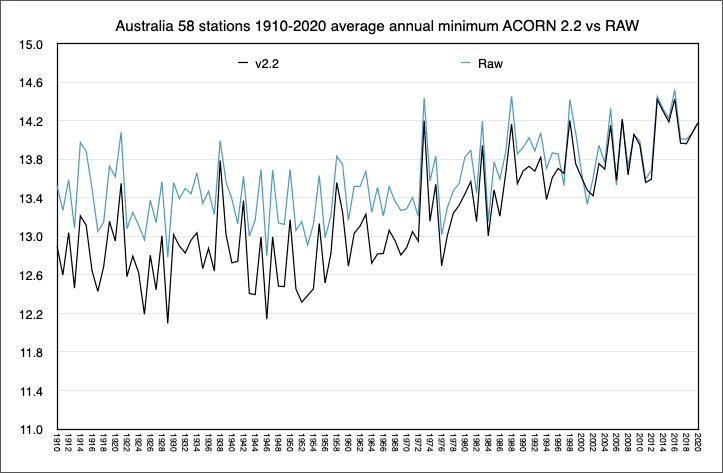
Chris Gillham plots the longest running stations from the ACORN 2.2 set against the old raw readings:Chris Gillham, ACORN 2.2 versus Raw Temperatures

Who knew all those old thermometers were so wrong?

Graham Lloyd:

Independent analysis of the latest changes show they added 0.06C to maximum warming and 0.11C to minimum warming from 1910-19 to 2010-19.

A series of updates to the ACORN data have added 0.228C mean temperature warming if comparing 1910-19 with 2010-17 (2017 being the final year of ACORN 1)

Clearly, the cheapest way to stop global warming would be to sack everyone at the BOM.

The Bureau admitted to Lloyd that they changed 25 sites in the latest round, most of them because of statistical revelations:

The bureau said changes were made to 20 sites on the basis of statistical analysis. According to the bureau, statistical analysis is used to identify an abrupt warming or cooling at a particular site, relative to other sites in the region.

The BOM refuses to tell us exactly how they do this — admitting that they can’t train anyone outside their sacred guild. Which reminds us of the old axiom, “if it can’t be replicated, it isn’t science”.

Apparently the future of life on Earth depends on their data, but it would take too long to train someone outside BOM to check it. Tell us again, how much does climate change matter?

Here’s the BOM explanation of the need for adjustments:

“A significant change relative to other sites indicates a non-­climatic driver, which sometimes has an easily identifiable cause (e.g. a new building near a site) and sometimes does not (often these will relate to local vegetation or land surface changes)”, the bureau said. “In carrying out this statistical analysis, the bureau uses 10 years’ worth of data from multiple sites to quantify the size of the change. Adjustments are only applied where a significant change has been identified.

So instead of researching the site history as deeply as they can, the BOM use statistical trickery analysis to figure out local site changes using some other thermometers “within a thousand miles”. What they don’t do is full historical research and documentation of the sites first. (Like the ones herehere and here, thanks Bill Johnston). So it’s possible that if, say, 10 sites got similar changes at the same time (like changing to a new small screen) the other better sites in non-changing screens could be slowly “corrected” one-by-one by the junkier sites with the right statistical algorithm. Now, perhaps the BOM have ways to make sure that doesn’t happen — but they won’t tell us what they are, they don’t publish the detailed documentation of either the full site histories or the methods they use to correct them.

As Chris Gillham notes, the BOM say the new adjustments didn’t change the long term trend. But a lot of little changes in the same direction would. The new adjustments might have also made a few local hottest ever headlines much easier to get. Suddenly the modern contenders for the longest heatwave, warmest night, and hottest summer all got a head-start.

The mysterious process of homogenization

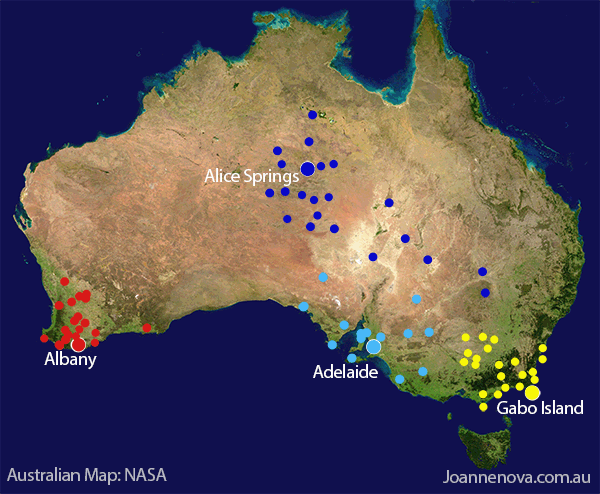
The Bureau “homogenizes” a site according to a mystical method that uses an inexplicable group of sites that are in the same region, or at least in Australia somewhere. For example, lighthouse readings off the Bass Strait have been corrected with help from Hay, 600 kilometers away, on the other side of the Great Dividing Range. A thermometer in Ballarat has been used to correct one at Bruny Island off the South coast of Tasmania.  The BOM has also corrected Alice Springs using measurements in Collarenabri nearly 1,600 kilometers away. (Thanks to Ken Stewart for that tip). When I said “a thousand miles” I wasn’t joking.Australian BOM, Bureau of Meteorology, homogenisation of sites. Map.

All the sites marked in black, for example, have been used to homogenize Alice Springs

The Sad State of Science

Science, as it is popularly understood, is in a parlous state. Politics and activists have captured important areas of research such as climate science and virology. People make stuff up and rely on dodgy computer “models” to make apocalyptic predictions, and nobody is ever held to account.

Now we have major science journals publishing mountains of computer-generated gibberish. So much for peer review.

Jo Nova writes:

Sea level height based on aerobics and other gibberish published in top science journals

Nature and Elsevier are agog and aghast that hundreds of junk papers filled with random word salad have been published in their esteemed journals.

It’s as bad as it sounds — one retracted title was: “‘Sea level height based on big data of Internet of Things and aerobics teaching in coastal areas’. “

They are shocked that  scammers who were “organised” and “sophisticated” found tricks to get published — wait for it — not just by hyping up, adjusting and exaggerating their cherry-picked papers and incompetent models, but with nothing more than fake e-mails “with ‘univ’ instead of ‘uni’ and ‘-ac.uk’ instead of ‘.ac.uk’”. That’s right, the highest and most intellectual “peer review” journals in the world have such inadequate, nonexistent standards, that not only do they fail to weed out weak papers, they couldn’t even defend themselves against randomized nonsense coming from fake professors with dodgy emails.

In other words, no one who matters even reads the papers before they are published.

Indeed, no one even read the titles…

Scammers impersonate guest editors to get sham papers published

Nature

Hundreds of articles published in peer-reviewed journals are being retracted after scammers exploited the processes for publishing special issues to get poor-quality papers — sometimes consisting of complete gibberish — into established journals. In some cases, fraudsters posed as scientists and offered to guest-edit issues that they then filled with sham papers.

Elsevier is withdrawing 165 articles currently in press and plans to retract 300 more that have been published as part of 6 special issues in one of its journals, and Springer Nature is retracting 62 articles published in a special issue of one journal. The retractions come after the publishers each issued expressions of concern earlier this year, covering hundreds of articles.

Guillaume Cabanac,  a computer scientist who uncovered nonsense papers, was shocked:

…it is shocking to see such papers in journals from ‘flagship’ publishers and that “it is not only predatory journals that publish bullshit”.

The papers are computer generated junk:

 71 articles have abstracts or titles that contain the words ‘dance’, ‘aerobics’ or ‘sports’ in relation to geoscience, including the articles ‘Sea level height based on big data of Internet of Things and aerobics teaching in coastal areas’ and ‘Rock stress and deformation characteristics based on SVM and sports high-intensity interval training’.

And it’s all happened before — in 2014 at least 120 papers were “computer generated nonsense” and were published and later retracted. It’s emblematic of the entire academic sector really. An industry using AI to produce nothing, discover nothing, get published, and then write papers about it?

So who benefits?

But the scammers’ motivations remain a mystery to Ivan Oransky, a journalist who runs Retraction Watch. Even the article titles, which would be listed as part of an individual’s publication record, often do not make sense, he says. “The papers are so obviously terrible, so why would you want them on your CV?”

Many of the papers were from authors based at Chinese institutions, and most contained nonsensical phrases that Elsevier thinks came from the use of reverse-translation software to disguise plagiarism.

Perhaps Western professors are trying to plump out their bio’s with statements about “publishing 412 Nature papers” and just paid a paper-scam generator in China. But who’d really want their name on papers like these? These papers are so bad, they look like the hoax papers done purposely to expose the rot in academia.Will a team appear next week admitting the papers were faked to test the system? Or are there just too many incentives for Chinese or other academics to “publish or perish”?

Either way, Western Civilization is paying tillions of dollars to change the weather based on “The Science” according to peer review — which appears to have no more intellectual prowess than a Nigerian 419 email scam.

Peer review is anonymous and unpaid and worth every cent.

SCIENCE: Warming Not Due To Carbon Dioxide

This is a pretty technical article, but the bottom line is this. Nearly all of the warming seen this century is due to a reduction in cloud cover NOT by carbon dioxide or other human causes. Of course, the renewable energy and emissions reductions band wagon was never about science.

From Watts Up With That:

2001-2019 Warming Driven By Increases In Absorbed Solar Radiation, Not Human Emissions

7 hours agoGuest Blogger94 Comments

Reposted from the NoTricksZone

By Kenneth Richard on 18. October 2021

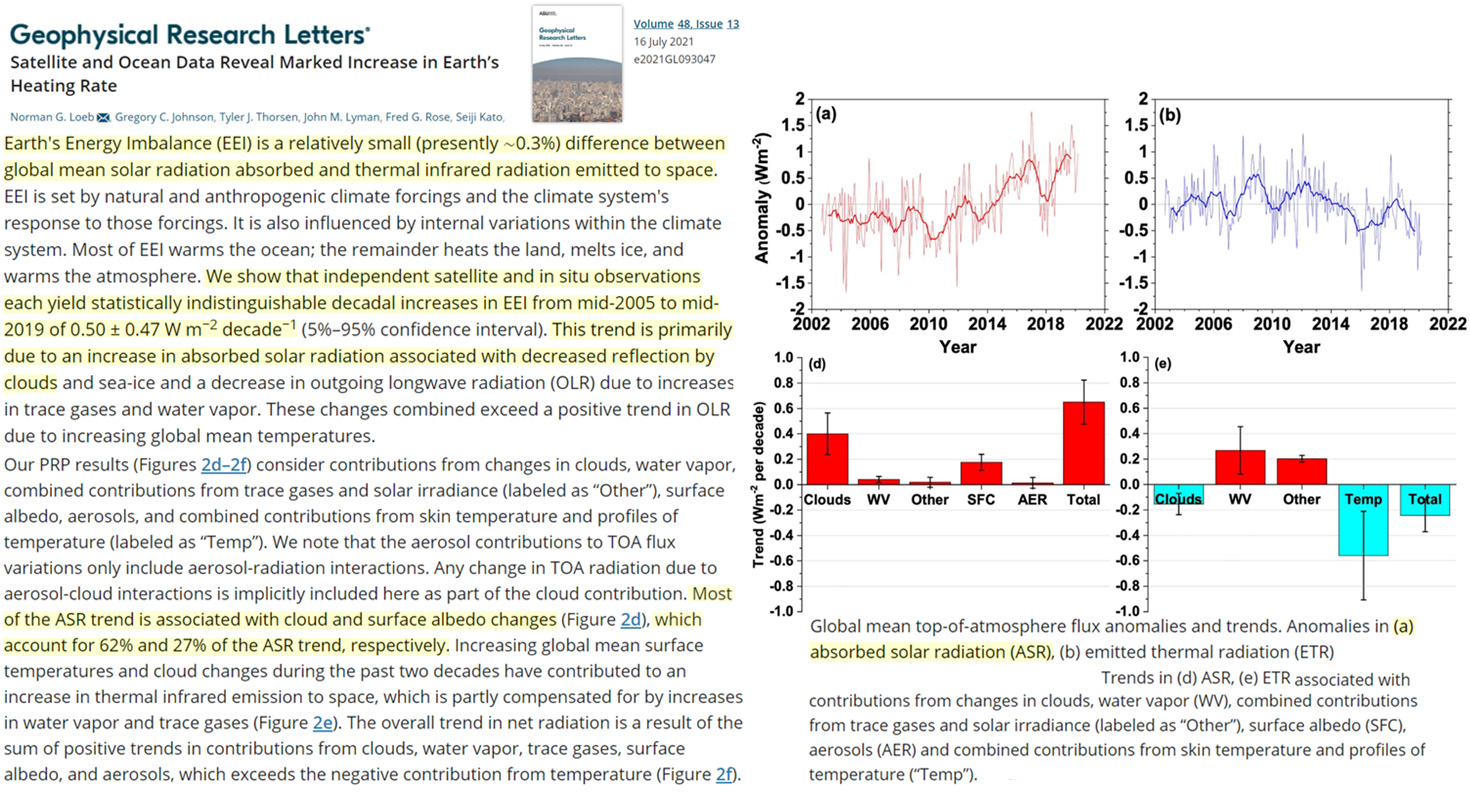
Three new studies affirm the increase in absorbed solar radiation associated with decreased reflection by clouds (albedo) has been the “root cause” of the positive Earth Energy Imbalance and global warming since the early 2000s.

Scientists (Loeb et al., 2021) have determined the rather uncertain positive trend in Earth’s Energy Imbalance (EEI) from 2005 to 2019, 0.5 W/m² ±0.47 W/m² per decade−1, is “primarily due to an increase in absorbed solar radiation associated with decreased reflection by clouds.”

CERES satellite data indicate clouds and surface albedo account for 89% of the absorbed solar radiation trend in the 21st century, whereas anthropogenic greenhouse gases account for but a tiny fraction of the trends in combined absorbed solar radiation and greenhouse effect forcing (reductions in emitted thermal radiation) during this period.

This very small human emissions/greenhouse gas impact is represented by the red “Other” (“trace gases”) bars in the graph below. In emitted thermal radiation, graph (e) shows the greenhouse gas impact is effectively offset by the cloud influence; both factors are cancelled out by temperature changes. This leaves the increase in absorbed solar radiation shown in graph (d) due to natural variations in clouds and surface albedo (SFC) as the primary driver(s) of top-of-atmosphere (TOA) flux forcing during the last two decades.

Image Source: Loeb et al., 2021

Other scientists (Dübal and Vahrenholt, 2021) have also concluded that the positive TOA net flux (+1.42 W/m²) from increasing downwelling shortwave (SW) facilitated by a drop in cloudiness has been the “major driving effect,” “dominating influence,” and “major heating cause” explaining the 2001-2019 ocean heat content increase (240 ZJ).

The authors note these CERES satellite observations “conflict with the assumption further global warming originates mainly from the LW [longwave] radiation capture caused by greenhouse gases, i.e., a decline in outgoing LW.” In fact, the LW or greenhouse effect impact has been negative; it has contributed a net cooling influence (-1.1 W/m²) over the last two decades.

Image Source: Dübal and Vahrenholt, 2021

The summarizing text from another new study (Ollila, 2021) bluntly asserts the substantial increase in downwelling SW radiation from 2000-2019 demonstrates “there are natural climate drivers that have rapid and significant temperature impacts exceeding the anthropogenic drivers,” and that any temperature increase since 2015-’16 “cannot be due to anthropogenic reasons.”

Read the full article here

Jo Nova: South Pole has coldest winter ever, but it’s just “a blip”

Jo Nova points out something that the climate establishment, including the green media, doesn’t want you to hear.

South Pole has coldest winter ever, but it’s just “a blip”

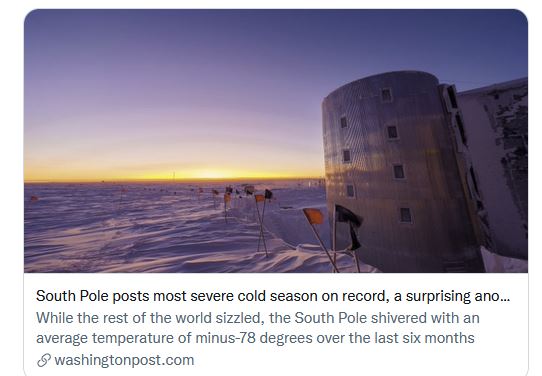
The sun has just risen on South Pole after the coldest six month period on record since 1956. The last winter there was suddenly 2.2 degrees Celsius colder than the average for the last 30 years.

Remember when Polar Amplification meant Antarctica was melting?South Pole Sunrise from the coldest winter ever.

Thanks to NoTricksZone

South Pole Sees Record Cold Winter, Smashing 1976 Record …“Chill Was Exceptional”

Jason Samenow and Kasha Patel, Washington Post

The chill was exceptional, even for the coldest location on the planet.

The average temperature at the Amundsen–Scott South Pole Station between April and September, a frigid minus-78 degrees (minus-61 Celsius), was the coldest on record, dating back to 1957. This was 4.5 degrees lower than the most recent 30-year average at this remote station, which is operated by United States Antarctic Program and administered by the National Science Foundation.

One hot weekend in Miami is Climate change but the coldest six months in Antarctic records is a blip:

While impressive and unexpected, scientists characterized this record as a mere blip and curiosity as both Antarctica and the planet continue to rapidly warm amid escalating extreme weather.

Antarctica has been cooling for a thousand years (or maybe 2,000). That’s a long blip.

Cooling for a thousand years.

Climate change has been making Antarctic summers cooler too. Blips are everywhere.

Surface Air temperature over East Antarctica (presumably in summer) from Hsu et al 2021.

And the ocean around Antarctica is cooler too:

The extreme cold over Antarctica helped push sea ice levels surrounding the continent to their fifth-highest level on record in August, according to the National Snow and Ice Data Center.

As usual, scientists didn’t predict the record cold — but they knew why it happened:

“Basically, the winds in the polar stratosphere have been stronger than normal, which is associated with shifting the jet stream toward the pole,” Amy Butler, an atmospheric scientist at NOAA, wrote in a message. “This keeps the cold air locked up over much of Antarctica.”

No climate story is complete without the cult litany:

Scientists stressed that the record cold over the South Pole in no way refutes or lessens the seriousness of global warming. Antarctica is notorious for its wild swings in weather and climate, which can run counter to global trends.

At minus 60C even the planes don’t go:

Matthew Lazzara, Antarctic scientist said “At these temperatures, it is difficult to operate aircraft,” he wrote in an email. “[B]etween -50°C and -58°C you put the aircraft at risk with the hydraulics freezing up or fuel turning into a jelly.”

Click here to read the full article

Great Barrier Reef growing at record rate

Jo Nova writes:

What climate disaster? The Great Barrier Reef has more coral growing on it than ever recorded

The coral cover as sampled by AIMS across the entire Great Barrier Reef is not just good, but better than it has ever been in the 36 years they have been studying it. If the reef is in danger — it’s from being overgrown with coral. Climate Change, such as it is, has caused no trend at all.

If anything, in the spirit of modern-media-science, climate change causes record coral growth.

Tonight the UN scientists decided not to list the reef as “in danger”. The ABC and every Green group who normally follow UN scientists slavishly said that was “only because of lobbying”.

Record Coral Cover on the Great Barrier Reef.

The new AIMS report on Monday showed the Great Barrier Reef had a remarkable recovery, but the graphs were of three different sections of the reef (North, central and South). Peter Ridd obtained all the data and combined it to make one graph and discovered that the coral cover of 2020 was a new all time record high.

Strangely none of the government agencies or paid Professors discovered this. You have to be unemployed to discover record coral growth.

Science and media doomsayers ignore good news on reef

Peter Ridd, (The Professor that JCU sacked for being “non-collegial”) The Australian

Like all other data on the reef, this shows it is in robust health. For example, coral growth rates have, if anything, increased over the past 100 years and measurements of farm pesticides reaching the reef show levels so low that they cannot be detected with the most ultra-sensitive equipment.

This data is good news. It could hardly be better. But somehow, our science organisations have convinced the world that the reef is on its last legs. How has this happened?

The only thing the reef is plagued with is “experts”:

It was reasonable in the ’70s to be concerned about these plagues and they ultimately precipitated AIMS’s long-term monitoring of coral and starfish in the ’80s. I was working at AIMS when this important work started, and it is interesting to look back on what has changed. The coral cover is no less, the number of starfish is no more, but the number of scientists and managers working on the reef has exploded. Perhaps this is the problem.

Record coral cover means there was no disaster on the reef. The only disaster is the quality assurance at the science organisations.

In the last few hours the Great Barrier Reef barely escaped being labeled as “in danger” by a branch of the China-friendly-UN. Instead UNESCO will leave it at “critical” and decide again in a year if the 340,000 square kilometer reef is in danger of turning into a calcium-carbonate quarry.

The Australian ABC has already decided this was only because the Minister played games and pulled some tricks on a “whirlwind diplomatic effort” to override the UN body’s scientific advisors. Apparently the science advisors of the UN are so corrupt they can be bought off with a few rushed phone calls from a minor Australian minister, but these same advisors would never be influenced by the giant Chinese Communists with their billion dollar Belt and Roads, debts and honeypot traps.

Remember the UN experts are always right except when they’re not.

But China still wins this round of sabre rattling. By leaning on the UN to tell Australia off, the Australian government is still  tying itself in knots and spending millions to save a reef that has already saved itself.

We’ll have to hand in our homework report again as soon as February 2022. And the hack-media are not reporting on why UNESCO don’t care about China’s concrete-the-reef approach.

Greenpeace et al, who would have told us how horrified they were if the reef was listed as “in danger”, said they were disappointed it was not.

UNESCO would not get away with these absurdly transparent games if the Western media and most universities did not provide continuous running cover for their hypocrisy.

REFERENCE

The Australian Institute of Marine Science’s (AIMS) Long-Term Monitoring Program – Annual Summary Report on Coral Reef Condition for 2020/21

Latest Great Barrier Reef Condition Report

The Reality Of Green EVs

From wattsupwiththat.com

I especially like the part about Scotland cutting down 1.4 million trees to make way for wind farms. Way to go, Scotland!

For 40% Of The EU And US To Drive EVs, 56,000-70,000 Km² Of Land Must Be Cleared For Wind Turbines

By Kenneth Richard on 15. July 2021

A new study warns that “a massive expansion of impervious surfaces” is an inevitable consequence of having electric vehicles reach a 40% share of citizens’ driving needs.  A land area the size of Croatia (in the European Union) or West Virginia (in the United States) must be completely covered with wind turbines to meet EV-charging energy demands for 4 of every 10 vehicles.

The already-weak power capacity of wind turbines, 0.5 We m² on average, will only continue to diminish as more wind farms are added to the landscape (Miller and Keith, 2018).

Consequently, the land area that must be devoted to the erection of wind turbines to meet the ever-growing energy needs of Earth’s citizens is harrowing.

Consider the US. Electricity generation only accounts for 17% of the US’s primary energy consumption. For wind energy to supply all the electricity needs for US citizens, a land area the size of California – 12 percent of the contiguous US – must be cleared to make way for wind farms (Miller and Keith, 2018). Again, that’s to meet just 1/6th of Americans’ energy needs.

Image Source: Miller and Keith, 2018

In Scotland, 14 million CO2-absorbing trees were recently chopped down to make way for wind farms. This way the Scottish government can ironically claim they’re doing their part to reduce CO2 emissions.

And now a new study documents how much more land must be converted to impervious surface so that new wind farms can supply the electricity to charge an exponentially-growing number of EVs in the coming decades.

“In order to run 40% of their vehicles with electricity, the EU should devote over 5000 km² of land (twice the size of Luxembourg) to photovoltaic panels or almost 56,000 km² (about the size of Croatia) to wind turbines, whereas the US should devote over 6000 km² (roughly the size of Delaware) to solar or almost 70,000 km² (more than the area of West Virginia) to wind.”

Image Source: Orsi, 2021

Put another way, an average EU or US city will need to expand its urbanized area by 0.2 to 4 km² due to dramatically rising number of EVs using low-density wind and solar energy to supply electricity.

And this is green?

Reef Fish Not Affected by Ocean “Acidification”

Photo by David Clode on Unsplash

A few years back there was an alarming study out of James cook University claiming that the gradual decrease in ocean pH caused by higher levels of CO2 in the atmosphere caused fish to radically change their behaviour.

A new study says this is not true.

From wattsupwiththat.com

James Cook University Researchers Refuted: “Ocean Acidification Does not Impair” Fish behaviour

Lower ocean pH level affecting fish?

Earlier research beginning in 2009 by Prof. Philip Munday and Danielle Dixon of Australia’s James Cook University suggested that that “ocean acidification” was having dire effects on fish behavior, thus prompting the IPCC to claim in a 2014 report that it could lead to  “profound consequences for marine diversity” and the media to put out a series of climate doomsday reports.

But the alarming research results of Munday and Dixon have since been seriously challenged by a group led by fish physiologist Timothy Clark of Deakin University in Geelong, Australia in a recent paper:

A year ago the researchers published the results of a comprehensive 3-year study in the journal of Nature in a paper titled: “Ocean acidification does not impair the behaviour of coral reef fishes“.

The paper’s abstract:

Coral reef fishes are predicted to be especially susceptible to end-of-century ocean acidification on the basis of several high-profile papers4,5 that have reported profound behavioural and sensory impairments—for example, complete attraction to the chemical cues of predators under conditions of ocean acidification. Here, we comprehensively and transparently show that—in contrast to previous studies—end-of-century ocean acidification levels have negligible effects on important behaviours of coral reef fishes, such as the avoidance of chemical cues from predators, fish activity levels and behavioural lateralization (left–right turning preference). Using data simulations, we additionally show that the large effect sizes and small within-group variances that have been reported in several previous studies are highly improbable. Together, our findings indicate that the reported effects of ocean acidification on the behaviour of coral reef fishes are not reproducible, suggesting that behavioural perturbations will not be a major consequence for coral reef fishes in high CO2 oceans.”

Die kalte Sonne reports on the new findings, noting that Clark et al repeated the trials by Munday and were unable to reproduce the results:

A team of seven scientists led by Timothy Clark of the Australian Deakin University published in  the renowned journal Nature an analysis with devastating criticism of the dramatic scenarios of the Munday group.” […]

“The group of critics also expect no negative consequences in the behaviour of the coral fish also at high levels of CO2 at the end of the 21st century.”

The James Cook University however, denies sloppy science was done by Munday and his team of scientists.

The James Cook University has been caught up in controversy, especially over the firing of researcher Prof. Dr. Peter Ridd, who claims he was sacked for expressing unpopular views.

Also read more on Munday’s controversial research here.

Healthy Polar Bears and Thriving Tigers: The Common Climate Tale

From cornwallalliance.org

by Vijay Jayaraj and E. Calvin Beisner

Last year, the world applauded Greta Thunberg’s emotional “How Dare You!” speech at the UN summit in New York. The teenager famously said, “Entire ecosystems are collapsing. We are in the beginning of a mass extinction.”

The mainstream media’s narrative is similar. Ecosystems are dying. Animals are going extinct. Our evil desire to consume fossil fuels is to blame!

What do you think? Are species going extinct because of manmade global warming? Christians, who honor God as Creator, should care about these matters. But caring by itself isn’t enough. We also need truth, for there is a way that seems right, though its end brings death (Proverbs 14:12).

Take two key species as examples. Polar bears have been climate alarmists’ mascots for years. Tigers are an important species in South Asian jungles.

Tigers: No Longer Crouching

To the dismay of climate doomsayers, tiger populations are on the rise!

Tigers are a keystone species. The integrity of their ecosystems is crucial to their welfare. Thriving tiger populations are evidence of healthy ecosystems.

So, what do you suppose is up with tigers?

India’s tiger numbers have doubled since 2006. That’s despite the country’s ever-expanding cities, industries, and mines. India counted 2967 tigers in its latest census. That is more than double the number in 2006.

Celebrating International Tiger Day, Indian Environment Minister Prakash Javadekar noted that “the country today has 70 percent of the world’s tiger population.”

Two-thirds of these tigers live in forest zones categorized as tiger reserves. The remaining third is a testament to the safe habitations outside highly protected zones.

Recent surveys affirm the healthy state of Indian forests on which tigers depend. Total forest and tree cover in India increased by 5,188 square km from 2017 to 2019. I witnessed the health of these ecosystems as a field ecologist in the buffer zones of a tiger reserve in the heart of India.

The primary concern of tiger conservationists in India is unlawful encroachment, not climate change. Climate change in the past decade has impacted tiger populations positively.

Tropical forest ecosystems in India are not dying. They remain healthy and are expanding. Tiger numbers benefit.

Read the rest of the article here

Germany Weighs Electricity Rationing Scheme To Stabilise Its Now Shaky Green Power Grid

Germany is a warning of where Australia will be in 10 years or less, unless we regain some sanity in electricity production.

From wattsupwiththat.com.

Germany Weighs Electricity Rationing Scheme To Stabilise Its Now Shaky Green Power Grid

Putting matches in charge of fighting gasoline fires?

Even more interference appears to be the German government’s approach to solving the power grid mess that its earlier meddling created in the first place.

Germany struggles to keep the lights on, looks for a law to prevent its power grid from crashing. 

Before the days of climate alarmism and hysteria, the job of deciding how to best produce electricity was left to power generation engineers and experts – people who actually understood it. The result: Germany had one of the most stable and reliable power grids worldwide.

Green energies destabilized the German power grid

Then in the 1990s, environmental activists, politicians, climate alarmists and pseudo-experts decided they could do a better job at generating power in Germany and eventually passed the outlandish EEG green energy feed-in act and rules. They insisted that wildly fluctuating, intermittent power supplies could be managed easily, and done so at a low cost.

Blackouts threaten

Fast forward to today: The result of all the government meddling is becoming glaringly clear: the country now finds itself on the verge of blackouts due to grid instability, has the highest electricity prices in the world, relies more on imports and is not even close to meeting its emissions targets.

Germany’s rickety and moody power grid now threatens the entire European power grid stability, as we recently witnessed.

The need for “smoothing out” demand peaks

So what solution does Berlin propose today? You guessed it: more meddling and interference, more outlandish bureaucrat solutions. Included among them are shutting down the remaining baseload coal-fired and nuclear power plants, and relying even more on the power sources that got the country into its current mess in the first place.

And new are restrictions as to when power can be consumed by consumers and industry! Energy rationing and targeted blackouts.

Hat-tip. Tichys Einblick

Cutting off e-vehicle battery chargers and industry

To deal with the power grid problems, Germany’s Economics Minister Peter Altmaier presented a draft law that would allow electric utilities “to temporarily cut off charging power for e-cars when there is once again too little electricity available”, an idea known as “peak smoothing”.

“Shutdowns due to power shortages have been practiced for some time. Aluminum smelters, for example, have to put up with having their power cut off for limited periods of time,” reports Tichys Einblick. “These, like refrigerated storage facilities, consume great amounts. It’s a dangerous game because after three hours the molten metal has solidified and the factory is ruined.”

Situation now “too critical”

The situation in the German power grid has deteriorated so much that Tichys Einblick also comments: “The situation in the power grids has become too critical. The only thing that helps are abstruse ideas like: ‘You are not allowed to refuel your car from 10 a.m. to 8 p.m. every day!’”

A law that would allow for “peak smoothing” has been demanded by power utilities for some time now as they struggle to keep the increasingly wind and solar powered grid from careening out of control and into blackness. In other words: targeted blackouts.

And as Tichy Einblick mentions, the increasing number of cars on the market will only serve to cause more extreme power demand peaks. Currently Germany is set to make a major push into electric mobility this year.

No electricity for up to 2 hours a day

In the proposed draft law, which has since been recalled because it was deemed so embarrassing, it was written that “controllable consumption facilities” would be able to receive no electricity for up to two hours per day if there was a threat of overloading the grid.

“This includes charging stations for e-cars as well as heat pumps, which can already be temporarily disconnected from the power supply,” reports Tichy.

More burden on power grid

Currently there are only 33,000 electric car charging points in Germany, a country with over 50 million cars, and the government plans a vast expansion in the future, yet isn’t sure what that infrastructure should look like. It’s a policy of going  full speed in total blackness and hoping there won’t be a brick wall in the way.

Government admits it’s not going to function

Tichy comments further: “The German government has recognized that in the future electricity system, it will no longer be possible to satisfy every demand at all times. Therefore, the control of the consumer side should be put on legal feet.” […] “Controllable consumers such as heat pumps, electric heaters and wall-boxes, i.e. charging stations for e-mobiles, would then be switched off variably at times.”

This is the sorry state of Germany’s once highly regarded power grid.