Jennifer Marohasy: Coral Snapshot 2022-23, & All the Unanswered Questions

From the IPA
ORIGINALLY APPEARED IN JENNIFER MAROHASY’S WEBSITE

Full marks to David Mills, writing in the Courier Mail, for asking why the government tends to bury good news reports about the Great Barrier Reef.

There are a few other questions that I would like answered.

Key government ministers, marine scientists, and climate scientists have been unable to acknowledge:

Q1. Overall coral cover has been increasing since at least 2009 (14 years).

Q2. According to official underwater surveys – that are perimeter surveys – coral cover is at a record high.

I know Sky Television legend Rowan Dean has been in trouble with the press watchdog over this good news claim. But it seems pretty straightforward, quoting from the most recent relevant government report:

Widespread recovery has led to the highest coral cover recorded by the Long-Term Monitoring Program in the Northern and Central Great Barrier Reef …

Q3. These perimeter surveys under estimate coral cover, claiming it to be less than 40%, when coral cover is often more than 90% at the crest of the same reef.

Corals around the outside/perimeter of reefs are particularly susceptible to cyclone damage.

The official surveys of coral cover are somewhat misleading because the survey is done of just one habitat type, the reef perimeter. Most of the coral is at the reef crest. The survey of John Brewer reef followed the track shown by the yellow, orange and green lines.
 

Q4. The number and intensity of cyclones has been decreasing since at least the 1970s. Something the Bureau of Meteorology is unable to acknowledge. Why?

Read the rest of the article here

Jo Nova: Corals On The Nullarbor

Jo Nova reports the astounding find of corals way above current sea levels. Maybe we could restore those coal fired power stations, burn some fossil fuels and restore the reef.

Corals covered the Australian desert once – maybe they’ll grow back if we screw in the right light globes?

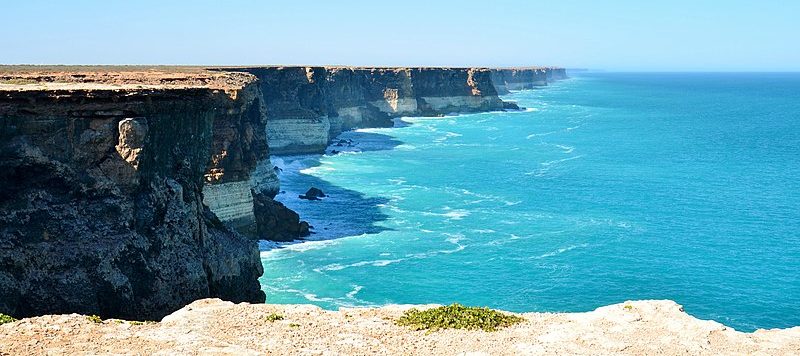
The remnants of a long gone coral reef are not in the water here, but on top of the cliff. This is what real climate change looks like:

Bunda Cliffs, Nullarbor, Great Australian Bight. Photo.

The whole coral reef is now 100 m out of the water | Bahnfrend |

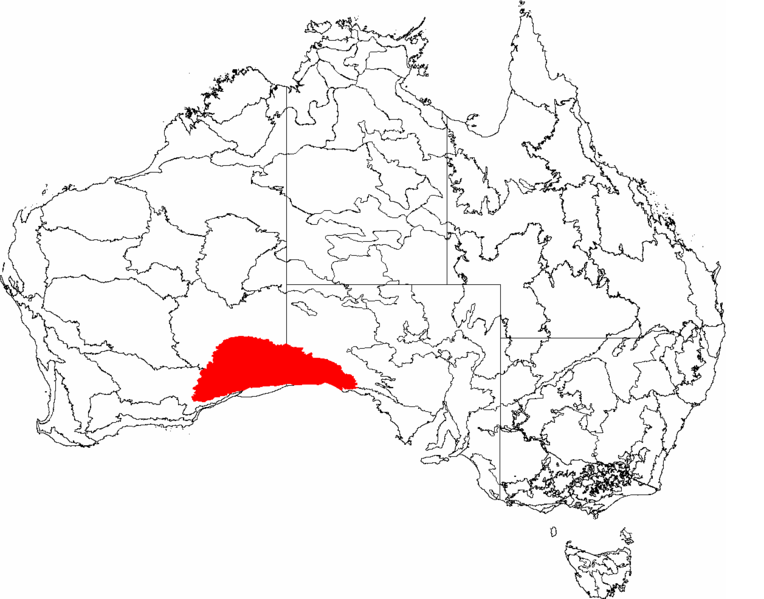
Nullabor plain map. Australia

The Nullabor Plain.

It turns out the high plateau desert called the Nullarbor was once a coral reef. It’s a thousand kilometer stretch without a tree that’s now about 100m above sea level. Obviously it’s a wilderness that’s begging to be restored to its true Miocene glory. The question is whether we can put on enough solar panels to save this reef, or if we can melt the Antarctic and raise the oceans…

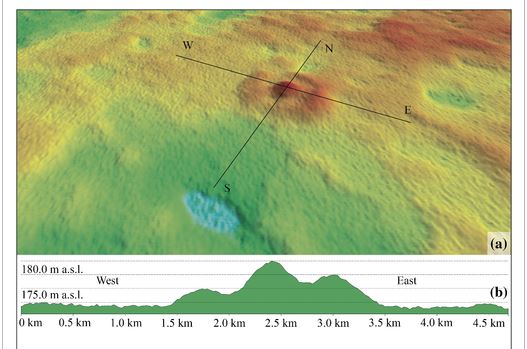
Researchers looking at satellite images spotted a suspicious looking dome and ring (below) . They figured out it was not a meteor crater but probably a former coral atoll. It’s about one kilometer across and corals built this (probably) 14 million years ago. Tectonic shifts lifted the land out of the ocean. If only the polyps had put in a carbon tax?

The Nullarbor is a bit special because the surface is well preserved. There is not a lot of rain, no rivers to speak of, humidity is low, storm surges don’t wash over it and sediments don’t settle on it. Plus the nearest glaciers are in New Zealand.

““So even though it’s exposed, it’s kind of like a land that time forgot … the erosion is so slow, [these features] get preserved for millions and millions of years, kind of capturing a snapshot of how environments were at different times.” —WA Today

Coral Dome, remnant, Nullabor Australia

Coral Dome, remnant, Nullabor Australia

Once fish frolicked in the afternoon sun among the anenome here. Now there is saltbush.

This is the kind of climate change we need to teach children at schools. Geological, not Gretalogical.

Imagine the effect if students knew almost nothing was permanent, life was adaptable, and the climate changed all the time.

Coral reef nullabor

The remnants of a 14 million year old reef

ScienceAlert:

Mysterious Reef From Millions of Years Ago Discovered in Vast Australian Desert

Most of Australia is now arid and dry, with vast inland deserts. Millions of years ago, though, during the Miocene, the continent was teeming with life; not just dense, thriving forest ecosystems, but huge inland seas.

“Through high-resolution satellite imagery and fieldwork we have identified the clear remnant of an original sea-bed structure preserved for millions of years, which is the first of this kind of landform discovered on the Nullarbor Plain,” says geologist Milo Barham of Curtin University in Australia.

The ocean that covered the Nullarbor started to dry up around 14 million years ago, exposing the shallow-water limestones deposited during the middle Cenozoic.

That means the Nullarbor is effectively a clean record of geological processes and features dating back to the Miocene.

“Evidence of the channels of long-vanished rivers, as well as sand dune systems imprinted directly into limestone, preserve an archive of ancient landscapes and even a record of the prevailing winds,” Barham says.

“And it is not only landscapes. Isolated cave shafts punctuating the Nullarbor Plain preserve mummified remains of Tasmanian tigers and complete skeletons of long-extinct wonders such as Thylacoleo, the marsupial lion.”

That’s not all. “At the surface,” adds Barham, “due to the relatively stable conditions, the Nullarbor Plain has preserved large quantities of meteorites, allowing us to peer back through time to the origins of our Solar System.”

REFERENCE

Lipar et al (2022) Enigmatic annular landform on a Miocene planar karst surface, Nullarbor Plain, Australia,  Earth Surface Processes and Landforms.  https://doi.org/10.1002/esp.5459

Coral Reefs Can Take The Heat, Unlike Experts Crying Wolf

Interesting article from reef scientist Peter Ridd about why coral bleaching is not the disaster some would have you believe. From Watts Up With That


Coral Reefs Can Take The Heat, Unlike Experts Crying Wolf

  • Date: 26/12/18
  • Peter Ridd, The Australian

This unreliability of the science is now a widely accepted scandal in many other areas of study and it has a name: the replication crisis. When checks are made to replicate or confirm scientific results, it is regularly found that about half have flaws.

Scientists from James Cook University have just published a paper on the bleaching and death of corals on the Great Barrier Reef and were surprised that the death rate was less than they expected, because of the adaptability of corals to changing temperatures.

It appears as though they exaggerated their original claims and are quietly backtracking.

To misquote Oscar Wilde, to exaggerate once is a misfortune, to do it twice looks careless, but to do it repeatedly looks like unforgivable systemic unreliability by some of our major science organisations.

The very rapid adaptation of corals to high temperatures is a well-known phenomenon; besides, if you heat corals in a given year, they tend to be less susceptible in the future to overheating. This is why corals are one of the least likely species to be affected by climate change, irrespective of whether you believe the climate is changing by natural fluctuations or because of human influence.

Corals have a unique way of dealing with changing temperature, by changing the microscopic plants that live inside them. These microscopic plants, called zooxanthellae, give the coral energy from the sun through photosynthesis in exchange for a comfortable home inside the coral. When the water gets hot, these little plants effectively become poisonous to the coral and the coral throws them out, which turns the coral white — that is, it bleaches.

But most of the time, the coral will recover from the bleaching. And here’s the trick: the corals take in new zooxanthellae, that floats around in the water quite naturally, and can selectselecting different species that are better suited to hot weather.

Most other organisms have to change their genetic make-up to deal with temperature changes — something that can take many generations. But corals can do it in a few weeks by just changing the plants that live in them.

They have learned a thing or two in a couple of hundred million years of evolution.

The problem here is that the world has been completely misled about the effects of bleaching by scientists who rarely mention the spectacular regrowth that occurs. For example, the 2016 bleaching event supposedly killed 93 per cent, or half, or 30 per cent of the reef, depending on which headline and scientist you want to believe.

However, the scientists looked only at coral in very shallow water — less than 2m below the surface — which is only a small fraction of all the coral, but by far the most susceptible to getting hot in the tropical sun.

A recent study found that deep-water coral (down to more than 40m) underwent far less bleaching, as one would expect. I estimate that less than 8 per cent of the Barrier Reef coral died. That might still sound like a lot, but considering that there was a 250 per cent increase in coral between 2011 and 2016 for the entire southern zone, an 8 per cent decrease is nothing to worry about. Coral recovers fast.

But this is just the tip of the exaggeration iceberg. Some very eminent scientists claim that bleaching never happened before the 1980s and is entirely a man-made phenomenon. This was always a ridiculous proposition.

A recent study of 400-year-old corals has found that bleaching has always occurred and is no more common now than in the past. Scientists have also claimed that there has been a 15 per cent reduction in the growth rate of corals. However, some colleagues and I demonstrated that there were ­serious errors in their work and that, if anything, there has been a slight increase in the coral growth rate over the past 100 years.

This is what one would expect in a gently warming climate. Corals grow up to twice as fast in the hotter water of Papua New Guinea and the northern Barrier Reef than in the southern reef. I could quote many more examples.

Read the full GWPF story  here.

Peter Ridd was, until fired this year, a physicist at James Cook University’s marine geophysical laboratory.