From Dave Walker
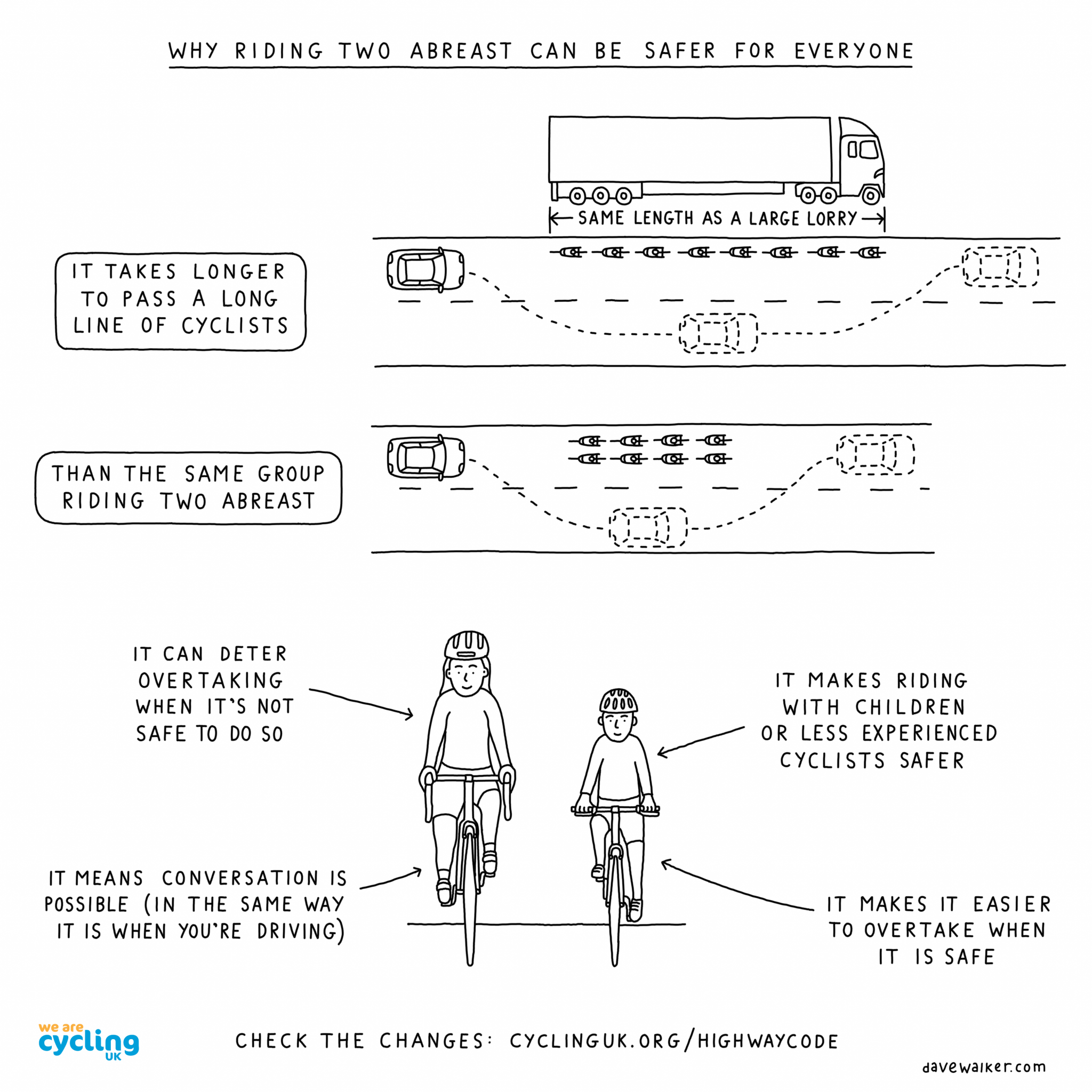
From Dave Walker
From the Conversation:
Research has consistently shown that people who are less physically active are both more likely to develop health problems like heart disease and type 2 diabetes, and to die younger. Yet there is increasing evidence that physical activity levels are on the decline.
The problem is that when there are many demands on our time, many people find prioritising exercise difficult. One answer is to multi-task by cycling or walking to work. We’ve just completed the largest ever study into how this affects your health.
Published in the British Medical Journal today, the results for cycling in particular have important implications. They suggest that councils and governments need to make it a top priority to encourage as many commuters to get on their bikes as possible.
Cycling or walking to work, sometimes referred to as active commuting, is not very common in the UK. Only 3% of commuters cycle to work and 11% walk, one of the lowest rates in Europe. At the other end of the scale, 43% of the Dutch and 30% of Danes cycle daily.
To get a better understanding of what the UK could be missing, we looked at 263,450 people with an average age of 53 who were either in paid employment or self-employed, and didn’t always work at home. Participants were asked whether they usually travelled to work by car, public transport, walking, cycling or a combination.
We then grouped our commuters into five categories: non-active (car/public transport); walking only; cycling (including some who also walked); mixed-mode walking (walking plus non-active); and mixed-mode cycling (cycling plus non-active, including some who also walked).
We followed people for around five years, counting the incidences of heart disease, cancers and death. Importantly, we adjusted for other health influences including sex, age, deprivation, ethnicity, smoking, body mass index, other types of physical activity, time spent sitting down and diet. Any potential differences in risk associated with road accidents is also accounted for in our analysis, while we excluded participants who had heart disease or cancer already.

We found that cycling to work was associated with a 41% lower risk of dying overall compared to commuting by car or public transport. Cycle commuters had a 52% lower risk of dying from heart disease and a 40% lower risk of dying from cancer. They also had 46% lower risk of developing heart disease and a 45% lower risk of developing cancer at all.
Walking to work was not associated with a lower risk of dying from all causes. Walkers did, however, have a 27% lower risk of heart disease and a 36% lower risk of dying from it.
The mixed-mode cyclists enjoyed a 24% lower risk of death from all causes, a 32% lower risk of developing cancer and a 36% lower risk of dying from cancer. They did not have a significantly lower risk of heart disease, however, while mixed-mode walkers did not have a significantly lower risk of any of the health outcomes we analysed.
For both cyclists and walkers, there was a trend for a greater lowering of risk in those who commuted longer distances. In addition, those who cycled part of the way to work still saw benefits – this is important as many people live too far from work to cycle the entire distance.
Read the full article at theconversation.com
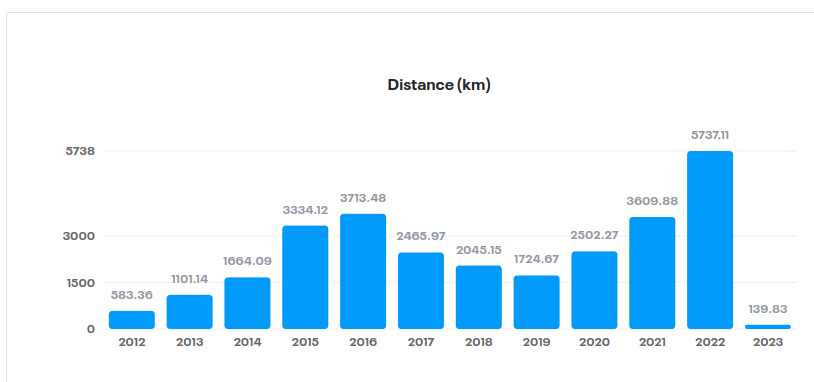
In 2022 I rode nearly 6,000 km, my biggest year on the bike ever.
This is about 1 1/2 times the road distance from Sydney to Perth.
Two lessons from this:
The last few days, I’ve been feeling a little off-colour and the bike hasn’t appealed.
Just uploaded 6 weeks worth of rides from #MapMyRide to #Strava and got all kinds of “Achievement” and “Local Legend” awards 😀
They know how to make you feel good about yourself!


From Forbes
A new study from the Danish Road Directorate shows that less than 5% of cyclists break traffic laws while riding yet 66% of motorists do so when driving. The Danish Cycling Embassy, a privately-funded NGO, puts this down to visibility: law breaking by cyclists is “easy to notice for everyone” but transgressions by motorists, such as speeding, are harder to spot.
The study was carried out for the Danish government by consulting firm Rambøll using video cameras sited at major junctions in Danish cities, including Copenhagen. It was found that just 4.9% of cyclists broke road rules when they were riding on cycleways. This rose to 14% of cyclists when there was no cycling infrastructure present. ( Want fewer scofflaw cyclists in your city? Install cycleways. )
The video cameras counted 28,579 cyclists crossing at intersections. The most frequently recorded transgression was bicycling on the sidewalk. Rule breaking by cyclists was twice as numerous in smaller cities which, in Denmark, have fewer cycleways. The new study had almost identical results to an earlier one carried out by the consulting firm Copenhagenize. This was also a video study and analysed the behaviour of 80,000 cyclists: it found that 5% broke traffic laws.
Read the full article here
Car Pooling For Bikes in Car Crazy L.A.
From Bloomberg.com
A UCLA project that uses an app to organize group rides aims to promote car-free transportation for Los Angeles residents.
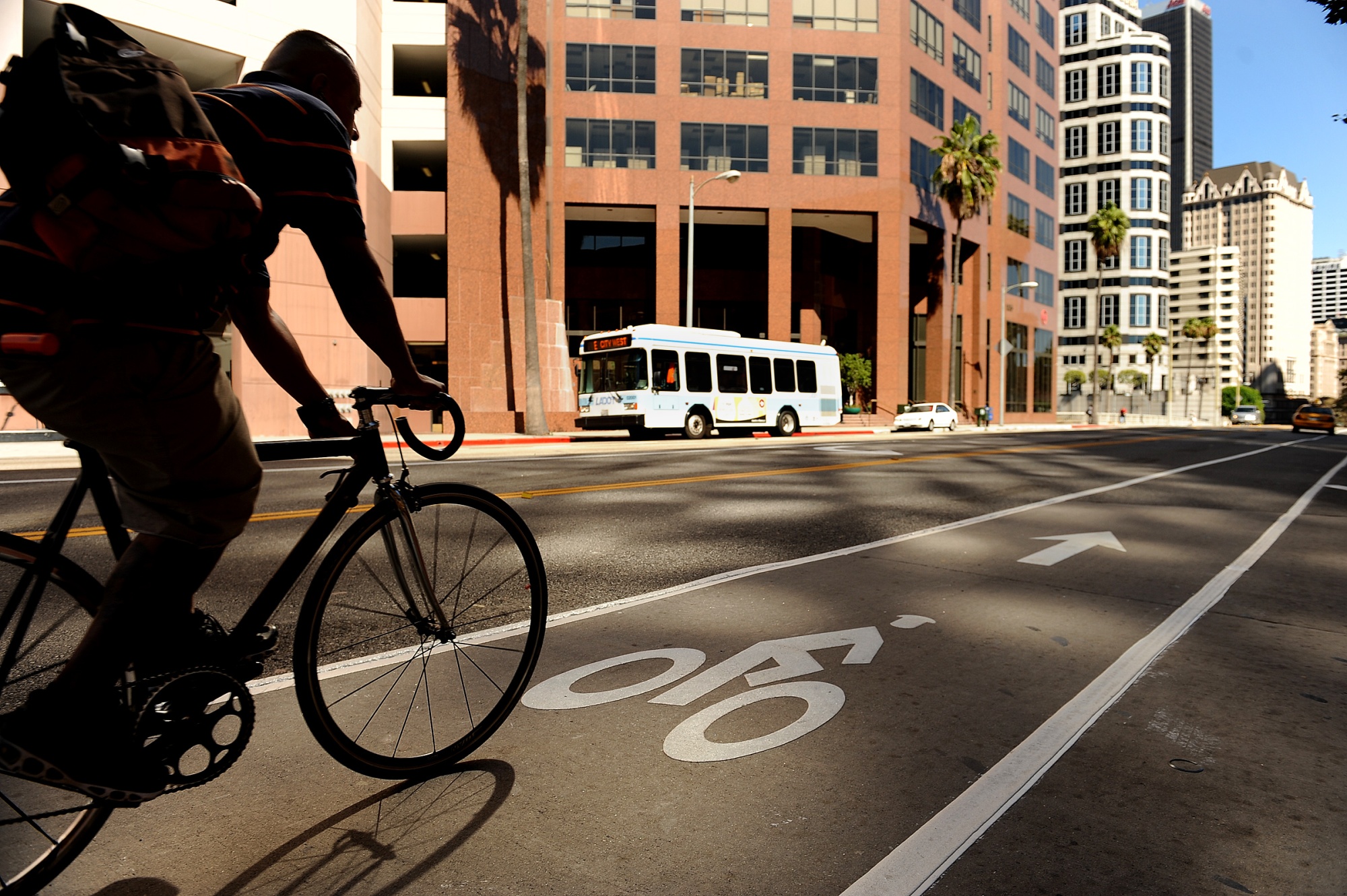
A bicyclist in downtown Los Angeles. Despite its agreeable climate, LA isn’t known as a welcoming city for bike commuters.
On paper, Los Angeles looks like bike commuter country: The sprawling LA basin boasts glorious year-round riding weather and generous expanses of largely flat streetscape.
But only about 1% of LA commuters get to work by bicycle, according to the US Census Bureau, a figure that reflects the challenges that riders face in a freeway-laden city that’s been optimized for the automobile. Protected bike lanes are rare, and the streets of Southern California are among the most dangerous for two-wheeled travelers. Between 2011 and 2020, 276 cyclists were killed in traffic in Los Angeles County — the most of any US county. In 2018, Bicycling Magazine declared LA the “Worst Bike City in America.”
To encourage more Angelenos to take to the streets by bike — and keep them safe there — a demonstration project set to launch this fall will encourage residents from low-income neighborhoods to bike to work in groups.
“It’s not just an informal group of cyclists — it’s a public transportation system based on bicycles,” said Fabian Wagmister, an associate professor at the University of California Los Angeles School of Theater, Film and Television and the founder and principal investigator of the Civic Bicycle Commuting research project, also known as CiBiC.
The concept is simple: Wagmister describes CiBiC as “carpooling, but on bikes.” In the pilot program set to start Oct. 1, users put their destination and arrival time in an app that determines the best route — or “flow” — to bring them to work. The app then pairs bike commuters with each other in groups of up to 12, known as a pod, led by two experts whose job is to prioritize safety on the road over efficiency.
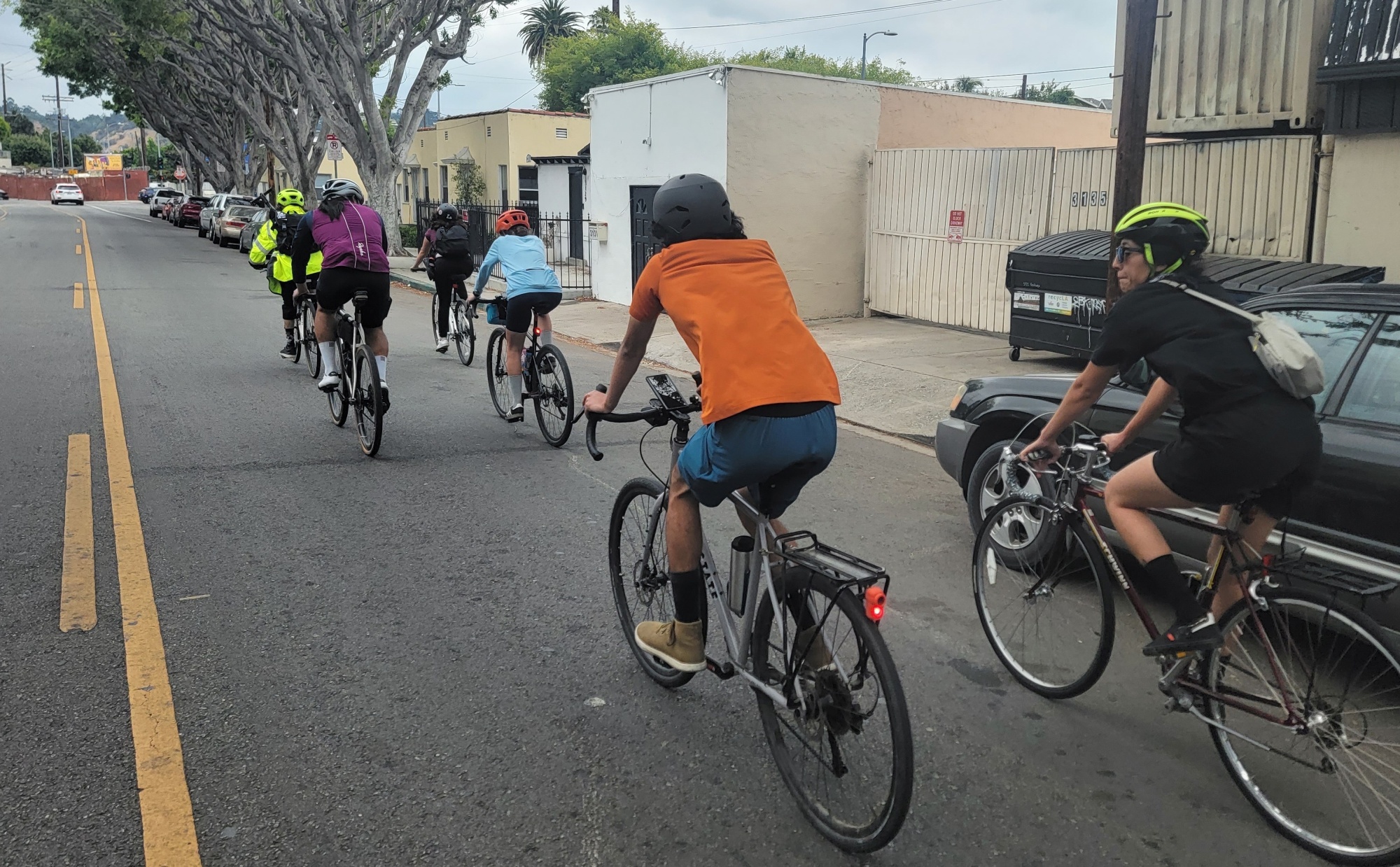
Bikepooling, Wagmister hopes, will help participants save money and improve their health and well-being while reducing vehicle emissions in a traditionally car-centric city. Armed with a $1 million grant from the National Science Foundation’s Civic Innovation Challenge, researchers at UCLA and community partners will focus on five Northeast Los Angeles neighbourhoods — including Chinatown, Solano Canyon and Lincoln Heights — which are home to lower-income communities of colour. According to a CiBiC survey, 73% of respondents in the area the pilot serves drive for commutes of less than five miles.
Read the full story at bloomberg.com
This video is from the UK, but the issues are the same in Australia.
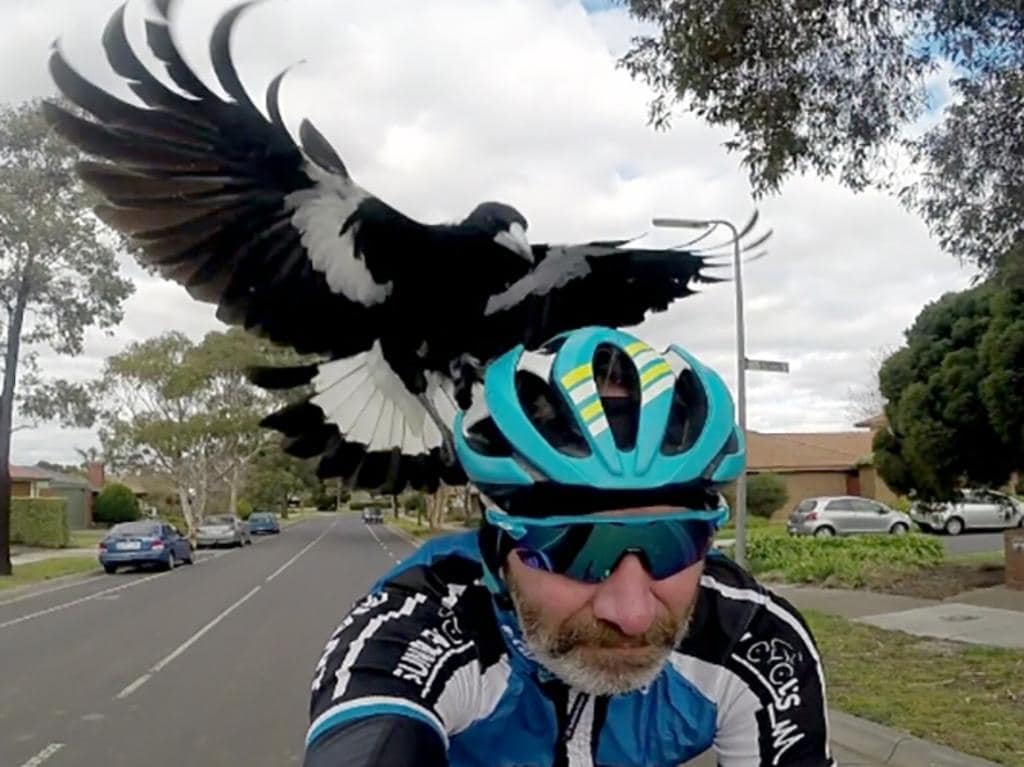
The Australian magpie is a very intelligent and usually friendly bird. That all changes in late winter and spring when some of them become very protective of their babies during breeding season.
Normally their form of attack is to swoop on people entering their territory, often with their angry noise, but sometimes with no sound at all. They always attack from behind, but rarely make contact, and once you leave their territory they leave you alone.
Sadly, this year, a baby died after her mother dropped her during a particularly nasty attack in Brisbane.
Cyclists are very vulnerable. I think the helmets make the birds think that riders are a greater threat than normal people, and possibly the much higher speed than pedestrians might add to the threat factor.
In Narrabri, magpie season usually starts in the first week of August. The drought the last few years made the winters a little warmer so the attacks started late July. I think also that the lack of food caused by the drought, and perhaps lower survival of the chicks made them more aggressive.
This year the season started about the second week, and have been less numerous and less intense than previous years. In my normal daily ride there are probably only about 2 swooping magpies spread over a distance of 11 km. I am especially glad that the bird we called the “nut job” has disappeared. He lived at the far end of the bridge near our house, and would attack without warning, often making contact with the helmet.
The magpies that live in the trees near our house are usually friendly enough. They had a go at me this morning in my own driveway. I walked out into the middle of the road and took my helmet off and put it back on again a couple of times while maintaining eye contact. The first time I did this, it was in attack mode but veered away when I removed the helmet. I hope they have it worked out now! Tim later went out on his bike and they attacked him, so he might have to teach them who he is with and without the helmet.
Can’t wait for October when the birds should resume normal behaviour. Although peewees, which have similar colouration to the magpies, can be aggressive even through summer.
Australia, the land where everything wants to kill you. 🙂
That’s how you teach motorists how to share the roads with others:
Police crack down on cyclist road safety with operation ‘close pass’
Anyone refusing road side education will receive a fixed penalty notice of £100 and three points on their licence for the offence of ‘driving a vehicle without reasonable consideration of others’.
Comments (0)Devon and Cornwall Police and Dorset Police Alliance have carried out an operation to improve the safety of cyclists on the road by education drivers on how to overtake them safely. During the two hour operation six drivers were stopped and all accepted safety advice from the police officers.
On Tuesday, July 11, the Devon and Cornwall Police and Dorset Police Alliance roads policing teams simultaneously launched Operation Close Pass.
Close Pass is an initiative intended to improve the safety of cyclists on the road by educating drivers on how to overtake them safely. It aims to raise awareness amongst motorists and cyclists alike on how to behave courteously to each other on the regions roads.
Head of roads policing for the Alliance, Chief Inspector Adrian Leisk, said: “Rolling out Close Pass across in Devon and Cornwall is in direct response to feedback we have received from cycling groups and individual cyclists about the danger and discourtesy they face on a daily basis on the regions’ roads.
“Our figures indicate approximately 400 or so collisions involving cyclists every year, 200 to 300 of which result in slight injury, 50 to 80 in serious injury. There were 4 cyclist fatalities in each of the years from 2012 to 2016.
“This initiative is very important in the safeguarding and education of our community of road users.”
Close Pass works by volunteer police officers in cycling clothes, effectively ‘undercover’, taking to the road on bicycles fitted with cameras which record the behaviour of drivers who overtake them.
If offences are found to have taken place, the officer radios colleagues further down the road to direct the offending vehicle into a checkpoint where the driver will be offered roadside education using a specially designed mat which illustrates the safe passing distance.
Anyone refusing road side education will receive a fixed penalty notice of £100 and three points on their licence for the offence of ‘driving a vehicle without reasonable consideration of others’.
Two Hundred years ago, a German nutcase invented the first bicycle and transformed the world.
From the ABC:
Cyclists across the country have celebrated the 200th anniversary of the world’s first bicycle ride.
Monday marks 200 years since inventor Karl Drais rode a bicycle for the first time, in the German city of Mannheim.
“Everything we have today … came from this machine. It’s as simple as that,” said vintage cycling enthusiast Stewart Clissold at a celebration in the Melbourne suburb of Brunswick.
Other celebrations have been held in Sydney, Darwin, Bendigo and Geelong.
“It started a total revolution,” Charlie Farren of the Vintage Cycle Club said.
“We’ve got to thank this nutcase inventor.”
The bicycle was invented as Europe suffered in the aftermath of an Indonesian volcanic eruption that caused chaos across the world.
“Back in the early 1800s, there was this phenomenal eruption, clouds of smoke and dust permeated everywhere [in Europe],” Ms Farren said.
“It’s said that the crops failed, the horses starved.
The invention quickly became popular, mainly with affluent young men.
However, poor road quality meant they would often ride on the footpaths, which led to the machine being banned soon after it was created.
Vintage cycling club members were proudly showing replicas to keen onlookers today, and explaining the machine had its limitations.
“I think not only was it the first carriage that went underneath a human, it was also the first natural contraceptive,” Mr Clissold said.
“I can assure you, after riding one a short period of time on rather rough cobblestone roads, you were not going home for anything other than a hot bath.”
However, Ms Farren said the replica was a delight to ride on flat surfaces, likening it to ice-skating.
“It’s a little bit like roller-blading,” she said.
“You get a beautiful stride going, and you glide along.”


 New Life Narrabri