Jo Nova: The EV Whirlpool Gets Stronger

Jo Nova writes:

EV Hell continues: Crash victims might have to be “left to die”, Hertz dumps another 10,000 cars, Tesla sacks whole charging team
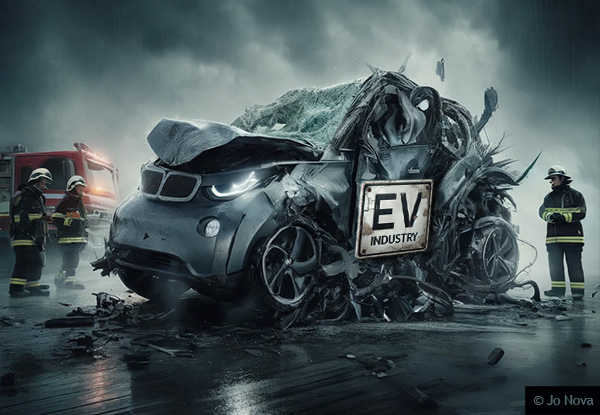
EV doom. The collapse of an industry. AI assisted.

By Jo Nova

Chronicling the collapse of the Big-Government-made EV bubble

In today’s EV obituary column, Elon Musk has dropped a bombshell. Two months after Telsa chargers became the industry standard (which promised to save the other car makers) his profits fell, and he’s fired the entire EV charging team overnight. Hertz, meanwhile, has realized that dumping 20,000 electric cars in January was not enough, and it has to offload another 10,000 electric cars, which now amounts to half its EV fleet. And then comes the news that there might be a secondhand “timebomb” coming at the eight year mark when most EV battery warrantees run out and cars will become “impossible to sell”.

As if that’s not enough, this week the fire and rescue experts in NSW are warning in the politest possible way, that they might have to do a “tactical disengagement” of a car accident victim, which means leaving them to die in an EV fire if the battery looks likely to explode. They say that first responders need more training, as if this can be solved with a certificate, but the dark truth is that they’re talking about training the firemen and the truck drivers to recognize when they have to abandon the rescue.

EV crash victims could be left to die in battery fires without training for responders, inquiry told

Jennifer Dudley-Nicholson, The Driven

The NSW government’s Electric and Hybrid Vehicle Batteries Inquiry heard testimony from fire and rescue services, paramedics, the Motor Traders’ Association, and TAFE on Tuesday in its second public hearing.

In the most serious incidents, firefighters said crews could be forced to abandon rescues or crudely rescue passengers from vehicles, and were being left “flying blind” at battery fires.

VRA Rescue NSW Commissioner Brenton Charlton told the inquiry worse outcomes were also possible, including battery explosions in which a rescue operation would put emergency workers at risk.

“We need to prepare ourselves and our volunteers… for the point in time we have to do a tactical disengagement, meaning if someone’s trapped and it does high order (explode) you might not be able to do anything,” he said.

“That will be a tragic, horrible thing to take part in.”

Just like that, Elon Musk fired the whole Tesla EV charging team, throwing the industry into chaos because Tesla network is the best by far and the bedrock of the so called “transition”. Tesla had agreed to open its charging network to other EV makers only recently, and Joe Biden was delighted. Tesla is getting subsidies to expand it’s North American Charging Standard (NACS) system. But this move

Tesla layoffs shake confidence in the EV-charging future

By David Ferris, E&E News

In a single stroke, CEO Elon Musk called his company’s vaunted charging reliability into question when he laid off most or all of Tesla’s Supercharger team, the people who made Tesla the envy of the EV industry. The network they built is bigger, faster, smarter and more reliable than any other company’s — and has become the linchpin of the auto industry’s plan to persuade millions of Americans to buy EVs and turn the tide on climate change.

“It feels like the rug just got pulled out from under a lot of the industry alignment that has been built in the last 12 months,” said Matt Teske, an industry veteran and CEO of Chargeway, an EV-charging software platform. “And leaves us on shaky ground.”

In 2022, as traditional automakers finally started delivering a substantial number of EVs to the roadways, they ran into a problem. Their drivers couldn’t use Tesla’s chargers, because they were meant only for Teslas. And the public networks had an array of reliability problems.

Ford was the first automaker to hit on the solution. Last spring, it struck a deal with Tesla to use its 12,000 U.S. charging stations and committed to building Tesla’s charging technology called the North American Charging Standard, or NACS, into its future vehicles.

Other automakers followed suit in short order. By February, Tesla’s NACS had become the industry standard, with virtually every automaker planning to redesign their charging systems to meet Tesla’s specifications.

The Hertz debacle truly might become an obituary

Hertz logo

Originally Hertz was going to buy 100,000 wonder-cars which would be cheap to fix and popular with punters. But the future fleet only reached 60,000 cars and is now reversing back to 30,000 cars which tourists apparently don’t want to rent much, and which cost twice as much to repair.

Not surprisingly, it’s a financial ruin. Hertz shares have lost three quarters of their value since 2022.

The company was an $11 billion dollar company in 2021 when it announced the mass EV purchases — it is now a $1.4 billion dollar company.

Hertz drops more EVs

RENTAL car giant Hertz, has announced that it is selling off 10,000 more EVs than it planned in January when it set out to stem the tide of massive depreciation that hit its fleet of 60,000 EVs.

Rental car companies need to be able to sell off their ex-rentals for a reasonable sum, but just as Hertz realized it couldn’t afford to repair these cars, it also realized it couldn’t sell them either:

…the program came under stress when Tesla began discounting its cars last year.

This set off a tsunami of depreciation for existing Tesla owners; including Hertz, which had the biggest exposure of anyone. In turn, other EV makers followed suit with discounts and retained values for all EVs became a race to the bottom.

And as word spreads, possibly no one else will be able to sell them either. What is an 8 year old EV with no battery warrantee worth? It’s pot luck whether it will keep going or suddenly need a £15,000 repair…

The used electric car timebomb –  EVs could become impossible to sell on because battery guarantees won’t last – find out if you are affected

By TOBY WALNE, This is Money

Money Mail can today reveal a timebomb looming in the second-hand market for electric vehicles (EVs).

Our investigation found that many EVs could become almost impossible to resell because of their limited battery life.

Experts said that the average EV battery guarantee lasts just eight years. After this time, the battery may lose power more quickly and so reduce mileage between charges.

In some cases, the cost of a replacement battery is as much as £40,000. For certain EVs, the cost of replacing the battery could be ten times the value of the vehicle itself on the second-hand market.

Yet geniuses in government still want to push us all into EV’s.

With uncanny timing the Australian Albanese government is about to launch emissions standards we don’t need to force people to buy a product they don’t want, in the hope, so they say, of stopping some storms.

The insanity would be hard to fathom if EV’s weren’t also the ideal tool for spying, data collection, law enforcement, and political control. Benefits that can launch a thousand political careers…
Jo Nova: Hertz To Sell One Third of EVs Because Customers Don’t Want Them.

What does this say really about the future of Electrical Vehicles?

From jonova.com

rollercoaster

By Jo Nova

With the western world hurtling into new cars that are more costly, inconvenient, slower to refuel, and prone to burning down carparks and cargo ships, it was only a matter of time before the cracks in the socialist car market started to show.

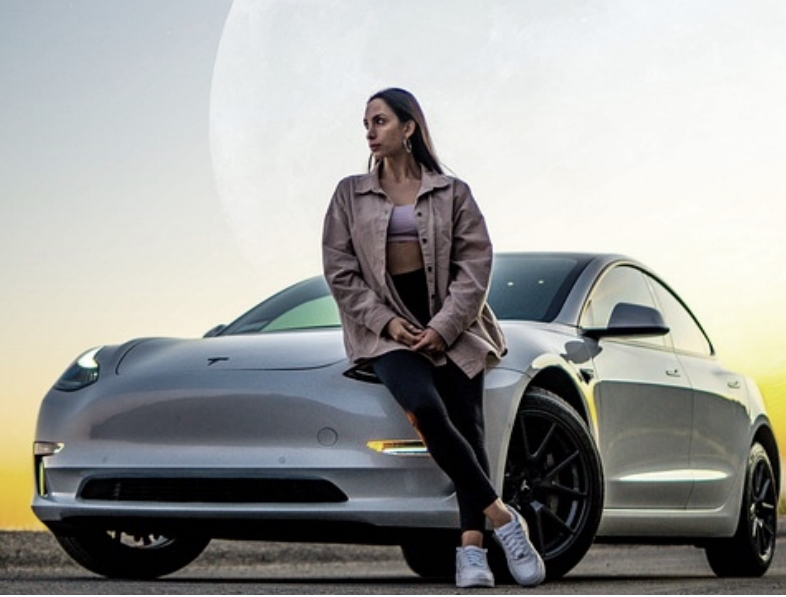
EV, electric car.

Around the world tonight headlines are sharing the news that Hertz is selling off 20,000 EVs, one third of their fleet, in order to buy some more fossil fuel cars. That can’t be inspiring news for customers thinking of giving up their gas guzzlers. As Oilprice said: Hertz’s Big Move Into EVs Turned Out To Be A Dud.  And as Reuters headlined: Rental giant Hertz dumps EVs, including Teslas, for gas cars.

It was the perfect storm in a bad way. Apparently the customers didn’t want to rent them, and when they did and they scratched them, they cost too much to fix. (Repair costs were twice as high).  Then the bottom fell out of the second-hand market, and to recover the depreciation losses, Hertz would have to raise the prices on a product customers already didn’t want. There was no way this was going to work.

The official dry Hertz announcement politely says that customers want fossil fueled cars and EV’s were too expensive to fix:

“..expenses related to collision and damage, primarily associated with EVs, remained high in the quarter”

“The Company expects to reinvest a portion of the proceeds from the sale of EVs into the purchase of internal combustion engine (“ICE”) vehicles to meet customer demand.”

Back in October 2021 it was all champagne and fireworks

Hertz put in an order for 100,000 EVs which was so exciting it pushed Tesla shares up 9% briefly to “a trillion dollar valuation”. (Two years later Tesla is worth 30% less.) At the time, Hertz expected to get the 100,000 cars by the end of 2022. Luckily for them, this didn’t happen. Instead they only got 50,000 by the end of 2022. This worked out to be about 11% of the Tesla total fleet. So these EV’s are not even very old. No one can say “the new models are better, because these are new models.

Some of the cars are already on the market. Two year old Telsa Model 3 EV’s are going for $22,000 US.

Hertz will book a $250 million dollar loss, and stocks in both Hertz and Tesla fell on the news.

With uncanny timing the Australian Albanese government is about to launch emissions standards we don’t need to coerce people to buy a product they don’t want, in the hope, they say, of changing the weather.

The insanity would be hard to fathom if EV’s weren’t also the ideal tool for spying, data collection, law enforcement, and political control. Benefits that can launch a thousand political careers…
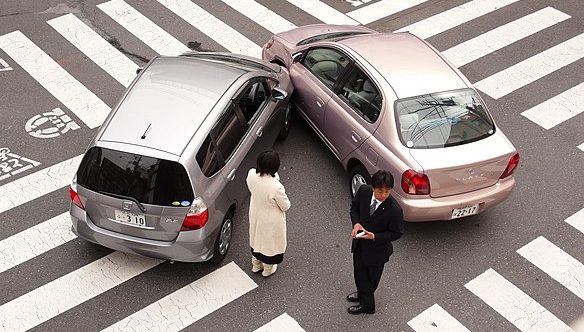
The not-so-sustainable EV’s that have to be written off after a scratch

Jo Nova shares another flaw in Electric Vehicles and the sustainability claims made for them:

#d6b15c">The not-so-sustainable EV’s that have to be written off after a scratch

car accident.By Jo Nova

Save the world with disposable EV’s?

After children in the Congo have dug out the cobalt for the blessed batteries we’d hope the cars would be sustained as long as possible. Alas, apparently there is just one more design flaw on top of the low mileagedelays, expense, spontaneous fires, and the need for a whole new grid.

After a minor accident, no one quite knows how to assess the safety of the battery, so it’s easier to throw it away. That means more waste in the landfill and higher insurance premiums to cover the cost of writing off near new cars. Where are the Greens? If child slaves and emissions matter, isn’t it better to reduce consumption by saving your old car from landfill, especially if your new one might end up there as well? Reduce, reuse, recycle…

Meanwhile the UN is demanding Net Zero targets, which are not even theoretically possible, be achieved ten years sooner.  Half the technologies we need are not even invented yet. Infinity-minus-ten is a number that won’t get you to work, but it powers whole careers at the UN.

h/t David and Notalotofpeopleknowthat

#302226;font-family: Candara, Verdana, sans-serif;padding-left: 80px">Scratched EV battery? Your insurer may have to junk the whole car

By Nick Carey, Paul Lienert and Sarah Mcfarlane, Reuters

LONDON/DETROIT, March 20- For many electric vehicles, there is no way to repair or assess even slightly damaged battery packs after accidents, forcing insurance companies to write off cars with few miles – leading to higher premiums and undercutting gains from going electric.

And now those battery packs are piling up in scrapyards in some countries, a previously unreported and expensive gap in what was supposed to be a “circular economy.”

“We’re buying electric cars for sustainability reasons,” said Matthew Avery, research director at automotive risk intelligence company Thatcham Research. “But an EV isn’t very sustainable if you’ve got to throw the battery away after a minor collision.”

Amazing what uncertainty can do to the value of a good car:

Allianz [an insurer] has seen scratched battery packs where the cells inside are likely undamaged, but without diagnostic data it has to write off those vehicles. …

It already costs more to insure most EVs than traditional cars. According to online brokerage Policygenius, the average U.S. monthly EV insurance payment in 2023 is $206, 27% more than for a combustion-engine model.

The Reuters team found many low mileage EV’s at salvage yards in Europe:

At Synetiq, the UK’s largest salvage company, head of operations Michael Hill said over the last 12 months the number of EVs in the isolation bay – where they must be checked to avoid fire risk – at the firm’s Doncaster yard has soared, from perhaps a dozen every three days to up to 20 per day.

“We’ve seen a really big shift and it’s across all manufacturers,” Hill said.

The UK currently has no EV battery recycling facilities, so Synetiq has to remove the batteries from written-off cars and store them in containers. Hill estimated at least 95% of the cells in the hundreds of EV battery packs – and thousands of hybrid battery packs – Synetiq has stored at Doncaster are undamaged and should be reused.

It’s just another bump on the road to Renewable World that shows that no one really cares how “clean-n-green” anything is. Your emission of CO2 are irrelevant, it’s only the power, control and profits that matter.


Army Bushmaster “E-Tanks” Work Great If You Can Find A Charging Station

From Daily Declaration:

Army Takes Us For a Ride With Its New E-Vehicle

Daily Declaration by Guest Writer

e-vehicle

If we are to rely on e-vehicles to transport our soldiers through warzones, the Australian Defence Force is certainly doomed. Perhaps we should consider an even more environmentally-friendly, natural means of transport.

Last month, amid great fanfare, an electric version of the battle-tested Australian Bushmaster (a concept E-Protected Mobility Vehicle) was launched in Adelaide.

The original, diesel-powered Bushmasters built in Bendigo served in the Afghanistan theatre. So impressive were they that allied combatants including the Netherlands and Britain purchased 120-plus of them.

Currently, 20 Bushmasters are en route to active service with the Ukrainian Army. Other defence force customers of the Bushmasters include New Zealand, Fiji, Japan and Indonesia.

The diesel-powered vehicle has an operational range of 800 kilometres.

So, now, an all-singing all-dancing concept electric prototype is ready for Army trials. It is anticipated that these e-Bushmasters will be silent and not generate the heat signature of a diesel vehicle.

Limitations

According to your ABC News of August 11, it is anticipated that the e-vehicle will have an impressive operational range of 1,000 kilometres.

That is not yet the case, according to the Defence Department’s release of August 19, which says: “The first version has about a 100-kilometre range, but a planned larger battery should increase this to 350 kilometres. There’s also work to mount small external generators, increasing the range to about 1,000 kilometres.”

A small detail missed in the media hype was that the e-vehicle could not drive to the Adelaide launch. This was confirmed by the Minister’s office, which said the e-vehicle was transported from Newcastle (NSW) on the back of a motorised vehicle.

Lumbering Death Trap

The e-vehicle is a child sired by the Army’s “Power and Energy Paper” of March 2020.

The lithium battery utilised in the e-vehicle features high-speed recharging; about three hours at an EV station; or, if the crew pull up outside a farmhouse and use the household plug, about seven hours.

An inconvenient feature of the large lithium battery is that if a bullet or shrapnel pierces its casing, the crew will probably be roasted alive. If it should happen in dense scrub, there is the possibility of a bushfire.

A convoy of E-Bushmasters rolling at 100 kilometres per hour from Melbourne to Sydney (870 km) would, with nine stops at EV points, take 36 hours (1½ days) to arrive; while the same 870-km trek in outback South Australia, Queensland, Western Australia or the Northern Territory stopping at farms to recharge would take 72 hours (three days). Diesel-powered Bushmasters can cover the same distance – with driver breaks every two hours – in about 11 hours (half a day).

But do not despair; Assistant Minister for Defence Matt Thistlethwaite said the electric Bushmaster is part of building a “future ready” Army.

Standard Operating Procedure for an army field-force convoy movement is to place the slowest vehicles in the lead. A worry for any convoy commander if he was moving a mixed convoy of motorised and e-vehicles would be the requirement to halt every 100 kilometres to recharge the electric units.

Moreover, not all e-vehicles would stop at the same location because some might “run out of puff” after 90 kms, others at 95 kms, or 98 kms, well short of the recharge point. A convoy with 20 e-vehicles would require a recharge point with 20 EV stations or 20 power points at a farm.

Missing in Action

A timely lesson for the Army comes from the Gloucestershire Constabulary, which boasts the largest full electric fleet in Britain, 91 vehicles. Its problem is simple: the force cannot respond to crime because the batteries “keep going flat”.

Police and Crime Commissioner Chris Nelson said officers had experienced problems finding recharging facilities in the county as the e-vehicles “run out of puff”, and staff needed to change police cars.

Police Scotland invested £20 million ($A34 million) providing 23 stations with e-vehicles but no EV charging points. When their vehicles were plugged into the station’s regular power point, the latter blew up. Now the e-vehicles are left at council car parks overnight with officers reverting to combustion-powered vehicles.

The e-Bushmasters engaged in a limited conflict in the remote outback or even in rural areas and “running out of puff” would certainly meet the Army’s “silent” criterion.

Natural Alternative

While it is easy to criticise a work in progress, any correspondent worth his salt should provide an interim workable solution that will work until the Army’s R&D e-vehicles are perfected before we face an invasion or shortage of liquid fuels.

Luckily, there is a solution to this self-defeating “carbon-constrained economy” nonsense: the camel.

Australia has (perhaps) a million feral camels roaming the Outback. Australian soldiers rode camels into battle during World War I in the Mesopotamia campaigns. Camel trains were used in remote Australia as each animal could carry 100 kilograms of stores, or be harnessed in teams to haul wagons.

In a military emergency, camel teams could haul “out-of-puff” e-vehicles to the nearest power point. A good camel will travel at five km/h; so, she’ll be right, no urgency; the troops can wait.

The Army’s use of camels would be an innovative carbon-reduction “work in progress” of Labor’s Climate Change Bill, now before the Senate, and would easily impress the UN’s climate barons and other assorted global-warming alarmists.

___

By Tony O’Brien.
Originally published at News Weekly.
Photo: Assistant Defence Minister Matt Thistlethwaite inspects the electric-powered Bushmaster armoured vehicle.