And what happens when that renewable drought is 1 terawatt hour?

From Jo Nova and Matt Canavan


And what happens when that renewable drought is 1 terawatt hour?

Australia has added more unreliable wind and solar than anywhere on Earth but when an energy crisis strikes, and those prices are still on fire, the solution is more of the same.

Senator Matt Canavan, The Australian

Map, Australia, Victoria, Vic.

As rest of the world wakes up on coal, we’re closing it down

Perhaps Australia’s broken electricity system is due to this mad rush towards renewable energy? No, according to our energy regulator, “Recent international events and Australian market events have further strengthened the case for the shift to renewables.”

The renewable energy investments must continue until morale improves.

[The energy regulator’s] recent analysis shows that Victoria could experience a “renewable drought” of 1 terawatt hour of electricity over just one week in the future.

How much is 1TWh? Well, the South Australian big battery can produce 130 megawatt hours, so we would need more than 7500 of these to keep the Victorian lights on. At about $100m a pop, that is a total cost of more than $700bn, or more than Victoria’s total annual economic output.

This winter’s energy shortfalls came just after the Liddell coal-fired power station in NSW’s Hunter Valley shut a 400MW unit in April. Its other three units (a total of 1200MW) will shut next April. Then, in 2025, Australia’s largest coal-fired power station, Eraring, also in the Hunter, is due to shut.

By the end of the decade, our energy regulators warn, almost two-thirds of our coal-fired power could shut.

And Victoria is just one state.

Indeed, across the world there are 345 new coal-fired power stations being built. What is the argument against Australia building just a few to guarantee our energy supplies?

A new ultra-supercritical coal-fired power station built in Australia would increase our emissions by about five million tonnes a year. That would mean global emissions would go up by 0.014 per cent. The world has warmed around 1C after 600 billion tonnes of emissions. So this new coal-fired power station may increase the temperature by 0.0001 of a degree over its life.

Yet we are told a new coal-fired power station would worsen climate change and create more bushfires, floods and all manner of other natural disasters. These arguments are nonsensical yet go unchallenged in polite society.

Matt Canavan is a Liberal National Party senator for Queensland and deputy leader of the Nationals in the Senate.
Jo Nova:Suddenly Nuclear Energy is popular

Jo Nova writes:

Suddenly Nuclear Energy is popular

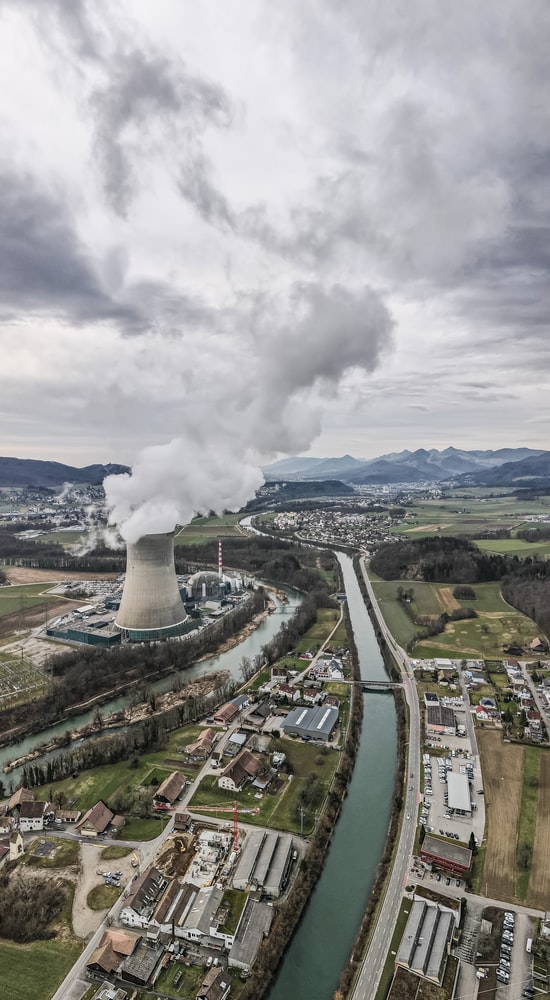
The Gösgen Nuclear Power Plant (in German Kernkraftwerk Gösgen, abbreviated in KKG) is located in the Däniken municipality (canton of Solothurn, Switzerland)

The Gösgen Nuclear Power Plant  by Pareixk Federi

The global energy crisis is squeezing the green religion to its logical endpoint. As long as we pretend “carbon” is pollution, the only way out of the maze for badgered politicians is nuclear power. The renewables industry may have thought that beating us over the head with climate propaganda was going to make renewables dominant and profitable, but it may just push everyone into nukes instead.

With the gas price crisis, wind drought, and coal shortage, suddenly everyone is talking about nuclear power:

Nations Go Nuclear As Prices Spike & Renewables Fail

Michael Shellenberger

National leaders around the world are announcing big plans to return to nuclear energy now that the cost of natural gas, coal, and petroleum are spiking, and weather-dependent renewables are failing to deliver.

France was reducing nukes from 70% to 50% of its total power generation fleet, but not any more:

“The number one objective is to have innovative small-scale nuclear reactors in France by 2030 along with better waste management,” said French President Emmanuel Macron.

 “But the mood has now changed,” the paper writes today. “Macron said on Tuesday he would begin investing in new nuclear projects ‘very quickly.’”  — Financial Times.

Public support for nuclear energy rose 17 percentage points in France. “I do not want our country to lose its energy sovereignty under the pretext of an absurd energy transition copied from Germany,” said a conservative French presidential candidate seeking to defeat Macron.

Finland has joined France, Poland, Hungary, the Czech Republic in lobbying the European Union to categorize nuclear power as sustainable.

Yesterday, Japan’s new prime minister, Fumio Kishida, defended his pro-nuclear policies in Parliament. Kishida came to power on a pro-nuclear platform.

Half of Australia wants nuclear power

The AUKUS “nuclear subs” announcement was a bolt from the blue after decades of Nuclear-free energy debates. But a recent poll shows Australians are rapidly growing to like the idea.  Of course, electricity prices have rocketed since 2015 too, adding to the shift.

In 2015, forty percent of Australians supported it, and forty percent opposed it, and one hundred percent of politicians avoided discussing it. Now suddenly, we’ve bought a couple of nuclear subs and in a blink 50% support nuclear power and only 30% oppose it.

Just like that, and with no discussion, suddenly nuclear power has potential. Imagine what the numbers would be if people actually discussed it?

The bottom line is that the West had better hurry.

China is the Fastest growing Nuclear Power in the world

As Jo Nova said in May:

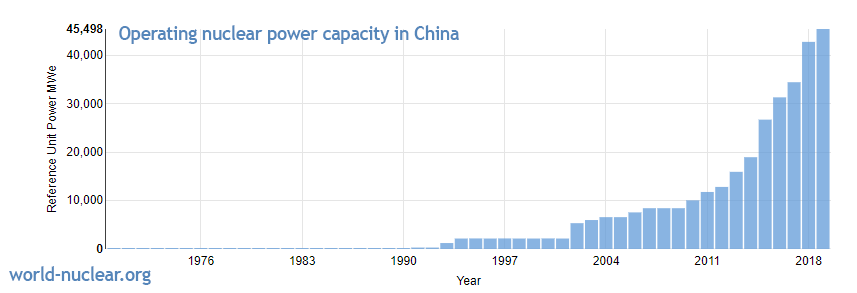
China is poised to be the largest global nuclear power by 2030, overtaking the USA in the next nine years. In the last twenty years, China has increased its fleet of nuclear power reactors from three to 49, with 17 more plants under construction. That means it will soon surpass France which has 57 reactors. At the rate the USA is closing plants, China may hit the No 1 spot faster than expected.

China has a nuclear Belt and Road project too, Argentina, Iran, Pakistan:

Future projects are also being developed in Eastern Europe, the Middle East, and South America

Brown coal is still the cheapest kind of electricity there is, and we are mad not to use it, especially because it’s only $30 a MWh and  feeds plants and we have a 300 year supply sitting there in the ground.Rise of Nuclear Power in China. Graph.

Rise of Nuclear Power in China. Graph.

Germany Weighs Electricity Rationing Scheme To Stabilise Its Now Shaky Green Power Grid

Germany is a warning of where Australia will be in 10 years or less, unless we regain some sanity in electricity production.

From wattsupwiththat.com.

Germany Weighs Electricity Rationing Scheme To Stabilise Its Now Shaky Green Power Grid

Putting matches in charge of fighting gasoline fires?

Even more interference appears to be the German government’s approach to solving the power grid mess that its earlier meddling created in the first place.

Germany struggles to keep the lights on, looks for a law to prevent its power grid from crashing. 

Before the days of climate alarmism and hysteria, the job of deciding how to best produce electricity was left to power generation engineers and experts – people who actually understood it. The result: Germany had one of the most stable and reliable power grids worldwide.

Green energies destabilized the German power grid

Then in the 1990s, environmental activists, politicians, climate alarmists and pseudo-experts decided they could do a better job at generating power in Germany and eventually passed the outlandish EEG green energy feed-in act and rules. They insisted that wildly fluctuating, intermittent power supplies could be managed easily, and done so at a low cost.

Blackouts threaten

Fast forward to today: The result of all the government meddling is becoming glaringly clear: the country now finds itself on the verge of blackouts due to grid instability, has the highest electricity prices in the world, relies more on imports and is not even close to meeting its emissions targets.

Germany’s rickety and moody power grid now threatens the entire European power grid stability, as we recently witnessed.

The need for “smoothing out” demand peaks

So what solution does Berlin propose today? You guessed it: more meddling and interference, more outlandish bureaucrat solutions. Included among them are shutting down the remaining baseload coal-fired and nuclear power plants, and relying even more on the power sources that got the country into its current mess in the first place.

And new are restrictions as to when power can be consumed by consumers and industry! Energy rationing and targeted blackouts.

Hat-tip. Tichys Einblick

Cutting off e-vehicle battery chargers and industry

To deal with the power grid problems, Germany’s Economics Minister Peter Altmaier presented a draft law that would allow electric utilities “to temporarily cut off charging power for e-cars when there is once again too little electricity available”, an idea known as “peak smoothing”.

“Shutdowns due to power shortages have been practiced for some time. Aluminum smelters, for example, have to put up with having their power cut off for limited periods of time,” reports Tichys Einblick. “These, like refrigerated storage facilities, consume great amounts. It’s a dangerous game because after three hours the molten metal has solidified and the factory is ruined.”

Situation now “too critical”

The situation in the German power grid has deteriorated so much that Tichys Einblick also comments: “The situation in the power grids has become too critical. The only thing that helps are abstruse ideas like: ‘You are not allowed to refuel your car from 10 a.m. to 8 p.m. every day!’”

A law that would allow for “peak smoothing” has been demanded by power utilities for some time now as they struggle to keep the increasingly wind and solar powered grid from careening out of control and into blackness. In other words: targeted blackouts.

And as Tichy Einblick mentions, the increasing number of cars on the market will only serve to cause more extreme power demand peaks. Currently Germany is set to make a major push into electric mobility this year.

No electricity for up to 2 hours a day

In the proposed draft law, which has since been recalled because it was deemed so embarrassing, it was written that “controllable consumption facilities” would be able to receive no electricity for up to two hours per day if there was a threat of overloading the grid.

“This includes charging stations for e-cars as well as heat pumps, which can already be temporarily disconnected from the power supply,” reports Tichy.

More burden on power grid

Currently there are only 33,000 electric car charging points in Germany, a country with over 50 million cars, and the government plans a vast expansion in the future, yet isn’t sure what that infrastructure should look like. It’s a policy of going  full speed in total blackness and hoping there won’t be a brick wall in the way.

Government admits it’s not going to function

Tichy comments further: “The German government has recognized that in the future electricity system, it will no longer be possible to satisfy every demand at all times. Therefore, the control of the consumer side should be put on legal feet.” […] “Controllable consumers such as heat pumps, electric heaters and wall-boxes, i.e. charging stations for e-mobiles, would then be switched off variably at times.”

This is the sorry state of Germany’s once highly regarded power grid.

Why The Green Transition Is Doomed In One Graph

Tackling climate change and transitioning to so-called “green power” are foolish aims.

In the developed nations, like Australia, we are busily rising power costs, driving out manufacturing and wondering every summer if we will have enough power to get us through. We are rationing power, paying large users of power to curtail their use in peak demand times, and generally turning our advanced grid into third world status. The total OECD energy consumption is steady.

Meanwhile, in the developing nations, like China, India, Brazil etc, they are embracing cheap fossil fuels to enable their rapid economic development. They don’t care about the evil CO2 molecules heating the world, they just want to lift their people out of abject poverty.

Zero Emissions Construction Digger!

Do you ever feel like everything these days is sleight of hand or outright lying?

Here is the “zero emissions” excavator. From wattsupwiththat.com

Zero emissions, construction digger, runs out of power in 2 hours. Requiring it to be recharged using a diesel generator for 8 hours!

New Study Shows Wind Farms Are Noisy

With the rush on for so-called renewable energy, you would think that there would be heaps of studies on possible side-effects of wind farms such as possible health effects of these monstrosities. Some years ago while I still believed that the ABC was capable of producing genuine information on science, there was a commentator on the Science Show who put down all the complaints to psychology, fear and climate denial.

Apparently there has now been a “world first” study on a tiny sample of houses that has discovered that even several kilometres away there are audible pulses of sound which must have some potential effect when it’s there constantly. Still, somebody has to take a shot to save the planet.

Jo Nov reports:

Finally “world first” study on nine houses shows wind towers make pulsing noise for 3.5 km

Wind Turbine pic near farms. Generic. Gonz - DDl

Generic wind turbine near farm. Photo: @gonz_ddl

Finally, a study looks at data on nine houses within ten kilometers of an old (probably small) wind turbine. What’s amazing about this research is not the result but that this study is so tiny, yet it’s still a “world first”.

There are already probably around400,000 wind turbinesinstalled around the world.* So you might think that there would have been scores of studies involving hundreds of people and followed up for a year or two. They would have looked at the effect of wind turbines upwind, downwind, side wind, in low wind, high wind, and at different times of day. They’d check for altered sleep patterns, lack of deep sleep, REM sleep, cognitive performance, blood pressure, cortisol levels, and school marks. Dream on. It’s like everything with climate change — who needs data?

Renewables are a$300 billion annual global industry. This work was done with a $1.4 million National Health and Medical Research Council grant. Where is the precautionary principle when we need it?

Can wind turbines disturb sleep? Research finds pulsing audible in homes up to 3.5km away

Nicola Hasham,Sydney Morning Herald

…the first results from ongoing Flinders University research into turbine noise and sleep found that low-frequency pulsing from a South Australian wind farm was audible about 16 per cent of the time inside homes up to 3.5 kilometres from a turbine, including 22 per cent of the time at night. The noise was audible 24 per cent of the time outside the homes. Recordings detected what complainants commonly describe as a pulsating, thumping or rumbling sound. The noise is technically known as amplitude modulation, and relates to a change in noise level that occurs approximately once per second as the turbine blade rotates. Field data was recorded at nine homes within 8.8 kilometres of the wind farm. Microphones were placed inside and outside homes and recorded almost 18,000 10-minute samples between 2012 and 2015. The data was recently analysed and the results published online last month in the Journal of Sound and Vibration.

In 2016 the research team was awarded a $1.4 million National Health and Medical Research Council grant for a separate wind farm noise study including lab tests and sleep measurement

If the world put just 0.5% of the annual “renewables investment” into researching the health effects that would be $15m a year.

There have been almost no studies into the health impact of wind farms. Remember the one in 2014 in Australia which was also a world first, andinvolved an eight week study on six people in three houses.It was a tiny study too — why we haven’t done this one hundred times bigger? Are we afraid of what the results might show?

Read the rest of the article here

Jo Nova- The Price of Renewable Energy in Australia


Nearly a billion dollars for electricity for just one day — $500 per family

The Electro-pyre conflagration escalates.

The cost of electricity on Thursday in two states of Australia reached a tally of $932 million dollars for a single day of electricity. Thanks to David Bidstrup on Catallaxy for calculating it.

As Bruce of Newcastle says ““Three days and you could buy a HELE plant with the money wasted.” That’s a power plant that could last 70 years, and provide electricity at under $50/MW. (Forget all the high charges for 30 years to pay of the capital (in red below), we could just buy the damn thing outright, paid off in full from day one.)

Cost of Coal plants, lifetime, USA. Institute for Energy Research (IER):

Cost of old coal plants in the USA. From the report by Stacy and Taylor, of the Institute for Energy Research (IER)

Burned at the stake: $500 per family

In Victoria, per capita, that means it cost $110 for one day’s electricity. For South Australians, Thursday’s electricity bill was $140 per person. (So each household of four just effectively lost $565.) In both these states those charges will presumably be paid in future price rises, shared unevenly between subsidized solar users and suffering non-solar hostages. The costs will be buried such that duped householders will not be aware of what happened. Coles and Woolworths will have to add a few cents to everything to cover their bills, and the government will have to cut services or increase taxes. No one will know how many jobs are not offered or opportunities lost. This is the road to Venezuela.

If Hazelwood had still been open, the whole bidstack would have changed, quite probably saving electricity consumers in those two states hundreds of dollars. Eight million Australians could have had a weekend away, gone to a ball, or bought brand new fishing gear. And this is just one single day of electricity. If Liddell closes, things will get worse, no matter how much unreliable not-there-when-you-need-it capacity we add to the system. Indeed, the more fairy capacity we add, the worse it gets. NSW will soon join the SA-Vic club.

This is what happens when an electricity grid is run by kindergarten arts graduates who struggle with numbers bigger than two.

This is utterly and completely a renewables fail

The socialist Labor-Greens are already trying to blame it on coal, but we ran coal plants for decades without these disasters. Right now, no one is investing in coal because of bipartisan stupidity. What company would pay the maintenance fees on infrastructure so hated by the political class? The coal plants are being run into the ground. Maintenance is even being delayed to keep the plants running through peaks like this.

No country on Earth with lots of renewables has cheap electricity. How many times do I have to repeat it? This is my mantra for 2019.

In Australia when we had mainly coal and no renewables our electricity was cheap and reliable. Now we are still mainly coal, but all it takes is a poisonous small infiltration of subsidized unreliable renewables to destroy the former economic incentives, the whole market, the system: our lifestyle.

The Liberal Party needs to grow a spine

This is surely a crisis. As long as the Liberals are a Tweedledum version of the Labor party, they can’t solve this and deserve to lose. New renewables installations must be stopped immediately — put on hold indefinitely — until they no longer need forced subsidies, until the RET is gone, the carbon taxes, the hidden emissions trading scheme and we have a proper free market. Then new renewables can be permitted to compete with all generation alternatives, though all new generators will also have to be responsible for paying for extra transmission lines, back up batteries, and any other frequency stabilization required. On net a generator must be able to guarantee that when the people call on it, it can provide, lets say, 80% of total nameplate capacity. When that day comes (thirty, fifty, years from now or maybe never) I will be happy to support renewables. Until then, we are global patsies handing over glorious profits to energy giants, renewables companies, Chinese manufacturers, and large financial institutions.

Lets have a plebescite: How many Australians would rather have a weekend away with their family or make the world 0.00 degrees cooler in 100 years in a symbolic display to assuage the Gods of  Storms?

Australia’s Economic Suicide

So why are we still in the self-destructive “renewables” obsession which is driving up power prices for no benefit at all to anyone except the subsidy seekers?

Forget Paris: 1,600 New Coal-fired Power Plants are Planned or Under Construction in 62 Countries

Here’s a small sample of how many coal plants there are in the world today.

  • The EU has 468 plants building 27 more for a total of 495
  • Turkey has 56 plants building 93 more total 149
  • South Africa has 79 building 24 more total 103
  • India has 589 building 446 more total 1036
  • Philippines has 19 building 60 more total 79
  • South Korea has 58 building 26 more total 84
  • Japan has 90 building 45 more total 135
  • AND CHINA has 2363 building 1171 total 3534

Here come our AUSTRALIAN politicians that are going to shut down our 6 remaining plants and save the planet!!

Source and read more: https://wattsupwiththat.com/2017/07/03/forget-paris-1600-new-coal-power-plants-built-around-the-world/

AuthorAdminPosted onJanuary 21, 2019CategoriesUncategorised

China Leaps Forward With Fusion Power

From the ABC, an exciting step forward in cheap, sustainable power generation

China’s ‘artificial sun’ reaches 100 million degrees Celsius marking milestone for nuclear fusion

By Jack Kilbride and Bang Xiao

Chinese nuclear scientists have reached an important milestone in the global quest to harness energy from nuclear fusion, a process that occurs naturally in the sun.

Key points:

  • The ‘artificial sun’ is designed to replicate the fusion process that occurs in the sun
  • Dr Matthew Hole said the achievement is significant for fusion science around the world
  • Fusion is seen as a solution for energy issues as it is clean, sustainable and powerful

The team of scientists from China’s Institute of Plasma Physics announced this week that plasma in their Experimental Advanced Superconducting Tokamak (EAST) — dubbed the ‘artificial sun’ — reached a whopping 100 million degrees Celsius, temperature required to maintain a fusion reaction that produces more power than it takes to run.

To put that in perspective, the temperature at the core of the sun is said to be around 15 million degrees Celsius, making the plasma in China’s ‘artificial sun’ more than six times hotter than the original.

The news comes after China shocked the science community last month with plans to launch an ‘artificial moon’ bright enough to replace city streetlights by 2020.

A moon, which replaces the globe in a light globe, hangs over Chengdu's cityscape.

PHOTO: Chinese scientists plan to send three artificial moons into space in the next four years. (ABC News: Graphic by Jarrod Fankhauser)

Speaking to the ABC, associate professor Matthew Hole from the Australian National University said the achievement was an important step for nuclear fusion science.

“It’s certainly a significant step for China’s nuclear fusion program and an important development for the whole world,” Dr Hole told the ABC, adding that developing fusion reactors could be the solution to global energy problems.

“The benefit is simple in that it is very large-scale base load [continuous] energy production, with zero greenhouse gas emissions and no long-life radioactive waste.

“It provides a silver bullet energy solution … providing that one can harness it.”

Fusion vs fission

How close are we to having nuclear plants that fit the clean, green bill? We explain the how different nuclear technologies work and where the research is up to.

He added that nuclear fusion reactors also avoid risks associated with the currently employed nuclear fission reactors, which can be adapted into dangerous weapons and are prone to possible catastrophic meltdowns.

The news went viral on Chinese social media, with most users excited by the achievement.

“There is nothing China can’t make,” one user on Weibo said.

Another proclaimed that “if this technology is put in use, the world will no longer feel anxious about the energy crisis.”

So how did China manage to pull it off?

China's Experimental Advanced Superconducting Tokamak (EAST), dubbed the 'artificial sun'.

PHOTO: China’s Experimental Advanced Superconducting Tokamak (EAST), dubbed the ‘artificial sun’. (Supplied: Institute of Plasma Physics Chinese Academy of Sciences)

While current nuclear power plants rely on nuclear fission — a chain reaction where uranium atoms are split to release energy — nuclear fusion effectively does the opposite by forcing atoms to merge.

One way of achieving this on Earth is by using what’s known as a tokamak, a device designed to replicate the nuclear fusion process that occurs naturally in the sun and stars to generate energy.

The EAST that pulled off the 100 million Celsius feat stands at 11-metres tall, has a diameter of eight metres, and weighs around 360 thousand kilograms.

The metal insides of the EAST

PHOTO: High-powered magnets line the ‘doughnut shaped’ inside of EAST. (Supplied: Institute of Plasma Physics Chinese Academy of Sciences)

It uses a doughnut-shaped ring to house heavy and super-heavy isotopes — atomic variations — of hydrogen known as deuterium and tritium.

The isotopes are heated by powerful electric currents within the tokamak, tearing electrons away from their atoms and forming a charged plasma of hydrogen ions.

Powerful magnets lining the inner walls of EAST then contain the plasma to a tiny area to maximise the chance that the ions will fuse together.

When the ions fuse they give off a large amount of energy, which can then be harnessed to run a power plant and produce electricity.

The Chinese research team said they were able to achieve the record temperature through the use of various new techniques in heating and controlling the plasma, but could only maintain the state for around 10 seconds.

The latest breakthrough provided experimental evidence that reaching the 100 million degrees Celsius mark is possible, according to China’s Institute of Plasma Physics.

Nuclear fusion a global mission, but not in Australia

Aerial shot shows the construction of the ITER

PHOTO: ITER is set to be completed around 2025. (Supplied: ITER Organization/EJF Riche)

Dr Hole said that while the energy possibilities of nuclear fusion as a clean energy source has attracted large investment from countries all over the world — including China — Australia has lagged behind.

“As a nation, Australia is about to lose its capability in fusion,” Dr Hole said, adding that many of his colleagues have changed field or are looking for work overseas due to a lack of investment in fusion science.

“Australia used to have good investment in this space, but it has really been neglected in recent years.”

He said that the achievement by EAST will be important to the development of the next major experiment in global nuclear fusion science: the International Thermonuclear Experimental Reactor (ITER).

Currently being built in southern France with collaboration from 35 nations including China, ITER is set to be the first fusion device to consistently produce net energy, producing 500 Megawatts of clean and sustainable power.

As EAST has a similar design to ITER but on a far smaller scale, it is likely to be an important testing device during the development of ITER, according to China’s Institute of Plasma Physics.

ITER is expected to be ready to create its first plasma and begin operations in 2025.

An aerial view shows the ITER site spanning across the French countryside

PHOTO: ITER will be the first in the world to produce more energy than it takes to run. (Supplied: ITER Organization/EJF Riche)

Facts Overcome Fear-Mongering

As the fear campaign against CSG ramps up, a few facts from the U.S. moght help counter the nonsense, or maybe not.

From Wattsupwiththat.com

America! Frac Yeah!

Guest commentary by David Middleton

By Hank Campbell — May 18, 2018

In 2009 the U.S. government attended the United Nations Climate Change Conference in Copenhagen and pledged to reduce overall greenhouse gas emissions 17 percent by 2020.

To make it happen, the Obama administration directed the U.S. Environmental Protection Agency to lead the way starting with carbon dioxide (CO2) and that resulted in the Clean Power Plan (CPP) in 2015. While the goal was laudable, no one is in favor of more pollution, it was a blunt instrument because it unfairly penalized fossil fuel power plants…

[…]

The Paris Agreement is now gone in America, what federal politicization of science giveth politicization of science can taketh away, but the emissions reductions the government sought still happened despite a lack of regulations and for that we can thank American science and technology.

Though the added regulations have not come to pass, that’s been a good thing. Without onerous cost increases on the poor, built-in higher rates due to solar and wind programs aside, the free market has continued to cause CO2 emissions to plummet, so much so that in 2017 America reached the CPP’s desired 2025 targetThat’s not due to solar or wind, finds the study in Environmental Science & Technology, it is overwhelmingly due to natural gas. Thanks to modern natural gas extraction techniques such as hydraulic fracturing…

[…]

co220emissions

[…]

If the federal government stays out of picking winners and losers in energy, the trend toward lower emissions is likely to continue.

[…]

That’s something we can all cheer.

[…]

American Council on Science and Health

Frac’ing A Bubba!

Hank Campbell is the antithesis of Chris Mooney.

And… From the No Schist Sherlock files…

UC study finds no evidence of drinking water contamination from fracking

The three-year study found no relationship between methane concentrations in groundwater and proximity to natural gas wells.

By Michael Miller

May 18, 2018

A study of drinking water in Appalachian Ohio found no evidence of natural gas contamination from recent oil and gas drilling.

Geologists with the University of Cincinnati examined drinking water in Carroll, Stark and Harrison counties, a rural region in northeast Ohio where many residents rely on water from private underground wells.

The time-series study was the first of its kind in Ohio to examine methane in groundwater in relation to natural gas drilling. The results were published in the journal Environmental Monitoring and Assessment.

“Some people had elevated concentrations of methane in their groundwater, but the isotopic composition showed it wasn’t from natural gas” said Amy Townsend-Small, associate professor of geology in UC’s McMicken College of Arts and Sciences.

“What we found is in most cases it was probably from underground coal in the area or biological methane produced in groundwater.”

[…]

They found no increase in methane concentration or composition in groundwater over the four years of the study, despite the presence of new shale gas wells drilled in the study area. Likewise, they did not find higher methane levels in closer approximation to shale drilling.

Researchers did find wide variability in methane concentrations in the drinking water, ranging from 0.2 micrograms per liter to 25.3 milligrams per liter, which is strong enough to catch fire in enclosed spaces. But researchers found no relationship between the methane observed in drinking water and the new gas wells.

[…]

“Some people had elevated concentrations of methane in their groundwater, but the isotopic composition showed it wasn’t from natural gas. It was from a different source,” Townsend-Small said. “What we found is in most cases it was probably from underground coal in the area or biological methane produced in groundwater.”

[…]

University of Cincinnati

This should come as no surprise… As hard as the Obama maladministration EPA tried, they couldn’t find a single specific incident in which frac’ing was related to water pollution.

Apart from Gasland-style lies, there is no evidence of frac’ing polluting groundwater/

COLORADO FLAMING FAUCET NATURALLY OCCURRING METHANE

Locally, in Fort Lupton, CO, the film shows a resident igniting his tap water, leaving the impression that the flaming tap water is a result of natural gas drilling. However, according to the Colorado Oil and Gas Conservation Commission (COGCC), which tested this resident‟s water in 2008, at his request,: “Dissolved methane in well water appears to be biogenic [naturally occurring] in origin. …There are no indications of oil & gas related impacts to water well.”(COGCC 9/30/08). This means that the natural gas in the resident‟s well water is of recent bacterial origin, which could result from the poor well completion and hygiene, or penetration of shallow coal seams. The film‟s implication that natural gas production and hydraulic fracturing are to blame is blatantly false.

COGA