Jo Nova:Suddenly Nuclear Energy is popular

Jo Nova writes:

Suddenly Nuclear Energy is popular
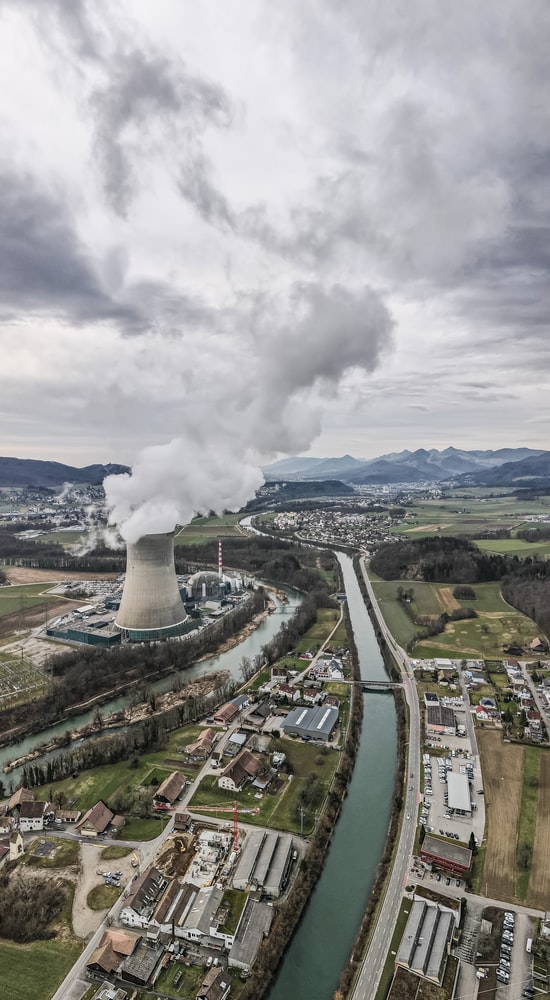
The Gösgen Nuclear Power Plant (in German Kernkraftwerk Gösgen, abbreviated in KKG) is located in the Däniken municipality (canton of Solothurn, Switzerland)

The Gösgen Nuclear Power Plant  by Pareixk Federi

The global energy crisis is squeezing the green religion to its logical endpoint. As long as we pretend “carbon” is pollution, the only way out of the maze for badgered politicians is nuclear power. The renewables industry may have thought that beating us over the head with climate propaganda was going to make renewables dominant and profitable, but it may just push everyone into nukes instead.

With the gas price crisis, wind drought, and coal shortage, suddenly everyone is talking about nuclear power:

Nations Go Nuclear As Prices Spike & Renewables Fail

Michael Shellenberger

National leaders around the world are announcing big plans to return to nuclear energy now that the cost of natural gas, coal, and petroleum are spiking, and weather-dependent renewables are failing to deliver.

France was reducing nukes from 70% to 50% of its total power generation fleet, but not any more:

“The number one objective is to have innovative small-scale nuclear reactors in France by 2030 along with better waste management,” said French President Emmanuel Macron.

 “But the mood has now changed,” the paper writes today. “Macron said on Tuesday he would begin investing in new nuclear projects ‘very quickly.’”  — Financial Times.

Public support for nuclear energy rose 17 percentage points in France. “I do not want our country to lose its energy sovereignty under the pretext of an absurd energy transition copied from Germany,” said a conservative French presidential candidate seeking to defeat Macron.

Finland has joined France, Poland, Hungary, the Czech Republic in lobbying the European Union to categorize nuclear power as sustainable.

Yesterday, Japan’s new prime minister, Fumio Kishida, defended his pro-nuclear policies in Parliament. Kishida came to power on a pro-nuclear platform.

Half of Australia wants nuclear power

The AUKUS “nuclear subs” announcement was a bolt from the blue after decades of Nuclear-free energy debates. But a recent poll shows Australians are rapidly growing to like the idea.  Of course, electricity prices have rocketed since 2015 too, adding to the shift.

In 2015, forty percent of Australians supported it, and forty percent opposed it, and one hundred percent of politicians avoided discussing it. Now suddenly, we’ve bought a couple of nuclear subs and in a blink 50% support nuclear power and only 30% oppose it.

Just like that, and with no discussion, suddenly nuclear power has potential. Imagine what the numbers would be if people actually discussed it?

The bottom line is that the West had better hurry.

China is the Fastest growing Nuclear Power in the world

As Jo Nova said in May:

China is poised to be the largest global nuclear power by 2030, overtaking the USA in the next nine years. In the last twenty years, China has increased its fleet of nuclear power reactors from three to 49, with 17 more plants under construction. That means it will soon surpass France which has 57 reactors. At the rate the USA is closing plants, China may hit the No 1 spot faster than expected.

China has a nuclear Belt and Road project too, Argentina, Iran, Pakistan:

Future projects are also being developed in Eastern Europe, the Middle East, and South America

Brown coal is still the cheapest kind of electricity there is, and we are mad not to use it, especially because it’s only $30 a MWh and  feeds plants and we have a 300 year supply sitting there in the ground.Rise of Nuclear Power in China. Graph.
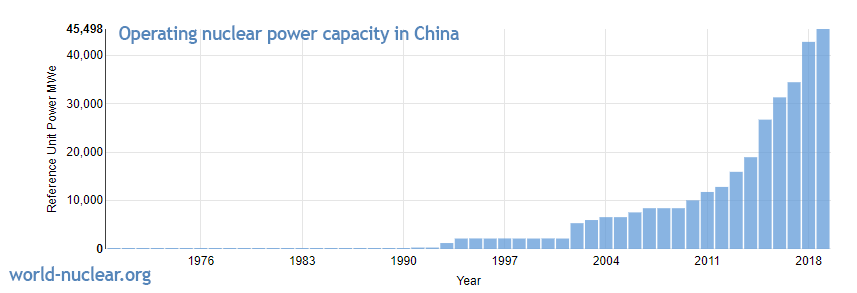
Rise of Nuclear Power in China. Graph.

Amazing! Australian Bush Optimised For Fire

This morning I woke to the astounding news that biologists have discovered that the populations of frogs in areas “devastated” by last summer’s bushfires have rebounded, including some “threatened” species.

This follows earlier reports that koalas, snakes and other animals are doing OK despite “literally billions” of deaths last year. Also platypuses in the Peel River aren’t doing too badly now that the drought is over.

Amazingly, glow worms in the Blue Mountains that were thought to have been wiped out are doing well, having sheltered in a disused railway tunnel – ironic that, given that in modern times the greenies would not allow that tunnel to be built because it would be a threat to the environment, and probably the exact same glow worm population.

My favourite example is the giant pink slug which lives in the Mount Kaputar National Park, near Narrabri. It was only discovered 20 years ago, but the usual climate worriers panicked that the slug had been destroyed by fires. Surprisingly, the slug which has weathered droughts, bushfires, torrential rain, earthquakes, plagues of locusts and other natural disasters despite our total ignorance of its existence, managed to survive this event.

So this morning, after my usual outburst of “What is wrong with these people?”, I worked it out.

The pseudo-scientific discipline called ecology is founded on two fundamental doctrines:

  1. The natural ecosystem is very complex, with many interacting species, and so it is potentially fragile as the disappearance of one species may cause the system to collapse.
  2. People are always bad for the environment.

In actual fact, natural ecosystems are very resilient because they are complex. They can self-correct as different parts of the system adapt to change.

That is why bush environments regenerate after fires and droughts. They have been doing it for thousands of years without the assistance of humans.

The other factor that is generally ignored is that everything was created by an infinitely wise creator. He designed Australia with a warm, dry climate and the slugs, frogs, koalas to suit that climate.

Strangely, God is better at being God than people are.

Jo Nova: “Everything you have heard about koalas is wrong.”

Koalas are meant to be a highly scattered population. There is no rick of koalas becoming “extinct” in NSW. Jo Nova writes:                                                                                                            

Koalas extinct? Hardly. “Nearly everything you have read or heard about koalas, is wrong”

Since Europeans arrived Koalas have been booming and busting

The calls were out this week saying that koalas will be extinct in New South Wales in 30 years. But they didn’t mention that Koalas thrive and multiply so fast that in the right conditions scientists talk of ‘plagues’. On Kangaroo Island last year, there were so many koalas, the South Australian government has been trying to sterilize or relocate thousands of them over the last twenty years.  Periodically scientists even discuss whether we have to cull them (the horror!).

They’ve survived twenty megafires in 200 years. They can recover. Ponder that Koalas were only introduced to Kangaroo Island in the 1930′s but by the 1990′s there were 14,000 of them and even though they are considered a tourism asset they are also considered a problem and pest too.

“Nearly everything you have read or heard about koalas, is wrong” — Viv Jurskis

Photo, Koala eating young gum leaves.

Koalas favorite snack  |      Photo by pen_ash

Viv Jurskis is a veteran forester and fire expert who studied them for years. He’s written The Great Koala Scam, Green propaganda, junk science government waste and cruelty.

Jurskis estimates that thanks to European settlers there are more koalas now than there were 250 years ago.

He describes how koalas have been booming and busting for two centuries. Before the first fleet arrived, koalas were so rare that the new settlers didn’t even see one for fifteen years! But after the indigenous cool burns programs stopped, dense forests grew which were choc-full of tender new shoots that koalas love to eat. So koala populations would flourish and boom right up until a fire wiped them out. In other areas farmers cleared land, but the “paddock” trees would get sick and resprout continuously, which also worked out pretty well for koalas. So koalas boomed in the valleys too. Sooner or later a drought would come and the valley koalas would starve and get sick themselves.

Jurskis recommends we use koala rescue funds to start doing better forest management with cool burns so the megafires don’t incinerate the next oversupply of koalas. It’s a man-made cycle of pain and suffering.

You’d think The Guardian and The ABC would be able to give us a more rounded view, especially since they covered the boom stories and the Koala Wars.  Here’s the ABC in 2002:

Scientists say the only solution to this crisis is to begin culling Koalas. Against the scientists are people who believe we need to be creating more habitats or the koalas. The Australian Koala Foundation are planting wildlife corridors to link koala habitats. But the scientists say this is just going to feed the problem – wherever the koalas have been introduced they thrive and eventually destroy their habitat.

Last year gave up sterilizing them to stop the plague on Kangaroo Island:

Koala and kangaroo culling considered as numbers become ‘overabundant’

  A report from a parliamentary inquiry has recommended the state’s environment minister make an immediate decision to declare koalas, western grey kangaroos, long-nosed fur seals and little corellas overabundant in some areas. The committee heard that sterilisation of the Kangaroo Island koala population had had little success.“Population numbers on the Island continue to rise and their impacts are threatening its biodiversity,” the report says. — The Guardian, 12th July 2019


Read the rest of the article here

Another Environmental Fuss Over Nothing

They keep saying “Plastic is forever” and wanting to ban plastic bags and straws to save the planet. It turns out that plastic does degrade realtively rapidly in the environment, under the influence of sunlight and microbes.

This article talks about plastic in the ocean, and we still need o be responsible in disposing of rubbish. There is no denying that animals near coastlines can be badly damaged by plastic, but outside of that particluar niche, not so much.

From wattsupwiththat.com

Plastics: Science is Winning

Kip Hansen / 2 hours ago October 18, 2019

Guest Essay by Kip Hansen — 18 October 2019

Science is beginning to win in the long battle over misinformed anti-plastic advocacy.  It has been a long time coming.  The most recent paper on the subject of pelagic plastic (plastic floating in the oceans) is from a scientific team at the Woods Hole Oceanographic Institution on Cape Cod, Mass., and the Massachusetts Institute of Technology.

The study is “Sunlight Converts Polystyrene to Carbon Dioxide and Dissolved Organic Carbon” by Collin P. Ward, Cassia J. Armstrong, Anna N. Walsh, Julia H. Jackson and Christopher M. Reddy.   It is good basic science.

styrene_cups

We are all familiar with polystyrene — it is prevalent in modern packaging, both as a solid,  such as yoghurt cups, or in expanded form used for disposable foam drink cups.  Much of the plastic flotsam found on the worlds beaches and floating  in rivers is this ubiquitous plastic, particularly the expanded foam.

The new abstract of the new study starts with this:

“ABSTRACT:   Numerous international governmental agencies that steer policy assume that polystyrene persists in the environment for millennia.  Here, we show that polystyrene is completely photochemically oxidized to carbon dioxide and partially photochemically oxidized to dissolved organic carbon. Lifetimes of complete and partial photochemical oxidation are estimated to occur on centennial and decadal time scales, respectively. These lifetimes are orders of magnitude faster than biological respiration of polystyrene and thus challenge the prevailing assumption that polystyrene persists in the environment for millennia.”   [ bolding mine — kh ]

It is about time that someone scientifically challenged the activist position held and promulgated by many environmental, anti-plastics and anti-corporate groups that “Plastic is Forever”.

Plastic is not forever.  Glass, both natural and man-made,  is forever, but not plastic.

Read the rest of the article here

The Great Extinction Myth Exploded

A few weeks ago when the UN report about biodiversity was released, the media unquestioningly reported that millions of species were going extinct and humans are the problem.

My initial, cynical reaction was, “Gee they have discovered that nobody is listening to the climate change scare any more so they’ve found a new scare.”

It also runs counter to what we are seeing around the world. Every year more and more land is converted to national parks, and for some years now the amount of land being reforested exceeds the area being cleared. Agriculture is becoming more efficient, food is more plentiful, people are moving to cities. Even with a still increasing global population we will have plenty of potential food for decades to come.

In fact, the only bleak spots are those caused by the demands of environmentalists. For example the EU has mandated a certain amount of so-called bio-diesel to be used in vehicles, leading to massive clearing of forests in Indonesia and Malaysia to plant palm trees. The other folly is the requirement to use ethanol in petrol in many developed countries. The main source of this is from corn in North America, leading to an increase in the price of corn, a staple food for millions of poor people, of between 5% and 10%

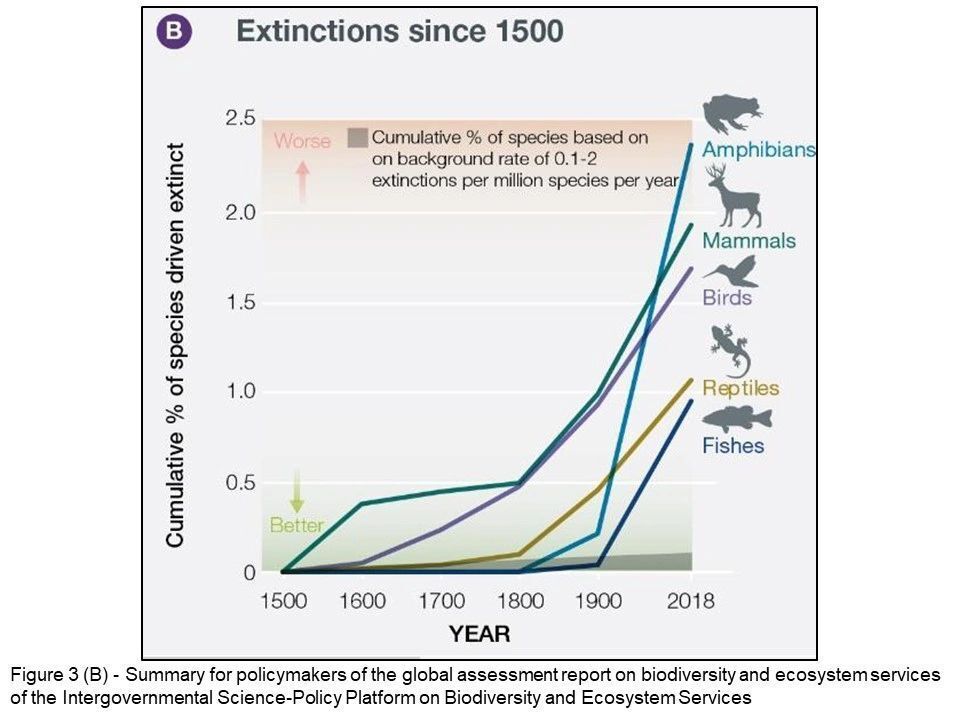
Anyway the extinction report claims that millions of species are going extinct in our time. Here is the only graph in the Summary for Policy Makers

Scary graph, until you look at the labels on the axes. “Cumulative % of species driven extinct.” It is not clear exactly what that means, but it does seem to be adding all the previous values as you go. That curve can never go down. It’s a bit like the old “hockey stick” of Al Gore fame.

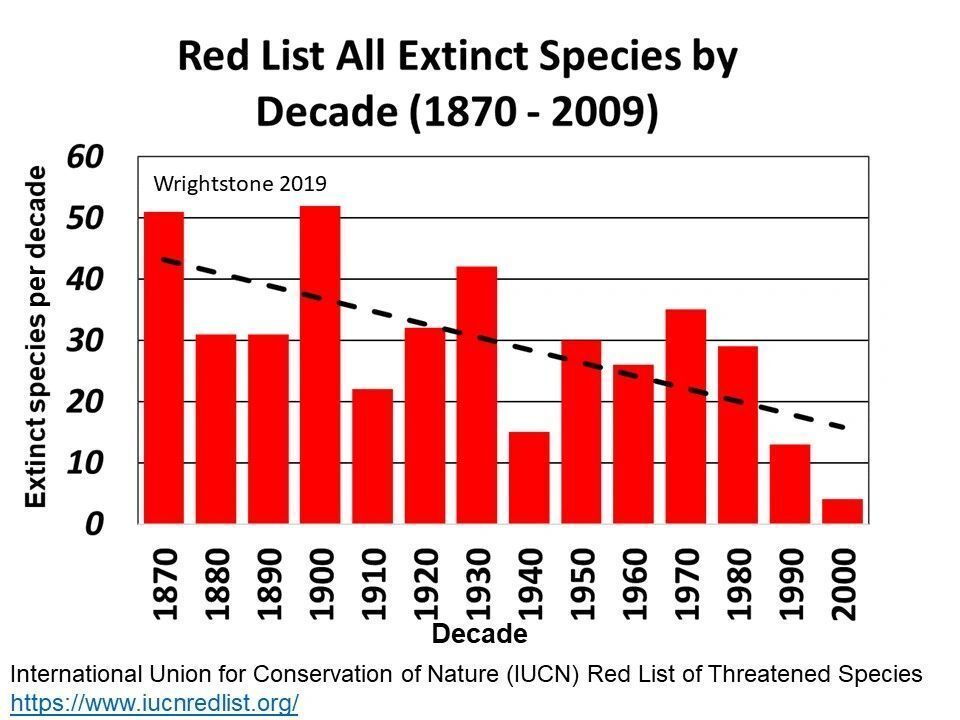
Here is the actual number of extinctions per decade recorded by the International Union for the Conservation of Nature.

So, it’s not quite zero, but we are heading in the right direction- the opposite direction to the one the UN would have us believe.

Oh look that decline is happening right through the period of time when so-called human caused global warming is happening.

These graphs are from a much more detailed article by Gregory Wrightson which I encourage you to read.

The so-called “Mass Extinction” is, sadly, another example of science being politicised and twisted to cause alarm.