Two thousand Iranians turning to Jesus every day

From God Reports

By Charles Gardner —
underground church Iran

The Bible Society, which operates around the globe, reports that more than 2,000 Iranians are turning to Jesus every single day! One 92-year-old believer, whenever she’s on a bus, pulls out a small book and asks her neighbour to help her read the tiny font.

In fact, she is secretly getting strangers to read the gospels. Every time she does it, the person sitting next to her ends up taking a New Testament home.

This is brave work in a land where leaving Islam is potentially punishable by death. But the Iranian revival is good news for Israel – and the Jews! For these dear people have been taught by their government and mullahs that Israel is their archenemy.

But now that they have opened their lives to Jesus, the Jewish Messiah, they find they are also growing to love the Jewish people, longing and praying for a restoration of the peace that the two nations once enjoyed.

This is profoundly good news for those who have eyes to see the bigger picture. For the strict Islamic state of Iran, whose rulers want to wipe out the Jewish people just as Hitler did and who are chief sponsors of monstrous terrorist groups like Hamas, is now the focus of a Christian revival where some two million people have discovered that Jesus, the Jew, is the Savior of the world.

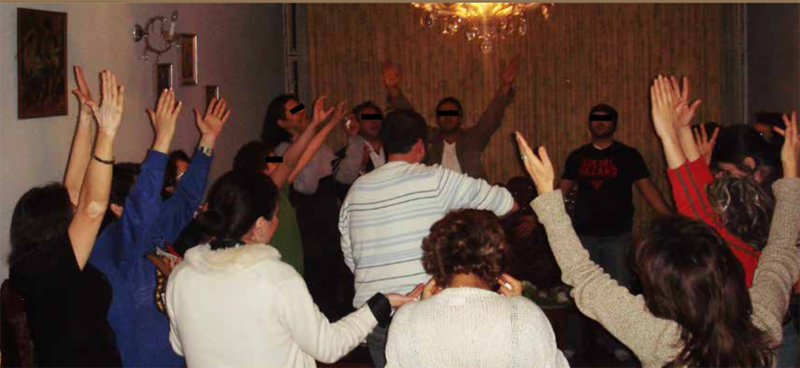
As the mosques shut down in great numbers, passionate Christians are filling the vacuum, though of necessity staying ‘underground’ for now, out of sight of the religious police.

The Islamic foundations are crumbling for the chief sponsors of terrorism, a fact graphically prophesied by the psalmist thousands of years ago when he wrote of them: “Come,” they say, “let us destroy them as a nation, so that Israel’s name is remembered no more. With one mind they plot together, forming an alliance against you.” (Psalm 83:4f)

Among the enemies named are ‘Ishmaelites’ and people from Philistia (Gaza) and Tyre (Lebanon), with Assyria (covering parts of Iran, Iraq, Syria and Turkey) joining them. Does this ring any bells?

Yet the psalmist (Asaph) is not vindictive. He calls on the Lord to bring shame on them so that they will know “that you alone are the Most High over all the earth”. And we are hearing that many in the Muslim/Arab world, even in the strictest of regimes, are indeed discovering the truth of Yeshua.

In the UK too, where Jews feel increasingly threatened and pro-Palestinian marchers are allowed to call for Israel’s demise on the streets of our cities, there is a revival of Christianity, which gives us hope.

After conducting a thorough survey, the Bible Society reports a remarkable fourfold increase in young men aged 18-24 attending church over the last six years.

Amid rumours that Donald Trump is about to announce recognition of a Palestinian State (albeit without Hamas), here in the UK we are hearing reports of a recruiting campaign for Islam within the National Health Service. And even Conservative MPs and peers are making previously unheard-of calls for recognition of ‘Palestine’.

A British TV program has just been rightly lauded for exposing a shocking miscarriage of justice against a host of sub-postmasters wrongly convicted of theft, false accounting and fraud when in fact it was due to a faulty computer system.

But I also believe the monumental miscarriage of justice of modern times has been the grossly misleading narrative – through media, parliament and elsewhere – of the Israeli-Palestinian conflict.

Restored to their ancient land through internationally recognized treaties, not to mention God’s law – their ultimate title deed – they are constantly subjected to a host of lies and propaganda accusing them of stealing what is their own property.

It’s important that we see the big picture of the unfolding spiritual warfare taking place. When Jesus sent out the 72 disciples to spread the gospel (as recorded in Luke 10:19,21), he told them he had given them authority to trample on snakes and scorpions and to overcome all the power of the enemy.

And he was full of joy through the Holy Spirit because God had hidden these things from the wise and learned and revealed them to babes.

It is not the proud and arrogant who will inherit the earth, but the meek and humble. And the latter will also be granted a clear-sighted vision of what is really happening amidst the turmoil of these terrible times which are surely preparing the way for our Lord Yeshua’s return.

As the darkness deepens around the world, especially in the Middle East, the light of Christ is shining ever brighter. It must be tempting for Israelis to feel greatly perplexed.

The psalmist assures us: “Do not fret because of those who are evil… for like the grass they will wither… A little while, and the wicked will be no more… but the meek will inherit the land and enjoy peace and prosperity.” (Psalm 37:1f, 10f)


Finding Jesus While Listening to Pink Floyd

From godreports.com

In Air Force barracks, he heard about Jesus while listening to Pink Floyd

0
4
 
Caught ya. A friend snaps Charlie Forman’s photo in the Air Force in the Philippines when the airman was unprepared.

By Michael Ashcraft –

In high school, Charlie Forman was a chanting Buddhist. Then he took LSD, read Carlos Castaneda and hoped to meet a Yaqui Indian witchcraft guide. But because he was high or drunk every day, he joined the Air Force to clean up his act.

“Nothing really worked,” he says.

Stationed at a radar site in the Philippines, he fell back into partying. “A lot of the officers partied like we did. I got in trouble; there were some drugs in my car.”

When he returned Stateside to Nellis Air Force Base, he was supposed to report to the Social Action of the Air Force to continue his rehabilitation. But his records took forever to catch up to him, and he didn’t mind because he didn’t want to be known as a dopehead.

What he did do was work hard and steer clear of drugs and alcohol. He wanted to go straight “but life was so boring. There was no purpose,” he says.

Ever since his mom died of cancer when he was seven-years-old, Charlie was on a quest to find the meaning of life. One thing he knew for sure, “it wasn’t Christianity. It was something mystical, maybe Transcendental Meditation.”

That’s when a man came into his barracks and shared his testimony.

“I was listening to Pink Floyd, “Charlie recalls. “I wasn’t really interested. This guy started talking and was fighting with the noise, so he asked if could turn it down. He seemed like a nice guy, so I turned it off. And listened. I really related to him. He had gone through similar experiences like me.”

He accepted Jesus.

“It was incredible. I felt like I was high. I had joy and peace. Immediately I was delivered from the drugs. Whereas before I had tried to quit and fell back, I was completely delivered. I had no interest in drugs. I was sauced on Jesus.”

In the Air Force, he was given the job of keeping and clarifying bombing range scheduling for pilots, a job that required three telephone calls a day “if it was a busy day.” The rest of the time, he read his bible voraciously.

But when he married his Filipina girlfriend and brought her to the United States while he was still in the Air Force, things went sour. At first, she got “truly and wonderfully saved. God just whacked her,” Charlie says.

“But she held on to a lot of things from Catholicism. She would not let go of the idea that you shouldn’t be fanatical about God, and she was insanely jealous,” Charlie says.


Read the rest of charlie’s story here

God Reports: Irritating roommate wouldn’t stop talking about Jesus

From God Reports

Irritating roommate wouldn’t stop talking about Jesus

0
6

By Michael Ashcraft –

Tom Payne’s roommate annoyed the Hell out of him.

Quite literally.

“Just shut up!” he said in his mind, frustrated that Jeff would argue with Louie, who had gotten saved, and that he had to listen to it in their one-bedroom apartment.

Tom, then 19, had come from New York to Prescott, Arizona, because it was famous as a college party town. “Getting saved wasn’t part of the plan. We were in a prolonged adolescence with the feigned attempt at getting an education,” Tom says on a Don’t Sell the Farm podcast.”

So when Louie got cornered by a Christian and acceded to go with him to church one day, Tom offered to provide the alibi when the Christian accompanied him to service.

“Just hide in the bathroom, and we’ll tell him you’re not in,” Tom told him.

But Louie was a nominal Catholic and used to showing up every so often to Mass, so he stayed true to his word.

That night, when Tom and Jeff stumbled out of the bar and walked home, Tom remarked sarcastically: “What if Louie got saved.”

They found him in his bed reading his Bible. Suddenly, their fears, however they were treated in jest, now became reality.

Louie told them he had gotten saved and invited them to church. Jeff started to argue with him. Tom rolled his eyes.

For the next days and weeks, the litany was unending. Louie invited them to church, Jeff argued, Tom fumed. “He was in our faces telling us about Jesus,” Tom told him. “Fine, we’ll go to Hell all by ourselves. But just shut up. I don’t want to hear it.”

Jeff was arguing with him nonstop. Louie was just devouring his Bible and was answering him. I couldn’t escape it.”

One evening as he lay on the bed trying to not hear the other two argue in the other room, Tom asked God if he was real. “I was laying on the bed with my hands behind my head, and I said, ‘God, I’m not going to do this just because Louie did this. But if you’re real, I’ll serve you.”

The “presence of the Holy God of the Universe came into that room,” he says. “I thought I was going to die. I couldn’t believe anybody had heard that prayer or would answer that prayer.”

Awestruck, he told God: “Ok, just don’t kill me.”

Tom attended a new convert’s class with Louie. He accepted Jesus. “I had already been confronted by the Holy Spirit,” he says. He was delivered from drugs, alcohol and cigarettes. The next day, he started looking for a job.

Finding a job was no easy matter in Prescott, then a town of 20,000. There weren’t many jobs to be had. He wanted to stay with the Prescott Potter’s House, a booming church. His first job to support himself and continue learning about Jesus as a “disciple” was to water plants at the community college. His last job was working on a trash truck.

Tom and his buddies were used to staying up to 4:00 a.m. partying, so when church let out at 10:00 p.m., he didn’t know what to do with his time. Fortunately, some of the brethren went out for coffee and fellowshipped after service.

He came home buzzed on caffeine, and he and his buddies went home afterward and wrote letters to all their friends back in New York that they were going to Hell and needed to get saved. “We bombarded them with letters,” he recalls. Tom wrote his girlfriend back home with the same unpolished approach.

Janice eventually came out for Tom’s birthday and wound up getting saved. She stayed in Prescott and they got married.

Tom, who threw himself fully into church activities and Bible study, was ordained by the same church to launch at start-up church just three years later. His wife was eight months pregnant, and Tom reassured her that God would take care of them even though they had no health insurance.

As foolhardy as that might have seemed, Tom and Janice have done well. He was one of the early pastors to be sent out of the small-town church that has turned into a worldwide movement. The Potter’s House capitalized on the Jesus Movement to turn former hippies into pastors.

“God went out of his way to touch my life,” Tom says. “I didn’t know all of what was going to happen, but I realized that this was big and I went all in and decided to become a disciple and got sent out.”

If you want to know more about a personal relationship with God, go here

WHAT MAKES A CHURCH GROW? UK RESEARCH SHOWS IT IS ENTHUSIASM FOR EVANGELISM

From “Eternity

There is a definite pattern in which church networks or denominations are declining or growing in the United Kingdom according to statistician John Hayward, a retired university maths lecturer.

His paper has been covered by The Times and reproduced by Christian websites like Anglican.ink.

Some churches are growing numerically in the UK, Hayward finds.

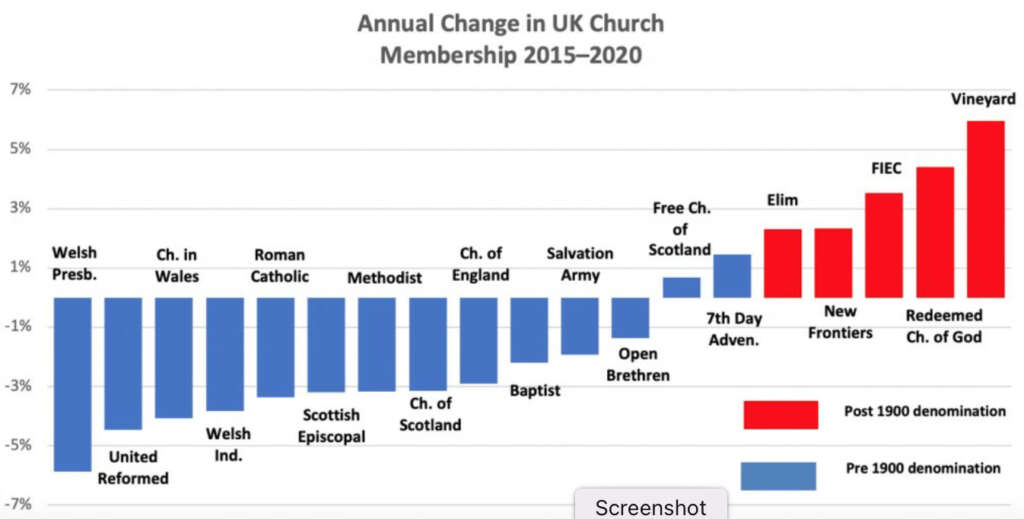
He has used the last five years of statistics to calculate the growth rate for churches. He finds that the Free Church of Scotland (Presbyterian) is growing slowly at less than 1 per cent a year, and the Vineyard network (a pentecostal network) is growing the fastest at 6 per cent a year.

Most of the churches founded before 1900 are declining – United Reformed at more than 4 per cent and the Church of England and Methodists at about 3 per cent a year.

“Both decline and growth rates have stayed constant over many decades,” Hayward writes. “I could have presented a similar chart 20 years ago! The main factor in church decline is the lack of conversions. These churches then get older, and their losses get worse due to higher death rates. Why have the declining churches been unable to increase conversions? How have the growing churches been able to sustain conversions?”

It is about enthusiasm

We have become used to the statistical language of an “R” rate during Covid. Hayward uses membership numbers to calculate the “R” rate for churches.

“For churches, I call it the ‘Reproduction Potential’. If this number is less than one, enthusiasts fail to reproduce themselves, conversions are too weak and the church dies out (the shaded region, figure 2). If the reproduction potential is greater than one, conversions are strong enough to counter losses and the church may grow.”

This graph is based on membership stats from 2000 to 2020.

How many people get converted depends on what he calls the “Limited Enthusiasm Model”. To stretch the Covid analogy, this indicates how many Christians are infectious spreaders of the good news.

“Three churches are increasing their numbers of enthusiasts: FIEC [Fellowship of Independent Evangelical Churches, conservative evangelicals [similar to the Australian group of the same name], Newfrontiers [Pentecostal] and the Elim Pentecostal Church,” Hayward notes. “Although their R numbers are only just over one, that is typical for social diffusion. If they maintain this potential to convert, they could reach five times their current number by the end of the century. But they would have to keep this value for 80 years. Quite a challenge!”

Will some churches cease to exist?

Hayward predicts most pre-1900 churches are in big trouble and headed for extinction. He sees the Baptists and the Church of England as the best placed to survive in this group, but with significantly reduced numbers.

He believes it is possible to predict extinction dates for one group of churches: those which are ageing.

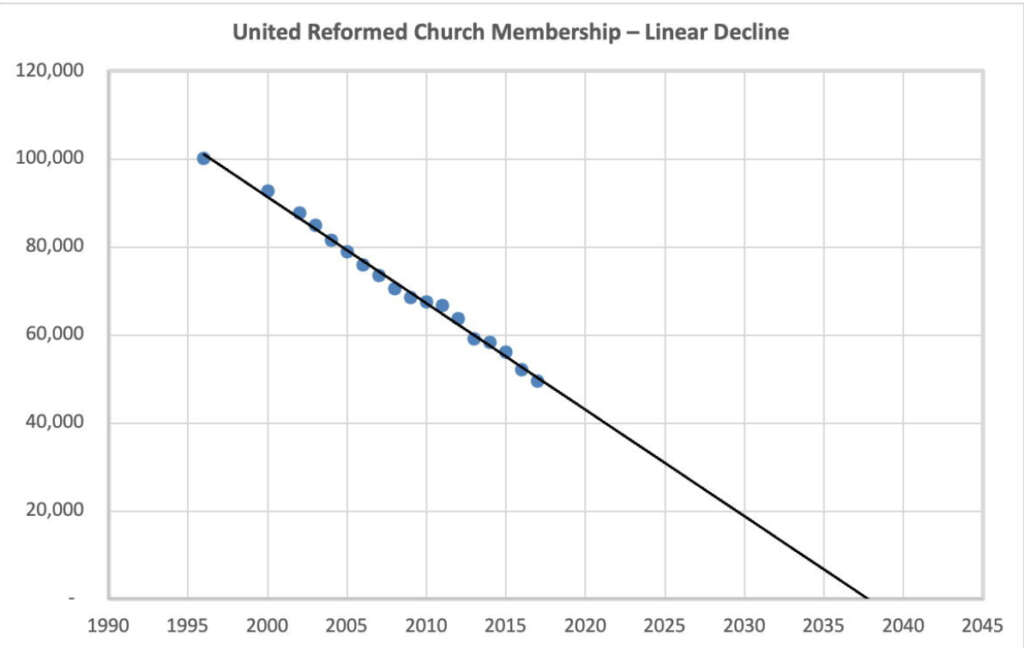
“Membership data for ageing churches follow a downward straight line. [The graph below] shows a typical straight-line decline, predicting the United Reformed Church will become extinct by 2038.

Churches with an R number less than one have time to turn around before extinction. Hayward suggests urgent prayer for revival. The Baptists and Open Brethren have until the end of the century. Catholics and the Church of England until 2060 or so.

The flavour of the church affects decline and growth

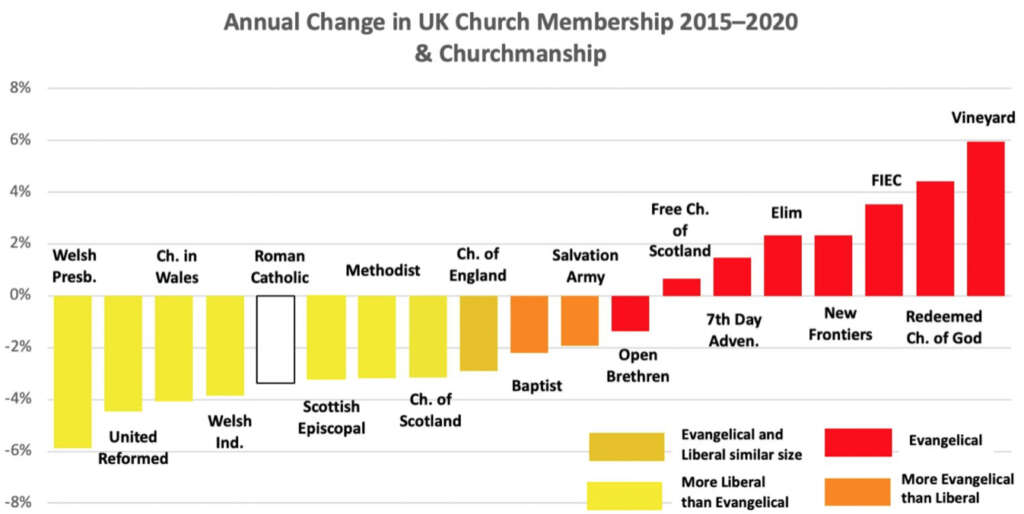
According to Hayward’s stats, the evangelical denominations and networks are more likely to grow, and more liberal/progressive ones decline.

All the evangelical groups in Hayward’s lists of denominations and networks are growing, bar the brethren. Mixed (liberal/progressive and evangelical) and liberal/progressive churches are declining. In the graph, he has analysed the relative amount of evangelical presence in the mixed churches, and there appears to be a connection between growth and decline.

Hayward believes that God’s blessing may shift from older denominations to fresher proclaimers of the gospel.

“These products of the Reformation and Puritan times have run their course. They have fulfilled God’s purposes and are no longer part of his plan. The Church of England will cease to be a national church, and the Churches of Scotland and Wales will disappear by the middle of this century. Instead, God will work through the next cycle of denominations – Pentecostal and evangelical ones – picking up the pieces left by the extinct historic churches.”

Recovering Evangelism in 2022

It is so easy to forget that we are called to make disciples. This is especially true when the pandemic has forced many of us into survival mode for much of the last two years.

The Lord has been really talking to me about this over the last month. A little over two years ago we had decided that this year would be a year to recover our focus on outreach, but people were burnt out and just tired from the stresses of the last two years.

I was despairing about how to encourage our cell leaders and I emailed Joel Comiskey to ask for his advice. Joel wisely reminded me that our call to evangelise is part of discipleship. We share the Good News in response to the call of Christ. This takes the pressure off, because we are only responsible for speaking and not for results. We sow, He grows.

To be effective in our call to make disciples, we need to be effective in all parts of the church

• As pastor, I need to re-engage in the community. I realised that I have unwittingly become cut off from unbelievers. I need to “Go” and make more friends.
• In the congregation, we will specifically devote the month of February to the topic of making disciples. Additionally the second Sunday of every month we will have a message with a definite salvation message, so that people will know that this will be a service they can bring people who are close to salvation.
• In cells, I have asked every cell leader to develop a 10 week plan  in which they work towards a prayer list for unsaved friends and family members and then plan an outreach event. Each cell should then be mobilised for 3 or 4 outreach activities in the year.
• Individuals will be encouraged to talk to their friends about how their faith helps in their daily life.

People who do not feel that they have the ministry gift of evangelism can be overwhelmed by the expectation to produce converts. The idea of fishing with nets as a team means that we are all working together, sharing our various gifts to bring the catch in.

As our congregation pivots towards outreach I am very excited about what God may do in us.

It’s Not What You Think: The Best, Least Expensive Way To Grow Your Church

Phil Cooke writes:

It’s Not What You Think: The Best, Least Expensive Way To Grow Your Church

I’ve been visiting some remarkable churches lately. I’m talking about churches that were growing before the pandemic, then embraced the digital world during the pandemic, and now are back growing again after the pandemic.

In every case, they cited one powerful tool for growing the church – and it’s a tool that doesn’t cost a thing.

Related: TV Evangelist Salaries and Perks: is Nepotism in Ministry Okay?

Word of mouth.

That’s right. The fastest growing churches in America are growing because their people tell their friends about it. They recommend it. They can’t wait to share what’s happening.

From a purely marketing perspective, a 2019 report by Edelman discovered that 63% of consumers between 18 and 34 years old said that they “trust what influencers say about brands much more than what brands say about themselves in their advertising.” In other words, they trust their friends more than they trust advertisers. Other research reveals that what we call “seeded” marketing campaigns (those that use influencers to discuss brands online and with friends) can increase sales by up to 18%.

When people talk about something, their friends listen. And like I said, it doesn’t cost anything, but there’s one critical thing that needs to happen before word of mouth advertising kicks in:

There needs to be something happening at your church that gets people talking.

It happened to Jesus on a regular basis:

Matthew 4:25: Large crowds followed Him from Galilee and the Decapolis and Jerusalem and Judea and from beyond the Jordan.

Matthew 8:1: When Jesus came down from the mountain, large crowds followed Him.

Mark 5:21: When Jesus had crossed over again in the boat to the other side, a large crowd gathered around Him; and so He stayed by the seashore.

There’s plenty more but you get the idea. Those crowds didn’t come to hear Jesus because of the billboards, social media campaigns, or TV commercials. They came because they wanted to see what everyone was talking about.

What’s happening in your church that gets people talking? Are lives being changed? Are people experiencing God? Are they discovering something that’s been missing in their lives?

For all the church growth programs, marketing strategies and advertising, we too often forget the simple fact that when things are happening at your church that gets people talking, they invite their friends.

What will it take to get people talking about your church? Whatever it is, it’s time to start…

‘IF YOU’RE SHARING JESUS AND IT DOESN’T FEEL LIKE YOU’RE GETTING ANYWHERE, DON’T GIVE UP’

From Eternity

“I grew up in a housing commission place in western Sydney. It was pretty rough. My dad worked night shift, so we didn’t see him very much, but we were all close to my mother.”

“After school, I started a degree in literature, which I enjoyed very much. But at the beginning of my second year, I was visiting a friend, and I got a call from a paramedic. He said my mother had died. It was sudden and horrific. She’d had an asthmatic attack at home. My father, and brother (who was 15) and sister (who was 12) were there when it happened. They tried to revive her before the ambulance came. They watched her pass away.

“It was an incredibly difficult time. I quit my Uni degree. We couldn’t even pay for my mum’s funeral. I got a full-time job, and I became responsible for everything in the home – cooking, cleaning, shopping, paying bills, supervising homework, driving my younger brother and sister around.

“I was barely an adult myself. My dad wasn’t coping at all. He would come home from work and stare at the walls. There was nobody to talk to. My friends at the time didn’t understand the load I was carrying. So I learned to hold it in and keep going.18 MAY 2021 3:31PM

“After 12 months I was in a really bad place. I remember waking up and thinking, ‘If God isn’t real, I’m not sure there’s any purpose to this, or any hope at all.’

“Some years earlier, we’d had Christian neighbours. Our house was semi-detached and there was a small brick fence out the front. Our neighbours would often be out the front when we were coming in or going out. Their mum would deliberately connect with us and share her faith in Jesus. She’d even taken us to her church a couple of times. But they moved out just after mum died and I didn’t know where they were. I wanted to talk to her, but I had no way of getting in contact.

“So I decided to give her old church a call. I explained over the phone that my mum had died and I was very depressed. I said, ‘I think I need Jesus.’

“The person said, ‘Come down here right now.’ So I did. I met with a youth leader who was fantastic. She sat me down and listened to me. I was able to talk for the first time. Within a few weeks, I decided to become a Christian. It was mostly because I realised that God was there in the midst of it. He had a plan and a purpose even when it didn’t feel like it. God was at work through everything.

“I went home and told my family. I said the Gospel made sense to me. I said that my faith in Jesus had made a big difference to me, and I encouraged them to come to church. My dad and brother also became Christians within the year. It wasn’t magical or overnight, but things definitely changed for us. Life was still hard but there was meaning and purpose. My dad became a changed person, after being quite angry and aggressive before.

“To me, it speaks about fruitfulness. Our neighbours witnessed to us for years, and they didn’t see any fruit. But when it came crunch time for me, I called the church. It reminds me that we’re called to sow the seeds, or water the seeds, but God brings the fruit, in his time.

“I want to say to people, if you’re sharing Jesus with your neighbours, or the people you love, and it doesn’t feel like you’re getting anywhere, don’t give up.

“Amazingly, just last year, our neighbour made contact with me again, 25 years later. I told her what had happened – that I’d come to faith, and that now I have three theological degrees, and I lecture at Mary Andrews College in Sydney. I told her that she’d been part of my story. She was amazed.

“But it’s the same for all of us. We never know when our words will make a difference for someone … maybe God will use them today.”

‘I planted the seed, Apollos watered it, but God has been making it grow.’ (1 Corinthians 3:6)

Louise’s story is part of Eternity’s Faith Stories series, compiled by Naomi Reed. Click here for more Faith Stories.

At training camp for children of terrorists, 672 kids shown JESUS Film

From “God Reports”

It happened in an extremely dangerous country, where the culture is hostile to Christ and

(photo credit: Ted Wilcox/JESUS Film Project)

His followers.

Every day a “JESUS” film team here begins their ministry with the same prayer. “Holy Spirit, where should we go today?” One day as they walked and prayed, they heard the voices of children. Following the sound, the team entered a compound filled with children and began talking to them about Jesus. The team had no idea where they were and the risk they were taking.

The police heard what they were doing, moved in and arrested them. Before being hauled away a team member had the presence of mind to quickly turn on a NewLifeBox in his backpack…leaving the backpack behind.

Arrested by the authorities, they transported the team members to the police station where they subjected them to torture, beatings, and threats. “How dare you?…you are spreading lies…you are teaching heresy…you will stop at once!”

Thinking they had intimidated the team enough, the police let them go. The team made their way back to the compound to retrieve the backpack. To their amazement hundreds of children were quiet, sitting in groups, eyes fixed on their smartphones, watching something…but what?

As they got closer, their best hope was confirmed: the children were watching the film “JESUS” on their phones. You see, the battery powered NewLifeBox they left behind creates a Wi-Fi hotspot, inviting anyone looking for a hotspot, and within 150 feet, to watch a film about Jesus.

In all, there were 672 children, and most were engaged with “JESUS.” Now the children began asking the film team many questions about what they had seen and heard. Then the children asked one more question: “Can you help us tell our parents about Jesus?”

Later, the team learned that the compound was a training center for the children of wealthy militants! The Lord had led the team and this amazing tool to the primary school for their children, where they were learning to fight for their religion.

Pray now that the doors remain open to many of these children and their families to learn more about Jesus.

To learn more go here

Bill Muehlenberg: Israel Folau, the Apostle Paul, and the Gospel

A great article here by Bill Muehlenberg about Rugby star Israel Folau’s uncompromising commitment to faith

So what does the Australian Rugby star and the great apostle of 2000 years ago have in common? Both are followers of Jesus Christ and both take their faith seriously. And they take sin seriously, speaking out on it when they can. Both have warned people that the consequences of sin is death and eternal judgment.

And both have been hated on for speaking the truth. Paul constantly got into trouble for sharing God’s truth with those who did not want to hear it, and so has Israel Folau. Indeed, I have written several pieces on the Australian sportsman already. See here: billmuehlenberg.com/2018/04/06/folau-and-unacceptable-truth/

And here: billmuehlenberg.com/2018/04/11/folau-hell-and-biblical-truth/

As to the Apostle Paul, let’s look at how he described his lot, as he spoke truth, shared the gospel, and warned sinners of their fate. In 2 Corinthians 11:23-27 we read:

I have worked much harder, been in prison more frequently, been flogged more severely, and been exposed to death again and again. Five times I received from the Jews the forty lashes minus one. Three times I was beaten with rods, once I was pelted with stones, three times I was shipwrecked, I spent a night and a day in the open sea, I have been constantly on the move. I have been in danger from rivers, in danger from bandits, in danger from my fellow Jews, in danger from Gentiles; in danger in the city, in danger in the country, in danger at sea; and in danger from false believers. I have labored and toiled and have often gone without sleep; I have known hunger and thirst and have often gone without food; I have been cold and naked.

Hmm, it seems most folks really did not like it when Paul shared biblical truth. Most folks hated it, and they reacted to his preaching accordingly. And nothing has changed. For two thousand years Christians have been hated on for preaching the gospel.

That is always the way it is. As Jesus forewarned, people love darkness rather than light, and they will hate his messengers just as they hated him. This is as basic as you can get. Sharing Christian truth WILL always offend people. And it is Folau who is again feeling the heat big time for daring to share biblical truth in public.

He had recently responded to the news that Tasmania has passed new legislation making gender optional on birth certificates. To this he replied: “The devil has blinded so many people in this world, REPENT and turn away from your evil ways. Turn to Jesus Christ who will set you free”.

He also posted an image on Instagram with these words: “Warning – drunks, homosexuals, adulterers, liars, fornicators, thieves, atheists, idolaters – hell awaits you. Repent! Only Jesus saves.” Next to this image were these biblical truths and passages:

Those that are living in Sin will end up in Hell unless you repent. Jesus Christ loves you and is giving you time to turn away from your sin and come to him.

Now the works of the flesh are manifest, which are these , adultery, fornication, uncleanness, lasciviousness, idolatry, witchcraft, hatred, variance, emulations, wrath, strife, seditions, heresies, envyings, murders, drunkenness, revelings, and such like: of the which I tell you before, as I have also told you in time past, that they which do such things shall not inherit the kingdom of God.
Galatians 5:19-21 KJV

Then Peter said unto them, Repent, and be baptized every one of you in the name of Jesus Christ for the remission of sins, and ye shall receive the gift of the Holy Ghost.
Acts 2:38 KJV

And the times of this ignorance God winked at; but now commandeth all men everywhere to repent:
Acts 17:30 KJV

Needless to say all the usual suspects were livid because of his remarks: atheists, homosexuals, those in the lamestream media, and so on. And his own in the sporting world turned on him as well. As one article reports:

Rugby Australia released a statement shortly after saying the post was ‘unacceptable’. “Rugby Australia is aware of a post made by Israel Folau on his Instagram account this afternoon,” Rugby Australia said in a statement. “The content within the post is unacceptable. It does not represent the values of the sport and is disrespectful to members of the Rugby community.

“The Rugby Australia Integrity Unit has been engaged on the matter tonight.” Sydney Morning Herald columnist Peter FitzSimons wrote that Folau’s latest post should see Rugby Australia cut their ties with the 73-test Wallaby. “Israel Folau has to go, and will go,” the former Australian test player wrote. “Quick. Clean. Gone. At least until such times as he repents.”

“Rugby Australia simply has no choice. They cannot go through one more time the agony of last year when Folau’s social media comments trumpeting that gays would go to hell, saw rugby lose sponsors, fans and support,” FitzSimons said in the Sydney Morning Herald.

According to rugby.com.au, there was a reported clause in Folau’s contract negotiations last year that was specific to his use of social media. The tweet has been widely shared and commented on, with most people responding having a negative view of his comments.
www.nzherald.co.nz/sport/news/article.cfm?c_id=4&objectid=12221212&fbclid=IwAR3Q-ryvFJSTXo7SIbD_1JiiXjNRVbwnlv4KMkO9gr5a6UA1dTrfOaTLEt8

So here we have the world turning on him – once again. He is not being a good boy. He refuses just to be a star athlete. When he just did sport, everyone loved him. But he also takes his faith seriously – much more seriously than his own career. And for that everyone hates him.

But as is usually the case, it is not just the God-haters who went ballistic at Folau. We also had plenty of trendy lefty Christians and members of the religious left strongly condemning him. ‘Oh but Jesus would never speak to people this way.’ ‘You need to be more loving and less intolerant and judgmental.’

Um, actually no one warned more about hell and judgment to come than Jesus Christ. And given that Folau did basically nothing but quote from Peter and Paul who were inspired by God to say and write what they did, these critics are simply out to lunch.

The truth is Folau may not always be as tactful or delicate as some of these craven Christians and men-pleasing believers want him to be, but he has courage and conviction. I will take that any day of the week over these milquetoast pansies who likely have never shared the gospel with anyone all their lives.

These armchair critics are a dime a dozen. They love to condemn bold and courageous Christians, while they grovel before the world, seeking to befriend it and get along with it. The Bible is quite clear about the sin of trying to please men while displeasing God. Consider just a few passages:

-Luke 6:26 Woe to you when all men speak well of you, for so did their father to the false prophets.

-John 12:42-43 Yet at the same time many even among the leaders believed in him. But because of the Pharisees they would not confess their faith for fear they would be put out of the synagogue; for they loved praise from men more than praise from God.

-Galatians 1:10. Do I seek to please men? For if I still pleased men, I would not be a servant of Christ.

Sure, we all want to be tactful and careful as we share biblical truth in public. But we also need some Holy Ghost boldness here. If you see a little girl playing on the street and a big truck hurtling her way, if you cared at all, you would yell, scream, jump up and down and do all you can to save her.

You would NOT try to be polite, respectful and calm, making sure no one gets offended. You would act quickly and sound the alarm because a life is at risk. Folau gets it: all people are sinners and they are all heading to a lost eternity unless they repent.

They must be warned. They must be told. Sure, it is always nice if this can be done over a period of time with a nice relationship established. But we do not always have that luxury. Some of the people who read Folau’s warnings today may well be dead tomorrow.

In the same way hoping to build a relationship with the little girl first would be madness. Whether she is a friend, relative, or a complete stranger, she NEEDS that warning or she will die. All unbelievers need such warnings too. Yet most Christians have never shared their faith even once.

They are far too cowardly and too spineless. They would rather keep people happy, even if it means watching them slide into a lost eternity. I may not always do things as Folau does them, but I will give him credit. He has more guts than most believers.

And he seems to care about the lost a whole lot more than most believers. If these spineless wonders want to sit on the sidelines and criticise him, well, I am not really interested in what they have to say. They remind me of the woman who went up to the great evangelist D. L. Moody and complained about the way he evangelised. As the story goes:

The woman said to him, “Mr. Moody, I don’t like the way you do evangelism!” “Well, ma’am, let me ask you, how do you do it?” Moody asked. She replied, “I don’t!” Moody responded, “Well, I like my way of doing it better than your way of not doing it!”

Three cheers for Israel Folau.

Surprising Results About Youth Evangelism

A report from Faithwire suggests churches may have their youth strategies all wrong. I might need to go and buy an old building! I am not sure about the methods used to get to this result or how they transfer across cultures.


A newly released study from research consultancy ComRes has found that many young people are exploring the Christian faith as a direct result of visiting beautiful religious buildings. In a  2016 survey, nearly 13 percent of teen converts cited “visiting a church building” as playing a vital role.

Photo Credit: Flickr/Andrew Gustar

The report indicates that the experience of beautiful religious architecture is more effective in evangelizing the younger generation than attending a youth group (11 percent) or a church service (12 percent), according to a write-up of the report by U Catholic.

ComRes interviewed 2,000 people aged 11-18 in December 2016, but the results of the online survey were not released until last summer. This was as a result of analysts finding it hard to believe that the figures were true.

Read the full article here