In a post-Christian, post-modern, post-everything society, God’s people are called to operate from courage, not fear. And when we live courageously, putting our hope in the reality of who God is and what God has already accomplished, it changes everything. We’re freed up to be the people of God living out the mission of God despite what new challenges come our way.
But given our increasingly hostile cultural landscape, what does making new disciples, in terms of evangelism, look like? And how do we go about it? I think you’ll be surprised by where we end up, though you probably shouldn’t be.
Evangelism in an Age of Unbelief
When we talk about what it means to be courageous and faithful in the age of unbelief, we have to talk about the Great Commission. That’s our mission. And though it’s always been true, I think it’s truer than ever to say that evangelism will include hospitality. Hospitality is not the sum total of courage or evangelism, but living courageously will involve living hospitably.
The idea of hospitality has been hijacked by popular culture. When the Bible speaks of hospitality, it almost always ties it to aliens and strangers — people who are not like us. Hospitality means welcoming those outside your normal circle of friends — the kind of people it takes a new heart to invite in. It’s opening our lives, and our homes, to those who believe differently than we do.
“Hospitality means opening your life and your house to those who believe differently than you do.”
Hospitality is all over the Bible. In fact, it’s so important to God that when Paul lists out the traits necessary for a man to be qualified for the office of elder in a local congregation, we find that he must be “above reproach, the husband of one wife, sober-minded, self-controlled, respectable,hospitable, able to teach . . .” (1 Timothy 3:2). To be an elder, a man has to be able to open his life and show kindness to those who believe differently than he does. He has to open up his world to those who are outside of what he believes.
Now, why would God be so serious about hospitality? Well, because he has been so hospitable to us. Even when we were living as his enemies, he came and saved us. He opened the door and invited us into his presence. We demonstrate that we truly appreciate the divine hospitality we have received as we extend our own hospitality to those around us.
I’m not suggesting that biblical hospitality is the silver bullet for making evangelism work in the twenty-first century (news flash: there’s no silver bullet). But might it not be — in our cynical, polarizing, critical, dumpster-fire culture — that a warm dose of welcoming hospitality will take some folks by surprise and open up the door for opportunities to make disciples of Jesus Christ?
Four Ways to Show Hospitality
The God of the universe is serious about hospitality. Hospitality can create an entry point for living out the Great Commission and evangelizing our neighbors — especially in the age of unbelief when most think the church is about something completely different. Yet we still have to ask, How do we show hospitality today? It’s not complicated — though that doesn’t mean it’s easy.
1. Welcome Everyone You Meet
I think the best first step is to greet everyone you see. That’s easy to do if you are wired like me — I’m a total extrovert. That’s hard if you’re an introvert, and maybe you’re thinking, “Can we just skip to number two, please?” But often the best actions to take are the hardest to do. Pray for grace, ask for strength, take a risk, and greet people.
2. Engage People
Remember that every person you encounter is eternal. You have never met a mere mortal, as C.S. Lewis famously observed, and you have never met a human not created to image your God. How can we not seek to care about and take an interest in those we run across? I don’t think this is overly difficult. It simply requires us to be asking open-ended questions, letting our inner curiosity out.
We may think this is all obvious — but often we hold back from doing it. We need to get to know people, take an interest in them, and listen to them, rather than just trying to think about how we can say something memorable or hilarious.
3. Make Dinner a Priority
Over and over again, God’s word testifies to the holiness of eating together. Long dinners with good food, good drink, good company, and good conversations that center around our beliefs, our hopes, our fears — that’s a good dinner. And I don’t mean just dinner with friends. Yes, eat with your church small group, invite over your good friends, but remember that hospitality means to give loving welcometo those outside your normal circle of friends. It is opening your life, and your house,to those who believe differently than you do.
4. Love the Outsider
In every work environment, every neighborhood, we know people who, for whatever reason, are outliers. These men and women are all around us — perhaps more so than ever, in our globalized world. Because of the way sin affects us, we tend to run away from differences and from being around people who think differently and look different than we do. But I want to lay this before you:Jesus Christ would have moved towards the outsiders. God extends radical hospitality to me and to you. That’s why we learn to love, and pursue, the outsider — because we were the outsider.
It All Starts with Courage
As dark and dire as the landscape may appear right now, as vast and venomous as it may be, we know that the battle has already been won — and that means we don’t fight on the world’s terms. This age of unbelief may feel big and intimidating for the church, but it’s simply a small subplot in a bigger, better story — the greatest story ever told.
And in a truly spectacular paradox, there’s a yawning chasm between God’s story and our stories. While we know there are spiritually significant realities at work, we are called to simple, everyday faithfulness that works itself out in lives marked by hospitality.
In some ways, it’s the big, flashy acts — the kind of stuff we photograph, slap a filter on, and show all our “friends” online — that go most noticed yet require the least of us. True Christian courage probably looks more like inviting a group of strangers into your home for dinner than the attractive, successful ideas we have dreamed up in our minds.
“Remember that everyone you meet is eternal. You have never met a mere mortal.”
Taking a risk to be genuinely hospitable actually requires courage because it forces us to rely on our Lord and his strength, not our own. When we open up our homes and build friendships with those who don’t look like us, believe like us, or act like us, we open up our lives and make ourselves vulnerable. We risk getting hurt and making enemies with those who don’t think the way we think or act the way we act. Yet we can do it because of the hope, strength, and courage that we have in the Lord.
So, greet the people you see today. Learn to ask good questions. Open up your home to them, especially if they’re lonely or isolated. And above all, trust in God to use your weak hospitality to show his power.
The most famous evangelist in our era has gone home to the Lord. What an awesome influence for good this man has had over his 99 years of life.
Ed Stetzer reflects on this life:
Reflections on the Passing of Rev. Billy Graham, One of the Greatest Christian Heroes of Our Time
Ed Stetzer, who holds the Billy Graham Distinguished Chair at Wheaton College (Billy Graham’s alma mater), shares his thoughts. |
ED STETZER
Image: Billy Graham Center Archives
Eighty million people. That’s the number of people that Rev. Billy Graham is thought to have preached the gospel to during his years of active ministry. This doesn’t include those who heard via radio or film. Millions have come to faith in Christ as a result of his commitment to his Savior and his pursuit of the call of God on his life. He has held the position ofone of the most admired people in America more than any other individual.
Billy Graham was beloved by both Christians and non-Christians, admired by those who love Jesus and those who have rejected Him. And with his passing today, we are at a loss for words in many ways.
His impact on modern Global Christianity is unparalleled. And yet His life calling was one of simple obedience. “My one purpose in life,” Rev. Graham once said, “is to help people find a personal relationship with God, which, I believe, comes through knowing Christ.”
In the Billy Graham Center, where I work, we have an entire section devoted to the life and ministry of Rev. Graham. On the walls are panoramic pictures of him at Crusades, him with his family, him on magazines, and perhaps most importantly, him praying to the God he loved so dearly.
These walls tell the story of Rev. Graham, from the time he was born in 1918 and through his latter days. Having walked through these sections many times, it is hard to believe he is now face to face with the One he told millions about.
William Franklin “Billy” Graham Jr., the eldest of four children, was born on November 7, 1918, near Charlotte, North Carolina. He grew up on a dairy farm, and at the age of 16 went to visit evangelist Mordecai Ham. He trusted in Jesus at one of Ham’s revivals. Graham attended Florida Bible College, where he received his call to ministry, and later Wheaton College, where he met his future wife, Ruth Bell, the daughter of a medical missionary. The couple had five children.
While attending Wheaton College, Graham became pastor of the United Gospel Tabernacle and later served as pastor of First Baptist Church in Western Springs, Illinois, after which he took over the radio program “Songs in the Night” from his friend and fellow evangelist Torrey Johnson. In 1947, at the age of 30, Graham was named as President of Northwestern Bible College in Minneapolis. He served in that position until 1952. During this time he became the first full-time evangelist with Youth for Christ and in 1949 held a crusade in Los Angeles, which launched him into national prominence.
Over his ministry career, Rev. Graham held over 400 crusades in 185 cities. He also spoke at InterVarsity’s Urbana Student Mission Conference nine times.
In 1950, Rev. Graham founded the Billy Graham Evangelistic Association.
It is nearly impossible for me to imagine the welcome he is receiving in heaven, the “well done” spoken directly to him from the One he spent his life telling others about.
As an Evangelical leader, and now holding my position as head of the Center that bears Rev. Graham’s name, it is hard for me to put into words how I feel and respond knowing that he has passed into heaven.
Thankfulness and extreme gratitudetop my list—gratitude that he rarely lost sight of his true calling to proclaim Christ to a lost and hurting world. Rev. Graham was on a mission to tell people about our Savior so much so that he once said, “I’ll preach until there is no breath left in my body. I was called by God, and until God tells me to retire, I cannot. Whatever strength I have, whatever time God lets me have, is going to be dedicated to doing the work of an evangelist, as long as I live.”
Awe and admirationcome in a close second. Rev. Graham was a man who knew what was important. His God, his family, his friends. He didn’t waver in the face of numerous opportunities to be esteemed and lifted high in the sight of man. He didn’t cower in speaking the name of Jesus at all times, in all ways, to all who would hear. His singular vision to see our world know Jesus is nearly unparalleled.
I have had some thoughts today about what the church should be. It was sparked by some friends saying of other members of their church that they just want it to be a safe and comfortable place for their children and now their grandchildren.
The church is meant to be a place of equipping, training and maturing so that those who are christians are able to go out and share the Good News of Jesus with their neighbours. Church, in that sense, isn’t only a place to be comfortable. Sometimes we need to offer healing and emotional care, but that is a part of a much larger process of equipping people to know the love of God in order to share that love with others.
This afternoon I saw a police car, two ambulances, a fire truck and the Volunteer Rescue Association truck all flying out of town with sirens blaring. Clearly some kind of terrible incident has occurred that has summoned these people out of the comfort of their buildings at the peak of a hot and dry day.
They would be no use to anyone if these people stayed in their facilities, training and practising for an incident but never attended the real accidents taking place around them.
Imagine a hospital operating at peak efficiency but never admitting patients.
The church can be like this- is often like this. We choose a congregation on the basis of the nice preaching, the children’s ministry, the music. We listen to endless exhortations on sharing our faith, attend workshops on healing or supernatural ministry. But we never put those things into practice in our daily life.
It’s not the beauty of our worship services or the authenticity of our cell groups that matters.
It’s about taking the Christ we worship on Sunday and letting Him into our lives on Monday to allow Him to heal and redeem the broken people in our neighbourhood.
Here is a question for you (well, two questions really). What was last Sunday’s sermon about? What are you going to do this week to put it into practice?
If we just did that each week the world would be a much better place for having experienced God’s people doing God’s work in the power of God’s Spirit.
From Open Doors comes this powerful story of one mans’s faith and the impact his witness had on the men who had come to kill him
Samson, Central Asia
Image: Samson holding a Bible.
We had arrived at another registered, but very much under the radar, church in Central Asia. We met Samson, he looked like a wrestler – in his early 50’s but lean and strong. As we sat on the floor broke bread and sipped tea, Samson began to share his testimony.
This is – without a doubt – one of the craziest stories I’ve heard from my time at Open Doors.
One Sunday night they came at 2am to kill him.
Eight people with machine guns and knives. They said, “Come with us.” Samson could not see their faces as they were wearing black head coverings that only left their eyes visible.
Samson told his wife, “My friends have come and I’ll be back in the morning. When you hear my voice then open the door.”
Samson’s wife locked the door and Samson went with them. They took him to a garbage tip.
They said, “Today is the last day for you. Jesus is not a God he will not save you.”
The Mujahedeen came and grabbed his hair and pulled his head back placing a knife on his throat. They asked Samson, “What do you want to say?”
Samson replied, “Jesus loves you and I forgive you.”
They asked him, “Do you accept Islam?”
And he said, “No I’ve found the truth, the creator of earth, heaven and all mankind. People created religion. You [God] created holy work. Please reveal Your work to my brothers here, salvation, protection for their children, and let them know that my blood is not on their hands. Please bless their families and I forgive them. Amen.”
The Mujahideen (Islamic extremists) screamed at him, “Are you a fool? We want to kill you. And you are blessing our families! Go home, we will come again and take you.”
Two weeks later thirty people and two Mujahideen’s came back.
They said, “We want to talk! We are those that wanted to kill you.”
And Samson replied, “If you want to kill me now please give me five minutes. I have been working so much I didn’t get time to hug my children. I will not tell them you are going to kill me. I will come back.”
They said, “We are not going to kill you.”
The two Mujahideen standing at the front said the 30 men behind them were their army, “As the leaders we are the ones who kill our victims.”
They proceeded to tell Samson how 24 heads of the army would retreat to the hills during the day and come down at night into the town.
Recently 24 leaders came down from the mountains at night and walked into an ambush set up by the government.
The two leaders at the front of the group told how they laid on the ground with bullets flying over from all four sides. They couldn’t raise their heads or they would get shot.
One of the leaders said, “While we were lying there we saw you and you came to us and said, ‘Throw yourself into the water and you will survive,’ and the two of us jumped into the water and we survived. The 22 other leaders were killed.”
They asked Samson, “How did you manage to come to us? And why weren’t you shot?”
Samson replied, “I was not there but my God sent an angel who looked like me because I am his servant. He did it for you to come to me to tell you Jesus loves you, died for you and can give you salvation.”
The man said to Samson, “I will never fight again.” They threw open their arms and said to the soldiers, “This Christian speaks truth. I will accept Jesus.”
God has a habit of waging war with strange weapons. He fought Egypt with frogs, gnats, and boils. He defeated the Midianite army with Gideon’s clay pots and torches. Strangest of all, he defeated sin and death using a tree. So, it should be no surprise to us that Jesus calls us to take up forks and spoons to fight back Satan and his legions.
Brothers and sisters, hospitality is war.
The word hospitality seems harmless enough. Maybe it conjures images of Ina Garten serenely chopping herbs plucked from her lush palisade and soft-lit montages of company having lighthearted conversation while enjoying tomato crostini. Maybe you just picture an old fashioned potluck. Either way, does hospitality really have eternal value? Can sharing the table with others really advance the kingdom of Christ?
Gathering at the King’s Table
“It has been Christ’s plan since the beginning of the church to advance his kingdom through dinner tables.”
It is the prerogative of conquering kings to invite guests to their table. In kindness, David invited Mephibosheth, grandson of King Saul, to join his royal banquet (2 Samuel 9:10). In the book of Daniel, King Nebuchadnezzar extended hospitality to Daniel and his friends after his conquest of Judea (Daniel 1:5). An invitation to the king’s table is an extension of sovereign grace and mercy.
As Christians, hospitality also flows from our King. Jesus started his ministry in Mark’s Gospel going about “proclaiming. . . ‘the kingdom of God is at hand’” (Mark 1:14–15). In the very next chapter, Jesus gives a foretaste of his triumphant victory, sharing the table with the most unlikely of guests. The scribes marvel at his dinner company: “Why does he eat with tax collectors and sinners?” (Mark 2:16).
Our King has invited us to dine at his table as royal sons and daughters. Consider this reality: “You prepare a table before me in the presence of my enemies” (Psalm 23:5). Nothing snubs an enemy and declares, “We are untouchable!” like sitting down to dinner in the middle of a war.
It’s no accident that we accept the hospitality of our Savior every time we approach the Communion Table. Jesus has invited us to share in his eternal victory through his death and resurrection at a table. It signals to the powers of darkness that our victory is certain; their defeat is imminent.
Gathering Together at One Table
In the Old Testament, Jews and Gentiles were reminded of a glaring separation every time they sat down for dinner. Jews did not eat what Gentiles ate, did not sit at Gentile dinner tables, and weren’t even supposed to enter Gentile homes (Acts 10:28). This rift separated all of mankind into two irreconcilable categories, and the whole world was reminded of it at 5:30pm every evening.
However, as the apostles spread the message of Jesus’s death and resurrection far and wide, the unthinkable became reality. Jesus brought an end to the food fight. The King invited both Jews and Gentiles to his table.
“Are you sitting down to eat with people you should never get along with?”
It began with a series of troubling dreams where the Lord commanded Peter to eat Gentile food. Peter was puzzled by the Lord’s chiding: “What God has made clean, do not call common” (Acts 10:15). However, when he entered a Gentile home for the first time and watched as a Roman centurion named Cornelius and his whole household became believers, Peter realized that the blood of Jesus washes all men clean.
When Jesus wanted to show Peter the full implications of the “good news of peace through Jesus Christ” (Acts 10:36), he brought Peter to a dinner table. In the home of Cornelius, Peter learned that one Lord, one faith, and one baptism meant that men who formerly hated one another could now peacefully share a dinner table.
Never before had a Galilean fisherman been a houseguest of a Roman centurion. The dividing wall of hostility had been torn down in Christ (Ephesians 2:14–16). Peter and Cornelius celebrated their King’s victory before the whole world by sharing the hospitality that was theirs through the same gospel (Acts 10:48).
Hospitality Is Worth the Fight
It has been Christ’s plan since the beginning of the church to advance his kingdom through dinner tables. The first believers in Acts are found “day by day, attending the temple together and breaking bread in their homes, [receiving] their food with glad and generous hearts” (Acts 2:46). For millennia, the dinner table was a visible reminder of the division between men. It is at the dinner table that the peace of Christ must now visibly reign.
So, how are you celebrating the victory of our crucified and risen King day by day? Are your meals bizarre to the world? Are you sitting down to eat with people you should never get along with? Are you dining with people from other races, nations, and social classes — eating food you would never have tried if not for the unity of Christ’s body? How does your mealtime shine forth the peace that Christ has brought to a hostile world?
“God has made forks and spoons, pans, pots, and plates weapons of war against the darkness.”
Showing hospitality is a fight. Satan will convince you, six ways to Sunday, that you don’t have time to share your table with others. Whether scheduling issues, sports practices, fatigue, or money constraints — there will always be a reason not to invite others over for dinner.
But hospitality is worth the fight. When you survey your kitchen at the night’s close, and it is filled with dirty silverware, piles of plates, and a sink overflowing with greasy pans and pots, may you realize these are the well-used weapons of our war against the darkness. Make your ladles, casserole dishes, and cookie sheets become your trusty side arms in our fight to expand his kingdom.
“In Alice Springs we harvested fruit that we did not sow. Particularly among the indigenous people, Dr. Bell and other missionaries planted the seeds of faith in Jesus Christ decades ago, and we were able to see the result last weekend.”
(Charlotte, NC) — [BillyGraham.org] Evangelist Will Graham returned to Australia last week – a continent on which he’s preached biannually since 2010 – to share the hope of Jesus in the arid Outback. The three-day event, titled Reality, was held May 20-22 at Blatherskite Park in Alice Springs, Northern Territory. (Photo via Billy Graham Evangelistic Association)
Alice Springs is located in the approximate center of the continent, nearly equidistant between Darwin on the northern coast of Australia and Adelaide on the southern coast.
In this remote town of 28,605, nearly 6,000 people attended the weekend event.
“Some of you have a broken life and God doesn’t use band aids. God wants to completely change you,” said Graham from the podium. “Salvation is a Person and His name is Jesus. Jesus can change everything in life. He can change your life tonight!”
At Graham’s invitation, a total of 549 people made a commitment to Jesus. An additional 297 responded for prayer and spiritual support.
Reality featured five different events over the course of the weekend, including evangelistic outreaches on Friday, Saturday and Sunday nights, a KidzFest program for children on Saturday morning, and a combined church service for the city on Sunday morning. (Photo via Billy Graham Evangelistic Association)
Reflecting on Reality, Graham referred to another evangelist who traveled the same territory more than 45 years prior. Dr. Ralph Bell, a longtime ministry partner of Billy Graham’s, spent two months preaching in and around Alice Springs in 1969, and—Graham says—paved the way for the success of this event. “In Alice Springs we harvested fruit that we did not sow. Particularly among the indigenous people, Dr. Bell and other missionaries planted the seeds of faith in Jesus Christ decades ago, and we were able to see the result last weekend.”
This was Graham’s fourth time preaching in Australia, dating back to 2010. He’s shared the Gospel in Gunnedah, Moree and Tamworth (2010); Orange, Lithgow and Bathurst (2012); and Broken Hill (2014).
Will Graham’s grandfather, Billy Graham, preached extensively on the continent in 1959, 1968, 1969 and 1979. His 1959 tour, which covered Adelaide, Brisbane, Canberra, Launceston, Hobart, Melbourne, Perth and Sydney, is widely viewed as a watershed moment in the early years of Billy Graham’s ministry. Will Graham’s father, Franklin Graham, preached at multi-city tours of Australia in 1996, 1998 and 2005.
We were blessed beyond measure last weekend when we hosted Steve and Christina Stewart of Impact Nations.
Impact Nations takes teams of people from wealthy countries such as Australia and take them to poor countries to minister healing and preach the gospel. A typical day on a Journey of Compassion, as they are called, might involve medical clinics in the day time and evangelism rallies at night. In many different settings, they pray for people to be healed and they are.
We were taught how to pray for healing and how to expect healing to happen, not because we are good but because God is good.
During the meetings we had several opportunities for people to receive healing. One person reported healing from Motor Neurone Disease, another improved peripheral vision.
The question that changes everything is very simple: “May I pray for you?” Those 5 words allow God to come into people’s lives who do not even think of God or of prayer, but recognise that they need help.
My highlight was going to a poor part of the town to knock on some doors. I normally hate that kind of thing, but somehow this seemed like fun. The assignment was to offer people a small bag of fruit- apples, oranges and mandarins- and then ask if we could pray with them. We talked with people and shared something of God’s love. Where people felt like their life was pretty good and they had nothing to pray about, we simply prayed God’s blessing on them.
What was amazing was there were no grumpy people. We had ten pairs of people armed with three bags of fruit and all reported positive responses. I think people are happy to be offered something simple and there was no attempt to coerce people to be “religious.”
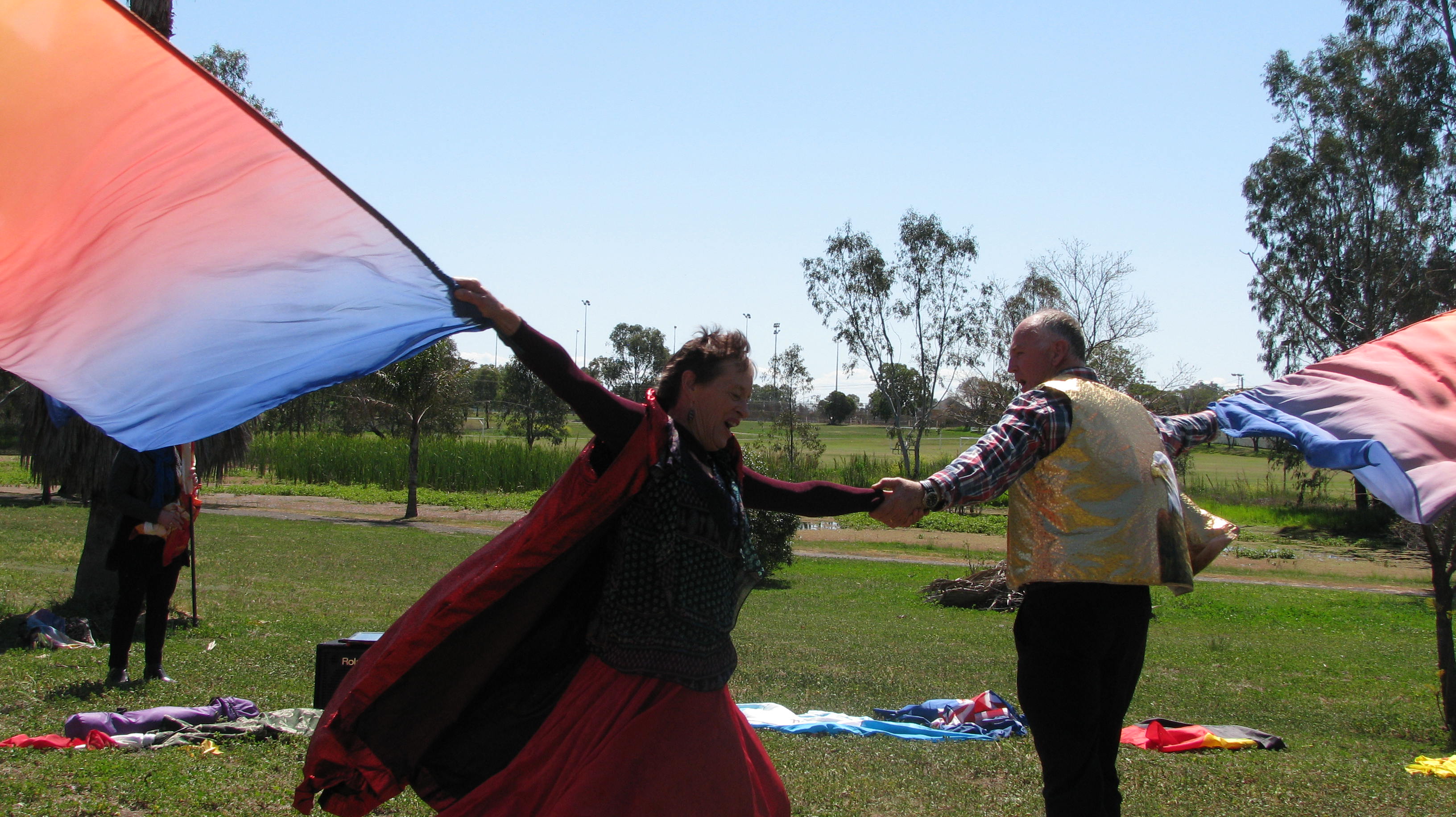
We also had some people visiting from other parts of NSW, including Dee and Mark McAllister who do prophetic dance.
“Kings and armies flee in haste; the women at home divide the plunder”Psalm 68:12 NIV
After I’d been praying, prophesying and believing God for revival for years, the Father asked me one day, “What kind of revival do you want?”
Knowing full-well His questions are usually leading questions, I asked Him, “Well, what kind of revival should I want, Father?”
He answered back, “Do you want a revival of souls or of miracles?”
I thought for a bit and answered, “I want a revival of souls…with a lot of miracles!”
“How many souls do you want?” He continued.
Digging deep for an answer, I remembered Evan Roberts from the historical Welsh revival asked God for 100,000 souls and he got them. So, I hesitantly answered, “Could I have 100,000 souls, Lord?”
He was silent.
I knew I had answered timidly, so I tried again. Reaching for more faith, I answered, “500,000 souls, Lord?”
Again, I heard nothing.
I knew I was not believing for enough from Him and tried again. “1,000,000 souls, Lord?” I asked sheepishly.
Again, nothing. I tried again, “5,000,000?”
Nothing.
Wow! I really thought I was led by faith with that last guess, so I just threw caution to the wind and declared loudly, “One-billion souls, Lord!!!”
“Now you are talking, daughter,” He answered.
Later, I questioned Him, “Lord, how could I win a billion souls?”
Apparently cash give-aways at Easter are a thing in America. The folly of this is the focus on getting people to church at any price rather than getting them to Christ.
We are nearing the day many Christians look forward to all year. Yes, there’s the somber reflection and penitence of the Passion week, culminating in the resurrection of Jesus to celebrate on Easter Sunday, but there’s also some fabulous cash and prizes. Every year some churches seek to outdo themselves — and their local competition — by luring unbelievers (and I suppose interested believers) to their Easter service(s) with the promise of big shows and in some cases big giveaways. One guy in Texas made national news a couple of years ago for giving away new cars. More and more churches each year are dropping prize-filled Easter eggs out of helicopters to gathered crowds below. Local churches with more modest budgets sometimes promise door prizes like iPods or iPads or gift certificates to local restaurants.
I’m not against “Easter egg hunts” and kids having fun and all that, but I think the sort of large-scale, giveaway promotion that takes over this time of year in the church calendar is profoundly unwise and in many cases very, very silly. I want to offer ten general reasons why, but first some caveats: I’m not talking about a church giving out gifts to visitors. Gift cards, books, etc. to guests can be a sweet form of church hospitality. What I’m criticizing is the advertised promise of “cash and prizes” to attract people to the church service. Secondly, I know the folks doing these sorts of things are, for the most part, sincere believers who want people to know Jesus. But I don’t think good intentions authorizes bad methods. So:
Ten reasons luring people in with cash and prizes is not a good idea.
1. It creates buzz about cash and prizes, not the Easter event.When the media takes notice, nobody wants to interview these pastors about the resurrection. They want them to talk about the loot.
2. It identifies the church not with the resurrection, but with giving toys away.It makes us look like entertainment centers or providers of goods and services, not people of the Way who are centered on Christ.
3. Contrary to some offered justifications, giving prizes away is not parallel to Jesus’ providing for the crowds.Jesus healed people and fed them. This is not the same as giving un-poor people an iPod.
4. It appeals to greed and consumerism.There is no biblical precedent for appealing to one’s sin before telling them to repent of it. This is a nonsensical appeal. We have no biblical precedent for appealing to the flesh to win souls.
5. Yes, Jesus said he would make us fishers of men, but extrapolating from this to devise all means of bait is not only unwarranted, it’s exegetically ignorant.The metaphor Jesus is offering here is just of people moving from the business of fishing to the business of the kingdom. There is likely no methodology being demonstrated in Jesus’ metaphor. (But the most common one would have been throwing out nets anyway, not baiting a hook.)
6. It is dishonest “bait and switch” methodology.Sure, the people coming for the goodies know they’re coming to church. But it’s still a disingenuous offer. The message of the gospel is not made for Trojan horses.
7. It demonstrates distrust in the compelling news that a man came back from the dead!!I mean, if nobody’s buying that amazing news, we can’t sell it to them with cheap gadgets.
8. It demonstrates distrust in the power of the gospel when we think we have to put it inside something more appealing to be effective.What the giveaways really communicate is that we think the gospel needs our help, and that our own community is not attractive enough in and of itself in its living out the implications of the gospel.
9. The emerging data from years of research into this kind of practice of marketing-as-evangelism shows the kind of disciples it produces are not strong.I have no doubt these churches are going to see many “decisions” Easter weekend. We’ll see the running tally heralded on Twitter. As questionable a practice as that can be, I’d beextrainterested in how discipled these folks are in a year or two years or three. Hype hasalwaysproduced “decisions.” Would anyone argue that after 30 years or so of the attractional approach to evangelism the evangelical church is better off, more Christ-centered, more biblically mature?
10. What you win them with is what you win them to.
From Christianity Today comes this awesome account of how Christians and Muslims are reacting to the murder of 21 christians by ISIS.
How Libya’s Martyrs Are Witnessing to Egypt
Murders spark largest outreach ever amid new freedoms and new threats.
Jayson Casper in Cairo/ FEBRUARY 23, 2015
Image: Bible Society of Egypt
Covers of the English and Arabic tracts.
Undaunted by the slaughter of 21 Christians in Libya, the director of the Bible Society of Egypt saw a golden gospel opportunity.
“We must have a Scripture tract ready to distribute to the nation as soon as possible,” Ramez Atallah told his staff the evening an ISIS-linked group released its gruesome propaganda video. Less than 36 hours later, Two Rows by the Seawas sent to the printer.
One week later, 1.65 million copies have been distributed in the Bible Society’s largest campaign ever. It eclipses even the 1 million tracts distributed after the 2012 death of Shenouda, the Coptic “Pope of the Bible.” [A full English translation is posted at bottom.]
Image: Bible Society of Egypt
Arabic tract (outside)
The tract contains biblical quotations about the promise of blessing amid suffering, alongside a poignant poem in colloquial Arabic:
Who fears the other? The row in orange, watching paradise open? Or the row in black, with minds evil and broken?
“The design is meant so that it can be given to any Egyptian without causing offense,” said Atallah. “To comfort the mourning and challenge people to commit to Christ.”
The Bible Society distributed the tract through Egypt’s churches, but one congregation went a step further.
Image: Jayson Casper
Poster at Isaaf Evangelical Church
Isaaf Evangelical Church, located on one of downtown Cairo’s busiest streets, hung a poster on its wall at eye-level with pedestrians. “We learn from what the Messiah has said,” it read over the background of an Egyptian flag. “‘Love your enemies, do good to those who hate you….’”
Pastor Francis Fahim said the poster was meant to express comfort to all Egyptians, Muslim and Christian.
As CT reported on Thursday, the beheadings by the Islamic State in Libya have resulted in unprecedented sympathy for Egypt’s Christians, who are increasingly finding common identity across denominational lines. The martyrdoms have also allowed Copts a platform to witness to the realities of their faith, as they publicly forgave the terrorists.







 (Charlotte, NC) — [
 Reality featured five different events over the course of the weekend, including evangelistic outreaches on Friday, Saturday and Sunday nights, a KidzFest program for children on Saturday morning, and a combined church service for the city on Sunday morning. (Photo via Billy Graham Evangelistic Association)



 Wow! I really thought I was led by faith with that last guess, so I just threw caution to the wind and declared loudly, “One-billion souls, Lord!!!”


 New Life Narrabri