
This week we have been enjoying a week of ministry by a team led by Tony Rae and Mark Saines. There have been some great times of teaching and training in evangelism.
Today’s sermon is here.
Saturday’s message is here.
It multiplied
So the church throughout all Judea and Galilee and Samaria had peace and was being built up. And walking in the fear of the Lord and in the comfort of the Holy Spirit, it multiplied. Acts 9:31
I’m not against strategic plans. I’m for them. They have their place, as a matter of wise stewardship. But they cannot generate the astonishing outcomes described in the book of Acts.
I remember hearing Michael Green at the Lausanne Congress on World Evangelization in 1974. He asked us, Why don’t we see anywhere in the book of Acts a man-made strategic plan for evangelizing the world? His answer: They didn’t have one.
What then did they have? Two things, for starters: the fear of the Lord, and the comfort of the Holy Spirit.
In the fear of the Lord, they were teachable, they were humble, they were listening to the gospel, they were open and grateful and easily bendable. They did not have a spirit of self-assurance. They were eager to learn and grow and change in any way the Lord wanted them to.
In the comfort of the Holy Spirit, they were gladdened, they felt forgiven, they were reconciled to God and reconciling with one another. They saw their sins and failures, but they also saw the far greater reality of Jesus crucified for them. To put it in a secular way, they couldn’t believe their luck.
Openness in a know-it-all world, comfort in an angry world – that ancient world simply could not resist these heaven-sent powers. So the church didn’t just grow, it multiplied.
Those early churches had no master plan for their future. But they were walking in the fear of the Lord and in the comfort of the Holy Spirit, and it worked.
Church growth takes planning. Let’s do it. But church multiplication takes miracle. Let’s be open to what only God can do.
Last night I saw an advertisement in our local paper inviting people to attend an Australia Day service. This follows a successful pre-Christmas service where locals were invited to come to that church.
This got me thinking about the way we “do” evangelism.
There are two basic approaches to the process of sharing the Good News with people who do not yet believe.
The first is the “attractional” model. In this approach, exemplified by the example I gave already, a church puts on some kind of event. It might be a special service with an evangelistic speaker, a bigger band than normal, perhaps drama or some kind of gimmick. The plan is to attract people to a central place where we hope that they will hear the message and be saved.
This is the way that the church has long done evangelism in the West. Think Billy Graham and other evangelists.
The problem is that this is resource- hungry and very intensive for the small group of people who take on the responsibility of producing the event.
Of course it assumes that people are waiting to be invited to church, which may be true of some. Increasingly, though, church is seen as an alien, even frightening place for many people. The expectation that some express is that the roof will fall in if they cross the threshold.
Some churches respond to this by raising the ante- offering the possibility of winning a car or a holiday, or paying people to attend.
The second method is called “incarnational”. Rather than inviting people to come to where we are, we go to where the people are, living the gospel in daily life. This is a more dispersed approach that sees evangelism happening in the midst of real life, rather than taking place in a specially designated place at a particular time.
The Indian missiologist D.T. Niles described evangelism as “one beggar telling another beggar where to find bread.” In other words it is a conversation on the street of people who are spiritually poor sharing the Good News of what they have found through the grace of God.
Cell groups are a great opportunity for this kind of sharing. We invite neighbours to a meal, a picnic, or perhaps we serve them at a place of need. Out of a relationship, over time, the opportunity to share what we know about Jesus arises.
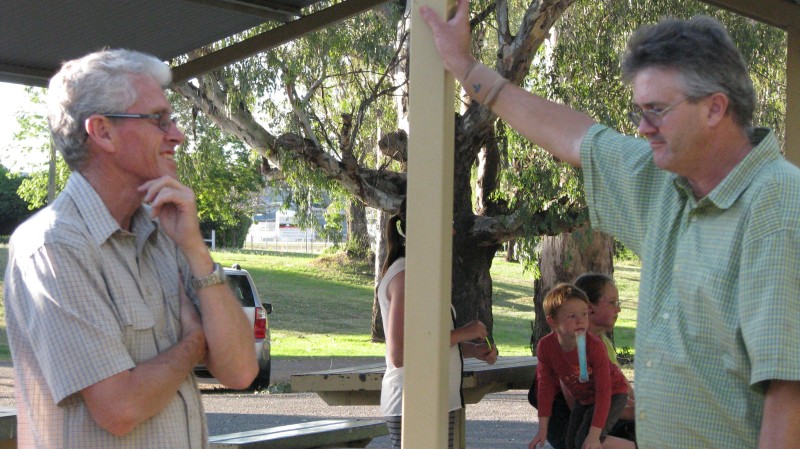
Near the end of last year, we ran a Family Festival as a Christmas outreach. It was an event, but it was incarnational. We sought out a location that was accessible to people- a park beside the river. We arranged activities, food and music. Each family received a gift bag with various goodies, including a New Testament. There was a good, happy and peaceful atmosphere, and people were free to converse in a relaxed environment. There was no altar call, but the Kingdom of God was present.
The attractional model has the advantage of being centralised and controllable. We can see how many attended and how many responded. It gives people a reason to invite people and to talk about their faith.
The incarnational approach is less tidy, but more like the way Jesus acted. He didn’t call out from heaven “Come on up and I’ll show you how to get saved.” He came down to where we live and showed us what God looks like in the flesh. Then He told us to do the same- show others what God looks like in the flesh.
The Great Commission tells us to GO and make disciples rather than STAY and tell people to come.
Let’s get out and live it.
 New Life Narrabri