faith
Former Sceptic Who Studied 1,500 Near-Death Experiences Says Evidence Points to Jesus

From Faithwire.com
A pastor and author who has investigated more than 1,000 near-death experiences (NDEs) believes there’s definitive evidence that many of these experiences are authentic.
John Burke, co-author of “Imagine the God of Heaven Devotional: 60 Reflections on the Heart of God from the Bible and Near-Death Experiences” with his wife, Kathy, told CBN News he was once a sceptic.
“Not only did I not believe in near-death experiences, I didn’t believe in Jesus or God,” he said. “Many … decades ago, my dad was dying of cancer and someone gave him the very first research that coined the term near-death experience.”
Burke said this came in the form of a book, which he ended up reading. At the time, Burke wanted evidence — and the book provided just that: stories of people who were clinically dead and resuscitated. Among the stories, he noticed many of those experiencing NDEs claimed to have seen Jesus.
“That really began my whole faith journey, because so many saw Jesus,” he said. “I was like, ‘I better be open to the Bible.’ So I started reading, and studying the Bible, came to faith.”
That was the start not only of Burke’s faith journey, but also his foray into NDEs. Over time, his intrigue bloomed into an investigation of 1,500 real-life cases. His previous book, “Imagine the God of Heaven,” was a hit and sparked much conversation about these important stories.
“What I write about is how the commonalities really do relate to the Bible and what the Bible’s expectation of heaven, of hell, of God,” Burke said.
His wife, Kathy, told CBN News she had a very different faith trajectory and can’t remember a time when she wasn’t a believer.
“Scriptural truths have always been a big part of my life, and I’ve enjoyed being able to stand on them,” she said. “And I know they’re solid.”
NDE’s left her deeply intrigued, with Kathy explaining that, though she believes the truth of Scripture is enough, these stories offer a fresh perspective and have revitalised her faith.
“It just has really given me a fresh perspective and revitalised my faith, and the the power of my faith, and the power of God in really amazing ways,” she said.
John expressed some of the most fascinating reflections he has had after exploring these stories — particularly the types of people who claim to have experienced NDEs.
“The thing that I like to point out is that many of these people that I’ve interviewed and write about, they were CEOs, they were spine surgeons, commercial airline pilots, bank presidents, lawyers,” he said. “They don’t need money, and they have nothing to gain by making up crazy, wild stories about dying and going to heaven and seeing Jesus, and yet, they consistently say it was the most real thing that ever happened to them.”
John said these stories inspire people all over the world, and he believes God is using these journeys to help illuminate Scripture and point people back to Him. Kathy mirrored these reflections.
“I also think that it reminds us that things are not hopeless,” she said. “God has not changed, and He’s the same yesterday, today, and forever, and so we have to keep our focus on Him, and we can still find that peace, and joy, and love, and goodness radiated because we’re His image bearers.”
It should be noted, though, NDEs aren’t embraced as legitimate experiences by the secular world and even some Christians. In fact, critics are often vocal about their opposition to these stories.
“God operates in more mystery than I think sometimes we’re willing to allow in the church and in our box of theology,” John said. “And God doesn’t feel any need or constraint to the box we try to put him in.”
He continued, “What we’re trying to do … in these books is help people see, ‘No, it’s not against what God’s been saying in Scripture all along — it actually aligns.’”
Kevin Vawser: Believe In Him

Believe in Him
I was in prayer a few nights ago, and God highlighted something to me. I was praying for something that was quite important, yet in my heart, I had fallen into despair. I was praying for something as if I had already lost the battle.
In that moment, God brought the most unlikely verse to my heart. John 3:16.
For God so loved the world that He gave His only begotten Son, that whoever believes in Him should not perish but have everlasting life.
As I heard that verse repeated, three words stuck out to me. ‘Believe in Him”
Suddenly, it was like an awakening to the reality I had placed myself in. I was believing in the problem, but had lost sight of God’s powerful hand.
We are saved through faith, and we are saved into faith. Our relationship with God is one of dynamic trust that is so much more than the key to our salvation. It is the foundation on which we stand that enthrones God over not only our lives, but our circumstances.
I don’t know how God will answer that prayer – but in the end, it does not matter. He will, I know it. Whatever it looks like, though – I believe in Him and trust Him to make it so.
So consider this in your prayer life, in the things you are seeking, and even in the questions you ask. Believe Him to answer – even if you do not know the details and even if it has already been a long time. Know that He is good, and does not contradict His word.
Kevin Vawser
Fear Uncertainty Doubt

The ability to create fear, uncertainty and doubt (FUD for short) has been shown over millennia to be an effective way to control people.
Tyrants rule by fear.
Politicians seek to score political points over their opponents or to undermine ideologies they disagree with, causing uncertainty.
Doubt arises when we believe that somebody cannot be trusted.
FUD is present everywhere in society and it takes many names.
People can be emotionally abusive to a spouse, using FUD to make the partner become more dependent on their abuser.
Gaslighting uses lies to cause a person to doubt their own senses, memories and sanity.
Technology businesses use FUD to make people lock into their products rather than a competitor.
I have been on the receiving end of a FUD attack and the emotions it generated in me were deep dread, fear and hopelessness. It was awful! Some people live with this every day.
All of this is opposed to God’s way of love. Paul tells us in 1 Corinthians 13:13. “And now these three remain: faith, hope and love. But the greatest of these is love.”
Faith is the opposite of fear, because by faith we believe that God is greater than anything that can destroy us.
Hope is opposed to uncertainty because hope looks forward to a better future, one that is held in God’s hands and not the manipulations of people.
Doubt is overcome by love because we can trust God to love us without fail.
Don’t let FUD overcome you. Instead let faith, hope and love flourish in your spirit.
Get You A Bible
‘Get You a Bible’: Couple Married 84 Years Delivers Powerful ‘God’ Response While Sharing Secrets to Love, Long-Lasting Nuptials

A couple with the longest-running marriage in the state of Arkansas has some simple advice for a successful marriage: seek the Lord.
Cleovis Whiteside, 102, and his wife Arwilda Whiteside, 98, got married in 1939, and with 84 years of matrimonial ups and downs under their belt, the couple recently delivered pointed advice to others.
“Pray,” Arwilda told USA Today, speaking to anyone considering walking down the aisle anytime soon. “Know how to get on your knees, and get you a Bible, because that Bible is going to have to take you through all kinds of storms.”
The couple openly credited God for their long-lasting nuptials, with Arwilda saying the Lord placed them together to “love one another.”
“We can hardly believe this is happening to us because we feel like we were the least, but God said, ‘No. You’ll glorify my name and love one another,’” she said, according to KATV-TV.
The Whitesides were honoured by the Arkansas Family Council, a Christian organisation that celebrates traditional families and marriage. The organisation honours the longest-married couples in the state, with the Whitesides reportedly currently holding the record in Arkansas.
The couple told USA Today about how their love story began, with the two meeting when Cleovis was 13 and Arwilda was 9; they married just a few years later.
The loving husband and wife had 12 children of their own and also housed others in need of families, with the duo being described as “pillars in the community.” Generosity, it seems, is ingrained in the fabric of the family, with Arwilda praising her husband’s kindness.
“He is always trying to help people,” she said.
Read more about the family’s story here.
‘Get You a Bible’: Couple Married 84 Years Delivers Powerful ‘God’ Response While Sharing Secrets to Love, Long-Lasting Nuptials
A couple with the longest-running marriage in the state of Arkansas has some simple advice for a successful marriage: seek the Lord.
Cleovis Whiteside, 102, and his wife Arwilda Whiteside, 98, got married in 1939, and with 84 years of matrimonial ups and downs under their belt, the couple recently delivered pointed advice to others.
“Pray,” Arwilda told USA Today, speaking to anyone considering walking down the aisle anytime soon. “Know how to get on your knees, and get you a Bible, because that Bible is going to have to take you through all kinds of storms.”
The couple openly credited God for their long-lasting nuptials, with Arwilda saying the Lord placed them together to “love one another.”
“We can hardly believe this is happening to us because we feel like we were the least, but God said, ‘No. You’ll glorify my name and love one another,’” she said, according to KATV-TV.
The Whitesides were honoured by the Arkansas Family Council, a Christian organisation that celebrates traditional families and marriage. The organisation honours the longest-married couples in the state, with the Whitesides reportedly currently holding the record in Arkansas.
The couple told USA Today about how their love story began, with the two meeting when Cleovis was 13 and Arwilda was 9; they married just a few years later.
The loving husband and wife had 12 children of their own and also housed others in need of families, with the duo being described as “pillars in the community.” Generosity, it seems, is ingrained in the fabric of the family, with Arwilda praising her husband’s kindness.
“He is always trying to help people,” she said.
Read more about the family’s story here.
5 Lies Our Culture Is Telling Us: Rosaria Butterfield
5 Lies Our Culture Is Telling Us

Lie #1: Homosexuality is normal.
Included in this lie is the belief that homosexual orientation is true and immutable—fixed and never-changing. Homosexual orientation, a nineteenth-century Freudian invention, is an unbiblical category of personhood and an antagonist to the creation ordinance because it redefines sinful desire as something that defines who you are rather than how you feel. Lie #1 claims that the word of God doesn’t apply to homosexual orientation because homosexual orientation represents a person’s core truth. Some professing Christians believe that homosexual orientation is fixed, immutable (unchangeable), and part of God’s creational and eternal plan. Some people believe that homosexuality is embedded in a person’s identity.
We must ponder why God’s attribute of immutability has been embraced by the LGBTQ+ movement as an attribute of homosexual orientation. God is immutable—God never changes. One theologian defines God’s immutability as “that perfection in God whereby He is exalted above all.” But if you exchange the Creator for the creature, you impose God’s attributes on man. When we hear “homosexual orientation is fixed and immutable—it never changes,” this is only imaginable in a world that has already exchanged the worship of the Creator for the worship of the creature—of God for an idol. “Gay Christians” (an oxymoron if there ever was one) teach that you can’t repent of who you are, how you feel, or even what you desire. They believe that homosexual orientation is morally neutral, separate from one’s sin nature, cannot be repented of, and rarely changes over a person’s lifetime. This is a lie.

Five Lies of Our Anti-Christian Age
Rosaria Butterfield
Bestselling author Rosaria Butterfield addresses 5 lies modern culture has embraced about sexuality and spirituality, using the word of God to help illuminate each topic.
Lie #2: Being a spiritual person is kinder than being a biblical Christian.
Unbiblical spirituality welcomes people exactly as they are or, at least, makes this promise. This is a religion that elevates being a “good” person over giving your life to Christ. To the unbiblically spiritual person, everything is one. Distinctions and hierarchies are called abusive, and true spirituality is supposedly found inside ourselves. This sort of spirituality, unbiblical spirituality, believes that everything in the universe supposedly shares in this divine power and unifying balance. Rules, divisions, and distinctions are violent, or so says the unbiblically spiritual person.
In contrast, for the biblical Christian, there are two kinds of reality: God and creation. God is eternal, triune, personal, holy, loving, and separate from his creation. According to biblical spirituality, there are two kinds of people: those who love God and those who defy God. Even though we create our own problems by refusing to live by his laws, God provides the only solution through the Lord Jesus Christ. Pastor and theologian Peter Jones, founder of TruthXchange, offers the most helpful paradigm for comparing unbiblical spirituality to biblical spirituality. While unbiblical spirituality self-promotes as kind and inclusive, it is in reality narcissistic and damning.
Lie #3: Feminism is good for the world and the church.
Feminism began in 1792 with Mary Wollstonecraft’s A Vindication of the Rights of Woman. As its title suggests, it sought to “vindicate,” which means “to assert one’s right to possession.” And what rights needed possessing? Women needed to possess the rights to citizenship. Wollstonecraft sought rights for education and voting for women. Feminism has gone through four “waves” or phases since 1792, with the most recent wave so tied to the LGBTQ+ movement that now, in 2023, we cannot even define what a woman is or defend her right to exist—least of all to be noted as a citizen. Feminism in the world is passè—it has been displaced by transgenderism. Feminism in the evangelical church, however, is alive and well. When the church sets itself up to follow the world and not to lead it, it necessarily lingers long with discarded trends and affections.
We don’t need to be all-knowing, because God is. Christ alone can solve the problems we face today.
Adherents of feminism believe the Bible has no bearing on gender roles, responsibilities, or requirements because the idea of men and women being made by God’s design for God’s purposes on earth is old-fashioned, silly, dangerous, abusive, and culturally driven. Some professing Christian feminists believe that Adam’s headship is a consequence of the fall—and thus a sin. They claim that there is no biblical warrant for a married woman’s submission to her husband and elders or for elders and pastors to be qualified men. Bible verses that call for a wife to obey her husband in the Lord, such as Titus 2:4–5, 1 Peter 3:1, 5–6, and Colossians 3:18, are “contextualized” and then dismissed. Such feminists believe that feminism offers a corrective to Christianity because, without it, misogyny (the hatred of women) will run rampant with biblical support. Without feminism to the rescue, they argue, the church will unwittingly promote sexual abuse by giving perpetrators extreme and unchecked power and spiritual abuse by prohibiting a woman from using her gifts of teaching from the pulpit and assuming the roles of pastor and elder. This is a lie.
Lie #4: Transgenderism is normal.
People who believe in what is called “gender fluidity” also believe that sexual difference has no biological or ontological (original and eternal) integrity. Transgenderism is supposedly as normal for some people as freckles and a blue sky on a North Carolina summer day. Transgenderism maintains that there are more than two biological sexes and even more genders. The year 2022 boasts seventy-two genders and seventy-eight gender pronouns. In time there may be ten thousand. What does this all mean? How did we get to a place in the United States where someone can walk into Planned Parenthood and, forty-five minutes later, leave with a prescription for powerful hormones that will leave her sterilized for life if taken over time? We got here by believing the lie that transgenderism is normal—at least for some people.
Lie #5: Modesty is an outdated burden that serves male dominance and holds women back.
People who believe this lie dismiss the virtue of modesty for Christian women. Having denied that men and women are different, with different responsibilities, callings, and boundaries, those who reject modesty believe that calling women to a different standard of dress, speech, and conduct is oppressive. They deny that women owe their brothers the kindness of modesty. At the bottom of this is a feminist belief that it is not fair that women are different from men and that asking women to dress and behave with biblical modesty serves male dominance and holds women back. In the contemporary church climate, modesty has been replaced by exhibitionism.
Cling to Christ with Courage
When it seems like we are living at ground zero of the Tower of Babel, when the whole world seems to have gone mad, we need to cling to Christ with courage, read and memorize our Bible with fervency, be active members of a faithful Bible-believing church with passion, sing psalms with joy, and pray for our enemies with humility. We need to be humble people, remembering that we were not created to be all-knowing. We don’t need to be all-knowing, because God is. Christ alone can solve the problems we face today.
God calls us to live our Christian lives with courage, tell the truth, and fear God and not man. Can we with Jesus sing Psalm 118:6: “The Lord is on my side; I will not fear. What can man do to me?” I know. You can think of a long list of things the world can do to you. Your son, who calls himself Julie, won’t talk to you. You will be fired from your job if you don’t put a rainbow sticker on your door. Your neighbors will hate you when they learn that you believe in the God of the Bible. All of this may be true, and still this verse calls us to put things in perspective, specifically the Lord’s perspective as seen in Hebrews 11, where we see firsthand that God uses our faith whether we live or die.
This is the faith story we like:
And what more shall I say? For time would fail me to tell of Gideon, Barak, Samson, Jephthah, of David and Samuel and the prophets—who through faith conquered kingdoms, enforced justice, obtained promises, stopped the mouths of lions, quenched the power of fire, escaped the edge of the sword, were made strong out of weakness, became mighty in war, put foreign armies to flight. (Heb. 11:32–34)
This is the faith story that terrifies:
Others suffered mocking and flogging, and even chains and imprisonment. They were stoned, they were sawn in two, they were killed with the sword. They went about in skins of sheep and goats, destitute, afflicted, mistreated—of whom the world was not worthy. (Heb. 11:36–38)
God records that both life and death, if done in faith, advance the gospel and give glory to God. Christians ought never despise suffering for Christ. And as we are seeing today and have seen throughout church history, all true Christians will suffer for the truth of Christ.
This article is adapted from Five Lies of Our Anti-Christian Age by Rosaria Butterfield.

Casey Chalk: Texting With AI Jesus
From firstthings.com


Want to talk to the Son of God? There’s an app for that. Text With Jesus, a Los Angeles–based product that launched in July, replicates an instant messaging platform and features biblical figures impersonated by the artificial intelligence program ChatGPT.
Among the characters available on the app are the Holy Family, the apostles, various prophets, Ruth, Job, and Abraham’s nephew Lot. Mary Magdalene is also available, but only to premium subscribers for $2.99 a month. You can even chat with Satan, who signs his texts with a “smiling face with horns” emoji.
Perhaps such an app provokes fears of blasphemy. Not to worry: Stéphane Peter, the app’s developer and the company’s CEO, ensured that character responses always include a Bible verse. “Our AI always generates responses that are in line with the teachings of the Bible,” explains the website. He also invited unnamed “church leaders” to try the beta version of the app. Though some pastors had reservations at the beginning, the app’s final version received “pretty good feedback.”
Text With Jesus’s characters typically avoid any stance that might be perceived as offensive, instead maintaining a line of inclusivity and tolerance. If asked about gay marriage, for instance, the app will respond that it is “up to each individual to seek guidance from their own faith tradition and personal convictions,” and that users should “prioritize love and respect for all people regardless of their sexual orientation or gender identity” (followed by a rainbow and red heart emoji). If queried about feminism, app Jesus will explain the importance of “empowering women and breaking societal barriers that limited their opportunities.”
So far, so “healthy.” The app aligns with our clinical culture, which emphasizes personal affirmation and physical and mental wellness. Text With Jesus offers a moral, therapeutic god for a moral, therapeutic age, as sociologist Christian Smith calls it in his 2005 book Soul Searching. It replaces the arcane “second person of the Trinity” with Jesus the therapist and social worker.
This Jesus is not here to condemn (obviating less “warm and fuzzy” Gospel episodes such as the improperly dressed wedding guest of Matthew 22:1–14, or Jesus’s statements about the “Sign of Jonah” in Luke 11:29–32). He is here to affirm us and our behaviors and opinions. He certainly wouldn’t want you to feel bad about yourself and repent (unless you are repenting of “bigoted,” “patriarchal,” or “fascist” opinions on race, sex, or gender).
Text With Jesus represents the age-old human vice of pride. Through our creativity and brilliance, we seek to ascend to God’s level, to be like him, and even to dictate terms to the divine. Or rather, the app is a diabolical inversion of this: Instead of being transformed into God’s image, we aim to make him into our own. Is seeking to communicate with and control God through a handheld device really all that different from the ancient metalworkers who fashioned little totems to whom they could offer supplication for their own health and prosperity?
The app’s insistence that its content is “Bible-based” is curious, given that the biblical characters sidestep Scripture’s more controversial and provocative claims. It does then seem to reflect the embarrassing biblical illiteracy even of those claiming to be Christians, and that people, even the pious, tend to prefer a religion that avoids uncomfortable truths in favor of what we want to hear.
Yet perhaps most sadly, that Text With Jesus would even be conceived and consumed reveals how deeply wedded we have become to our smartphones. Prayer is such a remarkable human experience because of its universality, both in terms of who can do it (everyone) and where it can be done (anywhere). I pray in my bedroom, on my commute, waiting in line, and while exercising. I can pray the divine liturgy, a rosary, or simply talk and listen.
Indeed, one of the most beautiful things about Christian prayer is the quality of the access. “Ask, and it will be given you; seek, and you will find; knock, and it will be opened to you. For everyone who asks receives, and he who seeks finds, and to him who knocks it will be opened. . . . If you then, who are evil, know how to give good gifts to your children, how much more will the heavenly Father give the Holy Spirit to those who ask him!” (Luke 11:9–10, 13) What has happened to us, that anyone would contemplate inserting a gimmicky Silicon Valley tool into something so profoundly human and liberating? (I should note that I do not intend to “throw shade” on apps such as Magnificat or Hallow that help facilitate prayer through Scripture readings, meditations, or the divine liturgy.)
To be a people formed by prayer, we Christians need to protect and cultivate our little spiritual gardens, where we can let Jesus be himself, in all his terrifying glory. Because it is in “practicing in the presence” that we can appreciate the reality of an omnipotent, omniscient God who deigns to care about us and our problems. But in order to walk with him, and talk with him, and share that joy, I wager we’ll need to put our phones on silent.
Casey Chalk is a contributing editor at the New Oxford Review.
Queen Elizabeth wanted to see Jesus return, so she could cast her crown at his feet
From godreports.com
Queen Elizabeth wanted to see Jesus return, so she could cast her crown at his feet
By Charles Gardner —

Queen Elizabeth based her entire life, and her extraordinary 70-year reign, on Jesus, the Jew, the rock and guide of her long reign. Yet though she has travelled the world more than most, she never set foot in Israel, the land which gave birth to the Christian faith she so devoutly followed.
Every year at Christmas, in a broadcast to the nation watched by millions worldwide, the Sovereign shared her personal Christian faith as key to all she does.
Some years ago, for example, she quoted a verse from a well-known carol, In the bleak midwinter: “What can I give him, poor as I am, If I were a shepherd, I would bring a lamb, If I were a wise man, I would do my part, Yet what I can I give him, give my heart.”
As a true evangelist in the spirit of Billy Graham, she encouraged millions of viewers to give Jesus their heart. This was our Queen, and we are all so proud of her! Only today I heard of a conversation she held with an acquaintance in which she is said to have stated: “I wish Jesus would come back in my lifetime.” Asked why, she reportedly replied: “Because I would place my crown at his feet.”
In his sermon at St Paul’s Cathedral to mark the Queen’s Platinum Jubilee in June, Archbishop of York Stephen Cottrell said she was “someone who has been able to serve our nation faithfully because of her faith in Jesus Christ”. And then he added this challenge: “Perhaps there is no better way of celebrating her Platinum Jubilee than by doing the same ourselves.”
On this point, it is truly exciting to witness how the entire nation, led by the secular media, is being taken up with the wonder and reality of our late Queen’s faith.
Referring to the Apostle Paul, the Archbishop said he was only worth following because he was following Jesus, adding: “For me, the best leaders – like Paul, like Jesus – are those who know how to be led.”
The UK’s Chief Rabbi Ephraim Mirvis testified: “I recall how, on one occasion, she showed me and my wife items of Jewish interest and value in her private collection at Windsor Castle, including a Torah scroll rescued from Czechoslovakia during the Holocaust. Her affection for the Jewish people ran deep, and her respect for our values was palpable.”
The long exile from the modern Jewish state by British royalty is perhaps complex, but seems to reflect Foreign Office policy, which generally amounts to appeasement of the surrounding Arab nations.
The Queen’s affection for the Jewish people ran deep. But it was her faith in Jesus, the Jew, that proved the light and strength of her long life and reign.
The Queen’s mother-in-law, Princess Alice of Greece, was honored with the title of ‘righteous among the nations’ for her bravery in hiding a Jewish family during the Holocaust, and is buried on the Mt of Olives.

In 2018, significantly 70 years¹ after the rebirth of Israel, British royalty ended their ‘exile’ from official visits to the Holy Land when Prince William, the Queen’s grandson (now the Prince of Wales and first in line to the throne) toured the country.
The Queen’s eldest, now King Charles III, had already visited Israel twice to pay respects at state funerals as well as fulfilling a longstanding wish to visit his grandmother’s grave, but these were not considered official tours.
However, in what was seen to contribute to a positive new era in British-Israeli relations, Charles then attended the World Holocaust Forum in Jerusalem in January 2019. Charles has shown constant support for Holocaust survivors over the years, regularly inviting them to lavish teas, as one of them has shared with me.
In 2017, a rumored visit by Prince Charles was reportedly cancelled by the Royal Visits Committee on the grounds that it would “upset Arab nations in the region who regularly host UK royals”.²
The Queen’s late husband Prince Philip’s only trip was in 1994 to attend a ceremony commemorating his mother, Princess Alice who, as Princess of Greece, hid Jewish widow Rachel Cohen and two of her five children in her home. Rachel’s husband had in 1913 helped King George I of Greece, in return for which the king offered him any service he could perform, should he ever need it. When the Nazi threat emerged, his son recalled this promise and appealed to the Princess, who duly honored her father’s pledge.
As I watched Charles’ beautiful tribute to his mother shortly after she died, I found myself praying the prayer of William Tyndale as he was about to be martyred for daring to translate the New Testament into English: “Lord, open the King of England’s eyes.”
We know the new king has been less vocal and precise about his faith than his mother, but I pray that God will also open his eyes to the uniqueness of Christ and his gospel. God save the King!
We know the new king has been less vocal and precise about his faith than his mother, but I pray that God will also open his eyes to the uniqueness of Christ and his gospel. God save the King!
1 The period spent in Babylon by the Jews of old.
2 Daily Mail, 2 March 2018
Survey Shows Many Pastors Are Teaching Deception
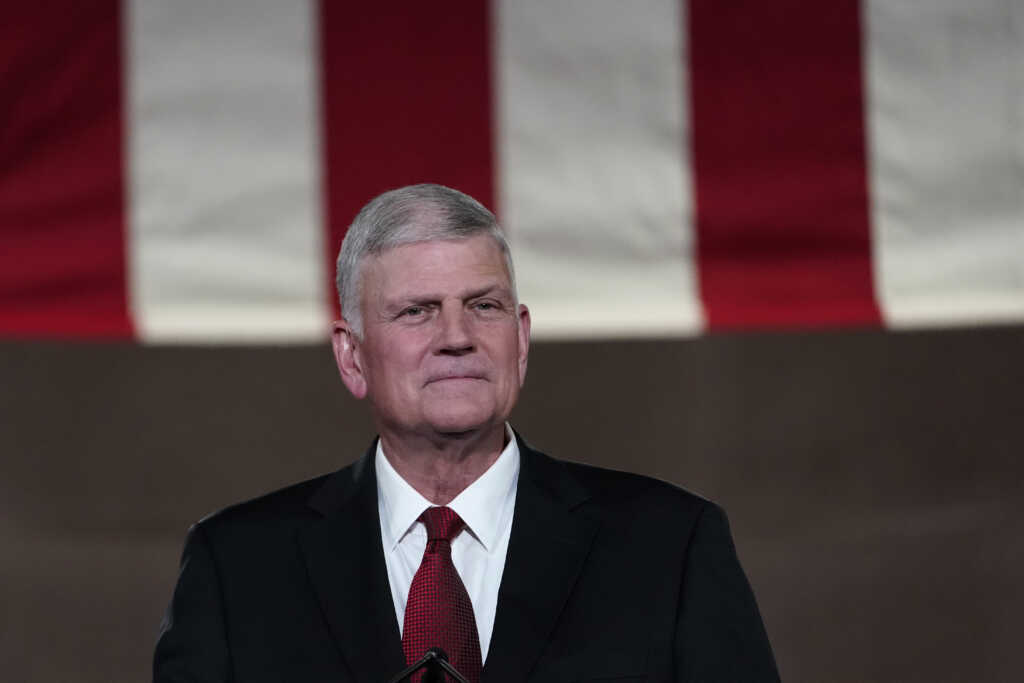
‘What a Lie’: Franklin Graham Reacts to Shocking Pastoral Survey, Lambastes ‘False Teaching…Leading People & Churches Astray’
From faithwire.com
Evangelist Franklin Graham reacted this week to shocking survey data showing more than one-third of senior pastors purportedly believe “good people” can earn their way to heaven, with Graham lambasting some of the findings as “false teaching.”
“I don’t know which 1,000 pastors this group surveyed, but the results are concerning,” Graham tweeted Monday. “39% of ‘evangelical’ pastors they asked said there is no absolute moral truth & that ‘each individual must determine their own truth.’”
He added, “What a lie.”
Graham’s strongly-worded response came after pastoral survey results were published by The American Worldview Inventory, an annual report from the Cultural Research Center at Arizona Christian University.
At least one-third of respondents also said they believe the Holy Spirit isn’t a person and is instead a “symbol of God’s power, presence, or purity,” with at least the same proportion preferring socialism over capitalism. At least one-third also believe “having faith matters more than which faith you have.”
Perhaps most stunning, though, is the 39% figure Graham cited, as that’s the percentage of evangelical pastors who reject the idea of absolute morality and believe individuals get to “determine their own truth,” as The Christian Post reported.
In an age of moral chaos and confusion, these statistics are deeply troubling, which is something Graham underscored as he warned of the impact false beliefs have on the body of Christ.
“The survey also said that 30% of evangelical pastors do not believe that their salvation is based on having confessed their sins & accepting Jesus Christ as their Savior,” he continued in another tweet. “This kind of false teaching is what is leading people & churches astray.”
Graham concluded his tweets on the matter with a passionate defense of the Gospel.
“The Bible is God’s Word, from cover to cover,” he wrote. “It is the absolute truth — it is what counts, not our opinion.”
As Faithwire previously reported, alarming data on American pastors’ beliefs is nothing new. Earlier released data from the Cultural Research Center revealed just 37% of U.S.-based pastors hold to a “biblical worldview.”
 New Life Narrabri