Peter Ridd: The Great Barrier Reef Is Doing Fine

My article from The Australian this morning below. But first, AIMS are agreeing that the reef is coming off record highs so the small drop should be viewed in that context. However, much of the media is still reporting the drop as a disaster.

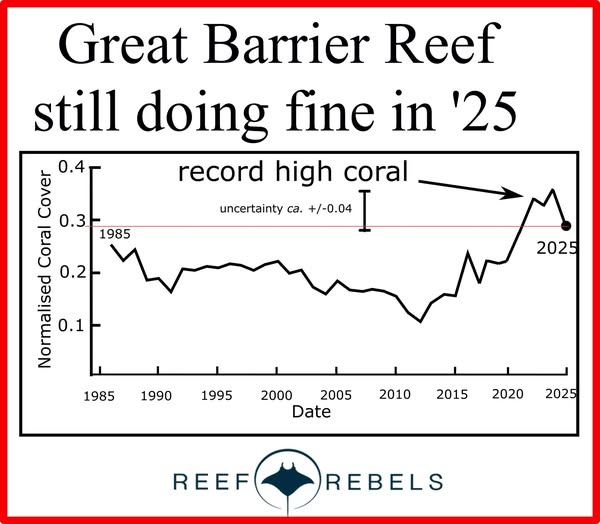
The latest 2025 statistics on the amount of coral on the Great Barrier Reef (GBR) show the reef is still doing fine despite having six allegedly cataclysmic coral bleaching events in the last decade. There should be no coral at all if those reports were true.

The normalised coral cover dropped from a record high number of 0.36 down to 0.29, but there is still twice as much coral as in 2012. The raw coral cover number for all the last five years has been higher than any of the previous years since records began in 1985. However, when one considers the uncertainty margin, the present figures are not significantly different from many of the previous years.

The Australian Institute of Marine Science collects coral data on around 100 of the 3000 individual coral reefs of the GBR. Analysis of the data at smaller scales shows the GBR is doing what it always does – change. There is a constant dynamic as cyclones, starfish plagues and bleaching events dramatically kill lots of coral in small areas, while it quietly regrows elsewhere.

Guess whether the ‘science’ institutions emphasise the death or regrowth.

The institutions often justify this embarrassingly high coral cover as just “weed coral”. But the type of coral that has exploded over the last few years is acropora, which is the most susceptible to hot-water bleaching. How can we have record amounts of the type of coral that should have been killed, again and again, from bleaching? The acropora takes five to ten years to regrow if it is killed.

There are two conclusions that must be drawn. First, not much coral has been killed by climate change bleaching – at least not compared to the capacity of coral to regrow. Second, the science institutions are not entirely trustworthy, and are in need of major reform.

And not just with regard to GBR or climate science. It is well recognised that most areas of scientific study are suffering a problem of reliability, which is damaging the reputation of science itself. It is well accepted that around half of the recent peer-reviewed science literature is flawed. Is there any other profession with such a high failure rate?

This last point has been noted in the United States, where American science is going through a process of genuine revolution. Scientists who were once victimised and ostracised have been appointed to lead science and medical research institutions. Among the more notable and encouraging appointments have been Professor Jay Bhattacharya who famously opposed the groupthink on Covid lockdowns, especially for children. He is now head of the National Institutes of Health and is proposing radical changes in the funding methodology to break the cycle of groupthink. He is also changing funding rules to encourage bright young scientists with new ideas rather than the present system which rewards older scientists who are wedded to conventional wisdom, and often enforce groupthink. In short, Bhattacharya is encouraging dissenters.

The US Department of Energy recently released a report on whether the conventional wisdom on climate change is entirely defensible. It is written by five eminent scientists, all with spectacular careers, who have consistently challenged the view that climate change is an existential threat. Their report includes data about GBR that shows there is little to worry about. Significantly, it systematically addresses many other aspects of Climate-Catastrophe Theory, such as wildfires and deaths from extreme weather events. And it points out the oft-ignored fact that carbon dioxide is a wonderful plant fertilizer which has already increased crop yields and plant growth.

Most importantly, rather than shutting down critics, the report’s writers are actively encouraging criticism, which they will respond to.

Science progresses through argument, logic, and quality assurance systems that make sure debate always takes place. Groupthink kills science, and groupthink is being challenged like never before in the US.

This revolution seems a long way off for Australia. But it will come, simply because US science, and science funding, dominates all other countries.

Imagine if Professor Ian Plimer, Australia’s most famous climate sceptic, was in charge of our climate science funding. Or if I were in charge of the Great Barrier Reef Marine Park Authority. Sounds crazy. But that is what has effectively happened in the US.

Australia’s science agencies would do well to contemplate whether they need to change their ways before the revolution comes to these shores. Better to adapt before the scientific guillotine falls.

Peter Ridd is an Adjunct Fellow at the Institute of Public Affairs.
Health of Fish Stocks Contradict Climate Alarmists Predictions

From wattsupwiththat.com

Health of Fish Stocks Contradict Climate Alarmists Predictions

By Vijay Jayaraj

The oceans are still very much a mystery to humankind, with a vast majority of it yet to be explored. Early in my career, I wanted to make an in-depth study of how climate affected marine life. After all, many media reports claimed that “oceans will become empty by 2048.”

So, as a graduate research assistant, I explored the adaptability of marine fish and invertebrates to fluctuations in ocean temperatures. I found that both are highly adaptable to changes in the water around them. That is the way they are made.

Now, evidence emerging from scientific studies shows that marine life may be benefiting from the relative warmth of modern temperatures.

Contrary to the hyperbole of climate reporters, there has been no alarming increase in global sea-surface temperatures. Even if temperatures increase substantially, fish are free to migrate to cooler waters and do, as documented by scientific studies.

Fish also have natural adaptive mechanisms. Since their initial emergence in Earth’s waters, fish have developed genetically in ways that allow them not only to survive but to thrive in a variety of environments. In addition to the generational genetic adaptability, fish also display short-term phenotypic plasticity which allows them to adapt to temperatures and other physical factors. When combined, these mechanisms act as significant protection against the ill-effects of the physical environment.

Despite this, it is not uncommon to see news of fisheries crashing under the weight of a climate crisis. However, real-world data contradict such negative reports, indicating instead that global fish catches will improve in the coming decades.

2016 scientific study “assembled the largest-of-its-kind database and coupled it to state-of-the-art bioeconomic models for more than 4,500 fisheries around the world.” The study found that global fisheries will profit from an increase in marine species. The degree of this commercial success will depend on a range of policy measures, including ones that enable increased catches for individuals and communities.

In 2020, there was a record 214 million tonnes of production from both wild catches and aquaculture. The State of World Fisheries and Aquaculture 2022 report says that this production is expected to grow 14 percent by 2030. Fish are expected to become more affordable and accessible, with prices decreasing between 2024-2029, according to two international bodies: the Organization for Economic Co-operation and Development (OECD) and United Nation’s Food and Agriculture Organization (FAO) that published the data in Agricultural Outlook.

As of 2017, around 65% of fish stocks were biologically sustainable. An index of population health is maximum sustainable yield (MSY), which is the point at which the stock can sustain itself without limits on fishing. The MSY calculation involves collaborative information gathering by marine biologists and fishers.

The 2022 report states that the number of catches from biologically sustainable stocks has been on the rise! This signals that catches can be increased without depleting the stock to levels that neither the species nor continued fishing is at risk. While some concerns remain for a few species, studies show that in regions where we have high-quality population data, the majority of fish stocks are either stable or improving.

In short, any threat to future catches is not “empty” seas but rather the effect of activities such as illegal fishing and overfishing. Fish as an important protein source is likely to remain available in large quantities. Reality contradicts the fallacious climate crisis that dominates popular media and politics.

This commentary was first published in American Thinker on February 10, 2024.

Vijay Jayaraj is a Research Associate at the CO2 Coalition, Arlington, Virginia.  He holds a master’s degree in environmental sciences from the University of East Anglia, U.K.

Jennifer Marohasy: Coral Snapshot 2022-23, & All the Unanswered Questions

From the IPA
ORIGINALLY APPEARED IN JENNIFER MAROHASY’S WEBSITE

Full marks to David Mills, writing in the Courier Mail, for asking why the government tends to bury good news reports about the Great Barrier Reef.

There are a few other questions that I would like answered.

Key government ministers, marine scientists, and climate scientists have been unable to acknowledge:

Q1. Overall coral cover has been increasing since at least 2009 (14 years).

Q2. According to official underwater surveys – that are perimeter surveys – coral cover is at a record high.

I know Sky Television legend Rowan Dean has been in trouble with the press watchdog over this good news claim. But it seems pretty straightforward, quoting from the most recent relevant government report:

Widespread recovery has led to the highest coral cover recorded by the Long-Term Monitoring Program in the Northern and Central Great Barrier Reef …

Q3. These perimeter surveys under estimate coral cover, claiming it to be less than 40%, when coral cover is often more than 90% at the crest of the same reef.

Corals around the outside/perimeter of reefs are particularly susceptible to cyclone damage.

The official surveys of coral cover are somewhat misleading because the survey is done of just one habitat type, the reef perimeter. Most of the coral is at the reef crest. The survey of John Brewer reef followed the track shown by the yellow, orange and green lines.
 

Q4. The number and intensity of cyclones has been decreasing since at least the 1970s. Something the Bureau of Meteorology is unable to acknowledge. Why?

Read the rest of the article here

Giant Reef Discovered Near Tahiti

Australian media seem to have been silent about the discovery of a giant pristine reef near Tahiti, apparently untouched by “climate change.” Makes you wonder how it has coped without UNESCO World Heritage listing or environmental worriers trying to “protect” it.

From Canada’s CBC:

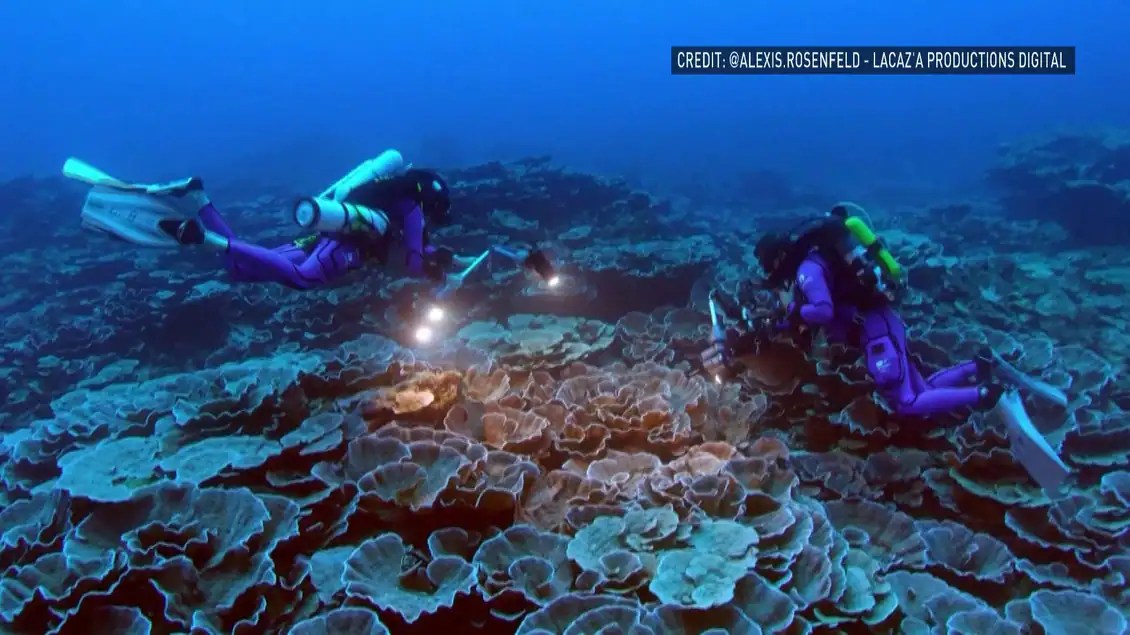
Scientists have discovered a pristine, three-kilometre-long reef of giant rose-shaped corals off the coast of Tahiti, in waters of the southern Pacific Ocean thought to be deep enough to protect it from the bleaching effects of the warming ocean.

The reef, which lies at depths of more than 30 metres, probably took around 25 years to grow. Some of the rose-shaped corals measure more than two metres in diameter.

“It was magical to witness giant, beautiful rose corals, which stretch for as far as the eye can see. It was like a work of art,” said French photographer Alexis Rosenfeld, who led the team of international divers that made the discovery.

Most of the world’s known coral reefs are in warmer waters at depths of up to 25 metres, the United Nations Educational, Scientific and Cultural Organization (UNESCO) said. The reef off Tahiti lies in the “twilight zone” 30 to 120 metres below the surface where there is still enough light for coral to grow and reproduce.

UNESCO says the newly discovered reef is one of the largest in the world.

Bleaching is a stress response by overheated corals during heat waves. They lose their colour, and many struggle to survive.

Perhaps the most famous — Australia’s Great Barrier Reef, a World Heritage-listed wonder — has suffered severe bleaching to an estimated 80 per cent of its corals since 2016.

The discovery off Tahiti’s shores suggests there may be many more unknown large reefs in our oceans, given that only about 20 per cent of the entire seabed is mapped, according to UNESCO scientists.

“It also raises questions about how coral reefs become more resilient to climate change,” UNESCO’s head of marine policy, Julian Barbiere, told Reuters.

More of the ocean floor needs to be mapped to better safeguard marine biodiversity, Barbiere said.

“We know more about the surface of the moon or the surface of Mars than the deeper part of the ocean.”

Great Barrier Reef growing at record rate

Jo Nova writes:

What climate disaster? The Great Barrier Reef has more coral growing on it than ever recorded

The coral cover as sampled by AIMS across the entire Great Barrier Reef is not just good, but better than it has ever been in the 36 years they have been studying it. If the reef is in danger — it’s from being overgrown with coral. Climate Change, such as it is, has caused no trend at all.

If anything, in the spirit of modern-media-science, climate change causes record coral growth.

Tonight the UN scientists decided not to list the reef as “in danger”. The ABC and every Green group who normally follow UN scientists slavishly said that was “only because of lobbying”.

Record Coral Cover on the Great Barrier Reef.

The new AIMS report on Monday showed the Great Barrier Reef had a remarkable recovery, but the graphs were of three different sections of the reef (North, central and South). Peter Ridd obtained all the data and combined it to make one graph and discovered that the coral cover of 2020 was a new all time record high.

Strangely none of the government agencies or paid Professors discovered this. You have to be unemployed to discover record coral growth.

Science and media doomsayers ignore good news on reef

Peter Ridd, (The Professor that JCU sacked for being “non-collegial”) The Australian

Like all other data on the reef, this shows it is in robust health. For example, coral growth rates have, if anything, increased over the past 100 years and measurements of farm pesticides reaching the reef show levels so low that they cannot be detected with the most ultra-sensitive equipment.

This data is good news. It could hardly be better. But somehow, our science organisations have convinced the world that the reef is on its last legs. How has this happened?

The only thing the reef is plagued with is “experts”:

It was reasonable in the ’70s to be concerned about these plagues and they ultimately precipitated AIMS’s long-term monitoring of coral and starfish in the ’80s. I was working at AIMS when this important work started, and it is interesting to look back on what has changed. The coral cover is no less, the number of starfish is no more, but the number of scientists and managers working on the reef has exploded. Perhaps this is the problem.

Record coral cover means there was no disaster on the reef. The only disaster is the quality assurance at the science organisations.

In the last few hours the Great Barrier Reef barely escaped being labeled as “in danger” by a branch of the China-friendly-UN. Instead UNESCO will leave it at “critical” and decide again in a year if the 340,000 square kilometer reef is in danger of turning into a calcium-carbonate quarry.

The Australian ABC has already decided this was only because the Minister played games and pulled some tricks on a “whirlwind diplomatic effort” to override the UN body’s scientific advisors. Apparently the science advisors of the UN are so corrupt they can be bought off with a few rushed phone calls from a minor Australian minister, but these same advisors would never be influenced by the giant Chinese Communists with their billion dollar Belt and Roads, debts and honeypot traps.

Remember the UN experts are always right except when they’re not.

But China still wins this round of sabre rattling. By leaning on the UN to tell Australia off, the Australian government is still  tying itself in knots and spending millions to save a reef that has already saved itself.

We’ll have to hand in our homework report again as soon as February 2022. And the hack-media are not reporting on why UNESCO don’t care about China’s concrete-the-reef approach.

Greenpeace et al, who would have told us how horrified they were if the reef was listed as “in danger”, said they were disappointed it was not.

UNESCO would not get away with these absurdly transparent games if the Western media and most universities did not provide continuous running cover for their hypocrisy.

REFERENCE

The Australian Institute of Marine Science’s (AIMS) Long-Term Monitoring Program – Annual Summary Report on Coral Reef Condition for 2020/21

Latest Great Barrier Reef Condition Report

Reef Fish Not Affected by Ocean “Acidification”

Photo by David Clode on Unsplash

A few years back there was an alarming study out of James cook University claiming that the gradual decrease in ocean pH caused by higher levels of CO2 in the atmosphere caused fish to radically change their behaviour.

A new study says this is not true.

From wattsupwiththat.com

James Cook University Researchers Refuted: “Ocean Acidification Does not Impair” Fish behaviour

Lower ocean pH level affecting fish?

Earlier research beginning in 2009 by Prof. Philip Munday and Danielle Dixon of Australia’s James Cook University suggested that that “ocean acidification” was having dire effects on fish behavior, thus prompting the IPCC to claim in a 2014 report that it could lead to  “profound consequences for marine diversity” and the media to put out a series of climate doomsday reports.

But the alarming research results of Munday and Dixon have since been seriously challenged by a group led by fish physiologist Timothy Clark of Deakin University in Geelong, Australia in a recent paper:

A year ago the researchers published the results of a comprehensive 3-year study in the journal of Nature in a paper titled: “Ocean acidification does not impair the behaviour of coral reef fishes“.

The paper’s abstract:

Coral reef fishes are predicted to be especially susceptible to end-of-century ocean acidification on the basis of several high-profile papers4,5 that have reported profound behavioural and sensory impairments—for example, complete attraction to the chemical cues of predators under conditions of ocean acidification. Here, we comprehensively and transparently show that—in contrast to previous studies—end-of-century ocean acidification levels have negligible effects on important behaviours of coral reef fishes, such as the avoidance of chemical cues from predators, fish activity levels and behavioural lateralization (left–right turning preference). Using data simulations, we additionally show that the large effect sizes and small within-group variances that have been reported in several previous studies are highly improbable. Together, our findings indicate that the reported effects of ocean acidification on the behaviour of coral reef fishes are not reproducible, suggesting that behavioural perturbations will not be a major consequence for coral reef fishes in high CO2 oceans.”

Die kalte Sonne reports on the new findings, noting that Clark et al repeated the trials by Munday and were unable to reproduce the results:

A team of seven scientists led by Timothy Clark of the Australian Deakin University published in  the renowned journal Nature an analysis with devastating criticism of the dramatic scenarios of the Munday group.” […]

“The group of critics also expect no negative consequences in the behaviour of the coral fish also at high levels of CO2 at the end of the 21st century.”

The James Cook University however, denies sloppy science was done by Munday and his team of scientists.

The James Cook University has been caught up in controversy, especially over the firing of researcher Prof. Dr. Peter Ridd, who claims he was sacked for expressing unpopular views.

Also read more on Munday’s controversial research here.

Rare albino turtle hatchling has slim chance of survival on Lady Elliot Island

Rare albino turtle hatchling has slim chance of survival on Lady Elliot Island

 / 

A white turtle emerges from the nest onto the coral cay of Lady Elliot Island.
The albino green turtle hatchling on Lady Elliot Island in the southern Great Barrier Reef.(

Supplied: Jessica Buckman

)

A rare albino green turtle hatchling has been seen making its way into the ocean off Lady Elliot Island in Queensland’s southern Great Barrier Reef, but it faces an even slimmer chance of surviving to adulthood than its siblings.

Key points:

  • Researchers estimate one in every 100,000 turtle hatchlings is albino
  • The lack of colour is caused by a melanin deficiency
  • The hatchling has limited sight and is more visible to predators

The tiny turtle emerged from its nest this week, taking researchers on the island by surprise.

The Island’s Ecosystem Management Officer Jim Buck said the team had not expected to encounter the unique creature.

“It’s not something that we see walking down the beach regularly,” Mr Buck said.

An tiny albino turtle hatchling scurries over pebbles and sand
Researchers believe the albino hatchling has a very slim chance of survival.(

Supplied: Jodi Carlton

)

“I believe there have been one or two observed here at Lady Elliot in the past, but it’s not something we see regularly.”

A previous sighting of a rare albino green turtle was reported on the Sunshine Coast in 2016.

Pink body, red eyes

Mr Buck said the hatchling’s unique appearance was caused by the absence of melanin.

“The amount of melanin in the system dictates the colour of the animal and in this particular instance the animal was white or pink in colour, indicating that melanin was absent or very, very low,” he said.

Survival odds slim

Researchers have estimated only one in 1,000 green turtle hatchlings survive to adulthood — and the outcomes for albino turtles are even less optimistic.

Mr Buck said poor vision and an inability to camouflage reduced albino turtles’ chances of survival.

“These little guys they struggle to get out of the nest and if they do they’re not well suited to the environment,” he said.

“We would normally expect about one in 1,000 hatchlings to return as an adult [but] in this instance, its chances would be very, very slim.”

Coral Reefs Can Take The Heat, Unlike Experts Crying Wolf

Interesting article from reef scientist Peter Ridd about why coral bleaching is not the disaster some would have you believe. From Watts Up With That


Coral Reefs Can Take The Heat, Unlike Experts Crying Wolf

  • Date: 26/12/18
  • Peter Ridd, The Australian

This unreliability of the science is now a widely accepted scandal in many other areas of study and it has a name: the replication crisis. When checks are made to replicate or confirm scientific results, it is regularly found that about half have flaws.

Scientists from James Cook University have just published a paper on the bleaching and death of corals on the Great Barrier Reef and were surprised that the death rate was less than they expected, because of the adaptability of corals to changing temperatures.

It appears as though they exaggerated their original claims and are quietly backtracking.

To misquote Oscar Wilde, to exaggerate once is a misfortune, to do it twice looks careless, but to do it repeatedly looks like unforgivable systemic unreliability by some of our major science organisations.

The very rapid adaptation of corals to high temperatures is a well-known phenomenon; besides, if you heat corals in a given year, they tend to be less susceptible in the future to overheating. This is why corals are one of the least likely species to be affected by climate change, irrespective of whether you believe the climate is changing by natural fluctuations or because of human influence.

Corals have a unique way of dealing with changing temperature, by changing the microscopic plants that live inside them. These microscopic plants, called zooxanthellae, give the coral energy from the sun through photosynthesis in exchange for a comfortable home inside the coral. When the water gets hot, these little plants effectively become poisonous to the coral and the coral throws them out, which turns the coral white — that is, it bleaches.

But most of the time, the coral will recover from the bleaching. And here’s the trick: the corals take in new zooxanthellae, that floats around in the water quite naturally, and can selectselecting different species that are better suited to hot weather.

Most other organisms have to change their genetic make-up to deal with temperature changes — something that can take many generations. But corals can do it in a few weeks by just changing the plants that live in them.

They have learned a thing or two in a couple of hundred million years of evolution.

The problem here is that the world has been completely misled about the effects of bleaching by scientists who rarely mention the spectacular regrowth that occurs. For example, the 2016 bleaching event supposedly killed 93 per cent, or half, or 30 per cent of the reef, depending on which headline and scientist you want to believe.

However, the scientists looked only at coral in very shallow water — less than 2m below the surface — which is only a small fraction of all the coral, but by far the most susceptible to getting hot in the tropical sun.

A recent study found that deep-water coral (down to more than 40m) underwent far less bleaching, as one would expect. I estimate that less than 8 per cent of the Barrier Reef coral died. That might still sound like a lot, but considering that there was a 250 per cent increase in coral between 2011 and 2016 for the entire southern zone, an 8 per cent decrease is nothing to worry about. Coral recovers fast.

But this is just the tip of the exaggeration iceberg. Some very eminent scientists claim that bleaching never happened before the 1980s and is entirely a man-made phenomenon. This was always a ridiculous proposition.

A recent study of 400-year-old corals has found that bleaching has always occurred and is no more common now than in the past. Scientists have also claimed that there has been a 15 per cent reduction in the growth rate of corals. However, some colleagues and I demonstrated that there were ­serious errors in their work and that, if anything, there has been a slight increase in the coral growth rate over the past 100 years.

This is what one would expect in a gently warming climate. Corals grow up to twice as fast in the hotter water of Papua New Guinea and the northern Barrier Reef than in the southern reef. I could quote many more examples.

Read the full GWPF story  here.

Peter Ridd was, until fired this year, a physicist at James Cook University’s marine geophysical laboratory.