“And no one puts new wine into old wineskins; else the wine will burst the skins, and the wine is spilled, and the skins will be destroyed: but new wine is put into fresh wineskins.”
Dear Friends,
History demonstrates that when God awakens His people in repentance and holiness, it often leads to remarkable social transformation.
A revival is followed by a reformation.
What begins in the Church produces changes in the community and the marketplace.
In the Welsh Revival, for example, police forces had nothing to do, grog shops closed, and the mine horses would not obey the drivers who had stopped using profanity—they didn’t recognize clean language.
But today, we seem stuck. We experience church revival while the country perishes.
Lets look at the historic and current pattern of revival.
An Old-Time Revival
Prayer
The Spirit of God moves in a whole community
The Gospel is communicated in some way
People repent, believe, and live differently
The community is transformed
Revival transmits to another community and transforms it as well.
The nation is transformed — reformation
Acts 19:18–20 “Many also of those that had believed came, confessing, and declaring their deeds… So mightily grew the word of the Lord and prevailed.”
God is still moving powerfully today—but revival now seems trapped inside the four walls of the church.
That’s an OLD WINESKIN problem.
A Modern Western Revival
Prayer
The Spirit of God moves in a church
The Gospel is communicated
People repent, believe, and live differently
The local church is changed
The local community is largely unaffected
Revival mainly transmits to other churches
IMPLICATIONS
Modern culture is entirely different than it was even fifty years ago.
Our society is no longer formed primarily by geographical communities, though most of us live in cities. Past revival methods mostly work inside church culture.
Local revival cannot touch those who shape the conscience and conduct of a society. They now live in a different kind of “community.”
Our culture is created through copper, fiber, satellites, wireless systems, and screens. We now live inside vast virtual communities shaped by television, the internet, mass media, the corporate marketplace, big government—and now AI-generated illusions of reality.
A global culture is saturating us.
Our new society permits a constant flow of wickedness that we often feel powerless to restrain. Most of the time, we’re just on the receiving end of a sewer pipe.
Psalm 11:3 “If the foundations be destroyed, what can the righteous do?”
Revival does not spread the way it once did. One hundred years ago, when a community shared a common culture, revival would permeate it. This still happens in some places—parts of Africa, for example—but not here.
THE NEED FOR A NEW WINESKIN
The Church needs a new wineskin to carry the new wine and bring the Kingdom of God into this culture.
That means new authority—locally and nationally—within the areas that actually create culture.
The Lord has been preparing a gigantic Gospel net that transcends national marketing systems, media platforms, and political boundaries, and can touch the heart of a nation.
It features a return to relationships, with the power of God released in the marketplace.
The shift has been a long time coming—but it will be right on time.
Habakkuk 2:14 “For the earth shall be filled with the knowledge of the glory of Jehovah, as the waters cover the sea.”
A NEW WINESKIN IS HERE
1. From Organizational to Relational
The Church is moving from an organizational way of being to a relational one. Relationship must be recovered—even in a virtual world.
John 13:35 “By this shall all men know that ye are my disciples, if ye have love one to another.”
2. From A Focus On Ministries to Jesus and His Bride
The focus is moving from ministries and organizations to Jesus Himself and being His Bride. Who we are is becoming as important as what we do.
Ephesians 5:27 “That he might present the church to himself a glorious church… holy and without blemish.”
3. From Superstars to Everyone Ministering
Ministry is shifting from a few platform superstars to everyone walking in power.
Ephesians 4:11–12 “…for the perfecting of the saints, unto the work of ministering.” Acts 1:8 “Ye shall receive power, when the Holy Spirit is come upon you…”
4. From Buildings to Relationships
The location of ministry is moving from church buildings to personal relationships in the marketplace and social networks.
Acts 8:4 “They therefore that were scattered abroad went about preaching the word.”
5. From Skill to Presence
The power of ministry is moving from skill and charisma to the presence of God Himself, anointing everyone by the Holy Spirit.
Zechariah 4:6 “Not by might, nor by power, but by my Spirit, saith Jehovah of hosts.”
6. From Performance to God’s Glory
The passion of ministry is moving away from idols—platforms, positions, performance—and toward God’s glory being seen.
John 12:43 “They loved the glory that is of men more than the glory that is of God.” 1 Corinthians 10:31 “Whatsoever ye do, do all to the glory of God.”
7. From Teaching to Impartation
Preparation for ministry is moving from teaching alone to impartation, from knowledge to anointing and holiness.
2 Timothy 1:6 “Stir up the gift of God which is in thee…” Hebrews 12:14 “…the sanctification without which no man shall see the Lord.”
8. From Control to Servanthood
Leadership is shifting from organizational control to servanthood and honor.
Mark 10:42–45 “Whosoever would become great among you, shall be your minister…”
9. From Corralling to Commissioning
Vision is moving from pastors safely corralling the flock to apostles leading the flock as an army.
Joel 2:7 “They run like mighty men… they break not their ranks.”
THE GLOBAL “FISH NET”
God is taking us into the next GLOBAL phase, new wineskin and all.
In the 1990s, God began deep character preparation. Now the culture and practice of the Church is undergoing massive change.
1 Peter 4:17 “For the time is come for judgment to begin at the house of God.”
A great—and often unpleasant—pruning has taken place over the last decade.
Holiness is rising
Mixture is being purged
Intimacy with God is increasing
Renewal is lifting religious burdens
Love and relationship are becoming foundational again
The prophetic is rising with authority. Prayer is increasing—identificational repentance, spiritual mapping, and warfare prayer.
Millions of ordinary believers are ascending alongside institutions and “super ministries.” Less emphasis on denominations. More on the whole Body of Christ.
Apostolic authority is being released to take territory for the Kingdom of God.
2 Corinthians 10:3–5 “The weapons of our warfare are not of the flesh, but mighty before God to the casting down of strongholds.”
A FINAL WORD
The Lord is judging man-made structures of church and ministry that are devoid of the life of God.
In the past, God forged sharp arrows—individual ministries—and fired them into strongholds.
Now, in a multicultural, multi-channel, multi-choice world, God is preparing a vast net—millions of believers casting together across the land.
Into this moment, God is releasing new strategies for our time.
New wine requires new wineskins. And new wineskins are here.
In 1979 the Lord woke me up with a booming bass voice (the only time I have ever heard God as a booming bass voice!) and said, “Mark, get up, I want to teach you how to hear My voice.” This was after six months of intense searching to answer the question of how I could hear God’s voice. I sat bolt upright in bed, wide awake. Then I lay back down and said, “You can teach me here.” He again said, “Get up and go to your office! I am going to teach you to hear My voice.”
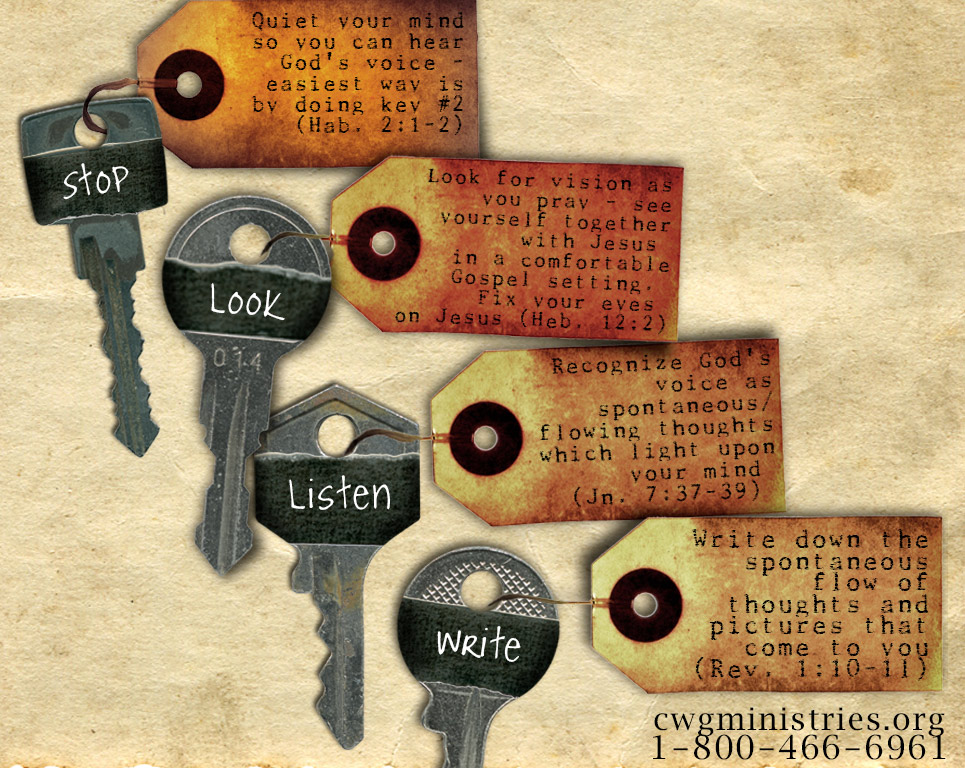
So I got up, went to my office, and He showed me that Habakkuk did four specific, simple things to hear God’s voice (Hab. 2:1,2). They are: stop, look, listen and write.
Stop – Become still– “Went to my guard post” means he quieted himself down to listen and hear.
Look – Look for vision – “Kept watch to see” means he was looking for vision.
Listen – Recognize God’s voice as spontaneous thoughts – “What He will speak to me” means he recognized God’s voice. We define God’s voice as flowing or spontaneous thoughts, because John 7:37-39 says the Holy Spirit within is sensed as flow. Likewise God’s vision is flowing pictures.
Write – Two-way journaling – “Record the vision” means he wrote down the flowing words and flowing pictures (visions) that were coming to him.
If you think about it, this is what we naturally do when conversing with a friend. We stop thinking about other things and put our focus on them; we look at them; we listen carefully; and when it is important, we write down what they are saying so we don’t forget it. It is completely normal and accepted to record words that we consider important, as for example, a stenographer would do in a courtroom. We are simply saying why not apply these steps to our conversations with God? Are not the words of our Lord to us the most important words we will ever hear?
So Who Else in Scripture, Besides Habakkuk, Used These Four Keys?
It is now 35 years later, and I hear the Lord speaking within me that I should take note that the four keys that Habakkuk used were used by others throughout Scripture, from Genesis to Revelation. So let’s take a look at ten individuals in the Bible who used these four keys and wrote over half the Bible.
The Apostle John used the same four keys when he wrote the book of Revelation. In Rev. 1:9-11 we see:
Stop – “I was in the Spirit on the Lord’s day”
Listen – “I heard a voice behind me saying”
Write – “Write in a book”
Look – “what you see”
King David was a man after God’s own heart and he certainly used the same four keys:
Stop – “Be silent my soul before Him” (Ps. 62:1).
Look – “I have set the LORD continually before me; Because He is at my right hand, I will not be shaken” (Ps. 16:8); “I saw the Lord always in my presence; for He is at my right hand” (Acts 2:25) means he saw the Lord with the eyes of his heart, with him constantly.
Listen – After King David would quiet himself (i.e. Selah), God would speak. “Hear, O My people, and I will speak; O Israel, I will testify against you; I am God, your God” (Ps. 50:7).
Write – David journaled out the details of the Tabernacle, and as he did, he said it was the Lord’s hand upon him (1 Chron. 28:19). In addition, he recorded many of his prayer times in the Psalms.
How about the Apostle Paul, did he also use these four keys?
Stop – “… appeared to Paul in the night” (Acts 16:9)
Look – “Was caught up into Paradise” (2 Cor. 12:4)
Write – Paul prayed for revelation (Eph. 1:17,18; Col. 1:9), and then wrote Ephesians and Colossians which are both FULL of divine revelation. I am convinced his epistles record the revelation Paul received from God during his prayer times.
How about Abraham, the Father of Faith – did he use the four keys?
Stop – “A deep sleep fell upon Abram” (Gen. 15:12,13)
Look – “The word of the LORD came to Abram in a vision…” (Gen. 15:1)
Listen – “Now the LORD said to Abram, ‘Go forth from your country…’” (Gen. 12:1)
Write – Since Genesis 15 was written by Moses, I am going to assume that Abraham recorded it in some way so it was available later for Moses to draw upon.
Moses used the four keys (Ex. 3:1-5).
Stop – Moses said, “I must turn aside…”
Look – He looked and behold the bush was burning.
Listen – God called to him from the midst of the bush and said…
Write – Moses wrote out this experience in the book of Exodus.
Did Isaiah use the four keys when he heard God’s voice?
Stop – He wakens me morning by morning (Isa. 50:4)
Look – “The vision of Isaiah the son of Amoz concerning Judah and Jerusalem, which he saw” (Isa. 1:1)
Listen – For the LORD speaks… (Isa. 1:2)
Write – Obviously he is writing it down, as that is how we got the book of Isaiah.
Jeremiah used the four keys to receive from the Lord.
Stop – Jeremiah was a priest who was ministering before the Lord (Jer. 1:1)
Look – “What do you see, Jeremiah?” … “I see a rod of an almond tree.” (Jer. 1:11)
Listen – “The word which came to Jeremiah from the LORD, saying” (Jer. 30:1)
Write – “’Write all the words which I have spoken to you in a book’” (Jer. 30:2)
Ezekiel used the four Keys (Ezek. 1:1-4).
Stop – “While I was by the river …”
Look – “As I looked, behold, a storm wind was coming …”
Listen – “the word of the LORD came expressly to Ezekiel …”
Write – He wrote the book of Ezekiel.
Daniel used the four keys.
Stop – As he lay on his bed (Dan. 7:1)
Look – “I was looking in my vision by night” (Dan. 7:1)
Listen – “I approached one of those who were standing by and began asking him the exact meaning of all this. So he told me and made known to me the interpretation of these things” (Dan. 7:16)
Write – He wrote the dream down (Dan. 7:1)
Peter used the four keys.
Stop – “I was in the city of Joppa praying” (Acts 11:5)
Look – “I saw a vision, an object coming down like a great sheet” (Acts 11:5)
Listen – “I also heard a voice saying to me, ‘Get up, Peter; kill and eat.’” (Acts 11:7)
Write – We have a biblical record of his encounter.
These biblical writers composed 663 chapters of the 1189 chapters in the Bible (over 50%). That is not to say that the rest of the writers didn’t also use these four keys. If we explored the Minor Prophets and discovered they also used the four keys of stop, look, listen and write that would add another 68 chapters to the total.
I have taken seriously the discipline of listening to the Holy Spirit for many years now. Mark Virkler’s 4 Keys To Hearing God’s Voice was foundational for me.
Here is a recent article by him explaining the 4 Keys:
Introducing Four Keys to Hearing God’s Voice
I tossed and turned in bed, unable to fall asleep. The thought kept going through my mind: “What if I died tonight? I’m not ready to go to heaven.” Since I could not shake the thought, I got up, went downstairs and waited for my parents to come home from their meeting. When they did, I announced that I wanted to get saved, and they took me straightway to the pastor’s home where he explained the plan of salvation and led me in the sinner’s prayer. I was 15 years old when I accepted Jesus Christ into my heart as my Lord and Savior.
Hearing God but not identifying the fact that I was hearing God
It was God’s voice that was speaking to me that night, calling me into His kingdom. His voice came as a spontaneous flowing thought inside my head. However, I didn’t define this as the primary way God’s voice is heard until I had completed a desperate 10-year search to hear Him clearly.
Christianity is unique among religions, for it alone offers a personal relationship with the Creator beginning here and now, and lasting throughout eternity. Jesus declared, “This is eternal life – that they may know God” (Jn. 17:3). Unfortunately, many in the Church miss the great blessing of fellowship with our Lord because we have lost the ability to recognize His voice. Though John 10:27 promises us that “My sheep hear My voice,” too many believers are starved for that intimate relationship that alone can satisfy the desire of their hearts.
I was one of those sheep who was unable to identify the voice of my Shepherd. I hungered for deeper spiritual intimacy with God, but I could not find it. Then on the eleventh year of my Christian life I had the spontaneous thought that “I should take a year of my life and focus on learning to hear God’s voice.” I decided to act on that thought and devote a year to focused effort, learning to hear His voice. Unbeknown to me, it was the Lord calling me to invest that time.
That year the Lord revealed four simple keys, all found in Habakkuk 2:1, 2, which unlocked the treasure of His voice. Using the four keys together allowed me to easily hear God’s voice daily. It was the most transforming step I have taken in the 57 years of my Christian life! I would like to share them with you so you can try them and see if they do the same for you.
Key 1 – STILLNESS: Quiet myself in God’s presence
STILLNESS: Quiet myself in God’s presence
Habakkuk said, “I will stand on my guard post...” (Hab. 2:1). Habakkuk knew that to hear God’s quiet, inner, spontaneous thoughts, he had to first go to a quiet place and still his own thoughts and emotions. Psalm 62:5 encourages us to silence our souls before God. There is a deep inner knowing (spontaneous flow) in our spirits that each of us can experience when we quiet our flesh and our minds. If we are not still, we will sense only our own thoughts.
Loving God through a quiet worship song is one very effective way to become still. (Note 2 Kings 3:15.) After I worship and become silent within, I open myself for that spontaneous flow. If thoughts come of things I have forgotten to do, I write them down so I can do them later. If thoughts of guilt or unworthiness come, I repent thoroughly, receive the washing of the blood of the Lamb, putting on His robe of righteousness, seeing myself spotless before God (Is. 61:10; Col. 1:22).
Clear focus provides the purest flow: To receive the pure word of God, it is very important that my heart be properly focused as I become still because the intuitive flow comes out of the vision being held before one’s eyes. If I fix my eyes upon Jesus, the intuitive flow is pure and comes from Jesus. But if I fix my gaze upon some desire of my heart, the intuitive flow is affected by that desire. To have a pure flow I must become still and carefully fix my eyes upon Jesus (Heb. 12:2).
Again, quietly worshiping the King, and receiving out of the stillness that follows quite easily accomplishes this. Beginning my prayer time as Jesus taught us to pray is expedient: “Our Father Who art in heaven, hallowed be Thy name…” Jesus taught us to begin prayer by lifting our eyes up to our Father and beholding Him. We don’t start prayer with our issues. We start our prayer by gazing upon Him!
Key 2 – VISION: Fix my eyes upon Jesus
VISION: Fix my eyes upon Jesus
Habakkuk said, “I will keep watch to see,” (Hab. 2:1,2). Habakkuk was actually looking for a vision as he prayed. Since I believe the Bible is meant to be lived, I decided that I, too, would begin looking with the eyes of my heart into the Spirit world to see what I could see.
Do what King David did! A good way to begin using the eyes of your heart is by doing what King David did: “For David says of Him, ‘I SAW THE LORD ALWAYS IN MY PRESENCE; FOR HE IS AT MY RIGHT HAND, SO THAT I WILL NOT BE SHAKEN” (Acts 2:25 NASB). The original Psalm makes it clear that this was a decision of David’s, not a constant supernatural visitation: “I have set (literally, I have placed) the Lord continually before me; because He is at my right hand, I will not be shaken” (Ps. 16:8). Because David knew that the Lord was always with him, he determined in his spirit to see that truth with the eyes of his heart as he went through life, knowing that this would keep his faith strong.
We say, “A picture is worth 1000 words.” I believe that is because pictures are the language of the heart. We notice that Jesus used pictures constantly as He taught (Matt. 13:34). When I use pictures in my prayer time, fixing my eyes on Jesus, I am speaking the language of my heart and that moves me quickly into heart/spirit realities getting me beyond my mind.
Use godly imagination: I choose to do what King David did and I develop “godly imagination,” which I define as “picturing things God says are so.” If I am picturing that Jesus is NOT with me, that would be picturing a lie, which is unwise. I can’t imagine any reason I would want to picture unscriptural things. So I see Jesus at my right hand, always. I add to this Paul’s prayer for God to enlighten the eyes of my heart (Eph. 1:17,18). Then I tune to the flow of the Holy Spirit, and He brings the scene alive. I find I can step from these godly imaginations, into a divine vision.
It is amazing, simple, and child-like! Of course, it would need to be, as we are told that to enter the kingdom we must become as little children. My 6-year-old granddaughter can do this and she shares with me her journaling and the visions of the angels standing on both sides of her protecting her and watching over her. You will find your young children can do these four keys more easily than you can! Try it with them and see.
From Genesis to Revelation God gave dreams and visions, and He specifically said that in the last days, He would pour out His Spirit and wewould see dreams and visions (Acts 2:1-4, 17).
We must look if we want to see! Daniel saw a vision in his mind and said, “I was looking…I kept looking…I kept looking” (Dan. 7:2,9,13). So I needed to repent for not looking and begin presenting the eyes of my heart to the Lord, and looking. As I pray, I look for Jesus, and I watch and listen as He speaks to me, doing and saying the things that are on His heart. Many Christians will find that if they will only look, they will see flowing pictures, in the same way they receive flowing thoughts.
Jesus is Emmanuel, God with us (Matt. 1:23). It is as simple as that. You can see Christ present with you because Christ is present with you. In fact, the vision may come so easily that you will be tempted to reject it, thinking that it is just you. But if you persist in recording these flowing pictures, your doubt will soon be overcome by faith as you recognize that the content of them could only be birthed by Almighty God.
A lifestyle: Jesus demonstrated the ability of living out of constant contact with God, declaring that He did nothing on His own initiative, but only what He saw the Father doing, and heard the Father saying (Jn. 5:19,20,30). What an incredible way to live!
Is it possible for you to live out of divine initiative as Jesus did? Yes! It is called “abiding in Christ” (Jn. 15). Fix your eyes upon Jesus. The veil has been torn, giving access into the immediate presence of God, and He calls you to draw near (Lk. 23:45; Heb. 10:19-22). “I pray that the eyes of your heart will be enlightened” and you will see His visions. They are His gift to you, freely given (Acts 2:17). See blog: Can I Live in Continuous Revival?
Key 3 – FLOW: Tune to flow
FLOW: Tune to flow
Habakkuk knew the sound of God speaking to him (Hab. 2:2). Elijah described it as a still, small voice (1 Kings 19:12). I had always listened for an inner audible voice, and God does speak that way at times. However, I have found that usually, God’s voice comes as spontaneous thoughts or flowing thoughts and His visions as flowing pictures within my mind.
For example, haven’t you ever been driving down the road and had a thought come to you to pray for a certain person? Didn’t you believe it was God telling you to pray? What did God’s voice sound like? Was it an audible voice, or was it a spontaneous thought that lit upon your mind? Jesus said the Holy Spirit is experienced as a River within us which FLOWS (Jn. 7:38,39).
Experience indicates that we perceive spirit-level communication as spontaneous flowing thoughts, impressions, and visions, and Scripture confirms this in many ways. For example, one definition of paga, a Hebrew word for intercession, is “a chance encounter or an accidental intersecting.” When God lays people on our hearts, He does it through paga, a chance-encounter thought “accidentally” intersecting our minds. We consider it a chance encounter in that we didn’t reason it up, however it is purposeful because God sent it to us.
Therefore, when you want to hear God’s voice, you tune to chance-encounter, spontaneous, or flowing thoughts. Even satan’s thoughts come to us as spontaneous thoughts, which is why we are commanded to “take every thought captive” (2 Cor. 10:5). I am sure all of us have experienced spontaneous evil thoughts coming to us, even attacking right in the middle of our prayer and worship times. So I conclude that analytical thoughts are mine, spontaneous good thoughts come from the Holy Spirit, and spontaneous evil thoughts come from evil spirits.
God’s flowing thoughts line up with Scripture and with His various names: Comforter, Counselor, Teacher, Giver of Life, Healer, and Deliverer. His thoughts edify, exhort, and comfort. They are pure, peaceable, gentle, reasonable, full of mercy and good fruits, unwavering (James 3:17).
Satan’s flowing thoughts line up with his various names: accuser, adversary, thief who comes to kill, steal and destroy. His thoughts condemn and bring despair, rejection, fear, doubt, unbelief, and in general, misery. Satan’s thoughts bring jealousy and selfish ambition (James 3:14,15).
Key 4 – JOURNALING: Record the flowing thoughts and flowing pictures
JOURNALING: Record the flowing thoughts and flowing pictures
God told Habakkuk to record the vision (Hab. 2:2). This was not an isolated command. The Scriptures record many examples of individual’s prayers and God’s replies (e.g. the Psalms, many of the prophets, and Revelation).
I call the process “two-way journaling,” and I have found it to be a fabulous catalyst for clearly discerning God’s inner, spontaneous flow, because as I journal I canwrite in faithfor long periods, simply believing it is God. I know that what I believe I have received from God must be tested. However, testing involves doubt and doubt blocks divine communication, so I do not want to test while I am trying to receive (Heb. 11:6). With journaling, I can receive in faith, knowing that when the flow has ended I can test it. This way I can stay in flow for an extended period of time and have extended two-way dialogue with Jesus. Afterward I make sure it lines up with Scripture (1 Thess. 5:21) and get confirmation from my spiritual advisors.
Remove doubt: Doubt may hinder you at first, but throw it off, reminding yourself that recording God’s words and visions is a biblical concept and that God is present, speaking to His children. In the Bible, satan is constantly casting doubt by saying, “Did God really tell you…?” (Gen. 3:1 GNB).
Learn to relax! When we cease our labors and enter His rest, God is free to flow (Heb. 4:10). Sit back comfortably, take out your pen and paper (or computer or iPad), smile, picture yourself as a child, and turn your attention toward the Lord in praise and worship, seeking His face. Write down, “Good morning, Lord! I love You. What do You want to say to me?” Then become still, fixing your gaze on Jesus. You will suddenly have a very good thought. Don’t doubt it; simply write it down. Later, as you read over your journaling, you will be blessed to discover that the content is amazing and that you are indeed dialoguing with God!
Reflections
Hear God through illumined Scripture: Knowing God through the Bible is a vital foundation to hearing His voice in your heart, so you must have a solid commitment to knowing and obeying God’s written Word. We are commanded to meditate on Scriptures (Josh. 1:8). As we pray over Scripture, we find verses leap off the page and hit us between the eyes. This is another very powerful way that God speaks to us. Regular scriptural meditation is commanded by God and is a must for the effective Christian life.
Utilize spiritual advisors: It is also very important for your growth and safety that you be related to solid, spiritual counselors. All major directional moves that come through journaling should be confirmed by your counselors before you act upon them. The Bible says in the mouth of two or three witnesses every fact is to be established (2 Cor. 13:1). Also, in the multitude of counselors, there is safety (Prov. 15:22). So make sure you walk in meekness and seek out and receive input from your spiritual advisors. This step must not be skipped! I ask them, “Does your heart bear witness this came from God.” So you are not asking what they think, but what their heart is saying.
The four keys appear again in the book of Revelation: John used the same four keys that Habakkuk did. In Revelation 1:9-11 we find he was in the spirit (stillness), and he heard a voice behind him (tuned to spontaneity), saying, “Write in a book (journaling), what you see (vision).” So in both the Old and New Testaments, we find the same four keys being used to receive God’s voice. Don’t worry about the order of the keys. Just make sure you are using all four keys. See blog:The majority of the Bible was written by men using these four keys.
As a PACKAGE these four keys work. Stop-Look-Listen-Write is another way to say the same four keys. These four keys get the job done! People hear. We guarantee that if you use these four keys together, they will work for you and you will hear God’s voice. Try them as a bundle, and see how they work for you. We have free downloadable coaching Jesus encounter adventure. It is available at www.cwgministries.org/galilee. The first part of the recording takes you for a visionary walk with Jesus along the Sea of Galilee, and guides you into using all four keys together. We encourage you to try several times! May you be restored to taking walks with the Lord in the garden in the cool of the day. May you experience the fullness of a personal relationship with our Lord and Savior, Jesus Christ. May communion with God be deepened in your life, and may His healing and creative rays fill you through and through.
 Dear Friends,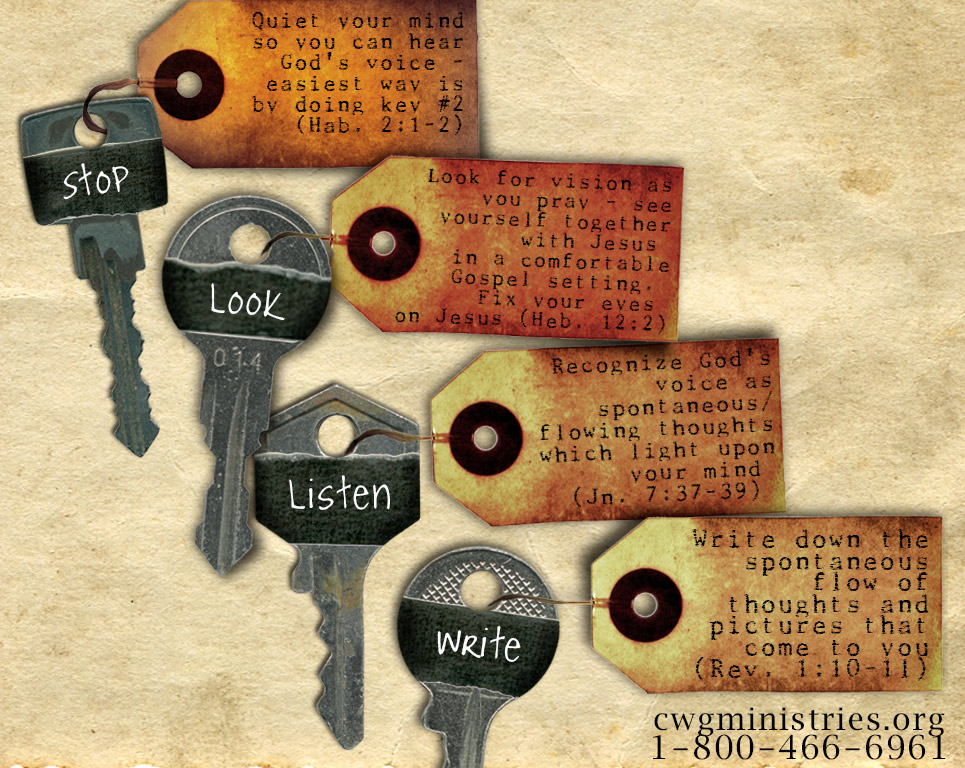








 New Life Narrabri