In the book “Overflow Of The Spirit”, Mark Virkler and others describe a way of tuning into God called “Two Way Journalling.” In Two Way Journalling, we write down a conversation, in which we ask God a question and then write what we believe He is saying back to us.
Virkler describes the constant stream of thoughts passing through our heads as a flow of ideas. Some of these thoughts are from our own head- “I am cold”, This is boring”, “I need to remember to buy milk”, and so on. Some of the thoughts are from satan: “You are no good”, “God would never talk to you”, etc. Then we have the voice of the Holy Spirit bringing revelation, exhortation and comfort. This flow is like the social media stream where all sorts of ideas just appear as we scroll through.
To hear God’s voice, we need to filter out what the other voices are saying to us and focus on God. Virkler describes a 4- step process to aid this.
1. Go to a quiet place and still your thoughts and emotions. Write down the things that might distract you and put them to one side. Breathe steadily and slow your body down.”Be still and know that I am God.”
2. Focus on Jesus. Play worship music, start to worship Jesus aloud with your words. Ask Him to reveal Himself to you.
3. Recognise that the voice of the Holy Spirit is heard in the spontaneous flow of thoughts. Having quieted your mind and focused on Jesus, the thoughts in your head are more likely to be the Holy Spirit speaking to you. Listen. Receive.
4. Write down your prayers and what it seems that God is saying to you. Let it be spontaneous and flowing. Don’t analyse anything. Listen and write.
Later, read over what you have written. Does it agree with Scripture? Does it sound like Jesus? Show trusted christians and ask their opinion.
We are not saying that this is the definitive way to listen to the Spirit of God. It is a way to sharpen our focus on the Holy Spirit and to learn to walk in a lifestyle of being led by the Spirit.
“Living by the Spirit means intentionally staying tuned to the flow within, which is the Spirit, the living water that flows from the throne of God.”
Jesus said that His sheep know His voice. God gives us His constant presence and regular guidance. All we need to do is learn to listen.
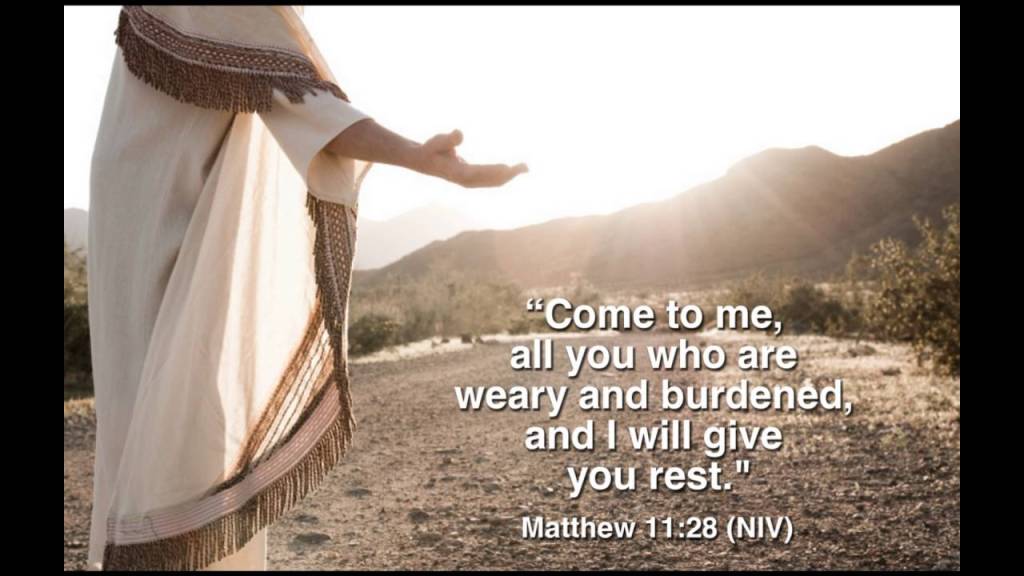
Matthew 11:28-30 “Come to me, all you who are weary and burdened, and I will give you rest. Take my yoke upon you and learn from me, for I am gentle and humble in heart, and you will find rest for your souls. For my yoke is easy and my burden is light.”
I realised this afternoon that with everything going on over the last 6 months or more, I was weary. Not weary in body or mind, just weary in spirit. Being ill at the end of last year, dramas with allergies at the beginning of the year, then dealing with the Covid thing- it had all sapped my relationship with God. The passion was no longer there- I believe, and I love Jesus, but something was missing in me.
I read earlier this week that another prominent formerly christian musician has lost his faith. It no longer makes sense to him and he finds worship is boring.
In contrast I think of the passionate cry from the heart by Kim Walker-Smith on one of the Jesus Culture albums where she shouts out something like,”If you don’t know Jesus tonight, and you would know if you did because everything would be different.”
It’s true, just one touch from the Lord and everything changes.
But we get tired, distracted or discouraged, and gradually worship becomes boring, and Jesus doesn’t make sense any more.
So I realised I needed to reach out to the Lord. I sat in a quiet place and said “I need you Lord.” Then I just sat and received. I felt a tingling come through my hands and a new burst of the Holy Spirit. I was renewed again.
A fresh touch of the Lord is what we all need from time to time- a fresh encounter with the living Lord.
If you haven’t received Jesus into your life, make that decision today. And if, like me, you’ve been walking too long since drinking the living water, take time now.
Churches across the world will commemorate the day of Pentecost this next Sunday, whether they meet online or in their buildings. Most will celebrate the need for the Holy Spirit’s power, and they might read Acts 2:1-4, which tells how the Spirit’s flame rested on all the disciples who prayed in the upper room that day.
But when they read verse 4 (NASB)—”And they were all filled with the Holy Spirit and began to speak with other tongues, as the Spirit was giving them utterance”—some people will shift in their seats or clear their throats. This aspect of Pentecost makes people uncomfortable. We don’t know what to do or say about tongues. It’s just too weird for most people.
It was awkward for me too, when I first heard about it. I’d never met a Pentecostal. Speaking in tongues wasn’t part of my church tradition, and I had never heard anyone do it. In fact, the first person I heard speak in tongues was myself, when I was baptized in the Holy Spirit in 1976!
Since then, I have prayed for countless people to be filled with the Holy Spirit. I don’t force them to speak in tongues. I just warn them that it might happen, since it happened in Acts 2.
Several years ago, when I was teaching at a ministry school, a 22-year-old guy from Maryland asked if I could pray with him. He had heard me share how I was baptized in the Holy Spirit at age 18, and he wanted the same experience.
This young man, Eric, understood that he already had the Holy Spirit living inside of him. But he knew that Jesus offers us more. He knew the baptism of the Holy Spirit is a second experience in which the fullness of God’s divine power anoints us for ministry.
I explained to Eric that speaking in tongues makes no sense in the natural. It actually sounds like gibberish, yet the Bible says praying in the Spirit strengthens us profoundly (see 1 Cor. 14:2, 4). I laid hands on Eric and asked Jesus to fill him with divine power and to release the Holy Spirit’s language as a manifestation of the overflow.
Nothing dramatic happened at that moment, but I told Eric to remain expectant. I’ve learned that oftentimes, the release of the Spirit comes more easily when people are alone and not distracted by people standing around. I encouraged him to go home and pray some more.
A couple of days later I received a message from him, letting me know that a small miracle had occurred in his life. He wrote: “Thank you for praying for me to speak in tongues. That night was interesting because phrases started to pop into my head. I began speaking the phrases, and by the next night I was speaking in tongues as I was falling asleep. Now, every moment that I am not worshipping, praying, eating or speaking to someone, I am practicing this gift. Praise God!”
Many of us fall into the trap of downplaying speaking in tongues, even after we’ve received the gift ourselves. We may consider it divisive (and it certainly can be when it is abused) or we’re embarrassed because it seems fanatical to our friends or family members.
Yet when I read the apostle Paul’s comments on the issue, I realize that speaking in tongues was a key component of the New Testament church. Not only did tongues play a fundamental role on the day of Pentecost when the church was born, but this strange gift also fueled Paul’s personal zeal. The same apostle who wrote the book of Romans and preached to Caesar wrote: “I thank God, I speak in tongues more than you all” (1 Cor. 14:18). Paul most likely prayed in tongues for hours at a time.
Paul also instructed the Corinthians: “Do not forbid to speak in tongues” (1 Cor. 14:39). He knew that even though some people might be tempted to misuse this gift (and this is usually why people restrict it), we must never shut it down.
Eliminating the gift of tongues can have a direct impact on the flow of the Holy Spirit’s anointing in the church. If you forbid tongues or pretend this gift is not needed today, you might as well flip a breaker switch and turn off all the lights.
Speaking in tongues doesn’t make us holier than anyone else. And if we don’t exhibit love and Christian character, Paul said it becomes a useless gift comparable to a noisy gong (see 1 Cor. 13:1). But when stewarded properly and tempered with humility, this seemingly insignificant gift becomes an invisible spiritual weapon.
I’m not saying we should showcase tongues in church gatherings, scream at people in tongues or make people feel like misfits if they haven’t experienced the gift. (We must forgive immature Christians for doing those things.) When the Corinthians put tongues on the platform and turned their meetings into chaotic circus sideshows, Paul rebuked them sternly.
But the same apostle who warned his followers not to flaunt tongues in public also spent countless hours praying in tongues privately—because it’s a vital source of spiritual power that we must never neglect. This Pentecost, don’t apologize for the secret of the apostle Paul’s power just because it’s awkward. We need the Holy Spirit’s power like never before.
When I was in my 20s, I was praying about whether I should enroll in graduate school. Then one morning in my devotional time I came to Psalm 32:8a, and it seemed to be flashing like a neon sign. It said, “I will instruct you and teach you in the way which you should go.”
The Holy Spirit was emphasizing that God would teach me and that I didn’t need additional schooling. That’s not to say graduate school is wrong for everyone else; it was just not God’s plan for me at that time. And God illuminated a particular Scripture to clearly show me what path I should take.
The Bible promises that God will guide us. But many Christians find it difficult to hear God’s voice. And in some charismatic churches we complicate things when we try to make guidance mystical or weird—as if you have to hear an audible voice from heaven about what color shirt to wear.
Years ago, I learned from author Henry Blackaby that there are four distinct ways we receive divine guidance:
1. You can hear God’s voice by reading the Bible. Friends have sometimes complained to me: “I just never hear God speaking.” Yet when I ask if they read the Bible regularly, they say they’re too busy. Their Bible is collecting dust on a shelf while they beg God for a Technicolor vision from heaven!
God supernaturally inspired 40 authors over a period of 1,600 years to compile His love letter to us. After the Bible was written in Hebrew and Greek, many people were martyred because they translated it in a modern language. God went to a lot of trouble to compile the Bible. Yet today many people say they are too busy to read God’s most direct message to Planet Earth!
When you read Scripture with a prayerful heart, God can cause a verse to jump off the page as a direct message to you. British preacher Charles Spurgeon recognized this years ago when he wrote: “When I have been in trouble, I have read the Bible until a text has seemed to stand out of the Book, and salute me, saying, ‘I was written specially for you.'” Expect God to speak directly to you from Scripture.
2. You can hear God’s voice through the supernatural inspiration of the Holy Spirit. The Holy Spirit is not an eerie presence that just hangs around. He lives in every born-again Christian, and He comforts us and actively speaks to us. He can do this in many ways: through dreams, visions, warnings, a sense of conviction or—most often—through what we know as the “still, small voice” (1 Kings 19:12b) of the Spirit.
I have had prophetic dreams and visions over the years, but the most common way the Spirit speaks to me is through a deep sense of inward knowing. I will never forget a time in 1985 when God spoke to me while I was driving my car in Florida. A message came to me, not audibly but in my spirit: “You will move to Washington, D.C.” It seemed to come out of the blue, and I knew it did not originate with me. Four years later I was offered a job in the Washington, D.C., area, and I worked there for three years.
The ability to hear the Spirit’s voice is developed over years as we grow in Christ. If you really want to hear Him, you should ask God to fill you with His Spirit. As you allow more of the Spirit’s presence and power in your life, you will set aside your selfish agendas and sinful habits so God can communicate to you without any hindrance. Meanwhile, a selfish, stubborn attitude is the No. 1 obstacle to hearing God!
3. You can hear God’s voice through people. God never intended for us to live in isolation. We are members of His body, the church, and you will hear God better when you are in fellowship with His people. God can speak to you through a pastor’s sermon, a friend’s wise counsel, a mother’s rebuke, a mentor’s phone call or a prophetic word given to you by one of God’s Spirit-filled servants.
God uses the gift of prophecy, but you should never chase after prophecies. I know Christians who will travel across the country to attend a prophetic conference to get a word from God, yet they have not read the Bible in months or sat still long enough to hear from God on their own. Never treat the holy gift of prophecy like fortune telling. When God needs to speak to you in an unusual way, He has faithful messengers who will deliver it to you at the exact time you need it.
4. You can hear God’s voice through circumstances. Not everything that happens to you is God’s will. But God is sovereign, and He has power over nature, over government leaders and over all the details of your life. He opens doors that no man can shut. If you have been praying about getting a job at one company, and suddenly you get an offer at a different company, this may be God’s sign that He has a better place for you to work.
My oldest daughter wanted to attend a college in Tennessee, and we were praying about her decision. Right after we prayed, I got a call from the president of a college in Georgia. He was inviting me to speak at the school, but in our conversation, I learned that this school was willing to offer my daughter a scholarship. She ended up enrolling in that school, meeting her future husband there and working for that college four years later. God was totally involved in that phone call from Georgia!
Ask God to tune your ears to His voice in a fresh way. Read God’s Word with an expectant heart, listen carefully to what the Lord is saying through His servants, pay attention to what He is saying to you through circumstances and tune your spiritual ears to the inner voice of the Spirit. Guidance is not complicated when you sincerely want to hear Him speak to you.
We all need renewal in the Holy Spirit, but this is not something mystical or just a thing for the men and women of God. It’s so simple, but we forget.
If you want to win your battle, you must pick up your armor. (Pixabay)
Inside us is the Holy Spirit, and if we will let Him rise up, He can break any yoke, anything that’s coming against us.
We just have to learn to rise up in our spirit, and how do we do that? Well, we do it through quoting the Word, just quoting the Scripture. The Word of God is so powerful. I broke my foot and was really feeling bad, and the Lord just spoke to me, “Get up in the night and start quoting the Scripture on healing.” I know to do that, but I needed to do it more. I have begun seeing a real turnaround since I’ve done that.
Somehow, we forget to fight. In the middle of everything that’s going on, we get under it, but we forget to fight. We forget that if we resist the devil, he will flee from us. That we have the authority to overcome anything, but we have to take the authority. We have to take it, we have to rise up and use the weapons that are not carnal, but mighty.
I just feel like God wants to remind us this day, and the Lord says to you, “Look around you and see the things that you used to do, the things you used to know to do, but you do not do anymore. Look around you and recall the way you used to quote the Scripture, the way perhaps you used to worship.”
The Lord says, “It’s time for a renewal of the Holy Spirit. It’s time for you to come into a renewing where you take the things you know to do and pick up the weapons that have been given to you by the Holy Spirit.”
As I prophesied into this, the reason I started prophesying is this: I saw a table, we’re sitting at this big conference table in our office, but I saw all kinds of tools, weapons of warfare on the table, but we weren’t using them. We were crying out because we were being so attacked, and we were so upset that we were being so attacked, but we had weapons right there on the table.
Pick up your weapons, pick up your weapons and do what you know to do. If you will do this, I guarantee you will win.
Cindy Jacobsis an author, speaker and teacher with a heart for discipling nations in the areas of prayer and prophetic gifts. She and Mike—her husband of 43 years—co-founded Generals International in 1985.
The gifts of the Holy Spirit are for all believers, so why do some find it so hard to receive them?
Mark Virkler explains how we can position ourselves to receive the fullness of God’s Spirit and overcome some of the obstacles that get in the way. He has both video and pdf content on this page.
All who are led by the Spirit of God are children of God.
Observation
We are debtors, not to the flesh, but to God’s Spirit. If we live by the works of our flesh (our unredeemed natural self) then we will die. But if we allow the Holy Spirit to put to death the sinful ways we will live.
Everyone who is led by the Spirit is a child of God. When we first believed we received the spirit of adoption that calls out “Abba Father.”
The Holy Spirit bears witness with our spirit that we are children of God and therefore heirs with Christ.
Application
One of the great works of the Holy Spirit is to teach us that we are sons and daughters of God. We don’t have to prove how good we are to Him because He has adopted us into His family. He already loves us.
Many people have an orphan heart. That is, they have been badly hurt by the lack of a father in their life or by abuse by their father. This makes it hard for them to receive the love of the heavenly Father.
The Holy Spirit is given us to reveal to us how much we are loved by the Father.
Prayer
Father I thank you for your never-failing love. Help me to receive your love and to walk in it every day. Amen.
“Then the cloud covered the tent of meeting, and the glory of the Lord filled the tabernacle.” Exodus 40:34
In Exodus 40:16-33, Moses assembles the tabernacle. He does so carefully, thoroughly, obediently. The paragraph begins with a prospective summary in verse 16 and ends with a retrospective summary in verse 33, emphasizing the completeness of Moses’ obedience. In between, seven times the text records that his work was “as the Lord commanded.” What more could one hope for?
But the book doesn’t end with “So Moses finished the work” (verse 33). There is still another, better paragraph to go. In that final paragraph, verses 34-38, we read of what only God can do. God’s glory comes down and covers the completed tabernacle. After all, that was the whole point to begin with: “Let them make me a sanctuary, that I may dwell in their midst” (Exodus 25:8).
Our aim as pastors is not only that our churches will be well assembled, thoughtfully and carefully and biblically obedient in their doctrine and structures. That is important. But it is not ultimate. We desire the dwelling of the risen Christ among us. We desire his felt presence. We desire him.
If we are not experiencing his glory coming down upon us, we need to ask if we have been disobedient in any aspect of what we have built or failed to build. But even if we have built well, we need to ask if we have settled for mere constructional obedience. The Lord has more for us than that. He has himselfto give!
I recently attended a church service at a church that had once been described as “the jewel in the crown” of its denomination. A generation ago it had been a leader in evangelism, youth ministry, children’s ministry and in renewal. It had been a vibrant place to be, with people expecting that God could do anything in their midst.
The service was pleasant enough, and I have no doubt about the salvation or the commitment of the people leading it. But all through the service I kept thinking “The Holy Spirit has left the building.”
I have had this experience a few times over the years in various circumstances, and it always makes me feel sad. It also makes me more determined not to repeat the same mistakes in my own ministry.
Here are some of the factors that I think contribute to the fading of the glory of a church or a group of people. These are not always all present in any particular group, but some of them are invariably factors.
Failure of a new generation to own the faith for themselves. Each individual needs to be filled with the Holy Spirit in order to build on the inheritance handed down to them.
A spirit of control amongst one or more of those in leadership, causing the group to be led by human wisdom rather than by Holy Spirit
Reliance on the denomination’s teaching or leadership or on the traditions of the church.
Seeing worship as a duty to be performed rather than an opportunity to approach God.
Lack of prayer- corporately and individually
A spirit of individualism in which people think they should be free to do what they want rather than submitting to genuine godly authority.
Rebelliousness at one crucial time when it is clear (or should be clear) where the Holy Spirit is leading but the people refuse.
Is there hope for revival amongst such churches or people groups? Yes, of course, with God all things are possible. He can make dead bones live. But it takes a level of repentance and surrender that many find difficult. Often it takes a new generation to rise up and discover the power of the gospel.
I hadn’t heard of this before, but it sounds quite wonderful.
From St John’s Lutheran Church in Lewistown, USA “Serving Christ and the Community since 1796”:
The Dark Ages, from about the fifth century to the beginning of the eleventh century, was a time of cultural bleakness, after Rome had been sacked and its empire destroyed. It was essentially a six hundred year Great Depression, when food was scarce, people lived hand-to-mouth, and Western Civilization barely hung by a thread. The one bright spot in the culture was the local cathedral, which was like a church-sponsored works project, reminiscent of those of FDR during our own Great Depression. The work gave thousands of people jobs, and the cathedrals, which were built even in small towns, became the cultural, social and spiritual centers of life. Ironically, it was these Dark Ages that produced some of the most beautiful murals, sculpture, stained-glass windows, and pageantry, which, in a time of great illiteracy, helped to teach the stories of the faith.
The cathedrals were centers of community life, the court-house for local lawmakers, a place where travelers could find a meal and safe lodging. On the outside, booths selling everything from flowers to sausage surrounded the cathedral, as they do in most European cities even today. The presence of a large, busy cathedral in the center of a village guaranteed a relatively stable economic base, and was the center of life for most people.
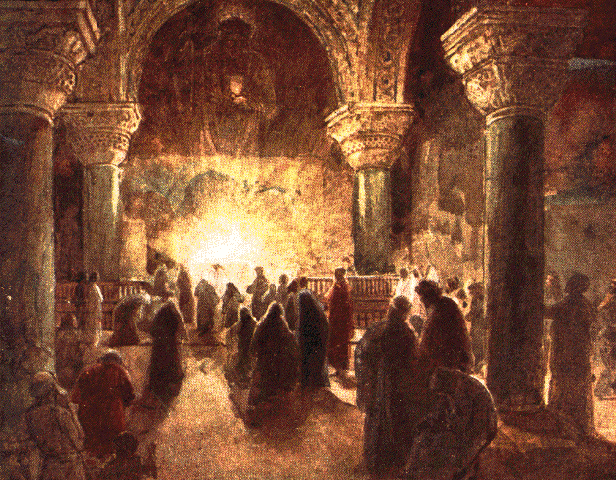
Pentecost was one of the great holidays celebrated in these cathedrals. In fact, many of them were built with special consideration for this great festival. The great domed and vaulted ceilings, so richly painted, disguised a number of trap doors that were used expressly for Pentecost celebrations. During worship, some hapless parishioners would be drafted to climb up on the roof. At the appropriate moment during the liturgy, they would release live doves through the trap doors, through the painted skies and clouds of the cathedral ceiling. These doves would come swooping down on the congregation as living symbols of the presence of the Holy Spirit. At the same moment, the choirboys were encouraged to make whooshing and drumming sounds, like a holy windstorm. Then, finally, as the doves swooped and the winds rose, the trap doors were again opened, and bushels of rose petals were showered upon the congregation, symbolizing tongues of flame falling upon the faithful below.
The holes through which this was done were called, “Holy Spirit holes.” You can image the wonder and delight that an event like that would bring into the hard, drab lives of those medieval Christians!
Today, we don’t have any holes in the ceiling like that. I suppose if we did something like that today, we’d have to use a laser display and some special audio-visual effects – a little “smoke and mirrors.” It still would not create the same kind of impression – people are so used to having exciting entertainment experiences. Yet today, I think we need “Holy Spirit holes” more than ever. Not the kind that serve as props for a medieval worship experience, but openings and conduits through which God’s Spirit can enter, permeate and revitalize people who are caught up in this violent, narcissistic, hedonistic, materialistic-oriented culture. We need Christians to serve as “Holy Spirit holes” – witnessing to the power of God’s love in this world. We need Christians who are willing to be conduits of God’s grace in a graceless world.