
The sermon for October 27th 2024 is now available on the New Life web site.
In this sermon, which is based on Romans 12:9-16, Troy talks about Sincere Love.
Click here to download the mp3 or to listen in your browser.
The sermon for October 27th 2024 is now available on the New Life web site.
In this sermon, which is based on Romans 12:9-16, Troy talks about Sincere Love.
Click here to download the mp3 or to listen in your browser.

The ability to create fear, uncertainty and doubt (FUD for short) has been shown over millennia to be an effective way to control people.
Tyrants rule by fear.
Politicians seek to score political points over their opponents or to undermine ideologies they disagree with, causing uncertainty.
Doubt arises when we believe that somebody cannot be trusted.
FUD is present everywhere in society and it takes many names.
People can be emotionally abusive to a spouse, using FUD to make the partner become more dependent on their abuser.
Gaslighting uses lies to cause a person to doubt their own senses, memories and sanity.
Technology businesses use FUD to make people lock into their products rather than a competitor.
I have been on the receiving end of a FUD attack and the emotions it generated in me were deep dread, fear and hopelessness. It was awful! Some people live with this every day.
All of this is opposed to God’s way of love. Paul tells us in 1 Corinthians 13:13. “And now these three remain: faith, hope and love. But the greatest of these is love.”
Faith is the opposite of fear, because by faith we believe that God is greater than anything that can destroy us.
Hope is opposed to uncertainty because hope looks forward to a better future, one that is held in God’s hands and not the manipulations of people.
Doubt is overcome by love because we can trust God to love us without fail.
Don’t let FUD overcome you. Instead let faith, hope and love flourish in your spirit.

The recent Covid Pandemic showed how much fear rules the lives of many people, including those who claim to be christians.
Governments fanned the fears so they could institute tyrannical lock downs, vaccine mandates and mask mandates. They didn’t have to try very hard because people were already hyperventilating in fear of a new disease.
If you have no god other than yourself, fear is a natural response to almost everything. If you are responsible to control everything in your life that is a terrible burden. No wonder people were so happy to contract this to government officials- just tell me what to do to stay safe and I will be happy.
The commandment “Do not be afraid” occurs hundreds of times in the Bible. There are also commandments to “Rejoice” and to not be anxious.
There is only one thing that makes these commandments feasible. We are told in 1 John 4:18 “There is no fear in love. But perfect love drives out fear, because fear has to do with punishment. The one who fears is not made perfect in love.”
When we know that God loves us we have nothing left to fear. If a pandemic kills us or cancer or we have a fatal car accident, we know that we will go to be with God in perfect eternal joy. And if we lose all of our money or our job, God has got that as well because He promises to meet our needs.
When you know God, really know Him, and you know His promises and commands, then there is nothing that can ever make you afraid. There is nothing that is stronger than God. Nothing can snatch you out of His hands. Nothing can steal your salvation.
Don’t be afraid. God loves you perfectly.

The Fruit Of The Spirit- Love
“But the Holy Spirit produces this kind of fruit in our lives: love, joy, peace, patience, kindness, goodness, faithfulness,gentleness, and self-control. There is no law against these things!” Galatians 5:22-23 (NLT)
When we make the decision to follow Jesus, God the Holy Spirit comes into our lives and starts equipping us to fulfil that decision.
One of the ways that the Holy Spirit does that is to make our character to be more like that of Jesus. Paul describes these qualities as the “fruit of the Holy Spirit.” It is important to realise that although there are nine qualities (to match the nine gifts in 1 Corinthians 12), there is one fruit. These characteristics are connected together- you don’t get more love without self-control and patience for example. As we examine the fruit of the spirit we must always remember that there is overlap and connection, one fruit in nine parts.
The first quality is the one which over-arches all the others, that is love.
There are four words in Greek that describe love. The word used here is agape (pronounced ag-a-pay) which refers to the love which God has for us. This is unconditional love which loves people regardless of their response. This is selfless love which expects nothing in return. This is unfailing love which never gives up.
Agape love is the love that God demonstrated to us at the cross. God so loved (agape) the world that He gave his one and only Son, so that everyone who believes in Him will not perish but have eternal life.” (John 3:16). God’s love is poured out upon us, even when we reject it, but it is made complete when we receive it and start to return love to Him.
Paul describes agape love in 1 Corinthians 13:
Love is patient, love is kind. It does not envy, it does not boast, it is not proud. It does not dishonour others, it is not self-seeking, it is not easily angered, it keeps no record of wrongs. Love does not delight in evil but rejoices with the truth.It always protects, always trusts, always hopes, always perseveres Love never fails
In human terms, this kind of love is impossible for us to express to other people because we are sinful. The love that comes closest to this is the love of a parent for a child- this is sacrificial, self-giving, at times to the point of death.
The Holy Spirit makes it possible for all christians to become channels of God’s agape love to other people, christians and non-christians alike. As we enable the Holy Spirit to transform us, the hurts, self-centredness and other obstacles to love are melted away. Instead of focusing on our own needs and wants, we learn to focus on the needs and wants of other people.
Historically, it has been the heroic love of christians which has impressed pagan cultures. The care of christians for abandoned babies, for widows and for orphans was a big factor in the turning of the Roman Empire to Christ. In times of plague before modern medical technologies were available, christians often stayed to care for the sick after others had fled the city, putting their own lives at risk.
Love is the fruit of the Holy Spirit. We don’t have to force it or fake it or follow a template. The Holy Spirit makes it second nature to love others with the love of the Lord.

Marty Sampson, a well respected Hillsong musician recently announced in social media that he has either lost or is losing his faith. The original posts have been deleted, so it’s hard to find the exact message.
I’m not here to condemn anyone, but there is a long list of ministry fatalities in Hillsong and other mega churches.
I suspect that most mega churches are great leadership raising machines that spit out amazing people, but it seems the fatalities are also amazing. My observation from attending years of Hillsong conferences was that there is a huge amount of pressure put on people to perform to a high level of excellence. Some thrive, and others crash and burn.
Looking through Scripture I don’t see that model being promoted anywhere. There is pressure, but the pressure is from persecution rather than from driven leadership.
In fact, Jesus demonstrates a very laid back approach. Jesus made this very laid back invitation
Matthew 11:28-30
“Come to me, all you who are weary and burdened, and I will give you rest. Take my yoke upon you and learn from me, for I am gentle and humble in heart, and you will find rest for your souls. For my yoke is easy and my burden is light.”
I feel that the church in many places has lost track of something important: our primary task is to love God and love people. If only we can love extravagantly, then many of the issues that come from burnout, disappointment and unrealistic expectations could be headed off.
I have been reflecting a lot on the parable of the lost son. It seems to me that Jesus is trying to show us a God who loves us abundantly (prodigally) despite our poor performance. If only we can get our heads around that kind of love and start living from that place.
The trouble with love is that it takes time to pursue. Loving God is more than a 5 minute devotional. Loving people means investing ourselves into them, and that takes time, empathy and sometimes money. In our culture, time is too precious a commodity that we are reluctant to give it away.
This isn’t just a city phenomenon. Country people can often feel pressured by long commutes or the pressures of surviving in drought.
Churches must develop a culture of love, investing in solid relationships that strengthen over decades. We have found cell church is an effective way of doing this- combining large group and small group worship. The advantage of cell church is that people are weekly encouraging each other to go deeper in their walk with the Lord and to share the gospel in little ways as a part of normal discipleship.
If any of the big name falling away christians were to turn up in our church, we would encourage them into a cell group and help them to find their way back to Jesus. We would find ways of loving them until they can see Jesus again. It isn’t a formula or a process, just what Jesus calls the church to do.
Anne Voskamp writes about the one cure for burnout
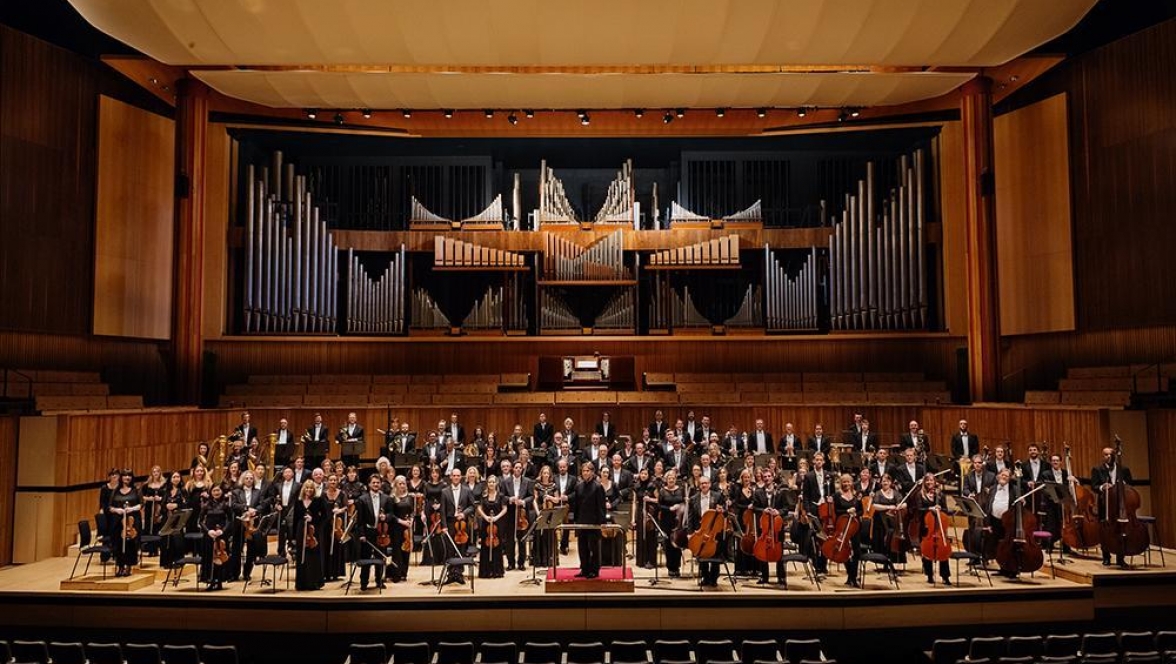
So this symphony lover invites me to a concert, a box seat, up over the orchestra.
It’s cold. Chicago. The violinists warm up. The whole northern hemisphere keeps trying to warm up to spring.
From anywhere in the building, you can see the guy up front, the conductor.
Somebody’s ironed his black threads pretty smooth. His hair – not so much. It’s this perfect balance of grace.
The lights dim, papers stop rustling. A thousand smart phones are rendered dumb. The conductor raises his arms and in one moment it’s like he’s pulled a million strings and the music rises — and there it is, clear as a spotlight:
The only way to lead a symphony is to turn your back to the crowd, the critics, the court.
Something inside me unhinges.
Read the full article here
Twenty days ago, ironically enough on Father’s Day, we received one of those late night door knocks that only ever bring bad news. Our daughter, just 10 weeks or so from giving birth to our first grandchild, had noticed that the baby had stopped moving. The doctors at the hospital had been unable to find a heart beat and the fate of the baby would be confirmed with an ultrasound the following morning.
Sometimes the journey that we think we are travelling is abruptly ended, changed to a completely different one with a destination that nobody could foresee and that nobody wants.
Last week at the memorial service for baby Henry we were to release a helium balloon. As I left to collect it Margaret asked me to buy some small flowering plants to put near the water feature near the church door to add some colour. A couple of pots of gerberas with bright yellow flowers were perfect.

After the service was over, I planted them in some pots in the garden expecting them to be here to remind us of the grandson who isn’t here. But this morning I found this:

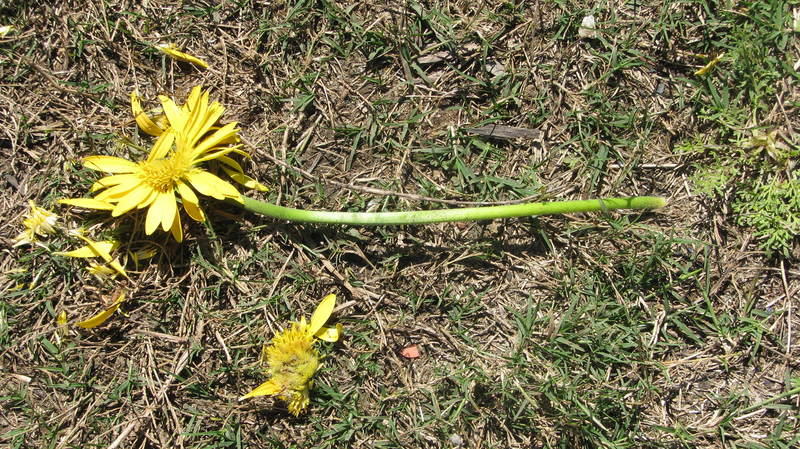
There was no doubt who the culprit was.

I was so angry, sad and despondent.
On the one hand it is just $20 worth of plants- another item on this horrible dog’s tally of destruction. But on the other hand, it touched me at a level of my soul because of the connection of these flowers to baby Henry. It is irrational but the destruction of these plants brought to the surface a new collection of emotions that needed to be felt and understood.
Today was a difficult day, but not just for my own grief. I heard of a father who died after an illness of several years whose family has literally been barely surviving for that time. I heard of the struggle of a good friend in a difficult marriage. I know of another young father who is about to die from an aggressive leukaemia.
And over the last few weeks we have heard of people with seemingly happy families and lovely children who have suffered a similar loss to ours.
The worst thing about being a parent is that you can’t fix the really important things in your children’s lives. Love for others allows us to share their joys, but it multiplies our capacity for hurt.
All of this points to the limitless capacity of God’s love to us. While two sets of parents were trying to help their son and daughter through an awful time there were little gracelets that brought light into the darkness. There were smiles in the tears brought to us by a loving Father who knows what it’s like to lose a Son.
So we walk a path we did not choose, and would not if it were ours to choose.
But we know that God is walking with us.
This morning I was studying John 17:20-26 and I was struck by an interesting chain of logic in this section of Jesus’ prayer.
The logic runs like this:
A similar thread runs around the word glory. In John’s gospel it is on the cross that Jesus is glorified, and this is happening right before the crucifixion.
When christians argue and refuse to love one another it is a sign that they don’t love God enough and have not seen His glory. If you do a search on almost any well-known Christian leader you will quickly find a thousand or more pages about why that person is a heretic or not even saved.
Those pages betray a problem with their authors- they don’t love God enough.
The positive side of this is that if we pursue God with pure passion, then He will give us a greater love for His people. I have seen that in my own life. Each morning as I pray for the people in my church, the Lord gives me a deeper appreciation and love for each one. Lately He has directed me to pray for the other pastors in the town and I am finding the same process at work. I actually like these men and women!
If we want to see our town and our nation turn to Christ we first must learn to love one another more. But to do that we must love God more. The starting place has to be worship, both personal and corporate, reading the Scriptures and praying for our brothers and sisters in the Lord. As we do these things, He will show us people to pray for and give us the love to serve them.
In the midst of all these things, if I read John 17 correctly, we will start to see the glory of God released and flowing out from us to the world.
That is how revival starts.
Ann Voskamp reminds us that we need to stay in love with Jesus:
Stay in love.
I tell the girl that in a hardly voice, the kind of voice that comes from a primal place.
Though, truth be told, she tells me she doesn’t know if she had ever found that love place in the first place — which, yeah, makes it relatively hard to stay in love.
Falling in love, staying in love? That’s what seduces across the radio waves. That’s what the lingerie catalogues woo us with, what the billboards tease us with, what the MTV videos hard sell.
When the world’s selling goods dressed up as love while the church is selling law dressed up as good news —– guess where the next generation starts lining up?
Read the rest here
I just love Sarah Bessey’s writing about the special weirdness of christians.

Go ahead, wave your flag
On the weekend, I did one of the most Vineyard-y things I’ve ever done in my life: I took two of my tinies to a worship flagging workshop. Like, it was a class about great big coloured flags and how to wave them well during church as part of the worship service.
So we have flags. We wave flags.
I know.
It’s weird to outsiders, and I get that. But I guess I can admit now that most of what we do as Christians is a bit weird to outsiders and so just roll in the weird altogether.
I’m not a flagger myself but I have an unreasonable love for people who wave the flags. I’ve reached the point in my story when I want all the crazy. All of it. I want the sloppy prayers and the hope and the flags and the unreasonable and embarrassing expectations for the voice of God to break through my life and the unprofessional dancers and the praying in tongues and the Eucharist and the Book of Common prayer being read aloud like it’s slam poetry in an old warehouse. I want anointing oil in my purse and ashes on my forehead.
Part of my own story is that I went for a big wander outside of my my mother Church, encountering different and new and ancient ways of experiencing and knowing and being changed by our big and generous God as if I were encountering occasional cups of water while in the desert, drinking each one down as if they were sustaining me for the next leg of the journey. But at the end of the story – or at least at the point of the story where I am right now, who can say if this is the end? – I came home.I came home to the school gyms and the folding chairs, the humble people of God also thirsty for the inbreaking of the Holy Spirit, imperfect and sometimes disappointing and unabashedly sincere and utterly beloved to me.
Read the rest of the article here
 New Life Narrabri