Health of Fish Stocks Contradict Climate Alarmists Predictions

From wattsupwiththat.com
Health of Fish Stocks Contradict Climate Alarmists Predictions

By Vijay Jayaraj

The oceans are still very much a mystery to humankind, with a vast majority of it yet to be explored. Early in my career, I wanted to make an in-depth study of how climate affected marine life. After all, many media reports claimed that “oceans will become empty by 2048.”

So, as a graduate research assistant, I explored the adaptability of marine fish and invertebrates to fluctuations in ocean temperatures. I found that both are highly adaptable to changes in the water around them. That is the way they are made.

Now, evidence emerging from scientific studies shows that marine life may be benefiting from the relative warmth of modern temperatures.

Contrary to the hyperbole of climate reporters, there has been no alarming increase in global sea-surface temperatures. Even if temperatures increase substantially, fish are free to migrate to cooler waters and do, as documented by scientific studies.

Fish also have natural adaptive mechanisms. Since their initial emergence in Earth’s waters, fish have developed genetically in ways that allow them not only to survive but to thrive in a variety of environments. In addition to the generational genetic adaptability, fish also display short-term phenotypic plasticity which allows them to adapt to temperatures and other physical factors. When combined, these mechanisms act as significant protection against the ill-effects of the physical environment.

Despite this, it is not uncommon to see news of fisheries crashing under the weight of a climate crisis. However, real-world data contradict such negative reports, indicating instead that global fish catches will improve in the coming decades.

2016 scientific study “assembled the largest-of-its-kind database and coupled it to state-of-the-art bioeconomic models for more than 4,500 fisheries around the world.” The study found that global fisheries will profit from an increase in marine species. The degree of this commercial success will depend on a range of policy measures, including ones that enable increased catches for individuals and communities.

In 2020, there was a record 214 million tonnes of production from both wild catches and aquaculture. The State of World Fisheries and Aquaculture 2022 report says that this production is expected to grow 14 percent by 2030. Fish are expected to become more affordable and accessible, with prices decreasing between 2024-2029, according to two international bodies: the Organization for Economic Co-operation and Development (OECD) and United Nation’s Food and Agriculture Organization (FAO) that published the data in Agricultural Outlook.

As of 2017, around 65% of fish stocks were biologically sustainable. An index of population health is maximum sustainable yield (MSY), which is the point at which the stock can sustain itself without limits on fishing. The MSY calculation involves collaborative information gathering by marine biologists and fishers.

The 2022 report states that the number of catches from biologically sustainable stocks has been on the rise! This signals that catches can be increased without depleting the stock to levels that neither the species nor continued fishing is at risk. While some concerns remain for a few species, studies show that in regions where we have high-quality population data, the majority of fish stocks are either stable or improving.

In short, any threat to future catches is not “empty” seas but rather the effect of activities such as illegal fishing and overfishing. Fish as an important protein source is likely to remain available in large quantities. Reality contradicts the fallacious climate crisis that dominates popular media and politics.

This commentary was first published in American Thinker on February 10, 2024.

Vijay Jayaraj is a Research Associate at the CO2 Coalition, Arlington, Virginia.  He holds a master’s degree in environmental sciences from the University of East Anglia, U.K.
Strange Fish Behaviour

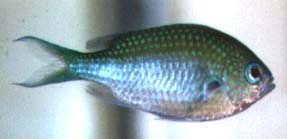
I have several fish called Chromises in my aquarium. The photo above looks quite dull, but they are very colourful blue-green fish that like to school. A school of chromises looks quite fantastic.

While I was feeding the fish on Saturday, one of these guys swam rapidly to the surface (they do feeding frenzy really well) then shot to the bottom of the tank, hitting a piece of rock on the way. Then it lay flat on the sand at the bottom, not moving for some time.

I always expect the worst, and I thought the impact must have killed it. However, an hour or so later, the fish was missing from its previous resting place and was happily swimming around.

What was weird was that there was now something like a clear plastic ring around its mouth. You could see that it was able to open and close its mouth OK, but there was this strange thing right on the front of its face. Had it picked up some plastic refuse from my tank?

The next morning the fish was back to normal appearance. I think that it must have given itself the fishy equivalent of a fat lip in its strange accident.

A few days later and it is still right as rain. The incident is something of a mystery.

The Piglet Squid

The variety of creatures that live on the land and in the sea is a testament to the creativity of God our Creator.

From Australian Geographic

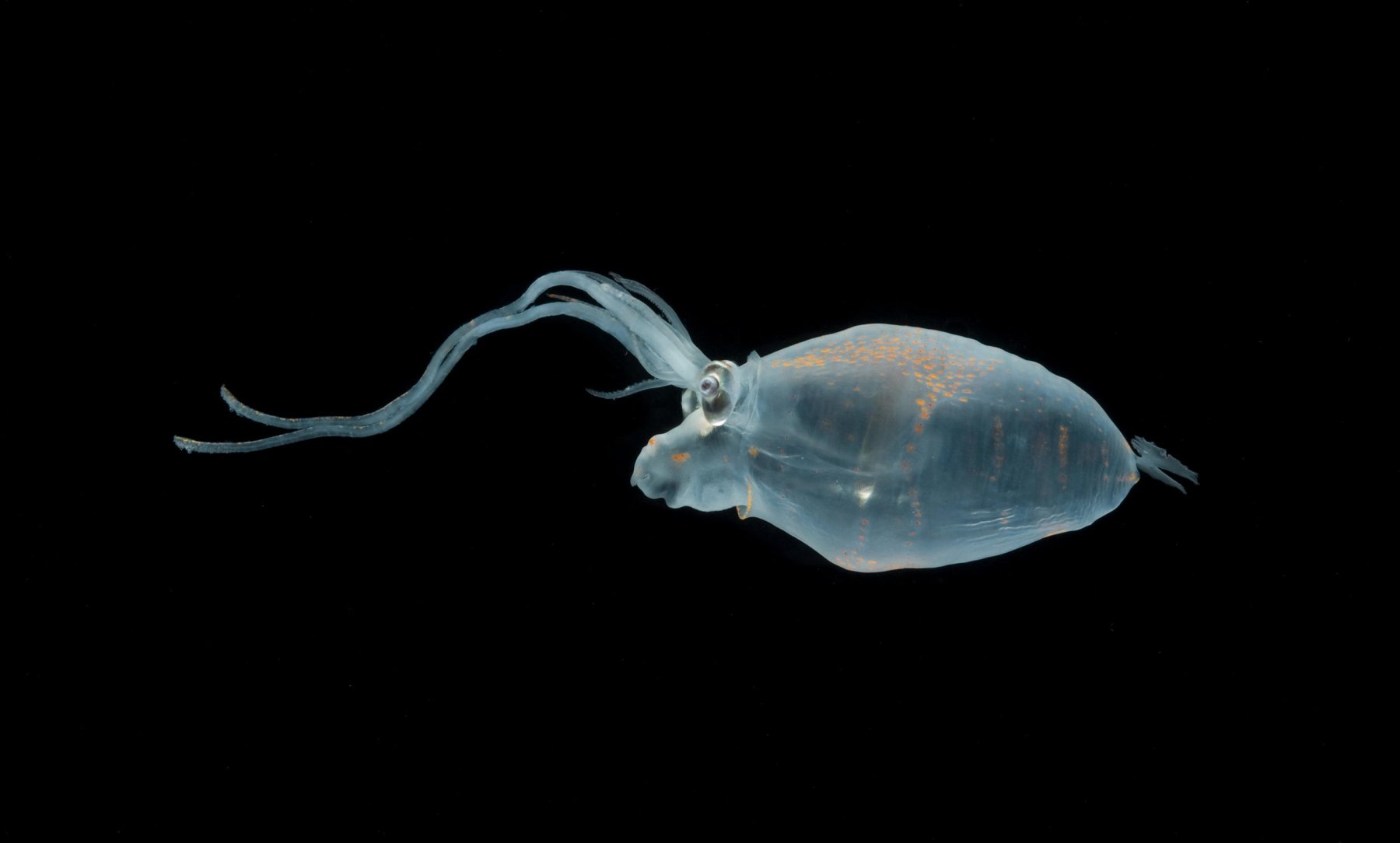
The piglet squid is a squidgy little enigma

Only the luckiest divers, researchers and ocean-enthusiasts will ever get the chance to spot a piglet squid in the wild. Or, if you’d prefer, a squiglet.

These elusive little cephalopods charm with their cartoonish appearance and intrigue with their gelatinous, transparent bodies. Those spots you can see in the image above are chromatophores, or pigment organs, which, when you look at the piglet squid from front-on, give it the appearance of a broad smile

The piglet squid (Helicocranchia pfefferi) grows to about 8 or 10 cm long. It’s found throughout the Pacific and Atlantic Oceans, ranging from tropical to polar waters. It can live at depths of just 1 metre to more than a kilometre below the surface – an unusually wide range for such a delicate creature.

It’s been spotted off the coast of Australia right down in the south-eastern corner of the mainland and occasionally in Tasmanian waters.

The piglet squid’s ‘nose’ is an exposed syphon, a hole used for filling itself with water, breathing and propulsion. Oddly enough, the piglet squid is able to keep itself buoyant by regulating the levels of ammonium (yes, the same kind of chemical you use to clean the oven) and sodium ions throughout its body.

You can see the way it bobs around in the ocean as these chemical levels ebb and flow within its balloon-like mantle (the main body of a squid) in the amazing deep-sea footage below. It was captured by a robotic underwater rover in the Palmyra Atoll, located in the Pacific Ocean roughly halfway between Australia and Mexico:Play

Piglet squids belong to the family Cranchiidae, which comprises roughly 60 species of glass squid, named for their transparent bodies.

Glass squid have been known to display an unusual habit of swimming upside-down, and no one really knows why they do it. It gives them the appearance of having a weird mop of hair, their arms and tentacles flowing freely above their eyes.

Read the full article here

Clever Mimicry in Marine Fish

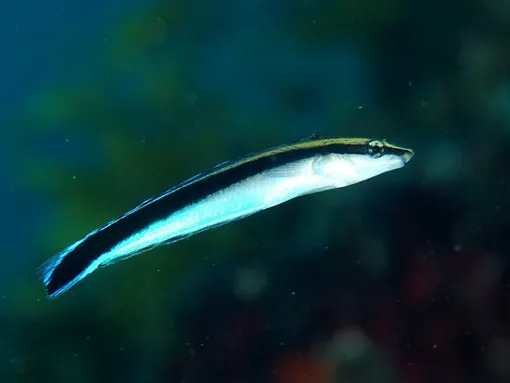
Instead of cleaning parasites off the host, this aggressive mimic will actually bite them instead.

I just love the huge variety in the world of marine fish. They are a testament to the amazing creativity of the Creator God. Here are some examples of the ways in which some fish try to mimic other fish for a variety of reasons.

From Saltwater Aquarium blog

7 Sly Examples of Mimicry in Saltwater Fish

Let’s face it, it’s a fish-eat-fish world out there. Carving out a niche and surviving is a full-time job. One of my favorite survival strategies among animals is mimicry–and we’re fortunate to have several great examples of mimicry in saltwater fish.

7 Stealthy Cases of Saltwater Mimicry

If you want to jump right into things, you can scroll down to see the first case of mimicry in saltwater fish for yourself, but it might be helpful to provide some background about the few interesting types of mimicry that will be shown in this article:

  1. Batesian mimicry
  2. Self-mimicry
  3. Aggressive mimicry

Batesian 

The first, and perhaps most well-known type of mimicry is called Batesian. It is named after Henry Walter Bates, who put forward a theory that this visual copy-catting is an evolutionary adaptation/strategy that helps avoid predation.  Batesian mimicry occurs when a relatively harmless species imitates the coloration patterns of a species known to be toxic or have harm-inducing defenses. It’s sort of a distastefulness-by-association approach, where the harmless animal benefits by association, while the species being copied is largely unaffected.

Click here to read the rest of the article