Jo Nova: Microbes Are Dealing With The Plastic “Crisis”

Jo Nova writes:

Plastics are not forever: Bugs already evolved 30,000 new plastic eating enzymes
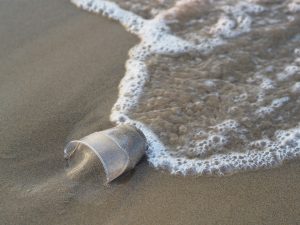
Plastic cup at the beach. Photo

flockine

Plastics are a free dinner for life on Earth so it was just a matter of time before microbes evolved to eat it.

A PET bottle normally takes 16 – 48 years to break down, but if it were lunch for microflora it would take weeks instead. Hydrocarbons are ultimately just different forms of C-H-O waiting to be liberated as carbon dioxide and water. The only question was “how long” it would take bacteria and fungi to break those unusual bonds.

Sooner or later all plastic will be biodegradable.PET Plastic, Polyethylene-terephthalate
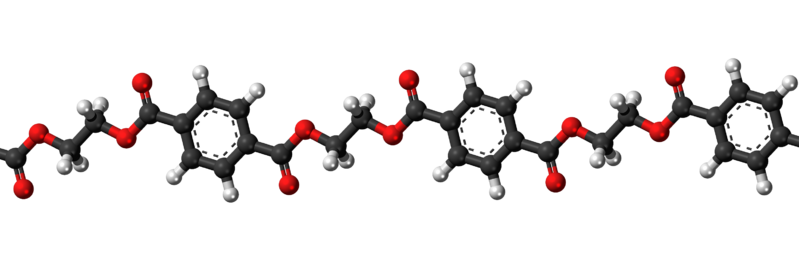
Polyethylene-terephthalate (PET)

The first bacteria known to chew through PET bottles was discovered at a Japanese rubbish dump in 2016. But we had no idea then just how advanced the microbial world of plastic processing was.

A new study shows. Instead of hunting for single bacteria Zrimec et al mined through collected metagenomes of soil and ocean and found not just 5 or 10 new enzymes but 30,000. It appears that they could metabolize at least ten different types of plastic.

And in places where there was more plastic pollution, there were more enzymes. All over the world a whole new ecosystem is rising out of the puddles and bubbles and grains of sand.

Enzymes that degrade plastics are found all over the worldMap od plastic degrading microbes
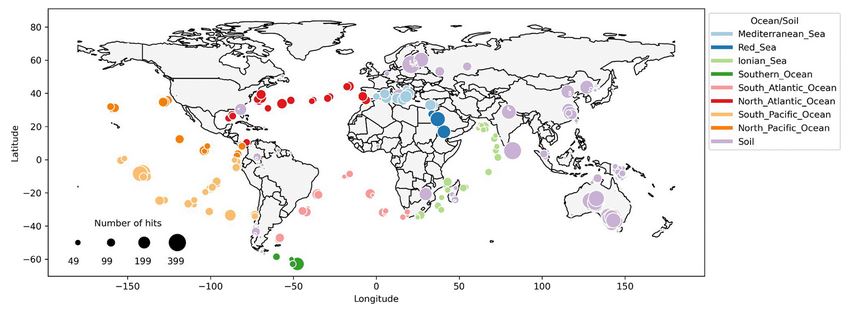
FIG 2 Plastic-degrading enzymes across the global microbiome. Depicted are 11,906 enzyme hits in the ocean and 18,119 in the soil data sets, obtained by constructing HMMs of known plastic-degrading enzymes and querying them across metagenomic sequencing data sets. The potential to degrade up to 10 and 9 different plastic types was observed in the respective ocean and soil fractions (Fig. S3A).

Mother Nature has a big toolshed of genes to play with:

With a library like this, is it any wonder life on Earth could find and amplify the right tools to process plastics?

For example, global ocean sampling revealed over 40 million mostly novel nonredundant genes from 35,000 species (35), whereas over 99% of the ∼160 million genes identified in global topsoil cannot be found in any previous microbial gene catalogue (34)

So there are 200 million genes to work with.

Bugs across globe are evolving to eat plastic, study finds

Damian Carrington, The Guardian, 15 Dec 2021

The explosion of plastic production in the past 70 years, from 2m tonnes to 380m tonnes a year, had given microbes time to evolve to deal with plastic, the researchers said. The study, published in the journal Microbial Ecology, started by compiling a dataset of 95 microbial enzymes already known to degrade plastic, often found in bacteria in rubbish dumps and similar places rife with plastic.

About 12,000 of the new enzymes were found in ocean samples, taken at 67 locations and at three different depths. The results showed consistently higher levels of degrading enzymes at deeper levels, matching the higher levels of plastic pollution known to exist at lower depths.

The soil samples were taken from 169 locations in 38 countries and 11 different habitats and contained 18,000 plastic-degrading enzymes. Soils are known to contain more plastics with phthalate additives than the oceans and the researchers found more enzymes that attack these chemicals in the land samples.

Nearly 60% of the new enzymes did not fit into any known enzyme classes, the scientists said, suggesting these molecules degrade plastics in ways that were previously unknown.

The not so apocalyptic plastic crisis
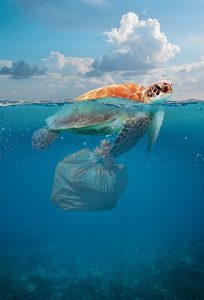
TheDigitalArtist, Turtle Ocean.

TheDigitalArtist

The new 250 page “Consensus” Study (their words) by the National Academies of Science, Engineering and Medicine, is as out of date and useless as it sounds. While it is scoring headlines, scaring us about accumulating plastics, it largely writes off the idea that microbes will evolve to degrade plastic, saying “measurable biodegradation (complete carbon utilization by microbes) in the environment has not been observed.” Which is one of those true but useless statements.

Some 40 year old theory says it won’t happen:

Plastics with hydrolysable chemical backbones (e.g., PET and polyurethanes) may be more susceptible to enzymatic degradation and eventual biodegradation than those with carbon-carbon backbones (Amaral- Zettler, Zettler, and Mincer 2020), as illustrated by the discovery of PET-degrading bacteria isolated from a bottle recycling plant (Yoshida et al. 2016). However, Oberbeckmann and Labrenz (2020) argue, based upon Alexander’s (1975) paradigm on microbial metabolism of a substrate, that the very low bioavailability and relatively low concentration of plastics in the ocean together with their chemical stability render these molecules very unlikely candidates for biodegradation by marine microbes, despite their potential as an energy and carbon source.

But if plastics are so tiny and low in concentration, it’s a big “so what” — they are unlikely to be a problem. If they were concentrated in one place or collected in an organism, they could be bad, but then, of course, they also become fodder for microbes.

The bottom line: We don’t want to drown dolphins and trap turtles, but we shouldn’t demonize plastics either.

Don’t throw rubbish in the ocean or toss hype in national news. It’s all litter.

Hat tip to Kip Hansen at Watts Up.

REFERENCES

Zrimec et al (2021) Plastic-Degrading Potential across the Global Microbiome Correlates with Recent Pollution Trends, ASM Journals mBio Vol. 12, No. 5 DOI: https://doi.org/10.1128/mBio.02155-21 

Reckoning with the U.S. Role in Global Ocean Plastic Waste, (2021) ISBN 978-0-309-45885-6 | DOI 10.17226/26132  https://www.nap.edu/download/26132

Full article

The Horrors of the Deep

Plastic literally at the bottom of the ocean. Very sad!

From news.com.au

Man-made horrors lurk at the bottom of the Mariana Trench, the deepest part of the ocean

Way, way down at the deepest point of the ocean lies a disaster of humanity’s own making that will never die – with untold consequences.Shannon Molloy3 min readNovember 24, 2021 – 1:18PM24 comments

A helium balloon decorated with characters from the film Frozen at the bottom of the Mariana Trench. Picture: Mariana Trench – In Pursuit of the Abyss

A helium balloon decorated with characters from the film Frozen at the bottom of the Mariana Trench. Picture: Mariana Trench – In Pursuit of the Abyss

The Mariana Trench is the deepest part of the ocean, and the deepest part of Earth itself, measuring some 11km down.

So unforgiving are the pitch-black, pressured and near-freezing conditions that we know little about what lurks below, with untold marine treasurers still waiting to be discovered.

Scientists consider the absolute lowest beds of the sea to be about as hard to reach as space.

Victor Vescovo was the last human to do so, reaching a new record depth of 10.9km in April 2019 in a Triton 36000/2 submarine, built to withstand the extreme pressure.

Over five dives to the bottom of the Mariana Trench, the American explorer found previously unknown crustacean species, witnessed brightly coloured outcrops and came across a pink snailfish.

Then, scattered throughout a place only two others have ever managed to physically reach, Vescovo saw plastic.

Lolly wrappers and a plastic shopping bag, to be precise.

CHECK OUT NEWS.COM.AU’S NEW YOUTUBE CHANNELhttps://www.youtube.com/embed/oJU8UrFg2rE

Nowhere is safe from humanity

Vescovo’s shock find almost overshadowed his remarkable achievement and the scientific promise of his sea life discoveries.

And for good reason.

“We always had this sense that there was a part of the planet that was beyond, that was untouched by human action,” Eric Galbraith, an ocean biochemist at the Catalan Institution for Research and Advanced Studies in Barcelona and adjunct professor at McGill University in Montreal, told the magazine Maclean’s.

“That used to be true. And now it’s no longer true.”

And unfortunately, Vescovo’s discovery isn’t the first, with previous unmanned voyages to the depths of the Mariana also encountering plenty of plastic pollution.

Showing how extensive the problem is – and how quickly waste can sink down – one dive found the remnants of a helium balloon decorated with characters from the children’s film Frozen, released in 2013.

Vision captured of that dive shows the balloon and, resting next to it, a heavy duty 20-litre plastic bucket.

A scene from the film Mariana Trench – In Pursuit of the Abyss shows plastic waste found by unmanned craft. Picture: YouTube

A scene from the film Mariana Trench – In Pursuit of the Abyss shows plastic waste found by unmanned craft. Picture: YouTube

A Frozen balloon and a plastic bucket was seen in the near-inaccessible area. Picture: YouTube

A Frozen balloon and a plastic bucket was seen in the near-inaccessible area. Picture: YouTube

In 2018, researchers from the Institute of Deep Sea Science and Engineering in China took samples of water and sediment at depths ranging from 2.5km to 11km.

“Man-made plastics have contaminated the most remote and deepest places on the planet,” they wrote in analysis published in the journal Geochemical Perspectives Letters.

“The (deepest Mariana) zone is likely one of the largest sinks for microplastic debris on Earth, with unknown but potentially damaging impacts on this fragile ecosystem.”

Read the rest of the article here

Another Environmental Fuss Over Nothing

They keep saying “Plastic is forever” and wanting to ban plastic bags and straws to save the planet. It turns out that plastic does degrade realtively rapidly in the environment, under the influence of sunlight and microbes.

This article talks about plastic in the ocean, and we still need o be responsible in disposing of rubbish. There is no denying that animals near coastlines can be badly damaged by plastic, but outside of that particluar niche, not so much.

From wattsupwiththat.com

Plastics: Science is Winning

Kip Hansen / 2 hours ago October 18, 2019

Guest Essay by Kip Hansen — 18 October 2019

Science is beginning to win in the long battle over misinformed anti-plastic advocacy.  It has been a long time coming.  The most recent paper on the subject of pelagic plastic (plastic floating in the oceans) is from a scientific team at the Woods Hole Oceanographic Institution on Cape Cod, Mass., and the Massachusetts Institute of Technology.

The study is “Sunlight Converts Polystyrene to Carbon Dioxide and Dissolved Organic Carbon” by Collin P. Ward, Cassia J. Armstrong, Anna N. Walsh, Julia H. Jackson and Christopher M. Reddy.   It is good basic science.

styrene_cups

We are all familiar with polystyrene — it is prevalent in modern packaging, both as a solid,  such as yoghurt cups, or in expanded form used for disposable foam drink cups.  Much of the plastic flotsam found on the worlds beaches and floating  in rivers is this ubiquitous plastic, particularly the expanded foam.

The new abstract of the new study starts with this:

“ABSTRACT:   Numerous international governmental agencies that steer policy assume that polystyrene persists in the environment for millennia.  Here, we show that polystyrene is completely photochemically oxidized to carbon dioxide and partially photochemically oxidized to dissolved organic carbon. Lifetimes of complete and partial photochemical oxidation are estimated to occur on centennial and decadal time scales, respectively. These lifetimes are orders of magnitude faster than biological respiration of polystyrene and thus challenge the prevailing assumption that polystyrene persists in the environment for millennia.”   [ bolding mine — kh ]

It is about time that someone scientifically challenged the activist position held and promulgated by many environmental, anti-plastics and anti-corporate groups that “Plastic is Forever”.

Plastic is not forever.  Glass, both natural and man-made,  is forever, but not plastic.

Read the rest of the article here

The Amazing Wax Worm Eats Plastic!

This is amazing!

From the ABC

Wax worms biodegrade plastic bags at ‘uniquely high speeds’, study finds

Posted about 3 hours ago

Scientist and amateur beekeeper Federica Bertocchini picked parasitic wax worms from the honeycomb of her beehives and left them sitting in a plastic bag.

When she returned to the bag, it was riddled with holes and many of the worms had escaped.

It was that chance discovery that led her to collaborate with scientists at the University of Cambridge in England to unearth the possibility of using worms to munch through the world’s plastic problem.

The team discovered the wax worm, a caterpillar commercially bred for fishing bait, has the ability to biodegrade polyethylene — a type of plastic used to make shopping bags — at uniquely high speeds.

The degradation rate was extremely fast compared to other discoveries, like plastic-eating bacteria, the study published in Current Biology found.

When the team exposed about 100 wax worms to a plastic shopping bag, holes started to appear after 40 minutes, with a reduction of 92mg after 12 hours.

To compare: plastic-eating bacteria biodegraded plastic at a rate of 0.13mg a day, and it takes 100 to 400 years to degrade polyethylene in landfill.

Analysis showed the wax worms transformed the polyethylene into ethylene glycol, a chemical used to make polyester and anti-freeze.

The team of three scientists said the discovery could lead to a biotechnological approach to plastic pollution.

People around the world use about 1 trillion plastic bags each year, the study said, and more than 45 million tonnes of polyethylene plastics are produced annually.

“The caterpillar produces something that breaks the chemical bond, perhaps in its salivary glands or a symbiotic bacteria in its gut,” said Cambridge University’s Paolo Bombelli said.

“If a single enzyme is responsible for this chemical process, its reproduction on a large scale using biotechnological methods should be achievable.”

Wax has similar chemical structure to plastic

Wax moths lay their eggs inside hives where the wax worms grow on beeswax.

The worms are known for living like parasites in bee colonies and damaging hives by eating their wax comb.

Researchers said breaking down plastic and beeswax required similar types of chemical bonds.

“Wax is a polymer, a sort of natural plastic, and has a chemical structure not dissimilar to polyethylene,” Ms Bertocchini, from the Spanish National Research Council, said.

When the team mashed up the worms and smeared them into plastic they had similar degradation results to when the caterpillar “ate through” the plastic.

“The caterpillars are not just eating the plastic without modifying its chemical make-up. We showed that the polymer chains in polyethylene plastic are actually broken by the wax worms,” Mr Bombelli said.

“The next steps for us will be to try and identify the molecular processes in this reaction and see if we can isolate the enzyme responsible.”