The Downside of Net Zero In 100% Green Canberra

From Jo Nova:

In “100%” Renewable Canberra people are queuing to hang out in warm libraries, and the air is more polluted

Kill trees, pollute the air, punish the poor and protect coal underground

Just another day in Green heaven.

Canberra Wood Smoke

Wood smoke over Canberra   |   Photo from Clean Air Canberra

The Australian capital city Canberra in midwinter is often minus 1 to 5 degrees C in the morning. Australian homes can get very cold and with heating bills rocketing, things are defacto becoming like life in Berlin, which is in a pre-War energy crisis. No one labeled Canberra public halls as “warm spaces” and they definitely aren’t open at night (it’s the public service!), but crowds are arriving at libraries just to escape the cold.

The ACT Government are a Labor-Green alliance, and are proudly, exuberantly “100% Renewable”, but won’t dare cut the cord to the coal plants that keep the lights on, making the claims of being 100% renewable a form of 100% false advertising. Even the ABC admits that the ACT itself only generates 5% of its own power, and 80% of the energy coming to the ACT through the wires is from fossil fuels. They pay off some distant wind farms to balance the theoretical gigawatt-hour tallies, and sponge off the states around for cheaper backup and stability that the coal plants provide.

But as electricity prices rises 14% of Canberran’s are heating their homes with wood. This has predictably increased actual air pollution. So now there is a movement to ban wood fires.

If only there was a 300 year supply of cheap fuel to burn at centralized clean power stations…

Like all Green policies putting fashion before facts, they get the opposite of what they aim for.

FLAT WHITE

Canberra: where electricity is a luxury the poor can’t afford

Tina Faulk, The Spectator

Public libraries in the National Capital are now considered, by staff and patrons alike, to be ‘community centres’ where people come to read, use the computers, charge their phones, and use the toilets. It’s where clients of the NDIS, escorted by carers, are brought and propped up in their wheelchairs in front of computers or seated in deep armchairs by the magazine stands. Some, abandoned by their carers, shout incoherently for attention. Newly arrived migrants – Somalis, Iraqis, Syrians – jostle for attention of the library staff, asking for translation assistance with various forms and declarations.

Our libraries, warm and welcoming, have a crowd at their doors before the 10 am opening.

Groups of women discuss where they go to get warm:

One [woman] who recently ‘VR-ed’ (Voluntary Retired) still goes back to her old workplace, usually late morning, when the security guard who remembers her gives a nod and a smile as she settles into one of the comfortable settees in the reception area.

How sad is that — going back to her old workplace foyer just to stay warm?

Wood heaters in the firing line as temps drop and pollution rises

Lottie Twyford, Riotact

A recent report showed woodfire heater smoke is the largest source of winter air pollution in Canberra. Currently, around 14 per cent of people in the ACT use a woodfire heater as their main source of heating.

Analysis of air quality shows the impacts of smoke are worse down south because the shape of the valley and temperature inversions hold pollutants closer to the ground. In 2020, there were 37 days in Tuggeranong when pollution levels were above acceptable levels; of those, 13 can be attributed to woodfire heater emissions, Mr Davis told the ACT Legislative Assembly.

The local newspaper is running stories about the “right temperature” to heat homes to. They suggest 18°C (colder than the public buildings in Germany which are now set down to 20°C). A few years ago I stayed with a friend in Canberra and the room was 11°C (and it was only May!).

Read the full article here

Good News For Pollution Reduction

From the University of Sydney

Engineers use electricity to clean up toxic water


Powerful electrochemical process destroys water contaminantsUniversity of Sydney engineers have used electricity to clean up heavily polluted industrial wastewater. They hope the findings will help wineries, pharmaceutical manufacturers and other industries that must comply with strict wastewater regulations.

Julia Ciarlini Junger Soares showcasing her work at the University of Sydney. The researchers used an advanced oxidation process that eliminated stubborn organic aqueous pollutants. Credit: Julia Ciarlini Junger Soares, University of Sydney

A team of engineers may be one step closer to cleaning up heavily contaminated industrial wastewater streams. 

Researchers from the School of Chemical and Biomolecular Engineering developed an electrochemical oxidation process with the aim of cleaning up complex wastewater that contained a toxic cocktail of chemical pollutants. 

“Our study, published in Algal Research, involved industrial wastewater that had been heavily contaminated with a cocktail of organic and inorganic species during a biofuel production process”, said Julia Ciarlini Junger Soares, who is completing a PhD in Chemical and Biomolecular Engineering under the supervision of Dr Alejandro Montoya.

The wastewater, which contained carbon, nitrogen and phosphorus, was generated in a pilot plant, designed by the team for the production of biofuels using naturally abundant microalgae.

The process involved treating wastewater with electricity using specialised electrodes. They discharged electricity, then drove oxidation reactions near the electrode surfaces, transforming the organic contaminants into harmless gasses, ions or minerals.

“We have employed an incredibly powerful process that eliminates even the most persistent non-biodegradable pollutants, such as pharmaceuticals and pesticides, as well as various classes of organic compounds that can be found in many industrial effluents,” she said.

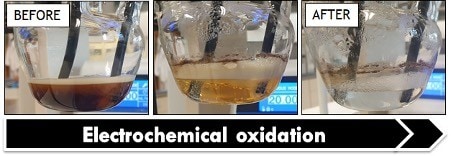
The water before, during and after treatment. Credit: Julia Ciarlini Junger Soares, University of Sydney 

“The process is relatively simple, does not require the addition of chemicals or severe operation conditions, and does not produce additional waste streams.

“Wastewater is a significant issue for our environment, as well as for many industries who use substantial volumes of water in their processes, such as in reactions, transport, and washing and cooling. Finding suitable solutions for reuse or disposal is often very challenging and costly. 

“The electrochemical method that we used can be readily applied to industries that must comply with strict regulations for wastewater disposal, such as pulp and paper processing, wineries, as well as pharmaceutical production facilities.

“Worldwide, researchers are investigating methods for the development of biofuels from algae. Developing alternatives for the treatment and reuse of this industrial effluent is a hot research topic and can bring opportunities for energy and resource recovery within a circular bio-economy framework.”

The team will soon carry out research focused on specific contaminants to better understand the chemical transformations that take place during electrochemical oxidation and will upscale the process.

A 2017 UNESCO report found that the opportunities from exploiting wastewater as a resource were vast, and that safely managed wastewater is an affordable and sustainable source of water, energy, nutrients and other recoverable materials. 

The Straw Man Argument

With the latest environmental hysteria gaining traction to ban plastic straws (as usual both irrational and unscientific) here is a graph that puts Australia’s plastic pollution in perspective:

Yeah, we don’t even make the top 12.

You may have also heard about the incredible figure of 500 million plastic straws used by Americans every day. It turns out that came from a science project by a 9 year old boy. That doesn’t prove it is wrong, just lacking in academic rigour because most 9 year olds have not been trained in the scientific method (much like most adult environmentalists)