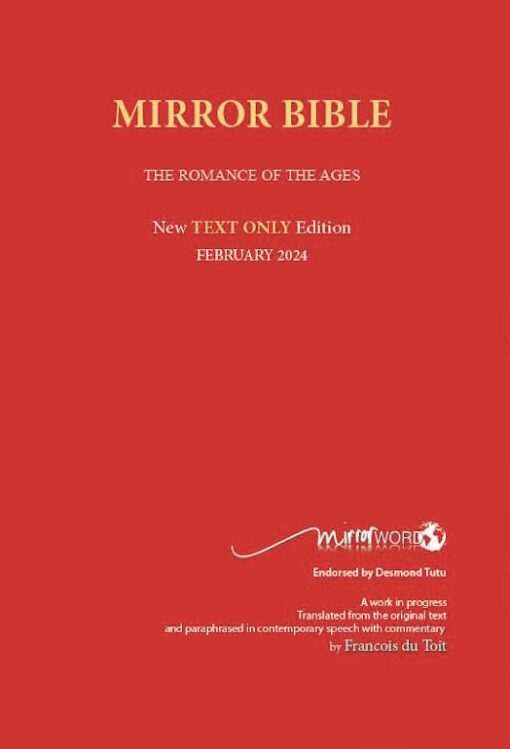
Avoid This At Any Cost!

There are many English translations of the Bible available, for which I am very thankful. They cover a range of reading styles, translation philosophies and so on. Usually they are written by teams of scholars who have devoted their lives to studying the Bible in the original languages.

The Mirror Bible is not one of these. It is written to push a particular theological viewpoint, imposing that idea on the text rather than letting the Scriptures lead us into correct understanding.

The author, Francois du Toit is from South Africa and has a three year theology degree (same as me, but I don’t laim to be a biblical scholar). He believes a number of twisted doctrines including

  • Universalism- the belief that every body will be saved
  • Sin is not real but is rather our inability to see the divine in us
  • Inclusivism- the belief that the gospel is meant to include everyone, regardless of their interest in God
  • The Bible is meant to help us to hold a mirror to ourselves so that we can see God in us, as opposed to the traditional view that the Bible is a mirror that revels our sin nature.

These beliefs are at the core of so-called Progressive Christianity (a mixture of christianity and left-wing political beliefs) and the Global Grace Ministries. What is strange, though, is that it is also popping up in hypercharismatic circles such as Kenneth Copeland’s Word of Faith movement and Bethel Church, Redding. Preachers such as Creflo Dollar, Jerry Savelle and others have been promoting it.

In her video on this subject, Melissa Dougherty compares some passages from the ESV Bible with The Missor Bible. The first one is John 14:6

Can you see how, instead of pointing the reader to Jesus as the Way, the Truth and the Life, The Mirror Bible points us back to ourselves?

John 14:12 tells us we must receive Jesus, but The Mirror Bible tells us that we already have Him.

Finally we have Romans 1:28.

Romans 1:20 says that people can see God in nature , but they choose not to acknowledge God, and so He gives them over to their sinful desires. The Mirror says they didn’t care about their own divine nature and so they could not see God.

This is such a terrible perversion of the teaching of Scripture that nobody who wants to draw close to God should look at this book.

The most trustworthy Bibles are the ones that have been translated by a team of scholars, where a thoughtful consensus of opinions prevents individuals from running off with their own pet ideologies.

I recommend that Bibles and paraphrases that have been written by a single person, such as The Passion Translation (Brian Simmons) and The Message (Eugene Peterson) should not be read as your main Bible. Use them as an addition to the NIV or the NLT, but not as your main source of godly inspiration.

And never, ever read The Mirror Bible.

If you want more information about this, I strongly recommend Melissa Dougherty’s video on this. It is long but it is thorough.

Scott Sauls: Compassion, Judgement, and the Insufficiency of “Progressive Christianity”

A great word from Scott Sauls

Compassion, Judgment, and the Insufficiency of “Progressive Christianity”

BY SCOTTSAULS | JULY 19, 2021

In my sermon on July 18, 2021, I shared some thoughts on a movement within the church called “Progressive Christianity.” Among other doctrines, proponents of this movement have questioned the long-held belief, as quoted in the Apostles’ Creed, that Jesus “will come to judge the living and the dead.” Efforts have also been made to re-interpret Jesus’s teaching about hell and judgment, which he spoke of even more than he spoke of love. Following is my attempt to explain why such “progressive” thought does not represent progress, but rather a major step back — not to mention a step away from orthodox belief.


One of the greatest stumbling blocks to Christianity, especially among those who are drawn to the idea of a loving, compassionate God, is the Bible’s teaching on judgment. As the Apostles’ Creed says, at the end of history Jesus “will come to judge the living and the dead.”

Jesus, who was full of compassion and gave his life because God so loved the world, spoke more about judgment than he did most other subjects. He could not have been more clear that an excluding verdict awaits those who, in pride and self-sufficiency, exclude themselves by dismissing his generous offer of salvation by grace through faith (Matt. 5:22; John 3:16-18).

And yet, with an even greater intensity, the same Jesus got sideways with pious religious people who wished judgment on others (Luke 9:51-56). Though divine justice demands payment for sin, he desires that all would turn to him and find shelter from the wrath to come. He takes no pleasure in the death of anyone, including “the wicked” (Ezekiel 18:23).

Jesus, at whose cross “heaven’s peace and perfect justice kissed a guilty world in love,” perfectly balanced judgment with compassion.

Read the full article here

Buffet Style Christianity

From “My Christian Daily”

‘Buffet-Style’ Christianity: 1 In 3 Evangelicals Believe Jesus Is Not God

Kevin SimingtonOctober 26, 2020


A recent study called “The American Worldview Inventory” has revealed that about a third of Americans who claim to be evangelicals do not believe that Jesus Christ is God. The study, conducted by Arizona Christian University, confirmed what has already become obvious over the last decade. Traditional Christian beliefs and values are on the decline – not just in society as a whole, but even with the Christian church itself.

The new ‘progressive’ version of Christianity that is beginning to gain traction is one of open-minded acceptance of many beliefs and practices that contradict the Bible. Progressive Christianity does not accept the Bible as God’s inerrant, authoritative Word. In particular, it tends to regard the accounts of Jesus Christ’s incarnation, miracles and resurrection as myths. This new ‘enlightened’ version of Christianity also embraces the LGBTQI movement and regards the Bible’s prohibitions against homosexuality and pre-marital sex as out-dated.

Of course, this type of liberal Christianity has existed for many years, particularly since the Age of Enlightenment in the 18th century. But it has gained significant momentum in recent decades. Today, gay pride flags adorn church buildings that were once bastions of orthodox beliefs. Christian publishing houses that once exclusively published orthodox evangelical works now promote a wide diversity of ‘progressive’ books that openly dispute the Bible’s authority and call for a re-imagining of what it means to be a Christian.

John Stonestreet, in his article, “Why Progressive Christianity is Another Gospel”, (in The Christian Post, Oct 19) says:

“Today, there is an effort to update Christianity, to adapt and re-form it according to the spirit of the age.” 

I recently heard a podcast interview with Alisa Childers, a member of the Christian pop group, “Zoe Girl”. Alisa spoke about her shock when she learned that her church Pastor was a sceptic. At one point, he apparently confronted her with arguments against the Bible’s reliability and authority, as well as admitting that he doesn’t believe that Jesus rose from the dead or that his death on the cross purchased forgiveness for sins. Even more shocking to Alisa, was her Pastor’s admission that he wasn’t even sure that God existed and, if he did exist, his assertion that God certainly isn’t at all concerned with our sexual choices and behaviour.

This is typical of the new open-minded Progressive Christianity – a form of religion which is much more concerned with social justice and personal autonomy than with what is perceived as narrowly-defined, out-dated, restrictive dogma.

Read the rest of the article here