Ashton Nichols: Caught Up In The Truck

Caught Up in the Truck: How a Greek Word and a Modern Miracle Exposed the Truth About the Rapture

​We often read the scriptures through the lens of what we’ve been told, rather than what is actually written on the page. For years, I viewed the “Rapture” as a physical exit from this world—a literal flight into the clouds. But what if we’ve been missing the most beautiful part of the mystery? By diving into the original Greek and reflecting on a life-changing encounter in the passenger seat of my truck, I’ve come to realize that being “caught up” isn’t about leaving the earth—it’s about a spiritual awakening that is available to us right here, right now.

​The Mystery of the “Air”

​I recently learned something I was previously unaware of while reading John Noe’s book, The Apocalypse Conspiracy. Specifically, it concerns the Greek word used for “air” in 1 Thessalonians 4:17.

​Most people who focus on the Rapture emphasize being “caught up,” but they often overlook the rest of the verse or fail to examine the original Greek meaning of the word “air.”

​1 Thessalonians 4:17

​”After that, we who are still alive and are left will be caught up together with them in the clouds to meet the Lord in the air.”

​There is no mention here of being in heaven or at God’s throne; it simply says we are caught up in the clouds to meet the Lord in the air. In the New Testament, there are two primary Greek words used to translate “air”:

• ​Ouranos: This refers to atmospheric air, where birds fly, or higher.

• ​Aer: This refers to internal breath, derived from a verb meaning “to breathe unconsciously.”

​Aer is the specific word the Apostle Paul used in 1 Thessalonians 4:17. Interestingly, the corresponding Hebrew word is “spirit,” which aligns perfectly with John’s description in Revelation 1:10, where he says, “I was caught up in spirit on the Lord’s day.”

​This is also reminiscent of Paul’s own experience described in 2 Corinthians 12:2-4:

​”I know a man in Christ who fourteen years ago was caught up to the third heaven. Whether it was in the body or out of the body I do not know—God knows… he heard inexpressible things, things that no one is permitted to tell.”

​Paul didn’t even know if he was in his physical body or out of it; he simply knew he was “caught up” and heard things he couldn’t describe.

​What About the Clouds?

​The original Greek word used in 1 Thessalonians 4:17 is nephos (νεφος). While it can mean a physical cloud, its metaphorical meaning is a “dense crowd” or a “multitude.” This same word is used in Hebrews 12:1: “Therefore, since we are surrounded by such a great cloud of witnesses…”

​It seems Paul was not referring to the literal clouds in the sky. This mystery is spiritual. It has nothing to do with physical death or being sucked into the sky; it has everything to do with being caught up in your spirit into God’s presence. This applies to all believers, here and now.

​My Personal Experience

​I want to share an experience that happened to me a little over three years ago.

​I was in a dark place, feeling that God didn’t love me or want me. My husband and I were driving down the road in our truck, and I was staring out the window, consumed by negative thoughts. Suddenly, something happened that is honestly hard to put into words. I heard the words, “I do love you!” very clearly.

​Not only did I hear it, but my body felt strange. An unexplainable peace washed over me—something I had never felt in my life. I heard that I would see miracles, along with a few other things that I curiously cannot remember. Tears streamed down my face. I wasn’t sad; I just couldn’t stop them. It felt as if time stopped and my body was frozen.

​While this was happening, my husband was apparently trying to get my attention to see what was wrong. I was unaware of this. When I finally “came to,” it took a while for my speech to return. When I finally told my husband, the look on his face was one of pure shock. I will always remember that He said He loved me. That experience changed my life.

​One of the miracles that immediately followed involved our home. We were about to lose our house because work had been so slow. That very same day, God used one of our clients to pay off our debt entirely. We also ended up with extra jobs that caught us up on everything else. We were completely out of our financial pickle! It happened so fast it was unbelievable.

​God said “miracles,” and since that is plural, I assume there may be more to come. I haven’t had an experience like that since, but I have been changed ever since. I was “caught up” with the Lord that day, and I didn’t even fully understand it until recently.

​A Call to See with New Eyes

​If this study of the Word and my personal testimony has opened your eyes, I hope you see that this has nothing to do with the traditional rapture. That teaching often keeps people waiting for a physical escape that isn’t coming, causing them to miss the spiritual reality available to them right now.

​When we stop looking at the sky and start looking at the Spirit, we realize that “meeting the Lord in the air” is about the internal breath—the Aer—and being caught up in the overwhelming love of the Father.

​Please share this with someone who needs to hear it. If this has resonated with you, help others move from carnal confusion to spiritual clarity. Let’s remind them that they don’t have to wait for a future event to be “caught up” in God’s presence; they can experience His miracles and His love today.

​Thank you for taking the time to read my story. 💕

Leaving Rapture Culture Behind | Chris Williams

Chris Williams writes:

Leaving Rapture Culture Behind | Chris Williams


Photo credit: Flickr, waiting for his word
Photo credit: Flickr, Waiting for His Word, no edits made. C.C. Licensing.

This post is part of a weekly series focused on the National Geographic Channel’s documentary miniseries “The Story of God with Morgan Freeman.” I’ll be tackling the topics of that series from a Christian perspective over the next few weeks, usually by Tuesday night or Wednesday morning. This post is based on the next episode, “Apocalypse,” which will air on 4/10 at 9 p.m.

I think most evangelicals go through a Rapture obsession.

I remember when it happened for me. I was 15 and my parents had taken me to a dc Talk concert. During the show, the trio played a cover of Larry Norman’s “I Wish We’d All Been Ready.” When the group got to the last verse of the song, what had been a light-hearted, energetic show suddenly chilled me to the bone:

The Father spoke, the demons dined
How could you have been so blind?
There’s no time to change your mind
The Son has come and you’ve been left behind
I wish we’d all been ready

I’d been raised in a Baptist church since infancy, so I knew that my family believed in the Rapture — the time when many Christians believe Christ will take His living and dead followers up to Heaven. According to that interpretation of Scripture, nonbelievers will remain to suffer through a period of suffering (the Tribulation) that culminates in the reign of the Antichrist, the battle of Armageddon, the fiery destruction of the planet and, ultimately, the Final Judgement. I’d heard about this for years, but this was the first time I began to consider its implications.

Would I be alive when Christ returned? What if I wasn’t truly saved? Would I be left behind? What would it be like for those who were? I had nightmares of friends and family suffering catastrophic war, giant locusts and continent-demolishing earthquakes.

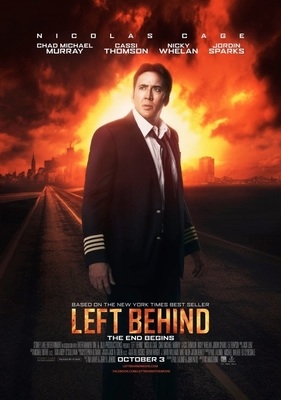
A few months later, Tim LaHaye and Jerry Jenkins published the first “Left Behind” novel. Like many other evangelicals, I devoured it. I also read other books that promised to unlock the code of Revelation, listened to church leaders theorize about the Antichrist’s identity — often the Democratic presidential candidate — and sometimes jumped if I heard something that sounded a little too much like a trumpet.

Left_Behind_film_poster

This wasn’t a new fad. Hal Lindsey ignited Christian culture’s end times obsession with his 1970 book “The Late, Great Planet Earth,” which theorized that the Rapture and Tribulation could play out in the ’70s and ’80s (spoiler alert: they didn’t). Russell S. Doughton’s “A Thief in the Night” and its three sequels depicted the Rapture and Tribulation for Christian filmgoers several decades before Kirk Cameron and Nicolas Cage were left behind. And any time a new war or global conflict occurred, writers found a new way to link those events to the Biblical warnings of trumpets, seals and horsemen — all for a price. Rapture culture is so pervasive that even Homer Simpson got in on it.

It’s easy to understand the evangelical obsession with the end times. We love doomsday stories, and Earth under the Tribulation is the ultimate dystopia. It’s the perfect plot for a movie, complete with apocalyptic weather, a world war and supernatural beasts; it’s no wonder Christian bookstores are filled with Rapture films and books. Plus, there’s a smug satisfaction evangelicals get from Rapture narratives. Not only do the bad guys get judged, but we don’t have to suffer; we get to sit on a cloud in Heaven watching the show.

Two decades after that concert, I’m a bit chagrined about how into all of this I was. Many Christians, including myself, actually believe “Left Behind” is way off base. The word “Rapture” doesn’t appear in the Bible at all. The idea of Christ coming to rescue believers before the Tribulation was popularized by an Irish priest in the 1800s. While Christians do believe Christ will return, judge the living and the dead, and bring Heaven down to Earth, we’re a bit muddy on how that all works. Some still believe in a pre-tribulation Rapture; others believe it might happen afterward or halfway through. Still others believe that Revelation is symbolic of events that have already happened, or is both a warning to the early church and a political allegory. The ominous number 666 conjures pictures of tattoo’d barcodes in some believers’ heads, while others believe it’s actually a reference to Caesar Nero, who was persecuting Christians around the time Revelation was written.

The truth is, I don’t know how the world is going to end. I also don’t know 

when

 it’s going to end, or if I’m going to be around to see it. I’ve stopped worrying or trying to figure it out. As a Christian, I rest in Jesus Christ and His finished work. If He chooses to take me away before things get bad, through death or Rapture, I’ll welcome it. But if it’s His plan for me to endure the Earth’s final days, I believe that He’ll give me the strength to do that as well. My job is not to try to predict events or look for hidden Bible codes. My job is not to fear the end times or pray for judgement. My job is to trust.

And to hope, which is something that goes missing in all the Rapture obsession.

In a culture that peddles fear and tension, end times theology has taken on a grim tone. Yes, the Bible says that things will get dark before Christ’s return. And looking around our world, it’s easy to see violence and disaster everywhere and wonder just how much worse it’s going to get. Admittedly, sometimes it feels like I’m just waiting for God to step in and say, “Time’s up.”

But what gets lost in the Rapture hysteria is that the promise of Christ’s return is not one of destruction, but of renewal. It’s a reminder that no matter how dark this world gets, there’s coming a day when Christ will make it right. This world might be destroyed by war, but it will be renewed by love. Oppressive regimes will be wiped away, replaced by a good king who’s died for his subjects. Sickness and death will be replaced by a life more vivid and vibrant than anything we can imagine. Revelation ends not with a war but with a feast. Not with enemies, but a family. Not with screaming, but with singing.

Photo credit: Flickr, Keoni Cabral
Photo credit: Flickr, Keoni Cabral. C.C. Licensing.

Contrary to media portrayals — and, very often, our own words — Christianity is not about licking our lips and waiting for our enemies’ annihilation. It’s about believing a truth so beautiful that we want the entire world to believe it: God has made a way for us to know Him. Many times when I was younger, I wondered why Jesus didn’t just take the disciples with Him to Heaven and end the story there. Why wait several millennia to return? It’s only been in recent years that I’ve discovered two reasons. One is that we know this world is a mess, and Christ’s followers are tasked with making it less messy. We have the job of preparing for the king’s arrival by pushing back the effects of sin. We’re called to love and serve others, live peacefully, take care of the planet, and pursue justice. And the other reason? Christians believe in “the more, the merrier.” We believe that the reason Christ hasn’t returned isn’t because He’s lazy or slow, but because He’s patient and has given us time to reach the world with His message. Those two things drive missionaries in every corner of the world and should be the beating hearts of our churches. That — not politics, morality or nationalism — is the heart of evangelicalism.

One thing that Morgan Freeman mentions at the end of the episode is that the word “apocalypse” doesn’t mean annihilation or ending. It’s actually a Greek word that means “unveiling.” And these days, when I look out at our world and think of what my faith tells me comes next, I’m no longer filled with fear, but with hope and expectation. For the Christian, the apocalypse isn’t the war to end all wars. It’s the wedding to end all weddings, and the start of the true story we’ve been preparing for all of our lives.It’s not an end; it’s the beginning of forever.