Jo Nova- Govt. Admits Renewables Will Never Beat Coal

By Jo Nova

At the top of the Faraway Tree, the cheapest form of energy need more subsidies. Just keep pouring the money…

The Australian Energy Market Commission (AMEC) has finally quietly admitted that they’ve given up on wind and solar power becoming cheaper than coal. Instead, renewables are so uncompetitive they will need another ten years of subsidies, or however long it takes until the last coal plant shuts off.

It’s so revealing. Once upon a time they might have thought (or at least pretended) that subsidies were there to get the unreliable generators ‘over the development hump’ so they could compete in a free market. But after 20 years of subsidies, there are no new economies of scale left to wait for. We got to the bottom of the cost efficiency curve and we’re going up the other side. Costs are now rising as the new projects have to go to far flung fields and wait for impossible transmission towers to appear. Windmills kept getting bigger until there was a nasty surprise in the maintenance bills that wiped 36% off Siemens shares in a single day.

AMEC opine about getting back to a free market once the coal plants are forced off the grid by the Big Government subsidies. They might as well be telling the world that wind and solar will never be as cheap as coal is.

How could the new unfree market, post coal, possibly be cheaper than the old one?

Green energy subsidies here until nation exits coal, says Australian Energy Market Commission

Perry Williams, The Australian

Australia’s official energy policy adviser says government subsidies for renewables will likely be kept in place for as long as coal-fired power generation keeps operating, locking in underwriting schemes for at least another decade.

It’s not renewables fault, it’s because we need “an orderly transition” (to a forced, fixed, and unfree market):

The Australian Energy Market Commission said underwriting mechanisms were needed to ensure there was an orderly transition to green energy as coal generation exited the nation’s power grid.

Sorry, did we say the subsidies would end?

“Are we going to get past this at some point when we won’t have governments underwriting new capacity. Maybe once we’ve seen coal exit and we’ve built out this phase of the transition,” AEMC commissioner Tim Jordan told the Citi Australia and New Zealand Investment Conference on Tuesday.

All the talk of free markets is just an illusion:

“We can then return to a more market-led approach where underlying demand growth will determine whether new capacity enters.”

Mr Jordan said the industry and government should aim for “market principles to take over again” once the transition from coal to renewables was complete.

What do we call a free market when the cheapest competitor is banned?

If the green subsidies can’t end until coal power is gone, it looks more like their primary goal was not to help renewables so much as to destroy coal…

Jo Nova: Fossil Fuel Comeback

Fossil Fuel Fightback: The gears shift on the Renewable Crash Test Dummy — Eraring coal lives, wind and solar slump

Australia's Renewable Transition plane,

By Jo Nova

If the whole renewables fantasy was crumbling, it would look something like this

Despite the Labor Government throwing money at unreliable energy, renewables hopes are quietly unraveling. The largest energy retailer in the country just announced a nice 26% profit jump, based on fossil fueled gas, and they also announced they’d be keeping Australia’s largest coal plant open longer. The two year extension for Eraring, is now a four year extension. Despite reaping in gas profits and keeping the planet-destroying-plant operating, the share price promptly leapt 6% to a ten year high.

Significantly, Giles Parkinson at Reneweconomy also noticed that Origin’s annual report includes talk of batteries, but no wind or solar projects, which seems like an important oversight in a nation belting headlong towards the Green Utopia.

Meanwhile, for the first time I can recall, a fossil fuel CEO is daring to defend the industry. The shift in confidence in palpable.  Mike Wirth, the Chevron CEO, is not only saying “oil is not evil” but he clearly isn’t afraid of the Australian government. He’s so unafraid he also delivered a “stinging rebuke” — saying that high costs, red tape and environmental rules have made Australia so uncompetitive, investors are leaving to spend their money in the US and the middle east instead. Indeed, Chevron had a plan to double their Australian gas production but have abandoned that now. Australia used to be the world’s largest LNG exporter but Qatar and the US outpaced us.

In a similar theme, Ampol just surprised the market by spending $1 billion dollars to double the number of petrol stations it owns, making it the largest retailer in the country. The CEO Matt Halliday said the unthinkable: “The transition [to EVs] will take decades, and combustion engines are going to still make up a large chunk of the national car fleet beyond 2050.” It was a very unfashionable and backward thing to say, but shares leapt 8% on the news yesterday.

Australia’s biggest energy retailerhits go slow button on wind and solar, mulling options on Eraring

Giles Parkinson, Reneweconomy

Origin Energy, Australia’s biggest energy retailer, appears to have hit the go-slow button on the rollout of new renewable energy projects, and is still mulling options on the already extended Eraring coal generator, the country’s biggest, which is officially due to close in 2027.

Curiously, in its annual report, the company says: “With the Eraring Power Station’s closure planned for August 2027, failure to deliver our major renewable generation projects may affect Origin’s future supply capacity, financial prospects and reputation.” Yet it has made no commitment to build those projects in that timeframe.

Think of the irony of putting the nations biggest battery next to the nations biggest coal plant, as if it needed back up:

But this is made up entirely of big batteries, including the giant 700 MW, 2,800 MWh Eraring battery being next to the coal generator…

It [the annual report] includes no wind or solar projects. The technologies did not even rate a mention in the results presentation, apart from the giant 1.45 gigawatt (GW) Yanco Delta wind project in the south-west of NSW, which has gained grid access rights but is still to complete environmental approvals.

Read the rest of the article here

The Downside of Net Zero In 100% Green Canberra

From Jo Nova:

In “100%” Renewable Canberra people are queuing to hang out in warm libraries, and the air is more polluted

Kill trees, pollute the air, punish the poor and protect coal underground

Just another day in Green heaven.

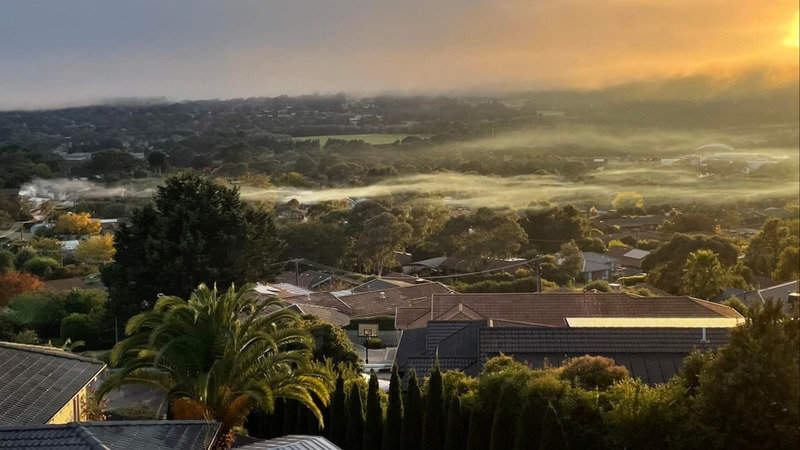
Canberra Wood Smoke

Wood smoke over Canberra   |   Photo from Clean Air Canberra

The Australian capital city Canberra in midwinter is often minus 1 to 5 degrees C in the morning. Australian homes can get very cold and with heating bills rocketing, things are defacto becoming like life in Berlin, which is in a pre-War energy crisis. No one labeled Canberra public halls as “warm spaces” and they definitely aren’t open at night (it’s the public service!), but crowds are arriving at libraries just to escape the cold.

The ACT Government are a Labor-Green alliance, and are proudly, exuberantly “100% Renewable”, but won’t dare cut the cord to the coal plants that keep the lights on, making the claims of being 100% renewable a form of 100% false advertising. Even the ABC admits that the ACT itself only generates 5% of its own power, and 80% of the energy coming to the ACT through the wires is from fossil fuels. They pay off some distant wind farms to balance the theoretical gigawatt-hour tallies, and sponge off the states around for cheaper backup and stability that the coal plants provide.

But as electricity prices rises 14% of Canberran’s are heating their homes with wood. This has predictably increased actual air pollution. So now there is a movement to ban wood fires.

If only there was a 300 year supply of cheap fuel to burn at centralized clean power stations…

Like all Green policies putting fashion before facts, they get the opposite of what they aim for.

FLAT WHITE

Canberra: where electricity is a luxury the poor can’t afford

Tina Faulk, The Spectator

Public libraries in the National Capital are now considered, by staff and patrons alike, to be ‘community centres’ where people come to read, use the computers, charge their phones, and use the toilets. It’s where clients of the NDIS, escorted by carers, are brought and propped up in their wheelchairs in front of computers or seated in deep armchairs by the magazine stands. Some, abandoned by their carers, shout incoherently for attention. Newly arrived migrants – Somalis, Iraqis, Syrians – jostle for attention of the library staff, asking for translation assistance with various forms and declarations.

Our libraries, warm and welcoming, have a crowd at their doors before the 10 am opening.

Groups of women discuss where they go to get warm:

One [woman] who recently ‘VR-ed’ (Voluntary Retired) still goes back to her old workplace, usually late morning, when the security guard who remembers her gives a nod and a smile as she settles into one of the comfortable settees in the reception area.

How sad is that — going back to her old workplace foyer just to stay warm?

Wood heaters in the firing line as temps drop and pollution rises

Lottie Twyford, Riotact

A recent report showed woodfire heater smoke is the largest source of winter air pollution in Canberra. Currently, around 14 per cent of people in the ACT use a woodfire heater as their main source of heating.

Analysis of air quality shows the impacts of smoke are worse down south because the shape of the valley and temperature inversions hold pollutants closer to the ground. In 2020, there were 37 days in Tuggeranong when pollution levels were above acceptable levels; of those, 13 can be attributed to woodfire heater emissions, Mr Davis told the ACT Legislative Assembly.

The local newspaper is running stories about the “right temperature” to heat homes to. They suggest 18°C (colder than the public buildings in Germany which are now set down to 20°C). A few years ago I stayed with a friend in Canberra and the room was 11°C (and it was only May!).

Read the full article here

And what happens when that renewable drought is 1 terawatt hour?

From Jo Nova and Matt Canavan


And what happens when that renewable drought is 1 terawatt hour?

Australia has added more unreliable wind and solar than anywhere on Earth but when an energy crisis strikes, and those prices are still on fire, the solution is more of the same.

Senator Matt Canavan, The Australian

Map, Australia, Victoria, Vic.

As rest of the world wakes up on coal, we’re closing it down

Perhaps Australia’s broken electricity system is due to this mad rush towards renewable energy? No, according to our energy regulator, “Recent international events and Australian market events have further strengthened the case for the shift to renewables.”

The renewable energy investments must continue until morale improves.

[The energy regulator’s] recent analysis shows that Victoria could experience a “renewable drought” of 1 terawatt hour of electricity over just one week in the future.

How much is 1TWh? Well, the South Australian big battery can produce 130 megawatt hours, so we would need more than 7500 of these to keep the Victorian lights on. At about $100m a pop, that is a total cost of more than $700bn, or more than Victoria’s total annual economic output.

This winter’s energy shortfalls came just after the Liddell coal-fired power station in NSW’s Hunter Valley shut a 400MW unit in April. Its other three units (a total of 1200MW) will shut next April. Then, in 2025, Australia’s largest coal-fired power station, Eraring, also in the Hunter, is due to shut.

By the end of the decade, our energy regulators warn, almost two-thirds of our coal-fired power could shut.

And Victoria is just one state.

Indeed, across the world there are 345 new coal-fired power stations being built. What is the argument against Australia building just a few to guarantee our energy supplies?

A new ultra-supercritical coal-fired power station built in Australia would increase our emissions by about five million tonnes a year. That would mean global emissions would go up by 0.014 per cent. The world has warmed around 1C after 600 billion tonnes of emissions. So this new coal-fired power station may increase the temperature by 0.0001 of a degree over its life.

Yet we are told a new coal-fired power station would worsen climate change and create more bushfires, floods and all manner of other natural disasters. These arguments are nonsensical yet go unchallenged in polite society.

Matt Canavan is a Liberal National Party senator for Queensland and deputy leader of the Nationals in the Senate.

The Green Industrial Revolution Is A Lie

As we gear up for a Federal election in May, you can be sure that Labor and the Greens will peddle the fantasy about “Green Jobs”. It is a lie, like the one about renewable energy being cheaper than coal, not to mention the whole climate change scam.

Ben Pile writes on spiked:

The green industrial revolution is a lie

The UK’s green sector has not grown in nearly a decade.

The green industrial revolution is a lie

Share

TopicsPOLITICSSCIENCE & TECHUK

The Office for National Statistics (ONS) published data earlier this month which showed that the UK’s ‘low-carbon and renewable-energy economy’ (LCREE) had not grown significantly between 2014 and 2020. This performance is a far cry from the promises of plentiful ‘green jobs’ and a ‘green industrial revolution’ that have echoed around Westminster for the past decade and more. It turns out that the much heralded green growth was nothing more than mould.

This news should surprise no one. As I have argued elsewhere on spiked, the green industrial revolution is a lie. Since the 2008 Climate Change Act, successive governments have embraced the fantasy of leading the world in the ‘transition’ to a low-carbon economy. And it’s all been to no avail. The rest of the world continues to increase its consumption of fossil fuels despite endless COP meetings, and Britain’s green industrial revolution stubbornly fails to materialise.

Back in 2009, the then Labour government, led by Gordon Brown, claimed the green economy was already thriving. He promised to add 400,000 new ‘green jobs’, taking the total number of people working in the green sector to 1.3million. These claims were based on proprietary data produced by an economic research company, which refused to share its data, as did the government even after freedom-of-information requests.

Even without access to the data, I was already able to point out in 2009 that growth in the ‘green economy’ is an illusion – or better still, an accountancy trick. The government was effectively compelling sectors of the economy, through a variety of green regulations, to ‘decarbonise’ their operations. It was then adding said sectors to the green economy and so the green economy appeared to be growing. This was happening even when the sectors in question had been harmed and diminished by the new regulations.

It took me until 2013 to obtain the data on which successive governments were basing their figures, policies and predictions. By then, it was being claimed that the ‘green economy’ was worth £122 billion. But it had only reached this size because the figure included sectors of the economy that simply do not qualify as ‘green’ in any meaningful sense. It even included the production, transportation and sale of liquefied natural gas and liquefied petroleum gas – otherwise known as fossil fuels – merely because such businesses were now subject to environmental regulation. My analysis at the time suggested that through such tricks, the government’s financial wizards had inflated the value of the ‘green economy’ by something in the region of 700 per cent.

Read the full article here

The Reality Of Green EVs

From wattsupwiththat.com

I especially like the part about Scotland cutting down 1.4 million trees to make way for wind farms. Way to go, Scotland!

For 40% Of The EU And US To Drive EVs, 56,000-70,000 Km² Of Land Must Be Cleared For Wind Turbines

By Kenneth Richard on 15. July 2021

A new study warns that “a massive expansion of impervious surfaces” is an inevitable consequence of having electric vehicles reach a 40% share of citizens’ driving needs.  A land area the size of Croatia (in the European Union) or West Virginia (in the United States) must be completely covered with wind turbines to meet EV-charging energy demands for 4 of every 10 vehicles.

The already-weak power capacity of wind turbines, 0.5 We m² on average, will only continue to diminish as more wind farms are added to the landscape (Miller and Keith, 2018).

Consequently, the land area that must be devoted to the erection of wind turbines to meet the ever-growing energy needs of Earth’s citizens is harrowing.

Consider the US. Electricity generation only accounts for 17% of the US’s primary energy consumption. For wind energy to supply all the electricity needs for US citizens, a land area the size of California – 12 percent of the contiguous US – must be cleared to make way for wind farms (Miller and Keith, 2018). Again, that’s to meet just 1/6th of Americans’ energy needs.

Image Source: Miller and Keith, 2018

In Scotland, 14 million CO2-absorbing trees were recently chopped down to make way for wind farms. This way the Scottish government can ironically claim they’re doing their part to reduce CO2 emissions.

And now a new study documents how much more land must be converted to impervious surface so that new wind farms can supply the electricity to charge an exponentially-growing number of EVs in the coming decades.

“In order to run 40% of their vehicles with electricity, the EU should devote over 5000 km² of land (twice the size of Luxembourg) to photovoltaic panels or almost 56,000 km² (about the size of Croatia) to wind turbines, whereas the US should devote over 6000 km² (roughly the size of Delaware) to solar or almost 70,000 km² (more than the area of West Virginia) to wind.”

Image Source: Orsi, 2021

Put another way, an average EU or US city will need to expand its urbanized area by 0.2 to 4 km² due to dramatically rising number of EVs using low-density wind and solar energy to supply electricity.

And this is green?

Climate Extremists “Forced” To Use Diesel Generator

Organisers told the Manchester Evening News they felt like hypocrites but had been forced to use the generator because it would have been too expensive to get a solar panel made

That’s exactly what you are- no feeling like it at all!

The protestors actually admitted what they normally refuse to say:

Solar power is more expensive

Solar power (especially in northern England!) is unreliable and requires backup by traditional reliable means.

From The Manchester Evening News:

Climate change protesters admit using a diesel generator to power their stage

Organisers told the Manchester Evening News they felt like hypocrites but had been forced to use the generator because it would have been too expensive to get a solar panel made

A diesel-powered generator is being used to run the music stage at the Extinction Rebellion protests on Deansgate.

Organisers told the Manchester Evening News they felt “like hypocrites” but had been “forced” to use the generator because it would have been too expensive to get a solar panel made.

The protest – which has brought one of Manchester’s busiest shopping streets to a standstill to highlight the threat of climate change – is on its third day.

Graham Buss, 63, said: “We were desperate to get a solar panel specially made for the demonstrations but it would have cost us £8,000.

“That’s money we simply don’t have.

“Even if we’d been able to get a solar panel made, we would have still had to have had a diesel-powered generator as a back up.

“It’s something we really do regret having to use and we feel like hypocrites, but this is the point.

“We’re part of a system that has made it incredibly difficult to use solar panels for these sorts of events and we feel like we’ve been forced to have to use the diesel generator.

Inertia Is A Good Thing, Really

A minor hiccup in power supply threw the south east of England into an unplanned “Earth Hour.” And it was all caused by wind generators.

Just before the blackout, the National Grid reported that fully 47.6% of the nation’s power was being generated by wind. Suddenly two small generators- one wind and the other gas- went offline. These generators account for less than 3% of power demand.

Immediately, the grid frequency fell from 50 Hz to 48.9 Hz and the power grid shut down to protect itself.

What is this Hz thing? Well, electricity mains systems use alternating current which in simple terms means that the electrons that flow to give us power are oscillating backwards and forwards at 50 times per second. If the frequency changes by a significant amount the whole grid can become unstable. In order to protect transformers etc, there are automatic switches that shutdown parts of the grid when the frequency gets out of a very narrow range.

This is what happened in London, and in South Australia three years ago.

In a traditional coal fired power system, electricity is produced by forcing high pressure steam past enormous turbines, which weight 200-800 tonnes. They are huge things and, once started, maintain a very steady speed even if there are changes in the rate of steam flow. Their inertia keeps the whole grid stable, so that if something goes wrong somewhere else, they still keep pumping out their power at 50 Hz.

But when smaller, more dispersed power generators dominate the grid, there is much less inertia to keep the power supply stable and things turn to custard very quickly.

The giant battery in South Australia is not there to keep the quantity of power flowing- it only has enough storage for a few minutes of power demand. It’s main role is to keep the frequency stable. Now power companies have to pay the battery for a service that coal powered generators provide for free- that’s progress.

H/T to Jo Nova for this analysis

All of this talk of grid stability and inertia made me think of how unstable our society has become, particularly over the last decade. What was once unthinkable has become normal, and it seems that every week there is some new perversion being promoted. Pornography is everywhere, families are disintegrating, and an epidemic of fatherlessness is being played out in mass shootings, suicide and violence.

The reason for this, I believe, is that we have bought into the lies of individualism. People think they have the right to do whatever they like, to indulge whatever desires and whims they might have, and all without any consequences.

Individualism has been around for a long time. Some people trace it back to the New Testament and the idea that ever single person is loved by God.

Previous generations had the church as the equivalent of the steam turbine. The morality and ethical standards of christianity have been taught, and continue to be taught, unchanging through the centuries. The word goes out steadily year after year, Sunday by Sunday, moderating the wild impulses of human flesh.

Then in the 1970’s people stopped going to church.It was deemed to be irrelevant and oppressive. People decided they could set their own moral codes. Everyone can do what they like without reference to anyone else, and it is all coming unravelled.

Without the steady inertia of the church, the moral grid of the nation has slowly turned to custard. The lights are going out, and we call it progress,

Jo Nova- The Price of Renewable Energy in Australia


Nearly a billion dollars for electricity for just one day — $500 per family

The Electro-pyre conflagration escalates.

The cost of electricity on Thursday in two states of Australia reached a tally of $932 million dollars for a single day of electricity. Thanks to David Bidstrup on Catallaxy for calculating it.

As Bruce of Newcastle says ““Three days and you could buy a HELE plant with the money wasted.” That’s a power plant that could last 70 years, and provide electricity at under $50/MW. (Forget all the high charges for 30 years to pay of the capital (in red below), we could just buy the damn thing outright, paid off in full from day one.)

Cost of Coal plants, lifetime, USA. Institute for Energy Research (IER):

Cost of old coal plants in the USA. From the report by Stacy and Taylor, of the Institute for Energy Research (IER)

Burned at the stake: $500 per family

In Victoria, per capita, that means it cost $110 for one day’s electricity. For South Australians, Thursday’s electricity bill was $140 per person. (So each household of four just effectively lost $565.) In both these states those charges will presumably be paid in future price rises, shared unevenly between subsidized solar users and suffering non-solar hostages. The costs will be buried such that duped householders will not be aware of what happened. Coles and Woolworths will have to add a few cents to everything to cover their bills, and the government will have to cut services or increase taxes. No one will know how many jobs are not offered or opportunities lost. This is the road to Venezuela.

If Hazelwood had still been open, the whole bidstack would have changed, quite probably saving electricity consumers in those two states hundreds of dollars. Eight million Australians could have had a weekend away, gone to a ball, or bought brand new fishing gear. And this is just one single day of electricity. If Liddell closes, things will get worse, no matter how much unreliable not-there-when-you-need-it capacity we add to the system. Indeed, the more fairy capacity we add, the worse it gets. NSW will soon join the SA-Vic club.

This is what happens when an electricity grid is run by kindergarten arts graduates who struggle with numbers bigger than two.

This is utterly and completely a renewables fail

The socialist Labor-Greens are already trying to blame it on coal, but we ran coal plants for decades without these disasters. Right now, no one is investing in coal because of bipartisan stupidity. What company would pay the maintenance fees on infrastructure so hated by the political class? The coal plants are being run into the ground. Maintenance is even being delayed to keep the plants running through peaks like this.

No country on Earth with lots of renewables has cheap electricity. How many times do I have to repeat it? This is my mantra for 2019.

In Australia when we had mainly coal and no renewables our electricity was cheap and reliable. Now we are still mainly coal, but all it takes is a poisonous small infiltration of subsidized unreliable renewables to destroy the former economic incentives, the whole market, the system: our lifestyle.

The Liberal Party needs to grow a spine

This is surely a crisis. As long as the Liberals are a Tweedledum version of the Labor party, they can’t solve this and deserve to lose. New renewables installations must be stopped immediately — put on hold indefinitely — until they no longer need forced subsidies, until the RET is gone, the carbon taxes, the hidden emissions trading scheme and we have a proper free market. Then new renewables can be permitted to compete with all generation alternatives, though all new generators will also have to be responsible for paying for extra transmission lines, back up batteries, and any other frequency stabilization required. On net a generator must be able to guarantee that when the people call on it, it can provide, lets say, 80% of total nameplate capacity. When that day comes (thirty, fifty, years from now or maybe never) I will be happy to support renewables. Until then, we are global patsies handing over glorious profits to energy giants, renewables companies, Chinese manufacturers, and large financial institutions.

Lets have a plebescite: How many Australians would rather have a weekend away with their family or make the world 0.00 degrees cooler in 100 years in a symbolic display to assuage the Gods of  Storms?