Car Pooling For Bikes in Car Crazy L.A.

Car Pooling For Bikes in Car Crazy L.A.

From Bloomberg.com

For 2-Wheel Commuters in LA, ‘Bikepooling’ Brings Safety in Numbers

A UCLA project that uses an app to organize group rides aims to promote car-free transportation for Los Angeles residents.
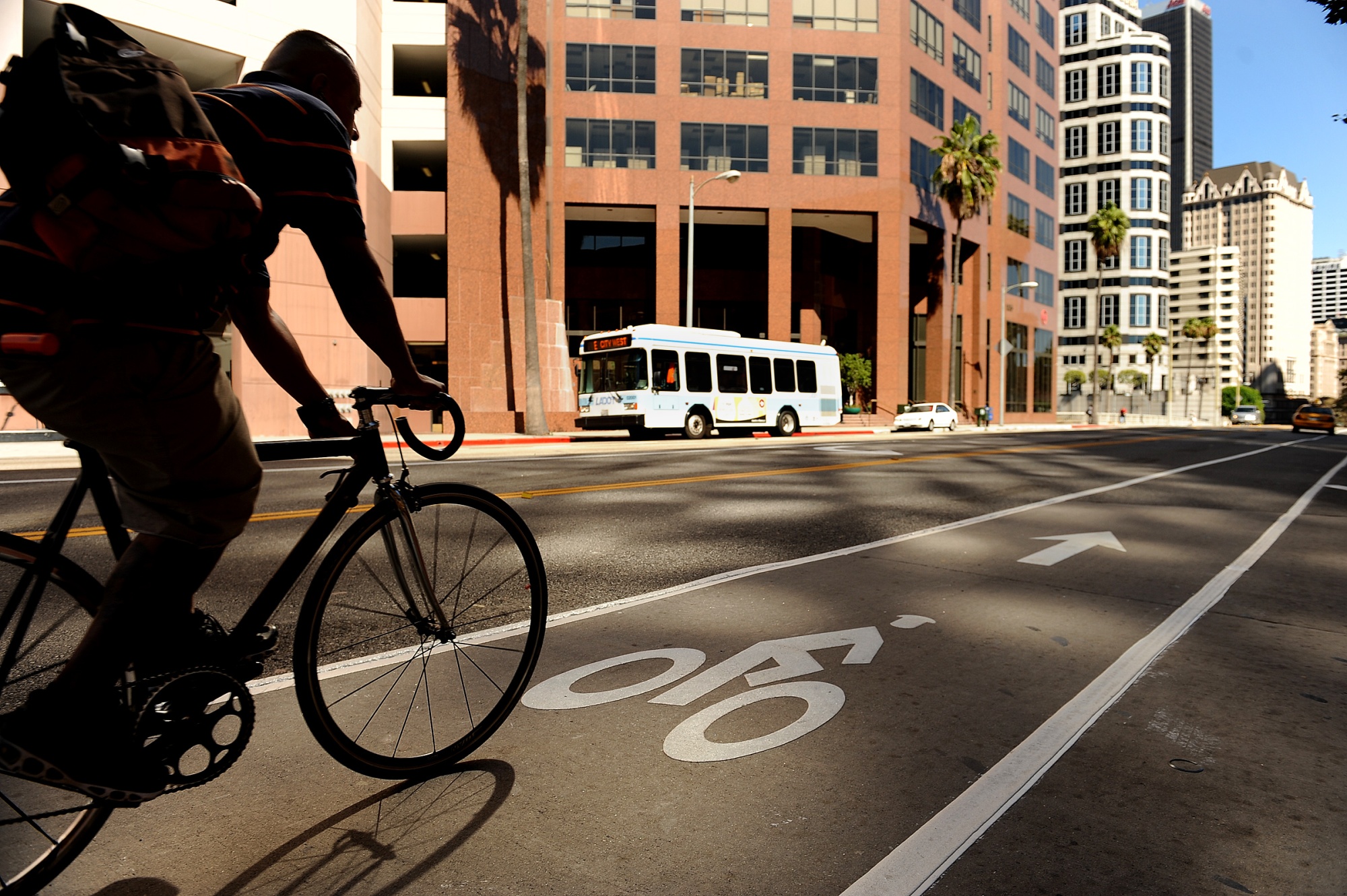
A bicyclist in downtown Los Angeles. Despite its agreeable climate, LA isn’t known as a welcoming city for bike commuters.

A bicyclist in downtown Los Angeles. Despite its agreeable climate, LA isn’t known as a welcoming city for bike commuters.

On paper, Los Angeles looks like bike commuter country: The sprawling LA basin boasts glorious year-round riding weather and generous expanses of largely flat streetscape.

But only about 1% of LA commuters get to work by bicycle, according to the US Census Bureau, a figure that reflects the challenges that riders face in a freeway-laden city that’s been optimized for the automobile. Protected bike lanes are rare, and the streets of Southern California are among the most dangerous for two-wheeled travelers. Between 2011 and 2020, 276 cyclists were killed in traffic in Los Angeles County — the most of any US county. In 2018, Bicycling Magazine declared LA the “Worst Bike City in America.”

To encourage more Angelenos to take to the streets by bike — and keep them safe there — a demonstration project set to launch this fall will encourage residents from low-income neighborhoods to bike to work in groups.

“It’s not just an informal group of cyclists — it’s a public transportation system based on bicycles,” said Fabian Wagmister, an associate professor at the University of California Los Angeles School of Theater, Film and Television and the founder and principal investigator of the Civic Bicycle Commuting research project, also known as CiBiC.

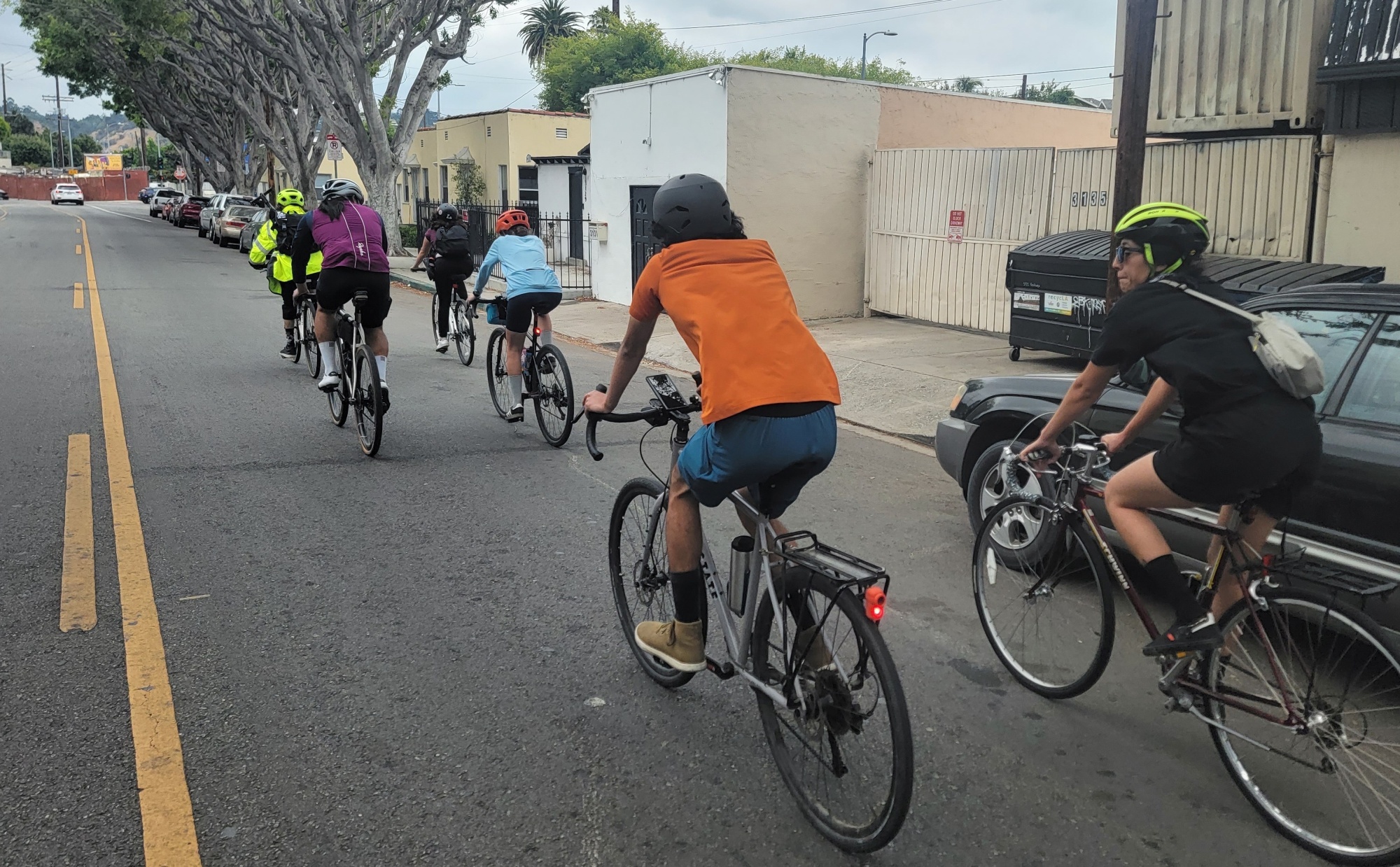
The concept is simple: Wagmister describes CiBiC as “carpooling, but on bikes.” In the pilot program set to start Oct. 1, users put their destination and arrival time in an app that determines the best route — or “flow” — to bring them to work. The app then pairs bike commuters with each other in groups of up to 12, known as a pod, led by two experts whose job is to prioritize safety on the road over efficiency. 
relates to For 2-Wheel Commuters in LA, ‘Bikepooling’ Brings Safety in Numbers
A group of CiBiC riders road-test a “flow” in Northeast LA in advance of the program’s October launch.
Photo courtesy of CiBiC

Bikepooling, Wagmister hopes, will help participants save money and improve their health and well-being while reducing vehicle emissions in a traditionally car-centric city. Armed with a $1 million grant from the National Science Foundation’s Civic Innovation Challenge, researchers at UCLA and community partners will focus on five Northeast Los Angeles neighbourhoods — including Chinatown, Solano Canyon and Lincoln Heights — which are home to lower-income communities of colour. According to a CiBiC survey, 73% of respondents in the area the pilot serves drive for commutes of less than five miles. 


Read the full story at bloomberg.com

Are Old Cars Really “Rock Solid”?

If you think the good old cars were safer in a crash, take a look a tthis video from the NRMA

Do you think old cars are safe? Watch this

It’s one of the most persistent myths in motoring: old cars are as solid as rocks and can crush new cars like beer cans.

The misconception arises from the recent development of the crumple zone, where designated parts of modern cars lose their shape under even minor impacts.

But what appears to be a weakness is actually a strength – crumple zones absorb energy and effectively sacrifice themselves for the sake of the passenger compartment, the safety and rigidity of which is constantly increasing with every new model.

It’s one of the fundamental design principles promoted by organisations like ANCAP and its international car safety partners, including the Insurance Institute for Highway Safety (IIHS) in the United States.

But despite decades of innovation and improvement through rigorous testing, the myth of the tough old car persisted – so the IIHS created this truly shocking video to disprove it:

The vehicles involved are a 2009 Chevrolet Malibu (sold in Australia by Holden since 2013) and a 1959 Chevrolet Bel Air, an iconic sedan featured locally in the original Mad Max movie.

The cars are crashed into each other in a 40 per cent offset collision at 64km/h, which is what ANCAP’s frontal offset collision test seeks to replicate – most recently and notoriously when the new Kia Carnival was scored only four stars.

The Malibu, which was rated five stars by ANCAP in 2013, behaves as you’d expect with the front of the car being crushed while the passenger compartment remains intact.

By comparison, what happens to the Bel Air is nothing short of terrifying. Even the dryly technical IIHS description of the impact captures the gut-wrenching terror of what would surely be the driver’s final seconds of life:

Dummy movement wasn’t well controlled, and there was far too much upward and rearward movement of the steering wheel. The dummy’s head struck the steering wheel rim and hub and then the roof and unpadded metal instrument panel to the left of the steering wheel.

During rebound, the dummy’s head remained in contact with the roof and slid rearward and somewhat inward. The windshield was completely dislodged from the car and the driver door opened during the crash, both presenting a risk of ejection. In addition, the front bench seat was torn away from the floor on the driver side.

In other words, it’s hard to say whether the driver would’ve been killed first by brain damage, a broken neck, multiple organ failure or blood loss from leg amputation.

In terms of the car’s structure, the impact pushes the engine into the footwells while the A-frame and chassis rail simply disintegrate back beyond the line of the roof.

“The Bel Air collapsed,” said David Zuby, the senior vice president for the IIHS’s vehicle research centre.

“The area in which the driver was sitting collapsed completely around him.”

The test was to mark the 50th anniversary in 2009 of the IIHS, a group funded by the US insurance industry.

The idea was to show how much automotive safety had progressed in five decades, particularly since the IIHS – in partnership with ANCAP and other national road safety bodies – started crash testing in earnest in 1992.

And while the test is now six years old, its message is as pressing as ever: buy the newest, safest car that you can afford and drive as carefully as you can.

Were you expecting this crash test to deliver this result? Let us know what you think.

To read more NRMA Advocacy content, click here.