Ten Reasons All Australians Can Rejoice at the Voice Referendum Result

From The Daily Declaration:

The Daily Declaration
referendum result

Ten Reasons All Australians Can Rejoice at the Voice Referendum Result

The Yes campaign and the corporate media might be in mourning, but in truth, the referendum result is a win for all Australians. Here’s why.

The result of the weekend’s referendum was known within an hour or so of polls closing. Australians emphatically voted against constitutionally enshrining an Indigenous Voice to Parliament.

Nationally, just 39.3 per cent affirmed the proposition, while a whopping 60.7 per cent made known their disapproval. Every state rejected it, along with the Northern Territory, home to the highest proportion of Indigenous residents in the nation.

The result was as definitive as the opinion polls had suggested. Once postal votes are accounted for, the No vote will likely swell some more.

The referendum debate subjected Australians to months of bickering and division. With some campaigners cynically framing the debate as a de facto empathy test or a vote on the value of Indigenous lives, the referendum took an especially heavy toll on many Aboriginal Australians.

However, as the dust settles on Saturday’s result, what are the positives all Australians can take away from our nation’s 45th referendum?

1. Indigenous Equality Reaffirmed

In 1967, over 90 per cent of Australians voted in favour of including Indigenous people in the census and empowering the federal government to legislate for Aboriginal people. That referendum took place in a decade that saw the full political equality of Aboriginal Australians affirmed, including their right to vote and stand for political office.

Almost 60 years later, Australians were effectively asked if Indigenous Australians should receive unequal political rights via a permanent race-based advisory body in Canberra. Their resounding rejection of the 2023 proposal race was a conspicuous reaffirmation of the 1967 referendum.

Thus, for more than five decades, our nation’s body politic has maintained remarkable consistency in its belief in the fundamental equality of all Australians, regardless of race. Put another way, the majority of the nation believes Aboriginal and Torres Strait Islander Australians do not need to be pandered or condescended to for the simple reason that they are already our equals.

2. National Unity Fortified

While the referendum debate was deeply divisive, the eventual outcome was clear and resounding. A hefty majority of Australians agree that there are far more constructive ways to address Indigenous disadvantage than the one recently offered.

Note that a constitutionally-enshrined advisory body in Canberra was not the only thing rejected on Saturday. The Uluru Statement from the Heart — the political manifesto behind the Voice — effectively argued for two competing Australian sovereignties.

“The invasion that started at Botany Bay is the origin of the fundamental grievance between the old and new Australians,” the document argues. “Our sovereignty preexisted the Australian state and has survived it.”

Two competing Australias, divided along ethnic lines, perpetually battling for the upper hand in Canberra? It was a recipe for an ugly but permanent national division. Whether or not most voters were aware of the Uluru Statement’s more radical aims, they have repudiated it — and future generations will thank them.

3. Identity Politics Rejected

Over the last decade, we have seen a concerted effort from many quarters to reduce people to their physical attributes, and reward or hinder them accordingly.

Identity politics is a reductionistic way of viewing the world, and an anaemic way of viewing our fellow human travellers, who are made in God’s image as one-of-a-kind individuals.

Cultural Marxism has taken this a step further, using race to categorise people as “oppressed” and “oppressor”. Western Marxists have been very successful at weaponising Indigenous people against Western institutions which — ironically — have been uniquely successful at protecting their dignity and equality in law.

It is a credit to voters and a blessing for Australia that such a strong majority have resisted this cynical ploy, choosing to view Indigenous Australians as individuals, not avatars of a political cause.


Read the rest of the article here
The Voice Is Silenced

Yesterday, Australia voted in a referendum to change our constitution to include a so-called Voice to Parliament. The Voice would have been effectively a third chamber of Parliament that represented the concerns of indigenous people, able to veto any legislation or executive action of the Australian Government.

This referendum will go down as Australia’s Brexit moment. As with the Brexit vote in the UK, the ordinary people of Australia told their elite overlords to get out of identity politics and the “woke” agenda and start listening to the people who pay for all this stuff.

There are many reasons why the Voice is wrong in principle, including the following:

  • It gives one group of people extra rights not enjoyed by others
  • The aboriginal industry has over 1000 groups paid for by tax payers already
  • In Parliament, the proportion of indigenous Members and Senators exceeds the proportion of the general population. If they cannot be a “Voice” to the Government, (their job description is literally to represent the interests of their electorate), then who can?
  • The Voice would not solve the problems of remote aborigines who are the 20% who comprise the gap between mainstream Australia and indigenous Australia
  • The Voice would just be a talk fest for the inner city elites who already have plenty of platforms to voice their grievances

In Australia, constitutional change is difficult to achieve. As well as getting a national majority in favour, proponents must also win a majority in a majority of states (i.e. 4 out of 6 states). To achieve that, history shows that both sides of politic need to be actively in favour. In this case they weren’t.

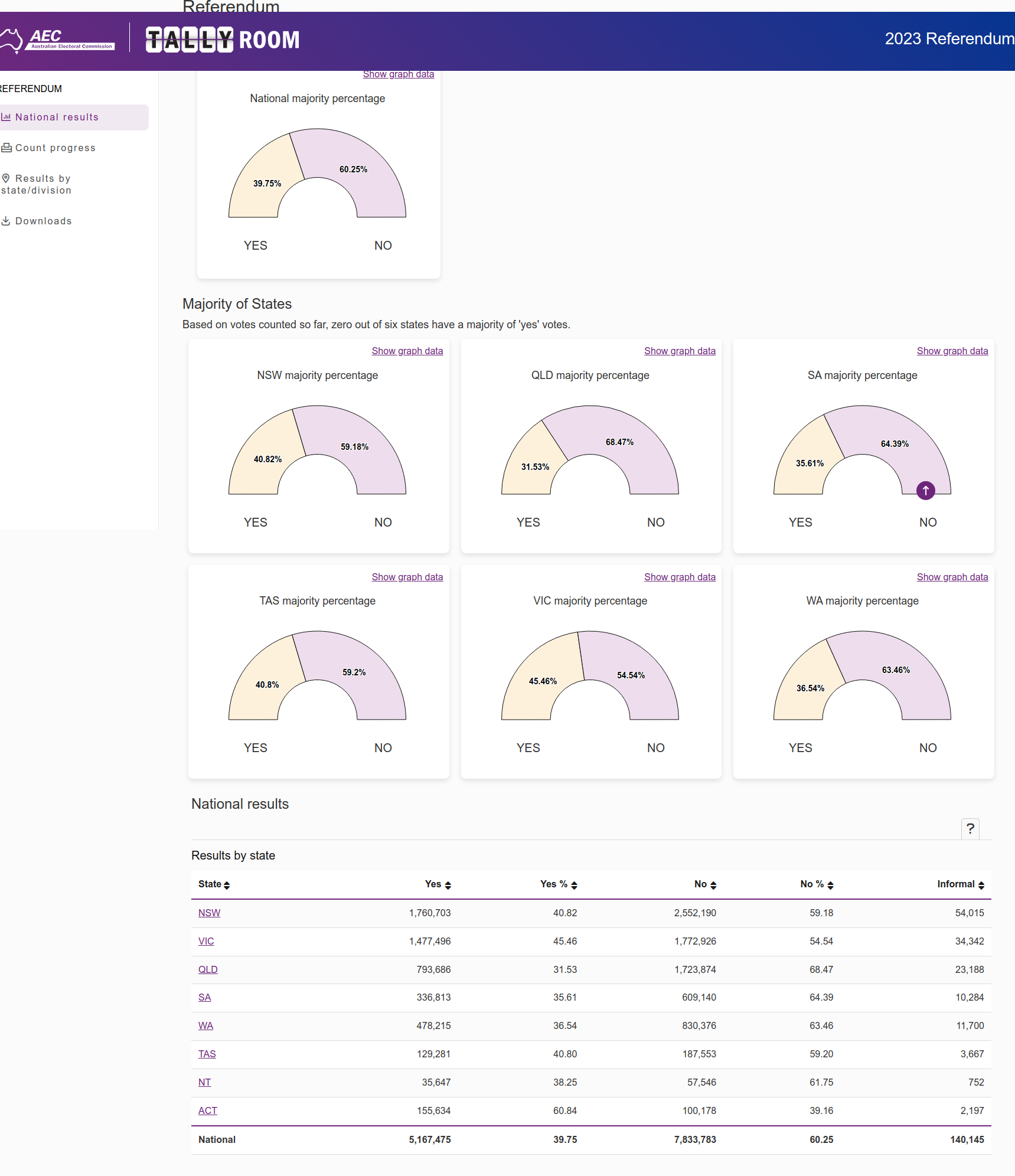
So here are the results from the AEC web site as of close of counting on Saturday night. The vast majority of votes have been counted, but the result cannot be officially declared for two weeks until postal votes are included.

Overall, the vote was about 60% “No” nationally and in every state. Even Victoria, the wokest state ended up 54% “No”. Early in counting, it almost looked like it would be about 50-50, but the later counting brought it more into line with the rest of the country.

Interestingly SA and WA which were the two states that the “Yes” campaign had to win to ensure the majority of states, they had an even greater “No” vote. In other words, the more people saw of this proposal, the more likely they were to reject it.

If you go to the last line in the table you see the ACT vote. They were the exact opposite of the rest of the country- 60% “Yes”. The Canberra bubble is the cause of most of the problems in this country. Dominated by the bureaucracy, the ACT is exactly out of step with the rest of the nation. It must surely be time to dismantle Canberra- that would be a constitutional change that could get through.

Even The Electoral Commission Is Biased

I have always been proud of our electoral system. We don’t have the issues the USA has, foe example, because we have a long tradition of independent and fair election administration that is separete from the Government and from all politics.

Now that seems to have ocme to an end, with the AEC tipping the scales in favour of “Yes” in the referendum.

From news.com.au

A sample ballot paper. Picture: AEC

#f6f6f6;color: ;font-family: sans-serif">‘Tick will be accepted, cross will not’: AEC boss slammed for confusing Voice referendum rule

The head of the AEC has sparked backlash after suggesting that ticks will be counted as votes for Yes but crosses will not be counted as Nos.

The head of the Australian Electoral Commission (AEC) has sparked confusion after suggesting that ticks will be counted as Yes votes but crosses will not be counted as Nos in the Voice referendum.

On referendum day, widely expected to be October 14, Australians will be asked to write either “yes” or “no” in English on the ballot paper to the question, “A Proposed Law: to alter the Constitution to recognise the First Peoples of Australia by establishing an Aboriginal and Torres Strait Islander Voice. Do you approve this proposed alteration?”

But appearing on Sky News on Wednesday, Australian Electoral Commissioner Tom Rogers was asked by host Tom Connell whether scrutineers would accept other types of marks inside the box.

“It’s a bit simpler than a normal election, it’s a yes or no — are you accepting anything inside the box?” Connell said. “A tick, a cross, a yes, a number one? How broad will you allow this, given the intention of people is going to be pretty clear, you’d think?”

Mr Rogers said it was a “great question” and again urged people to “make sure you write on that box ‘yes’ or ‘no’ in English”.

“Now there are some savings provisions, but I need to be very clear with people – when we look at that, it is likely that a tick will be accepted as a formal vote for yes, but a cross will not be accepted as a formal vote,” he said.

“We’re being very clear with people, part of our education campaign will talk about this, the materials in the polling place so people can look at it. But please, make sure you write ‘yes’ or ‘no’ clearly on the ballot paper in English. That way you can assure yourself that your vote will count.”

Connell suggested that accepting a tick but not a cross might “effectively inflate the ‘yes’ side”.

“The no side might say, well hang on, it’s a lower bar for the yes side,” he said.

“No not at all,” Mr Rogers said.

“That’s why we’re spending a lot of time talking to the community about what constitutes a valid vote. There will be very clear information on the ballot paper, in the polling place. We’re spending a lot of time on that issue and what we’re trying to do is make sure under the legislation, that when the voter’s intention is clear that those votes are included.”

Connell then asked, “What about ‘y’ or ‘n’?”

“Again the legislation says yes or no is a formal vote,” Mr Rogers said.

“There are some things called savings provisions and given the fact we’re trying to give effect to the voter’s intent, it is likely that a ‘y’ or an ‘n’ would be counted under the savings provisions. But I get nervous even talking about that because then people hear mixed messages. It’s just important to write either yes or no on that ballot paper.”

2GB host Ben Fordham on Thursday slammed Mr Rogers’ comments.

“How bizarre,” he said. “A tick counts as yes but cross does not count as no. That sounds dodgy. If you’re going to count the ticks, you’ve got to count the crosses, don’t you? Otherwise the yes camp has an advantage. Surely he would see the unlevel playing field here. But apparently not.”

Fordham said the AEC “has one job”.

“We’re giving them $365 million to hold the referendum,” he said. “Tom Rogers is on more than the Prime Minister, he earns $600,000 a year. How hard is it to get this right?”

Fordham said it was “ironic” that Mr Rogers was “warning about fake news”.

This week the AEC launched its referendum education campaign, Your Answer Matters, with Mr Rogers telling the ABC the Voice debate had generated the “highest level of mis- and-disinformation we’ve seen online”.

“Well Tom, I think you’ve just added to the confusion,” Fordham said.

Former Prime Minister Tony Abbott later appeared on 2GB, agreeing with the host that “it seems awfully confusing”.

“It does, and it’s quite simple, I would have thought,” Mr Abbott said.

“You either vote yes or you vote no, and I’m certainly urging people to vote no. But the problem with all of this is that there’s a suspicion that officialdom is trying to make it easier for one side. It seems that it’s going to be easier to get a yes vote than a no vote if a mere tick is going to count for a yes but you’ve got to specifically write ‘no’ to vote no. This is the worry all along that there is a lot of official bias in this whole referendum process.”

The former PM agreed with Fordham that “you’ve got to have the same rule for both camps”.

“I would have thought so, otherwise it’s not a level playing field, it’s not a fair fight,” Mr Abbott said.

“If a tick is a yes, why wouldn’t a cross be a no? And really the only way to get away from this kind of confusion is to make it absolutely crystal clear that you either vote no or you vote yes, but marks of one sort or another that are neither no nor yes don’t count.”

Mr Abbott added, “Unfortunately, I don’t want to be personally critical of the Electoral Commissioner, but nevertheless it does seem that this is causing confusion, and that’s a real problem.”

Prime Minister Anthony Albanese will officially announce the date of the Voice referendum in the must-win state of South Australia next Wednesday and kick off a six-week campaign.

It’s widely anticipated Australians will head to the polls on October 14 to vote in the first referendum in 24 years.

The PM is set to join prominent Voice supporters in Adelaide next week to announce the date in a bid to turn the tide and rally support for the proposed constitutional change.

In order for a referendum to succeed, it must win the majority of votes in a majority of states.

Only eight of 44 referendums have succeeded in Australia’s 122-year history — all with bipartisan support.

The latest polls have support for the Voice slumping in every state, and according to the latest Newspoll surveys the “Yes” vote is ahead in only South Australia and NSW.

The votes are evenly split in Victoria, while the “No” vote is leading in Western Australia, Queensland, and Tasmania, with the No campaign confident it can win over voters.

In a statement, Mr Albanese said the referendum campaign would be a chance to “celebrate our shared history and build a better shared future”.

“Very soon, our nation will have a once-in-a-generation chance to recognise Aboriginal and Torres Strait Islander people in our Constitution and make a positive difference to their lives with a Voice,” he said.

“Next week, the date will be announced. I will be campaigning for constitutional recognition because if not now, when? Nothing to lose, everything to gain. Every Australian will get a say in this. Every Australian will have the opportunity to vote yes for a practical, positive difference in people’s lives.”

More Coverage

Mr Albanese has ruled out legislating a Voice to Parliament if the bid for constitutional reform falls short, saying he will respect Australia’s wishes.

frank.chung@news.com.au