Avoid This At Any Cost!

There are many English translations of the Bible available, for which I am very thankful. They cover a range of reading styles, translation philosophies and so on. Usually they are written by teams of scholars who have devoted their lives to studying the Bible in the original languages.

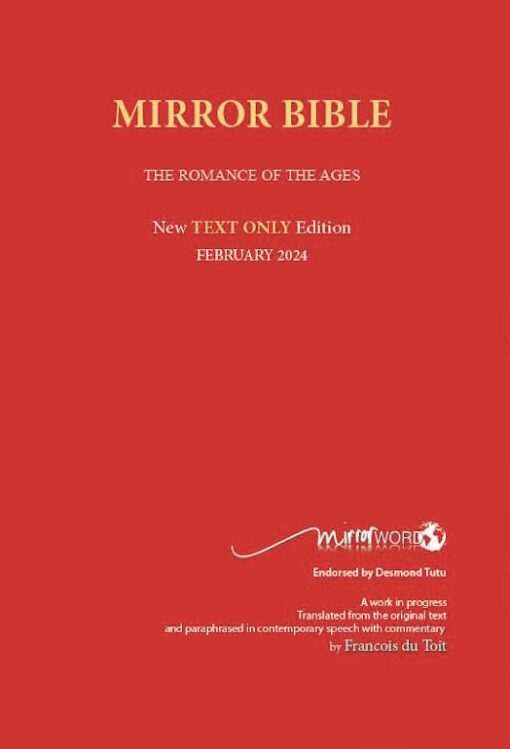
The Mirror Bible is not one of these. It is written to push a particular theological viewpoint, imposing that idea on the text rather than letting the Scriptures lead us into correct understanding.

The author, Francois du Toit is from South Africa and has a three year theology degree (same as me, but I don’t laim to be a biblical scholar). He believes a number of twisted doctrines including

  • Universalism- the belief that every body will be saved
  • Sin is not real but is rather our inability to see the divine in us
  • Inclusivism- the belief that the gospel is meant to include everyone, regardless of their interest in God
  • The Bible is meant to help us to hold a mirror to ourselves so that we can see God in us, as opposed to the traditional view that the Bible is a mirror that revels our sin nature.

These beliefs are at the core of so-called Progressive Christianity (a mixture of christianity and left-wing political beliefs) and the Global Grace Ministries. What is strange, though, is that it is also popping up in hypercharismatic circles such as Kenneth Copeland’s Word of Faith movement and Bethel Church, Redding. Preachers such as Creflo Dollar, Jerry Savelle and others have been promoting it.

In her video on this subject, Melissa Dougherty compares some passages from the ESV Bible with The Missor Bible. The first one is John 14:6

Can you see how, instead of pointing the reader to Jesus as the Way, the Truth and the Life, The Mirror Bible points us back to ourselves?

John 14:12 tells us we must receive Jesus, but The Mirror Bible tells us that we already have Him.

Finally we have Romans 1:28.

Romans 1:20 says that people can see God in nature , but they choose not to acknowledge God, and so He gives them over to their sinful desires. The Mirror says they didn’t care about their own divine nature and so they could not see God.

This is such a terrible perversion of the teaching of Scripture that nobody who wants to draw close to God should look at this book.

The most trustworthy Bibles are the ones that have been translated by a team of scholars, where a thoughtful consensus of opinions prevents individuals from running off with their own pet ideologies.

I recommend that Bibles and paraphrases that have been written by a single person, such as The Passion Translation (Brian Simmons) and The Message (Eugene Peterson) should not be read as your main Bible. Use them as an addition to the NIV or the NLT, but not as your main source of godly inspiration.

And never, ever read The Mirror Bible.

If you want more information about this, I strongly recommend Melissa Dougherty’s video on this. It is long but it is thorough.

Bible Translations

In the English language today we are blessed with dozens of translations of the Scriptures all aiming to convey the meaning of the original texts in our world in our language.

It’s not as easy as it sounds because it’s not just a matter of plugging equivalent words from Greek or Hebrew into their closest English meaning. That’s before you even start to consider underlying meanings and assumptions people in a given place and time make. For example how would you translate the expression “I’m flat out like a lizard on a rock” into normal English let alone another language? Just imagine the lep you have to make across 2000 years or more of history and life experience.

What made me think about this was a reading that Margaret Baxter shared on Sunday morning from Acts 2:42-47 from the New Living Translation:

42 All the believers devoted themselves to the apostles’ teaching, and to fellowship, and to sharing in meals (including the Lord’s Supper[a]), and to prayer.

43 A deep sense of awe came over them all, and the apostles performed many miraculous signs and wonders. 44 And all the believers met together in one place and shared everything they had. 45 They sold their property and possessions and shared the money with those in need. 46 They worshipped together at the Temple each day, met in homes for the Lord’s Supper, and shared their meals with great joy and generosity[b] 47 all the while praising God and enjoying the goodwill of all the people. And each day the Lord added to their fellowship those who were being saved.

What tripped me up there was the mentioning of the Lord’s Supper twice. I was looking at it and thinking “that’s not there” even as I was reading the words.

The New International Version puts it this way:

42 They devoted themselves to the apostles’ teaching and to fellowship, to the breaking of bread and to prayer. 43 Everyone was filled with awe at the many wonders and signs performed by the apostles. 44 All the believers were together and had everything in common. 45 They sold property and possessions to give to anyone who had need. 46 Every day they continued to meet together in the temple courts. They broke bread in their homes and ate together with glad and sincere hearts, 47 praising God and enjoying the favour of all the people. And the Lord added to their number daily those who were being saved.

The NIV doesn’t mention the Lord’s Supper or Communion at all. The Greek merely talks about breaking bread, which means sharing a meal together, but in the Christian context also means sharing Communion together. So the NIV is closer to the literal meaning, but the NLT is perhaps closer to what the first christians understood by the phrase.

I think what Luke is trying to convey here is the wonderful sense of community amongst the church. They were always hanging out together, doing ordinary things but also worshipping, listening to the apostles teaching and so on. There was no distinction between “church” and “secular” or “home” stuff.

I like the way the Contemporary English Version expresses it:

42 They spent their time learning from the apostles, and they were like family to each other. They also broke bread and prayed together.
43 Everyone was amazed by the many miracles and wonders that the apostles worked. 44 All the Lord’s followers often met together, and they shared everything they had. 45 They would sell their property and possessions and give the money to whoever needed it. 46 Day after day they met together in the temple. They broke bread together in different homes and shared their food happily and freely, 47 while praising God. Everyone liked them, and each day the Lord added to their group others who were being saved.

Both the NLT and the CEV have footnotes to indicate that the term “breaking bread” means sharing a meal and Holy Communion, but how many read the footnotes?

Does it matter that much? I don’t know.

I am sometimes frustrated when I realise that a particular verse in a particular version doesn’t mean what it seems to say. I guess we need to be thankful that we have so many translations to choose from  and  get on with the job of reading one of them and living out all that God shows us in His word.