Ukraine’s Holy Week Like No Other

APRIL 14, 2022BY ARCHBISHOP BORYS GUDZIAK

As Ukraine is being crucified by the enemy, millions of its people go through the same experience of darkness and a sense of the absence of God as Jesus did on the cross. Let us not doubt that God is with the suffering and that his truth, peace, and love will prevail.
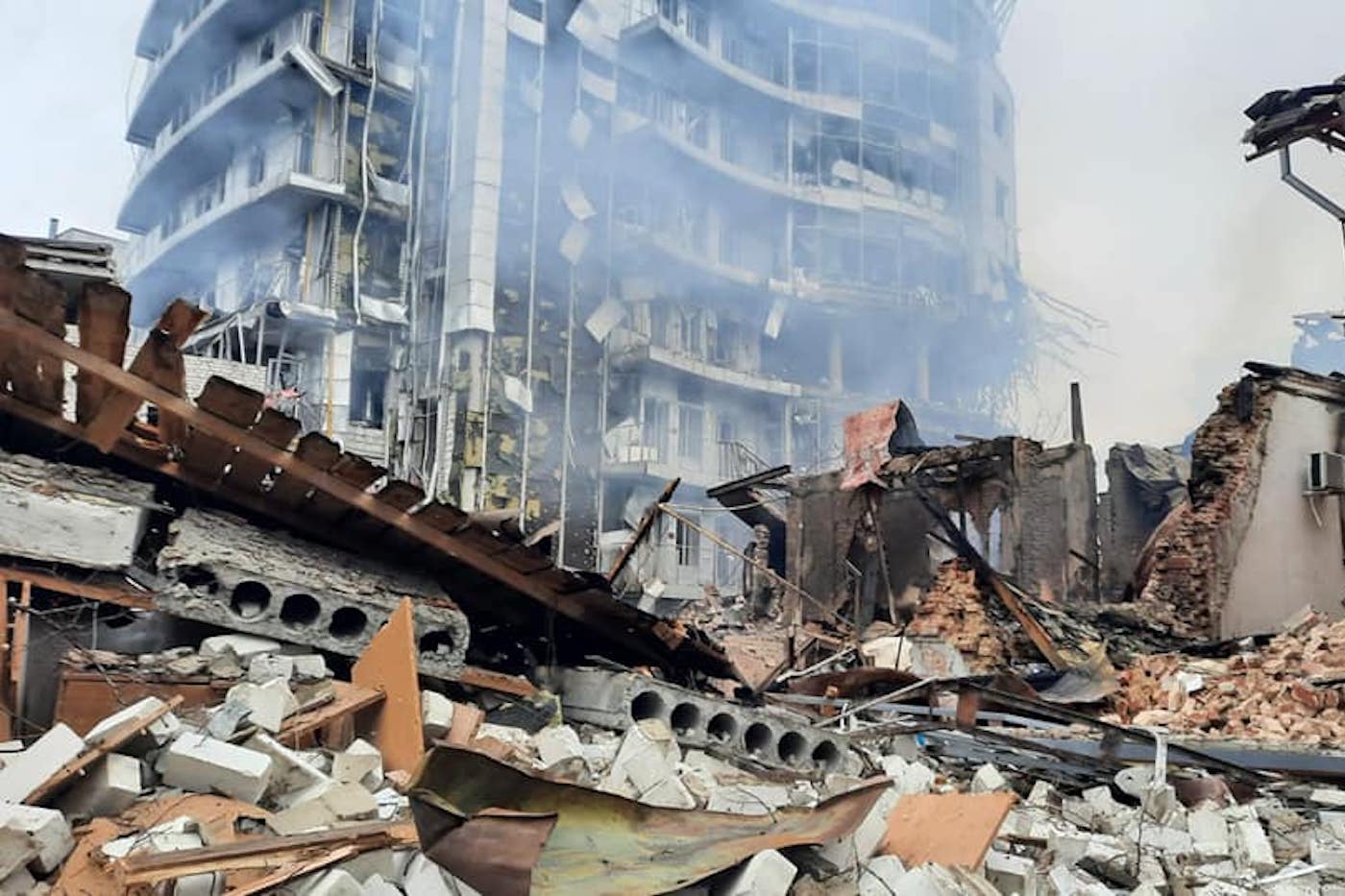
Christians of different traditions begin Lent on different dates. For Ukrainians of all denominations, their spiritual pilgrimage this spring started on February 24 at 4 AM. War and Lent have been deeply intertwined this year.

Lent is a time to discern evil, especially in one’s own life. Understanding violent and destructive passions is difficult amid the modern world’s comfortable, soft circumstances. For centuries, the Church’s tradition has helped us detach from worldly comforts during the Lenten journey through fasting, prayer, and works of charity. The war in Ukraine has given Lent a deeper resonance. Violence and suffering, sin and evil, compassion and sacrifice, virtue and heroism reveal themselves. War was something known to the monks of Constantinople and Jerusalem who wrote the prayers and hymns for our Lenten journey. And it was known to generations of our ancestors. But now we experience war in Lent first-hand.

His Beatitude Sviatoslav Shevchuk, Head of the Ukrainian Greek Catholic Church, also reflected on Ukraine’s violence-hewn Lent in his address on April 5, 2022, the 41st day of the war.

The Christian faith teaches us not to turn our eyes away from God who became human, from God whom humans dishonored, crucified, and killed in the most shameful way. The Christian faith teaches us to honor the wounds of Christ, to kiss them, because we know that by His wounds we are healed [cf. Isaiah 53:5], as the Prophet Isaiah writes.

These days Ukraine is experiencing her Golgotha, her crucifixion. Today I ask all of us—all Christians of the whole world, all people of goodwill—not to turn your eyes away from the humiliation and suffering, the death and wounds of Ukraine. . . . Just a few tens of kilometers from the center of Kyiv we see today hundreds of dead who were shot in the back of the head. We see the wounds of the Ukrainian people.

This Lent has made reality clearer to me than ever. The work of evil, the wicked will of the Enemy of humankind, and the frailty of our human nature are on display. We witness Adam’s grab. Adam had all the trees and their fruit in the garden of Eden. God the Giver gave Adam everything he needed. And yet, he decided not to live with God and be like God the Giver. Despite being forewarned, he decided to grab that which would lead to his death.

Grace amid Horror

Today we witness the leader of a contemporary empire that extends across eleven time zones grab for more. Unprovoked, he decides to invade a sovereign, independent country. In the account of Christ’s Passion, we see that Judas, blinded by greed, stretches out his arm to snatch silver in exchange for the Savior. These are different episodes of the same story of human sin. All of them lead to death.

Yet Easter gives us hope for salvation and new life. God repeats and renews His gift. Amid the brutality and horrors, there are many signs of grace. In this world, which is characterized by compulsive self-reference and the dictatorship of relativism, we see people giving their lives for others and for the truths of dignity, freedom, and justice. Ukrainians are demonstrating that greatest love defined by our Lord in John 15:13: “No one has greater love than this, to lay down one’s life for one’s friends.” As we recall and celebrate the salvific sacrifice completed on the Cross, we see the sacrifice of our contemporaries—brothers and sisters in Ukraine, military and civilians—who are willing to give their lives to protect the innocent. Through their sacrifice, we get a glimpse into the sacrifice of the Son of God once more.

Holy Week’s rich liturgical traditions help us understand reality. As Father Alexander Schmemann noted, in our liturgical celebrations, we do not merely remember past events. The power of liturgy is that it “transforms remembrance into reality.” Lazarus Saturday, celebrated by Byzantine-rite Christians on the day before Palm Sunday, places before us the reality of death. “It stinketh,” Jesus is told as he approaches Lazarus in the tomb. Schmemann writes that at the grave of Lazarus, God encounters Death, “the reality of anti-life, of destruction and despair.” Jesus weeps “because He contemplates the triumph of death and destruction in the world created by God.”

At the beginning of April, the world was shocked by the dreadful images of bodies and violence discovered in BuchaBorodiankaIrpin, and other towns near Kyiv; these were people Russian soldiers slaughtered during the weeks of occupation. We see death’s ugly face. And we weep as Jesus did. In the recent words of Bishop Erik Varden, “His tears show him aggrieved, indignant at the scandal of death’s reign in beings made for immortality, who long for paradise lost and lost friendship. Having wept, he goes up to Calvary to work our redemption.” The deaths Ukraine is experiencing bring the reality of Christian liturgy into full view.

After Jesus’s glorious entry into Jerusalem, we begin Holy Week by remembering the Lord’s last days on the earth before his salvific Passion and death. But the death on Great Friday will not be the closing of our week. Holy Week will be crowned by the feast of the Resurrection. The Resurrection provides all-important perspective on the suffering that Jesus, the Innocent One, endured.

Read the rest of the article here

Stephen McAlpine: Planting Flowers in Wartime

People are planting flowers in Kyiv. Spring is coming.

In the midst of all the chaos, horror and death that the Russian invasion has inflicted on Kyiv, there is something beautiful about people planting flowers in wartorn Kyiv.

As The Times reports, in the light of the Russian withdrawal from the city, the city’s mayor, former world heavyweight boxing champion, Vitaly Klitschko declared:

The municipal services have started spring cleaning. Parks, green areas are being arranged and trees and flowers are being planted.

The war isn’t finished of course. Far from it. Half of the city’s population is still missing, some dead, many in other countries. The devastation and pain will continue for some time yet.

But the normal process of planting seedlings in the flowerbeds, much the same as in my suburb on a seasonal basis, has recommenced. Spring in the air. Easter Resurrection in the air.

Planting flowers in wartime? It could be construed as denial. It could be misdiagnosed as futility or nihilism. Or it could be seen for what it is: Hope sprouting from the ground again.

And it’s a lesson too. A lesson for so many things, but a lesson, I think, for the church. I’ve written much about the straitened times that the church of God finds itself in in the West, either due to its own folly, or because of the turn against the Gospel in the hard secular age. There is much to be sober about. And let’s not get too shy about calling the Christian life a battle, or the spiritual work of the Church a warfare, for the sake of not offending, or for fear of being labelled seditious. If we were to jettison that language we’d have to cut large swathes out of the New Testament documents.

But in the midst of that, let’s remember the better story, the truer narrative of human flourishing, the light to the world, salt of the earth, shining like stars in the dark, sorta stuff that the New Testament speaks of as well. Let’s not forget the new citizens of a heavenly kingdom, the people who have a hope beyond the hope of this age.

In other words, the church gets to plant flowers in wartime. We have a hope that what springs from the ground in our midst, and as we do good to the world and in the world, will not be wasted. Our Resurrection Day is coming. Not Easter Sunday, that was the proto-type, the first-fruits springing from the ground, of which our resurrection will be the full planter bed, blossoming into eternity.

And that should encourage us as we approach what I believe could well be darker and harsher times ahead, both geo-politically and for the church.

The always brilliant Anglican rector and UK journalist Giles Fraser, pointed out recently in UnHerd, that in response to the Ukraine war, the Christian hope leaves the humanist hope quite literally for dead. Humanists have no way of explaining evil away, other than it being a good opportunity for humanity to glint through the darkest body count.

And while I think that humanists could look at the flower-planting in Kyiv and say “See? There’s humanity in all its glory!”, they are unable to counter that glory with any sense of the true horror of humanity that makes such a photograph as the one I posted above, truly memorable.

Read the rest of the article here

The End of History

Ukraine War Spells The End Of The Golden Arches Peace Theory

Just a week ago there was a theory that no two countries that both had McDonalds outlets had gone to war against each other. Not any more.

John Roskam writes:

ORIGINALLY APPEARED IN THE AUSTRALIAN FINANCIAL REVIEW

For the past quarter of a century, we’ve wanted to believe Francis Fukuyama and Thomas Friedman were right. And we’ve acted as if they were right.

Fukuyama’s book The End of History  and the Last Man, published in 1992 at the end of the Cold War claimed ‘history had ended’ because every country would become a liberal democracy.

No more perpetual globalisation: A McDonald’s restaurant in Moscow. Bloomberg

Friedman’s book The Lexus and the Olive Tree: Understanding Globalization, published in 1999, at a time when the intertwining of national economies seemed inexorable, made popular “the Golden Arches theory of conflict prevention” – “no two countries that both had McDonald’s had fought a way against each other since each got its McDonald’s”.

There are at least 700 McDonald’s outlets in Russia and more than 100 in Ukraine.

The idea of a new world order of peace isn’t new.

In the 18th century, Immanuel Kant envisaged a “perpetual peace” because, ashumanity embraced “reason”, communities would no longer tolerate “all the miseries of war”.

The day after the terrorist attacks of September 11, 2001, George Will wrote that “the nation’s decade-long holiday from history [has come] to a shattering end”.

Although he was referring to America and its political debates, which appeared to him to have reached “a nadir of frivolousness”, what Will said could easily have applied to the West as a whole.

Read the rest of the article at the IPA web-site

Ralph Neighbour- The Power of Prayer

Ralph Neighbour gives this stunning description of prayer in the Ukraine

The Power of Prayer


coaches_ralphN

by Ralph Neighbour

Perhaps a million pages have been published through the years on the subject of prayer. Men like E. M. Bounds and Watchman Nee are a couple of my favorites, and you have others to add to the list.

The problem is not that we need another series on prayer to be penned. It is the issue of praying where we are deficient. TOUCH Outreach Ministries surveyed 500 pastors from our mailing list of those purchasing cell materials in 1986 and we learned that they averaged, by their own admission, praying seven minutes a day!

I have been powerfully impacted by Pastor Vladimir Muntyuan who has founded and led the Regeneration Church in the Ukraine. He was raised in a communist city and had no contact with religion as he grew up, spending much of his youth in prison. At 19 he had so abused his body doctors sentenced him terminal and sent him home to die. It was then he met his first Christian who witnessed to him on the street and gave him a copy of the scriptures. As he read it he was thunderstruck with the God who healed. He determined to fast and pray until he met Christ. He had a Pauline confrontation with Him and was instantly restored to total health! From the start, prayer was precious to him.

I could write pages about this man’s ministry and how he now leads one of the fastest growing cell movements on earth. But I want to focus on his prayer life. On one of my first trips to coach his church I came to lead a major weekend training event. He greeted me by saying, “I will not be with you. I am going to the Crimea to spend this week in prayer.” I soon learned from his team that he spent much of his time alone in prayer, often sending for one or more of the team to join him for a period.

But this event blew me away: he said, speaking to 12,000 delegates who were together last year for a solid month in a cell church event they call “The Mountain of Moses,” where each day begins with 3 solid hours of prayer,

“I got so busy with the team preparing for this event I missed my prayer times. When I returned to meet with the Holy Spirit after those three days, He said to me, “Vladimir, I am glad you are back! I have missed you!”

Living among his team for weeks at a time has revealed their total focus on hearing the voice of God for the entire movement. Friday nights thousands of cell members gather to pray from 8 pm to 3 am. I spoke for an hour at one of those sessions and was deeply moved when at midnight, they packed up all the chairs against the walls so they could become one huge crowd, gathering with hands raised, praying aloud for the power to move in their midst. So precious are these sessions, so filled with His glorious presence, that the home cells are empowered for their weekly ministries to their unbelieving families.

We Americans have so much to learn from our Ukrainian brothers and sisters!