Note: In this brief article, I will not deal with the various historical views regarding the essence of Holy Communion.
Nowadays, many evangelical churches interpret “sola scriptura” to mean that they can do whatever they want as long as there’s some adherence to the Bible. We fail to realize that the early church observed certain practices and methodologies that should not be compromised.
Many seeker-sensitive churches rarely observe communion because it takes too much time away from the service. Their goal to have a streamlined 60-75 minute service, that appeals to the unchurched, is countered by the fact that people crave an experience. A witness to this is that many people have no issue spending three hours at a concert or sporting event.
Hence, they bypass the communion table and merely have an “altar.” We should note that the early church often celebrated communion after the original apostles passed away.
The following are seven reasons why churches should celebrate the Lord’s supper weekly:
1. It keeps the services Christ-centered instead of man-centered.
Too often, evangelical churches are based upon either the mega charisma of the lead pastor or a talented worship ensemble. Weekly communion keeps the services Christ and cross-centered, which is why many historical denominations have continued this practice. Since their birth, (Roman Catholic and Eastern Orthodox churches), even without great preaching, and despite their priests being transferred to another parish every three to seven years, they have observed the weekly communion.
2. We will ensure that the gospel is proclaimed weekly, irrespective of the sermon.
Often, non-Christians are not presented the gospel regularly because the sermon topic is focused on edifying the church instead of saving the lost. However, the apostle Paul tells us that every time we have communion, we are proclaiming the Lord’s death until He comes (1 Cor. 11:26).
3. The New Testament historical account of the original church in Acts indicate the church observed communion every time they met.
Acts 20:7: “On the first day of the week, when we were gathered together to break bread…”
First Corinthians 11:20 says: “When you come together, it is not the Lord’s Supper that you eat.” The phrase “come together” defines gathering as the church. Acts 2:42 lists the breaking of bread as one of the essential practices of the church, along with teaching, corporate prayer and fellowship.
4. Paul assumed communion was celebrated every week.
First Corinthians 1:17 reads: “When you come together, it is not the Lord’s Supper that you eat..”
5. The early church fathers practiced weekly observance of communion.
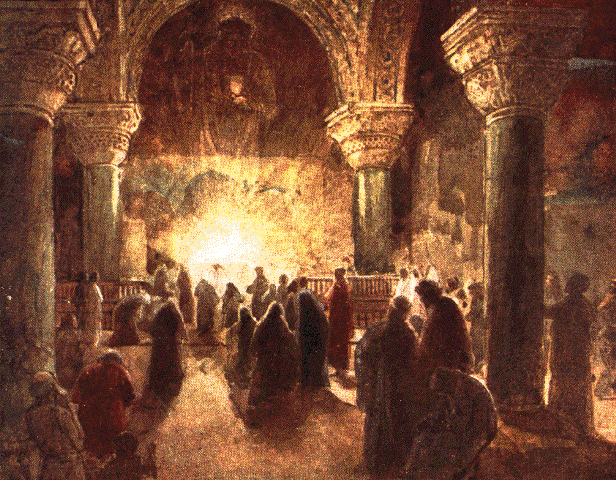
The catacombs in Rome contain many frescos telling us what the Christians living between c.100–c.350 AD believed, and how they lived out that faith. Prominent among these paintings is the early church’s priority regarding the observance of Holy Communion.
Justin Martyr, in the year 155 AD, wrote one of the most detailed accounts of a typical church service.
“On the day called Sunday, all who live in cities or in the country gather together to one place, and the memoirs of the apostles or the writings of the prophets are read, as long as time permits; then, when the reader has ceased, the president verbally instructs, and exhorts to the imitation of these good things. Then we all rise together and pray, and, as we before said, when our prayer is ended, bread and wine and water are brought…”.
“The Sacrament of the Eucharist, which the Lord commanded to be taken at meal times and by all, we take even before daybreak in congregations…”.
St. Ignatius of Antioch (c. 110 A.D.)
“They [i.e. the Gnostics] abstain from the Eucharist and from prayer, because they do not confess that THE EUCHARIST IS THE FLESH OF OUR SAVIOR JESUS CHRIST, flesh which suffered for our sins and which the Father, in his goodness, raised up again” (Letter to Smyrnians 7:1).
St. Cyprian of Carthage (c. 200 – 258 A.D.)
“And we ask that this Bread be given us daily, so that we who are in Christ and daily receive THE EUCHARIST AS THE FOOD OF SALVATION, may not, by falling into some more grievous sin and then in abstaining from communicating, be withheld from the heavenly Bread, and be separated from Christ’s Body…”.
St. Basil the Great (c. 330 – 379 A.D.)
“To communicate each day and to partake of the holy Body and Blood of Christ is good and beneficial;…We ourselves communicate four times each week…and on other days if there is a commemoration of any saint…” (Letter of Basil to a Patrician Lady Caesaria).
St. John Chrysostom (c. 344 – 407 A.D.) wrote how essential holy communion was to the faithful.
“Reverence, therefore, reverence this table, of which we are all communicants! Christ, slain for us, the SACRIFICIAL VICTIM WHO IS PLACED THEREON!” (Homilies on Romans 8:8). The lack of reverence, tradition, and communion in many Evangelical churches is probably one main reason so many are “deconstructing “and falling away! It is easy to pull up a tree that has shallow roots!
6. It should also be a means of celebrating our common union as believers in Christ.
The apostle Paul reminds us in 1 Corinthians 11:17-34 that the Holy Communion is an outward expression of believers’ “common union” as the body of Christ (1 Cor. 12). When we violate our common union by mistreating others during Holy Communion, we are judged by God for not properly discerning the Body of Christ (1 Cor. 11:27-32).
7.The early first-century church document “the Dediche,” written as a guide for church practice, assumed the weekly observance of communion.
In conclusion, I pray that the contemporary evangelical church no longer jettisons essential biblical and historical teachings and practices. We must be deeply rooted in our theologically and historically rich past so that we can have a bright future.
Dr. Joseph Matterais an internationally-known author, consultant and theologian whose mission is to influence leaders who influence culture. He is the founding pastor of Resurrection Church, and leads several organizations, including The U.S. Coalition of Apostolic Leaders and Christ Covenant Coalition. Dr. Mattera is the author of 13 bestselling books, including his latest “The Purpose, Power and Process of Prophetic Ministry,” and is renowned for applying Scripture to contemporary culture.
He was 22 and I was 21 when we bought the farm. It was April 26th — 25 years ago this week.
When one of the travelling feed salesman pulled into the farmyard that first spring, he rolled down his pick-up truck window, and hollered to the Farmer: “Hey, your dad around?”“How someone sees you doesn’t get to change how you see your dream.”
“I’m sure he is — over at his farm,” the Farmer grinned and it took that sales guy more than a beat or two to realize that the baby-faced boy, not looking a day over 16, was the man of this land, trying to make a go of this dirt on his own. How someone sees you doesn’t get to change how you see your dream.
We worked 18 hours day and scrounged to buy flats of Kraft Dinner when it was on sale and I picked rocks with a baby strapped on my back and on our second wedding anniversary we got out of the barn in time to see the sunset across the fields and I told the Farmer that’s all I’d ever need: If we walked into the barn before sun-up, if, now and then, we could finish up evening chores and walk out of the barn before sun down.
This is the part of the story where the hustlers tell you that this is the dream that hard work built — but this is not that story, because this world doesn’t work like that.
Over on my Facebook page, I share quotes from books that I have been reading. This quote from “The Benedict Option” garnered a lot of mostly negative reaction:
The need for liturgy is becoming clear to more and more Protestant theologians. Perhaps surprisingly for a Pentecostal, Simon Chan, a noted theologian, scholar, and writer based in Singapore, is one of a growing number of Evangelical church leaders who argue that their churches must return to the richness of liturgical worship. Evangelical ecclesiology is inadequate to the task of meeting postmodernity’s challenges, he has written. Rod Dreher
The first thing to note is that Pentecostal churches already have a liturgy, which is a fancy word for “order of service.” It is nearly always a variation of the following:
4-6 songs- 2- 3 fast songs (“Praise”) followed by 2-3 slower songs (“Worship”)
Prayer
Offering- usually preceded by an overly long exhortation to give
Communion (sometimes)- also preceded by an overly long mini-sermon
Sermon
Altar call or ministry time
If you know what is coming next than you have a liturgy, whether it is in a book or unwritten. There is nothing wrong with that because people are comfortable when they know what to expect. It doesn’t necessarily limit the Holy Spirit, but it does provide guidelines about when it is appropriate for people to pray in tongues or prophesy.
Our liturgy is a variation on this model, but when it seems appropriate we mix things up a little.
But when people talk about “liturgical worship” they usually mean a more formalised style of worship such as those found in the traditional churches.
That raises the hackles of many Pentecostal and Charismatic people who see this as “dead religion.”
We can have various opinions on that, but let me share an observation about the usefulness of liturgy.
I have been to several funerals over the last few years, some of which were led by “Spirit-filled” pastors. The thing that I noticed on these occasions was that they were indistinguishable from funerals led by non-christian celebrants, except maybe there was some reference to “Jesus” or “God” and comments about the person’s contribution to the church.
The central focus in each case was the person being buried. Not Jesus. Not the Holy Spirit.
In other words the church is copying the world, and losing its unique voice in the process.
In every act of worship by the church, the gospel must be proclaimed and Jesus must be worshipped. That is why liturgical worship at these formal events of funerals and wedding, in particular, is so important.
A good liturgy keeps Jesus at the centre. The prayers, the spoken word, the music, it is all gospel proclamation. There is no waffle, no adoration of a person, no stumbled prayers,
At the other extreme where the liturgy is everything, there are issues of over formality. I remember when I first started as a pastor in a small town, someone said to me after a funeral “At least with you, we know who is being buried.” The liturgy I followed had room to thank God for the life of the person, to pray for family members by name etc. But the suggested prayers offer gospel hope and constantly refer back to the cross of Christ and His resurrection.
We can make similar observations about wedding ceremonies.
As a pastor I am always wanting to make sure that my congregation is being brought to maturity in Christ. I think that is is what the quote is getting at. The reality is that a couple of “I Love You Jesus” songs followed by a preach about “Three Ways To Boost Your Bank Balance” is not enough to impart maturity into people, even if all the sermon points start with the same letter. But knowing the Apostles Creed or The Lord’s Prayer in the kind of familiarity that comes from saying them every week can give at least a chance for the great truths of scripture to sink into the soul.
Beware of any work for God that causes or allows you to avoid concentrating on Him. A great number of Christian workers worship their work. The only concern of Christian workers should be their concentration on God. This will mean that all the other boundaries of life, whether they are mental, moral, or spiritual limits, are completely free with the freedom God gives His child; that is, a worshiping child, not a wayward one. A worker who lacks this serious controlling emphasis of concentration on God is apt to become overly burdened by his work. He is a slave to his own limits, having no freedom of his body, mind, or spirit. Consequently, he becomes burned out and defeated. There is no freedom and no delight in life at all. His nerves, mind, and heart are so overwhelmed that God’s blessing cannot rest on him.
But the opposite case is equally true– once our concentration is on God, all the limits of our life are free and under the control and mastery of God alone. There is no longer any responsibility on you for the work. The only responsibility you have is to stay in living constant touch with God, and to see that you allow nothing to hinder your cooperation with Him. The freedom that comes after sanctification is the freedom of a child, and the things that used to hold your life down are gone. But be careful to remember that you have been freed for only one thing– to be absolutely devoted to your co-Worker.
We have no right to decide where we should be placed, or to have preconceived ideas as to what God is preparing us to do. God engineers everything; and wherever He places us, our one supreme goal should be to pour out our lives in wholehearted devotion to Him in that particular work. “Whatever your hand finds to do, do it with your might…” (Ecclesiastes 9:10).
“Then the cloud covered the tent of meeting, and the glory of the Lord filled the tabernacle.” Exodus 40:34
In Exodus 40:16-33, Moses assembles the tabernacle. He does so carefully, thoroughly, obediently. The paragraph begins with a prospective summary in verse 16 and ends with a retrospective summary in verse 33, emphasizing the completeness of Moses’ obedience. In between, seven times the text records that his work was “as the Lord commanded.” What more could one hope for?
But the book doesn’t end with “So Moses finished the work” (verse 33). There is still another, better paragraph to go. In that final paragraph, verses 34-38, we read of what only God can do. God’s glory comes down and covers the completed tabernacle. After all, that was the whole point to begin with: “Let them make me a sanctuary, that I may dwell in their midst” (Exodus 25:8).
Our aim as pastors is not only that our churches will be well assembled, thoughtfully and carefully and biblically obedient in their doctrine and structures. That is important. But it is not ultimate. We desire the dwelling of the risen Christ among us. We desire his felt presence. We desire him.
If we are not experiencing his glory coming down upon us, we need to ask if we have been disobedient in any aspect of what we have built or failed to build. But even if we have built well, we need to ask if we have settled for mere constructional obedience. The Lord has more for us than that. He has himselfto give!
I just love Sarah Bessey’s writing about the special weirdness of christians.
Go ahead, wave your flag
On the weekend, I did one of the most Vineyard-y things I’ve ever done in my life: I took two of my tinies to a worship flagging workshop. Like, it was a class about great big coloured flags and how to wave them well during church as part of the worship service.
So we have flags. We wave flags.
I know.
It’s weird to outsiders, and I get that. But I guess I can admit now that most of what we do as Christians is a bit weird to outsiders and so just roll in the weird altogether.
I’m not a flagger myself but I have an unreasonable love for people who wave the flags. I’ve reached the point in my story when I want all the crazy. All of it. I want the sloppy prayers and the hope and the flags and the unreasonable and embarrassing expectations for the voice of God to break through my life and the unprofessional dancers and the praying in tongues and the Eucharist and the Book of Common prayer being read aloud like it’s slam poetry in an old warehouse. I want anointing oil in my purse and ashes on my forehead.
Part of my own story is that I went for a big wander outside of my my mother Church, encountering different and new and ancient ways of experiencing and knowing and being changed by our big and generous God as if I were encountering occasional cups of water while in the desert, drinking each one down as if they were sustaining me for the next leg of the journey. But at the end of the story – or at least at the point of the story where I am right now, who can say if this is the end? – I came home.I came home to the school gyms and the folding chairs, the humble people of God also thirsty for the inbreaking of the Holy Spirit, imperfect and sometimes disappointing and unabashedly sincere and utterly beloved to me.
When I was a child, I sat in the front row of the church. I danced while the guitar played three-chord songs, kicking my feet in front of me, hopping from side to side, skinny arms outstretched. I learned to worship at the community centre, surrounded by misfit disciples who were on a first-name basis with resurrection. I sang the old songs about the blood of Jesus making me white as snow.
The church ladies would bring swaths of airy fabric, about two metres long apiece. I held onto one end and swung my flag. This was no banner for a war; this was a a homemade flag for a kid in a homemade church to wave. Sometimes, sure, I spun that flag around, hoping for people to notice me, to think that I was spiritual and holy, to think that I was beautiful and devoted. It was prideful at times, self-centred, but then there were those moments that broke through my own childish yearning to be noticed, to please the grown-ups, the moments when I felt the Spirit rush through my body and out through the fabric, like we were one, and I would spin like a star in the heavens, and I swear to you now that I felt the smile of God on me like wind, like water, like chains were falling off before they were even forged. I learned to pray with my body, relentless and free.
Then slowly, it seemed as if no one really danced in church anymore. Dancing with flags became something we made fun of, like duelling tambourines and long services and “falling out” in the Spirit and daring to pray for healing. We made fun of it to domesticate it, perhaps, or to heal ourselves from the abuse of it, but something in my thumbs still pricked, the Spirit isn’t afraid of being ridiculous, after all.
I wandered through other church traditions, traditional, contemporary, liturgical, meditative, mystic, seeker-sensitive, emerging, ancient-future, denominational, mega-church, old church, new church, basement church, no church for a while there: you name it, I found my way there and I found the people of God in each place, I did.
But my roots belong where I was first planted, I’ve reconciled myself to that now. I used to think I could travel far from where I began, but instead, I travelled only to find myself home again, like Richard Rohr says, as if I am only now seeing it for the first time.
We are so beautiful.
We sit in folding chairs in a school gym, one of the great cathedrals of my life. The pine benches line the walls, electrical tape holds the wires for the mics down, the stage can be broken down and set back up again every Sunday morning and Saturday night. This is my familiar place to encounter God.
“It is well and good for the preacher to base his sermon on the Bible, but he better get to something relevant pretty quickly, or we start mentally to check out.” That stunningly clear sentence reflects one of the most amazing, tragic, and lamentable characteristics of contemporary Christianity: an impatience with the Word of God.
The sentence above comes from Mark Galli, senior managing editor of Christianity Today in an essay entitled, “Yawning at the Word.” In just a few hundred words, he captures the tragedy of a church increasingly impatient with and resistant to the reading and preaching of the Bible. We may wince when we read him relate his recent experiences, but we also recognize the ring of truth.
Galli was told to cut down on the biblical references in his sermon. “You’ll lose people,” the staff member warned. In a Bible study session on creation, the teacher was requested to come back the next Sunday prepared to take questions at the expense of reading the relevant scriptural texts on the doctrine. Cutting down on the number of Bible verses “would save time and, it was strongly implied, would better hold people’s interest.”
As Galli reflected, “Anyone who’s been in the preaching and teaching business knows these are not isolated examples but represent the larger reality.”
Indeed, in many churches there is very little reading of the Bible in worship, and sermons are marked by attention to the congregation’s concerns, not by an adequate attention to the biblical text. The exposition of the Bible has given way to the concerns, real or perceived, of the listeners. The authority of the Bible is swallowed up in the imposed authority of congregational concerns.

 6. It should also be a means of celebrating our common union as believers in Christ.




 New Life Narrabri