A few weeks ago, I bought a new tank and stand to replace the items which have housed my fish collection since 1975. This is how I transferred the contents of one tank to the other. …
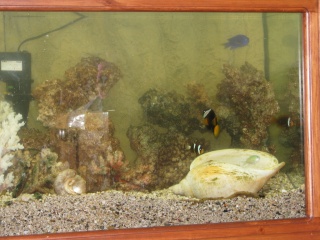
Here is the old tank. We were concerned that there may have been a leak developing- it now seems unlikely! However the stand does need renovating and as a part of our kitchen/dining room renovation, we need to move the tank.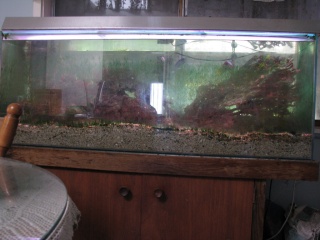
The new tank and stand.
The background is made of polystyrene coloured and moulded to resemble a generic rock wall. I washed it thoroughly before putting it into the tank. I used an "Aquarium Safe" silicone to attach it to the inside of the tank. This required 7 days to set and remove the toxic chemicals.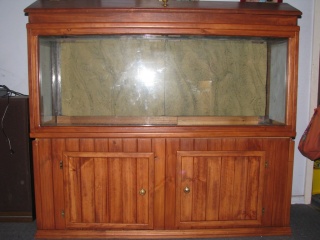
Preparing to empty the tank. Because of the position of the tank in the dining room and the tendency of more and more stuff to be parked around it, cleaning and maintenance have not been as regular as I would like 😦
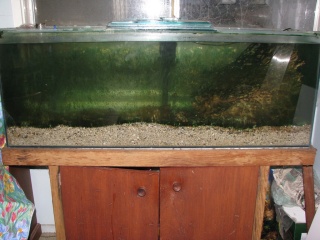
I had to plan out in advance how to transfer the fish, water, coral, equipment and substrate from one tank to the other.
First I removed the coral and the other material in the tank. The coral and live rock were treated to a light hosing to remove algae.

Next I removed the fish. They were surprisingly co-operative, although they were not very happy about being evicted.

THe plates for the under-gravel filter were transferred next. There was a thing that appeared to be a worm of some sort firmly attached to the plate with the riser tube attached. You can make it out in the photo. It didn't move much until I started adding the water and then it seemed to wiggle.
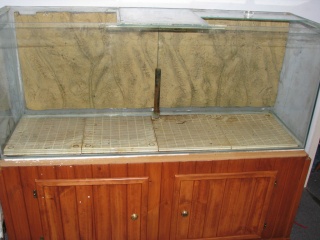
Next I transferred the crushed coral substrate. It was hard work scooping it out of the old tank and into the new one.
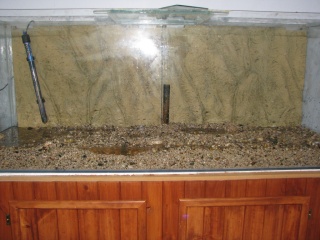
Stirring up the substrate really made the water very murky. There was 12 years of accumulated crud (to use the scientific term) and it gave the water the colour and texture of gravy.
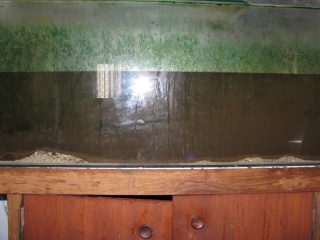
The new tank is ready to be filled with water.

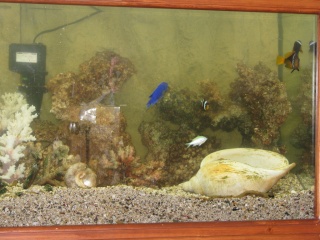
Here is the finished project. The fish seem quite happy in their new home.

After a few hours, the water had become clear and the fish had established themselves. I will have to siphon the tank bottom to remove all of the stuff that has settled out of the water.
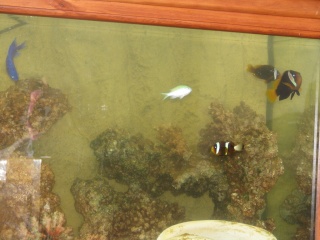
One disadvantage of the new setup that I hadn't thought about is that the hood makes it difficult to check the protein skimmer. The protein skimmer sits at the back corner of the tank. They are used in salt-water tanks to remove suspended protein particles by attaching them to tiny air bubbles where they froth up into a cup a few centimetres above the water-line. Removing this material this way (fish excreta and uneaten food) reduces the load on the biological filter. You need to adjust the air flow carefully as too little air results in no foam being produced, and too much air carries too much water up the tube and overflows the cup with plain water. It is actually impossible to see past the light when I open the front of the cover, and I will need to life the whole of the hood to remove the cup to empty it.

 New Life Narrabri
My fish experience….My mother bought my kids a fish bowl, 2 goldfish each and a spare. I was cleaning it twice daily, so I bought a 2.5 gal tank. Hubby came home with tropical fish. Goldfish back in the bowl, tropicals in the 2.5 gal with expensive equipment. Bought another 2.5 gal. tank. Hubby brought more tropical fish. Got a 50 gallon tank for the tropicals, my dad welded a sturdy stand for all this. The goldfish died and when we moved to Forida, the people who bough the house wrote the fish into the contract.
LikeLike
LOL!They can certainly be addictive to the point of taking over your life.
LikeLike