From sciencealert.com
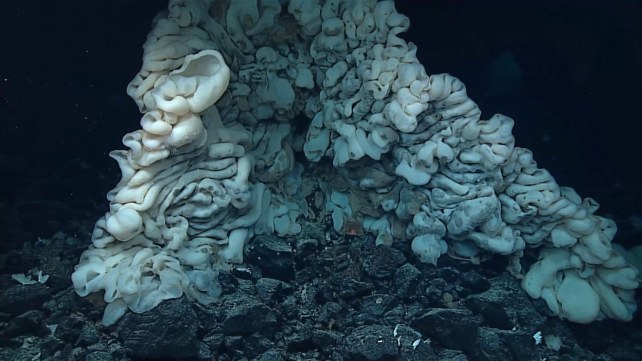 The largest sponge ever documented, discovered more than 2 kilometers beneath the Pacific Ocean near Hawaiʻi. (NOAA Ocean Exploration, 2015 Hohonu Moana)
Deep beneath the blue, blue waves of the Pacific Ocean, a true benthic monster makes its home.
Not the giant squid with its grasping, clasping arms; nor the sperm whale with its cunning eye and raking teeth.
Instead, this beast has the intricate folds of a forgotten pile of laundry, almost luminous against the inky darkness – the intestine-like configuration of the largest sponge humanity has ever seen.
NOAA scientists exploring the Papahānaumokuākea Marine National Monument in 2015 found it at a depth of 2,130 meters (6,990 feet), and measured its size.
The extraordinary colony came in at 3.7 meters long, 2.1 meters wide, 1.5 meters high – “about the size of a minivan”, according to NOAA.
And it could have been growing down there for a very long time.
The discovery was made during NOAA’s 2015 Hohonu Moana: Exploring Deepwaters off Hawaiʻi expedition aboard the research vessel Okeanos Explorer.
Using a remotely operated vehicle called Deep Discoverer, the researchers spotted the enormous animal on a ridge deep beneath the ocean’s surface.
Two parallel laser beams projected onto the sponge allowed the team to measure its height and width, while images captured from above by a second vehicle, Seirios, helped determine its length.
Those dimensions eclipsed the previous record – a colony of the glass sponge Aphrocallistes vastus, found in shallow waters off western Canada, that measured 3.4 meters long, 0.5 meters wide, and 1.1 meters high.
But we don’t really know who our mystery record-holder is. The researchers didn’t collect a sample of the enormous sponge itself, but they did retrieve a smaller specimen from a nearby location that they believed belonged to the same species.
Examining its microscopic skeletal structures, called spicules, revealed that it belonged to a family of glass sponges called Rossellidae. Its exact species, however, remains unidentified
Read the rest of the article here

