Jo Nova: A sick grid! In the rush to electrify Victoria, voltage falls too low for EV Chargers, microwaves and cooktops

From joannenova.com

By Jo Nova

It’s just another hiccup on the road to Utopia

Two years ago the Victorian government banned new houses adding a gas connection. The houses had to be built “all electric”. It’s all part of a smooth and efficient transition, the government said. (And you ‘vill save money whether you like it or not.*).

However the demand for electricity in some areas is so high that the voltage falls, and some householders can only use one hotplate on the stove at a time, or they can’t get the heat pump to work at all. And naturally, they can’t charge their electric vehicle. But it’s all for a good cause — pagan weather control.

Even the ABC can’t spin this:

Victorians transitioning from gas exacerbates growing problem of undervoltage

ABC News

      • A network operator has warned a massive spike in power consumption from houses transitioning off gas has led to undervoltage.
      • It is causing some households to be unable to use car chargers, cooktops and heaters.

Do the maths: by their own numbers, that’s 300,000 incidents a year where appliances fail:

CitiPower said it had received about 1,000 voltage complaints in the past 12 months, and estimate that for every complaint there are 320 additional customers experiencing non-compliant voltages.

Undervoltage issues were occurring primarily in older areas of the network, such as inner city and older suburban Melbourne, and older urban areas of Ballarat, Geelong and Bendigo.

“…shortly after moving in, problems started. First, Ms Slako noticed she could only use one hotplate at a time on her induction cooktop. Then she found the microwave would not heat food at dinnertime, but would burn everything at other times.

This month, she discovered her split system would not heat the house.”

“There’s a sense of dread waiting for winter when I’m cold and the split system’s not heating reliably.

From next year existing houses won’t be able to replace their gas appliances anymore. (Better lock in that new gas system now while you still can, eh?)

In other news, thousands flee Victoria amid crime and bad governance.

h/t David B

*Savings, as calculated by our models, and not compared to actual  electricity costs of 1995.

Just like that: Most Australians want to drill, baby, drill for oil and gas, and don’t care about “Net Zero”

From Jo Nova

Image by Cortex Zone from Pixabay

By Jo Nova

A few weeks of high fuel prices have destroyed 20 years of climate propaganda, pfft!

Australians have barely mentioned drilling for oil in Australia in the last twenty years. It was unthinkable. But two new polls  show a dramatic awakening. Suddenly Australian voters want more oil and gas. In the first poll, 65% support more drilling for oil and gas, and in the second poll, it was 57%. These are whopping majorities. And we’ve barely started to discuss it.

Only a small minority (just 16%) were still waving the Green flag and are opposed to oil drilling. Rarely in a democracy,  do we see so many people line up on the opposite side of the government policy.

Negativity to Renewables is rising. I don’t see how the Net Zero forced revolution is going to survive high fuel and electricity prices.

Surging support for new refineries, oil and gas drilling, and biofuels

By Geoff Chambers, The Australian, April 17th

More than 70 per cent of Australians support the development of new fuel refineries and 65 per cent of voters back more oil and gas drilling in the wake of the Middle East war, as resistance to Anthony Albanese’s renewables revolution grows.

Amid rising concerns about Australia’s fuel security following a fire at one of the two remaining oil refineries in the country, the poll showed surging support in favour of new refineries (73 per cent), unlocking more oil and gas to produce more fuel (65 per cent)…

Only 10 per cent of Australians oppose developing more refineries and 16 per cent reject allowing more oil and gas drilling.

The Mood of the Nation survey, (April 7-13), revealed “record high negativity towards the renewable energy transition”. The SECNewgate Mood of the Nation survey of 1237 voters across every state and territory

A new Sky News poll of 1.500 Australians also finds that an overwhelming majority want more oil and gas drilling, even if it undermines Net Zero emissions.

The numbers are so stark, that even 47% of Labor voters support oil and gas exploration. If the Opposition makes this an election issue, the Labor party will bleed voters. But the Liberals are vulnerable too. If they don’t champion oil and gas exploration, they will bleed votes to the Nationals and One Nation.

SkyNews.

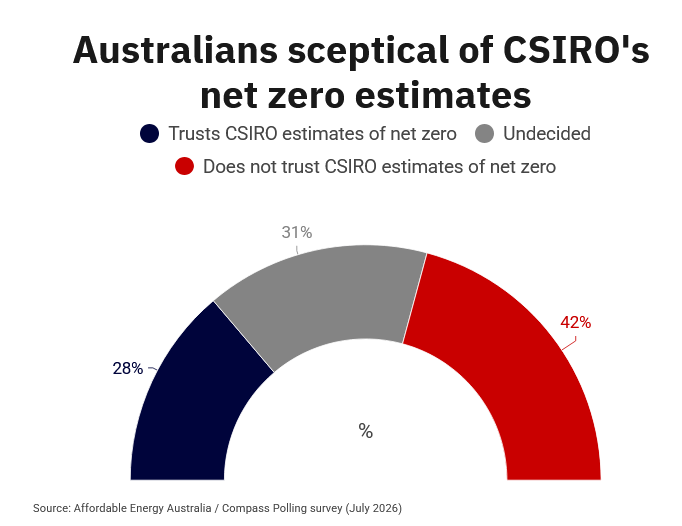
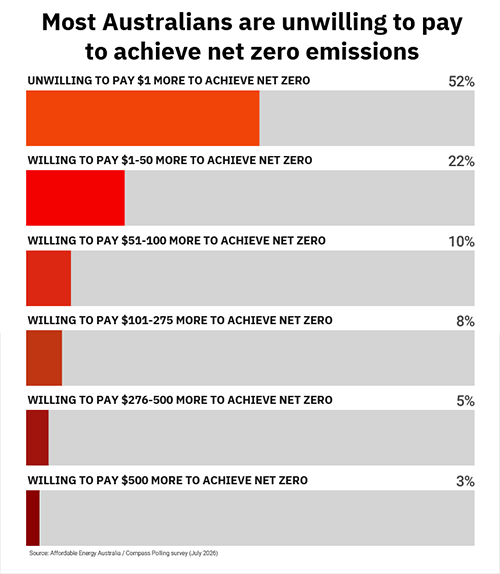
It’s not surprising that Australians are so willing to drop Net Zero. Hardly anyone ever really cared about this abstract UN policy. Last year half the country didn’t want to spend a single cent more to reach Net Zero targets and 83% didn’t want us to raise the target (which the Labor government then did anyway).

Policies that are the opposite of what 80% of the voters want aren’t supposed to happen in a Democracy, yet the Labor Party did it anyway…

No Link Between CO2 And Temperature For 3 Million Years.

Shock New Evidence Showing No Link Between CO2 and Temperature Over Last Three Million Years Stumps Net Zero Activists

From wattsupwiththat.com

Guest essay by Chris Morrison of the Daily Skeptic

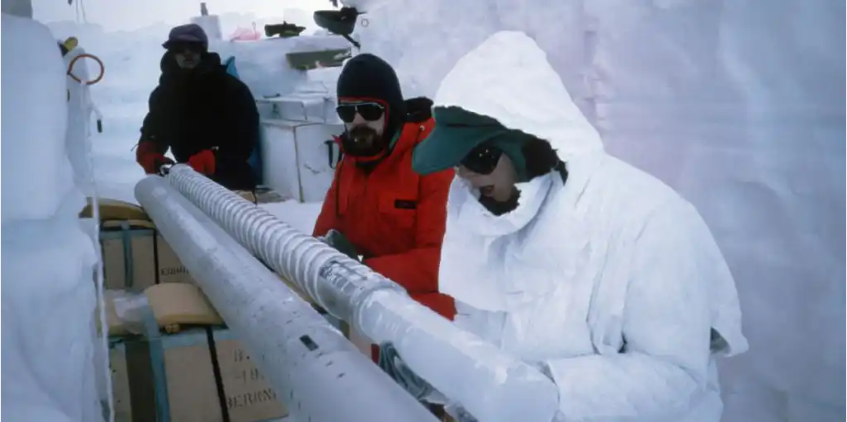
The climate science world (‘settled’ division) is in shock following the discovery in ancient ice cores that levels of carbon dioxide remained stable as the world plunged into an ice age around 2.7 million years ago. Levels of CO2 at around 250 parts per million (ppm) were said to be lower than often assumed with just a 20 ppm movement recorded for the following near three million-year period. In addition, no changes in methane levels were seen in the entire period. Massive decreases in temperature with occasional interglacial rises appear to have occurred without troubling ‘greenhouse’ gas levels, and this revelation has caused near panic in activist circles.

The assumed level three million years ago of COwas around 400 ppm, a convenient mark that has been used to explain the subsequent ice age and a drop to 250 ppm. Due to the recently published paper, this explanation has become more problematic and natural climate variation is correctly noted to have occurred with the temperature changes. Alas, similar explanations are mostly ignored in discussing today’s climate changes in the interests of promoting the Net Zero fantasy. Some cling desperately to a dominant CO2 role, including one of the authors of the findings published in Nature. The co-author states that the results suggest even greater climate sensitivity to the warming effect of CO2. In short, there is a great deal of applying the laws of physics and chemistry to one era, but failing to extend the same courtesy to another.

The title of the paper, produced by 17 America-based scientists, was enough to set alarm bells ringing in the ‘settled’ science, Net Zero-obsessed community: ‘Broadly stable atmospheric CO2 and CH4 levels over the past three million years.’ A related paper examining ocean heat content derived from the ice core record was also published. Carrie Lear, Professor of Past Climates and Earth System Changes at Cardiff University, claimed that the papers “don’t rewrite the role of CO2, they underline how sensitive the climate system is… that is why today’s rapid  CO2 rise is so alarming”.

Ah, yes. Even if COmovements are minimal, probably within a margin of potential error, they are still responsible for large variations in temperature. The laws of climate science are ‘settled’ – if the trace atmospheric gas CO2 is rising, falling or generally stable, it is almost wholly responsible for large movements in global temperature. Under this rather shaky assumption, humans must stop burning hydrocarbons and return to a neo-Malthusian pre-industrial age.

Study lead author Julia Marks-Peterson noted: “We definitely were a bit surprised. If correct, the findings may suggest that even small changes in greenhouse gas levels could trigger major shifts in climate.” That’s a little bit of a scary thought, she added, possibly with an eye on future grant funding. “May suggest” is doing a lot of the work here, and it may also be suggested that more plausible opinions are available.

Quoted in New Scientist magazine, Tim Naish, Professor of Earth Science at Victoria University in New Zealand, said it was “way too early to thrown the baby out with the bathwater”. Perish the thought that baby should be given its marching orders, ending a science-lite 40-year demonisation of CO2 and related promotion of a hard-Left Net Zero dream.

Read the rest of the article here

Jo Nova: Dept of Climate Change gives $1.6m in trips to Brazil as reward for prophets, activists, sycophants

From joannenova.com.au

Cynics are wondering what, exactly Australia got for spending $1.6 million sending 75 people on a two week junket in Brazil last year?

Australia, of course, got nothing, but this is the bread and butter currency for The Blob. How else can you convince bored bureaucrats to pretend warming causes cooling, and maintain the righteous indignation!

Getting a free trip to Brazil surely ranks pretty high on bragging lists at Saturday night dinners. That shine helps make up for the mental effort of selling your soul and pretending that Sunday night’s pot roast causes floods in Dhaka.

It also provides the inspiration to keep the next generation of Blobocrats focused. The underlings learn that people who shed tears about climate change get rewarded, while the critics don’t. Just one ill advised remark, one careless joke, could compromise the plane tickets.

Responses to Senate estimates questions on notice have revealed Department of Climate Change and Energy sent 32 officials, the Department of Foreign Affairs and Trade sent nine officials, and the Department of Agriculture sent one official to Belém, Brazil in November last year for the UN Conference of the Parties summit.

And the Department of Climate Change budgeted $1.6m for their 32 officials to fly to Brazil, it said.

And this $395,000 — it’s just an investment for the future. One day a Youth Climate Coalition leader will end up in a heavily edited documentary promoting your Department. Think of this as advertising money and it all makes sense….

The department also revealed it disbursed a $395,000 grant program for other organisations to attend the COP30 summit. This included groups like the Aboriginal Carbon Fund, Australian Youth Climate Coalition, United Nations Youth Australia, and Women’s Environmental Leadership Australia.

Remember, even as the Departments of Fisheries, Forestry and Agriculture enjoy their tours of the Amazon, that some fishermen, farmers and foresters have lost their jobs in Australia due to whimsical policy changes. Labor has recklessly damaged these industries, while the Departmental Chosen Ones use their tax dollars to party in Latin America.

Climate Crisis? What Climate Crisis

From wattsupwiththat.com

By Andy May

In a new paper by Gianluca Alimonti and Luigi Mariani, they argue that the public needs a proper definition of precisely what a climate crisis is to make rational decisions about how to address potential climate change threats (Alimonti & Mariani, 2025). They propose a set of measurable “Response Indicators” (RINDs) based on the IPCC AR6 Climate Impact drivers (IPCC, 2021, pp. 1851-1856).

Their intent is to switch from subjective perceptions of possible dangers to quantifiable metrics. Potentially this could put climate change debates on track and ensure that both sides are arguing about the same thing as opposed to talking past each other due to each of the debaters arguing from different definitions. It might also lead to real solutions to real problems, rather than flights of ideologically-based fancy.

The IPCC defines climate impact drivers (CIDs) as climate events that affect society. The impact on any affected society can be detrimental, beneficial, or neutral (IPCC, 2021, p. 1770). They define 33 categories of CIDs and have found that most of them have not emerged from the expected range of natural variability.

Alimonti and Mariani examined the EM-DAT disaster database, managed by the Centre for Research on the Epidemiology of Disasters from the year 2000 to the present. In this period, they detected no trend in deaths due to weather-related disasters. Just as important, there were clear improvements in global health over the period, once the growth in population was accounted for.

Temperature-related mortality accounts for 8% of the total weather-related deaths, of these 91% were due to cold and 9% to excess heat. From 2000-03 to 2016-19 cold related deaths decreased by 0.5% and heat related deaths increased by 0.2%, very small changes.

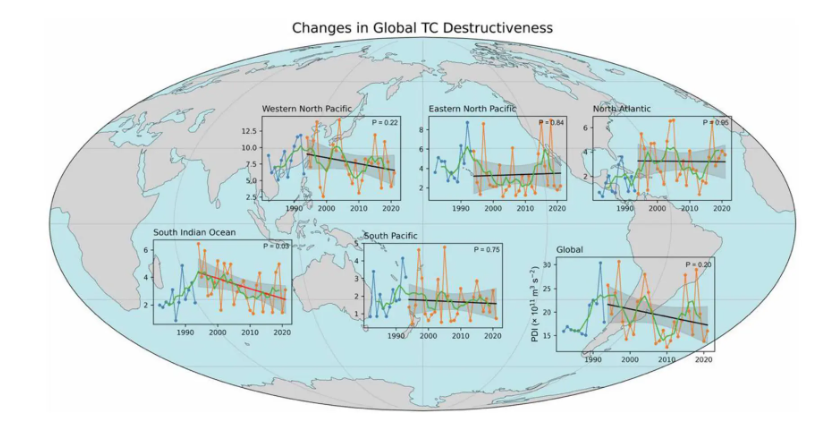
As Alimonti and Mariani’s Table 1 indicates, most measures of their climate change response indicators show no change, including cyclones, drought, floods, and wildfires. They show global GDP is improving, as is food availability.

The paper emphasizes that the reduction in climate-related deaths can be partially attributed to improvements in civil protection systems (levees, seawalls, forest management, etc.) which demonstrates that adaptation to climate change often proves more effective than mitigation. Most objective measures of the human-welfare impact of climate changes show no change, and most of the rest show improvement or an ambiguous impact, rather than detrimental effects.

The paper is worth the time to read; it is time for less subjectivity and more harder objective measures of the impact of climate change.

Jo Nova: UN climate conference drops “fossil fuels” from the draft deal. Activists say “We have nothing left”

It is as if Satan disappeared from the Bible

The sacred fabric of the climate religion is unravelling by the day. The COP30 deal is being hammered out in Brazil — but in the draft any mention of “fossil fuels” has been dropped.

Apparently the rich oil nations have formed a block that objects to a sentence committing countries to stronger, faster, action to reduce their use of fossil fuels. The UK, France and a few other nations have rejected this but the same small island nations that are frightened of drowning have joined the oil block.

Apparently they were offered more money to adapt to climate change.

UN climate summit drops mention of fossil fuels from draft deal

By Georgina Rannard, BBC

All mention of fossil fuels, by far the largest contributor to climate change, has been dropped from the draft deal under negotiation as the COP30 UN climate talks in Belém, Brazil enter their final stretch.

Brazil’s President Luiz Inácio Lula da Silva and some countries including the UK want the summit to commit countries to stronger, faster action to reduce their use of fossil fuels.

An earlier text included three possible routes to achieve this, but that language has now been dropped after opposition from oil-producing nations.

French Environment Minister Monique Barbut said the deal is being blocked by “oil-producing countries – Russia, India, Saudi Arabia, but joined by many emerging countries.” She suggested that small island nations may agree to a weaker deal on fossil fuels if they secured more finance to adapt to the changes in their countries caused by rising temperatures.

It was always about the money

The big question here (if this sticks) is why the oil block didn’t do this years ago?

The even bigger question is whether the oil block have found a way to circumvent The UN Blob? If they are paying the small countries off directly behind the scenes, the UN will miss out on collecting its share of the cash flow. The travesty!

The irony is that if  “man-made climate change” was really a crisis, it makes more sense for the oil giants to pay the islands to build sea-walls  — instead of rearranging the global economy to try to control the clouds and the ocean. But this unthinkable sacrilege cuts out the middlemen Blob-o-crats and stops the whole totalitarian power game.

The UN will not give up its aim to be the One World Government so easily.

The French Environment Minister was not happy:

On France’s position she said:”At this point, even if we don’t have the roadmap, but at least a mention of the fossil fuels, I think we would accept it. But as it stands now, we have nothing left.”

Expect The Blob to fight this all the way. There will be wrangling and then possibly “euphoric joy” about a “historic agreement” ready for cameras on the nine o’clock news.

From Jo Nova

Jo Nova: Prepare the escape pod — Kier Starmer says: “The consensus is gone”

Starship crashed. Fantasy.

Image by ThankYouFantasyPictures from Pixabay

By Jo Nova

The stench of failure is written all over Cop30 in Brazil

The USA, China and India are not attending. The UN has said the 1.5 degrees target is no longer possible. And the OECD admits “policy commitments have fallen from 10% annual growth to just 1%.

The Consensus is not only dead, but no one can hide the body under the rug any longer. Things are decomposing so fast, even Kier Starmer has flown all the way to the COP conference in Brazil to say “the consensus is gone”.

Kier Starmer didn’t even want to go to COP30 lest he look like he’s in the palm of the globalist Blob which would feed his nemesis – Nigel Farage. So he’s put in a last minute appearance and gone out of his way to avoid the usual fire and brimstone devotion by uttering a blasphemy. The consensus, after all, was the holy grail. It was the reason “to believe” and a reason to act even if we didn’t believe. The Blob always said: “We don’t want to fall behind” like being part of the herd was a benefit in and of itself.

For a bunch of Groupthinkers, this is big admission:

[The Guardian]  The UK prime minister told world leaders on Thursday at the Cop30 climate summit in Brazil that the “consensus is gone” on fighting climate change around the world, a decade after the landmark Paris agreement in 2015.

“Ten years ago, the world came together in Paris … united in our determination to tackle the climate crisis,” Starmer said. “The only question was how fast we could go. Today, however, sadly that consensus is gone.”

For Starmer, this might be the best escape route from the Net Zero bomb. As long as the fuse is lit and the carbon-clock is running, the globalist Blob parties face a wipe-out at the next election. But if “the consensus” is over, maybe he can pack the climate-talk away in a box for a few years and curb the fury over electricity prices. It’s what Mark Carney did to win in Canada. He scrapped the carbon tax on his first day in office and de-fanged the opposition. It may even placate the Groupthinking Greens, if he can convince them that no one else is acting and to wait for a better day.

Chris Bowen, the Australian Minister for Weather Control even agrees with Kier Starmer

But in renewable-crazy-land that just means that Australia has to do even more. The Guardian asked him about Kier Starmer’s words and he replied:

“I think that’s fair comment. Yes, it’s a contested space, but that makes supporting action in keeping with the science more important, not less important.

“It makes continued action by governments and industry who get it – that this is a scientific and environmental imperative, but also excellent economics – even more important. And that’s certainly our approach in Australia.”

Unlike the Reform Party in the UK, the opposition in Australia is a Lump of Jello, and doesn’t have a climate policy. So Chris Bowen is free to keep sprouting crazy witchery. He’s not afraid of the opposition because, effectively, there isn’t one.

Indeed, Bowen has to keep waving the flag, because the Australian government wants to host the next loser COP event this time next year. Thankfully, the opposition and the Nationals have both said “Let Turkey have it”. We want our billion dollars.

Even the OECD admits policy commitments have stalled. Globally, they only increased by 1% last year, when previously they would grow by 10% each year.

Global climate action losing momentum: OECD

By Ryann Cropp, The Australian Financial Review

The pace of global efforts to address climate change has ground to a halt, according to a report by the OECD that is likely to turbocharge Coalition wrangling over its commitment to emissions reduction.

The expansion of international climate policy commitments increased by just 1 per cent in 2024, with only 17.7 per cent of global emissions now covered by legally binding net zero pledges, according the Organisation for Economic Co-operation and Development’s annual Climate Action Monitor.

According to the OECD, the slowdown in climate commitments since 2021 contrasts significantly with the prior decade, when average emissions reduction policies expanded by about 10 per cent each year.

They have run out of excuses:

“This slowdown can no longer be explained by the COVID-19 pandemic or economic shocks: it reflects a loss of momentum in implementing effective policies,” the report said.

Now even the UN agrees that we will fail to hit their 1.5 degrees magical target, and that this is a “moral failure”:

It is, of course, our fault:

The failure to limit global warming to 1.5 degrees Celsius is an emergency and nations must now “lead or be led to ruin”, UN secretary-general António Guterres has said as the COP30 climate conference got underway in Brazil’s rainforest city Belém.

He added: “Every fraction of a degree means more hunger, displacement and loss — especially for those least responsible. This is moral failure — and deadly negligence.”

Mr Guterres, being a Blob man and the total socialist, paints this as capitalist greed:

“Too many corporations are making record profits from climate devastation, with billions spent on lobbying, deceiving the public and obstructing progress,” he said. “Too many leaders remain captive to these entrenched interests.”

After all, it’s not like the consensus died because millions of people in the largest economy on Earth were not convinced and voluntarily voted (twice!) for a man who called Climate Change a con and a hoax. Oh no…

Jo Nova- Govt. Admits Renewables Will Never Beat Coal

By Jo Nova

At the top of the Faraway Tree, the cheapest form of energy need more subsidies. Just keep pouring the money…

The Australian Energy Market Commission (AMEC) has finally quietly admitted that they’ve given up on wind and solar power becoming cheaper than coal. Instead, renewables are so uncompetitive they will need another ten years of subsidies, or however long it takes until the last coal plant shuts off.

It’s so revealing. Once upon a time they might have thought (or at least pretended) that subsidies were there to get the unreliable generators ‘over the development hump’ so they could compete in a free market. But after 20 years of subsidies, there are no new economies of scale left to wait for. We got to the bottom of the cost efficiency curve and we’re going up the other side. Costs are now rising as the new projects have to go to far flung fields and wait for impossible transmission towers to appear. Windmills kept getting bigger until there was a nasty surprise in the maintenance bills that wiped 36% off Siemens shares in a single day.

AMEC opine about getting back to a free market once the coal plants are forced off the grid by the Big Government subsidies. They might as well be telling the world that wind and solar will never be as cheap as coal is.

How could the new unfree market, post coal, possibly be cheaper than the old one?

Green energy subsidies here until nation exits coal, says Australian Energy Market Commission

Perry Williams, The Australian

Australia’s official energy policy adviser says government subsidies for renewables will likely be kept in place for as long as coal-fired power generation keeps operating, locking in underwriting schemes for at least another decade.

It’s not renewables fault, it’s because we need “an orderly transition” (to a forced, fixed, and unfree market):

The Australian Energy Market Commission said underwriting mechanisms were needed to ensure there was an orderly transition to green energy as coal generation exited the nation’s power grid.

Sorry, did we say the subsidies would end?

“Are we going to get past this at some point when we won’t have governments underwriting new capacity. Maybe once we’ve seen coal exit and we’ve built out this phase of the transition,” AEMC commissioner Tim Jordan told the Citi Australia and New Zealand Investment Conference on Tuesday.

All the talk of free markets is just an illusion:

“We can then return to a more market-led approach where underlying demand growth will determine whether new capacity enters.”

Mr Jordan said the industry and government should aim for “market principles to take over again” once the transition from coal to renewables was complete.

What do we call a free market when the cheapest competitor is banned?

If the green subsidies can’t end until coal power is gone, it looks more like their primary goal was not to help renewables so much as to destroy coal…

Jo Nova: Fossil Fuel Comeback

Fossil Fuel Fightback: The gears shift on the Renewable Crash Test Dummy — Eraring coal lives, wind and solar slump

Australia's Renewable Transition plane,

By Jo Nova

If the whole renewables fantasy was crumbling, it would look something like this

Despite the Labor Government throwing money at unreliable energy, renewables hopes are quietly unraveling. The largest energy retailer in the country just announced a nice 26% profit jump, based on fossil fueled gas, and they also announced they’d be keeping Australia’s largest coal plant open longer. The two year extension for Eraring, is now a four year extension. Despite reaping in gas profits and keeping the planet-destroying-plant operating, the share price promptly leapt 6% to a ten year high.

Significantly, Giles Parkinson at Reneweconomy also noticed that Origin’s annual report includes talk of batteries, but no wind or solar projects, which seems like an important oversight in a nation belting headlong towards the Green Utopia.

Meanwhile, for the first time I can recall, a fossil fuel CEO is daring to defend the industry. The shift in confidence in palpable.  Mike Wirth, the Chevron CEO, is not only saying “oil is not evil” but he clearly isn’t afraid of the Australian government. He’s so unafraid he also delivered a “stinging rebuke” — saying that high costs, red tape and environmental rules have made Australia so uncompetitive, investors are leaving to spend their money in the US and the middle east instead. Indeed, Chevron had a plan to double their Australian gas production but have abandoned that now. Australia used to be the world’s largest LNG exporter but Qatar and the US outpaced us.

In a similar theme, Ampol just surprised the market by spending $1 billion dollars to double the number of petrol stations it owns, making it the largest retailer in the country. The CEO Matt Halliday said the unthinkable: “The transition [to EVs] will take decades, and combustion engines are going to still make up a large chunk of the national car fleet beyond 2050.” It was a very unfashionable and backward thing to say, but shares leapt 8% on the news yesterday.

Australia’s biggest energy retailerhits go slow button on wind and solar, mulling options on Eraring

Giles Parkinson, Reneweconomy

Origin Energy, Australia’s biggest energy retailer, appears to have hit the go-slow button on the rollout of new renewable energy projects, and is still mulling options on the already extended Eraring coal generator, the country’s biggest, which is officially due to close in 2027.

Curiously, in its annual report, the company says: “With the Eraring Power Station’s closure planned for August 2027, failure to deliver our major renewable generation projects may affect Origin’s future supply capacity, financial prospects and reputation.” Yet it has made no commitment to build those projects in that timeframe.

Think of the irony of putting the nations biggest battery next to the nations biggest coal plant, as if it needed back up:

But this is made up entirely of big batteries, including the giant 700 MW, 2,800 MWh Eraring battery being next to the coal generator…

It [the annual report] includes no wind or solar projects. The technologies did not even rate a mention in the results presentation, apart from the giant 1.45 gigawatt (GW) Yanco Delta wind project in the south-west of NSW, which has gained grid access rights but is still to complete environmental approvals.

Read the rest of the article here

Peter Ridd: The Great Barrier Reef Is Doing Fine

My article from The Australian this morning below. But first, AIMS are agreeing that the reef is coming off record highs so the small drop should be viewed in that context. However, much of the media is still reporting the drop as a disaster.

The latest 2025 statistics on the amount of coral on the Great Barrier Reef (GBR) show the reef is still doing fine despite having six allegedly cataclysmic coral bleaching events in the last decade. There should be no coral at all if those reports were true.

The normalised coral cover dropped from a record high number of 0.36 down to 0.29, but there is still twice as much coral as in 2012. The raw coral cover number for all the last five years has been higher than any of the previous years since records began in 1985. However, when one considers the uncertainty margin, the present figures are not significantly different from many of the previous years.

The Australian Institute of Marine Science collects coral data on around 100 of the 3000 individual coral reefs of the GBR. Analysis of the data at smaller scales shows the GBR is doing what it always does – change. There is a constant dynamic as cyclones, starfish plagues and bleaching events dramatically kill lots of coral in small areas, while it quietly regrows elsewhere.

Guess whether the ‘science’ institutions emphasise the death or regrowth.

The institutions often justify this embarrassingly high coral cover as just “weed coral”. But the type of coral that has exploded over the last few years is acropora, which is the most susceptible to hot-water bleaching. How can we have record amounts of the type of coral that should have been killed, again and again, from bleaching? The acropora takes five to ten years to regrow if it is killed.

There are two conclusions that must be drawn. First, not much coral has been killed by climate change bleaching – at least not compared to the capacity of coral to regrow. Second, the science institutions are not entirely trustworthy, and are in need of major reform.

And not just with regard to GBR or climate science. It is well recognised that most areas of scientific study are suffering a problem of reliability, which is damaging the reputation of science itself. It is well accepted that around half of the recent peer-reviewed science literature is flawed. Is there any other profession with such a high failure rate?

This last point has been noted in the United States, where American science is going through a process of genuine revolution. Scientists who were once victimised and ostracised have been appointed to lead science and medical research institutions. Among the more notable and encouraging appointments have been Professor Jay Bhattacharya who famously opposed the groupthink on Covid lockdowns, especially for children. He is now head of the National Institutes of Health and is proposing radical changes in the funding methodology to break the cycle of groupthink. He is also changing funding rules to encourage bright young scientists with new ideas rather than the present system which rewards older scientists who are wedded to conventional wisdom, and often enforce groupthink. In short, Bhattacharya is encouraging dissenters.

The US Department of Energy recently released a report on whether the conventional wisdom on climate change is entirely defensible. It is written by five eminent scientists, all with spectacular careers, who have consistently challenged the view that climate change is an existential threat. Their report includes data about GBR that shows there is little to worry about. Significantly, it systematically addresses many other aspects of Climate-Catastrophe Theory, such as wildfires and deaths from extreme weather events. And it points out the oft-ignored fact that carbon dioxide is a wonderful plant fertilizer which has already increased crop yields and plant growth.

Most importantly, rather than shutting down critics, the report’s writers are actively encouraging criticism, which they will respond to.

Science progresses through argument, logic, and quality assurance systems that make sure debate always takes place. Groupthink kills science, and groupthink is being challenged like never before in the US.

This revolution seems a long way off for Australia. But it will come, simply because US science, and science funding, dominates all other countries.

Imagine if Professor Ian Plimer, Australia’s most famous climate sceptic, was in charge of our climate science funding. Or if I were in charge of the Great Barrier Reef Marine Park Authority. Sounds crazy. But that is what has effectively happened in the US.

Australia’s science agencies would do well to contemplate whether they need to change their ways before the revolution comes to these shores. Better to adapt before the scientific guillotine falls.

Peter Ridd is an Adjunct Fellow at the Institute of Public Affairs.