Jo Nova: Secret comms devices, radios, hidden in solar inverters from China. Would you like a Blackout with that?

Image by Maria Godfrida from Pixabay

By Jo Nova

Nice grid you have there, shame if someone suddenly… switched it off

Two insiders at the US Dept of Energy say they have found covert devices inside solar panel inverters and batteries that would allow them to communicate with China. Even though firewalls have been put in place, these backdoor devices could operate around them.

Last August a Dutch white hat hacker got into 4 million panels in 150 countries in an effort to warn the West that major infrastructure was vulnerable. A month later an Australian cyber expert warned that a foreign hacker could turn our home batteries into “pager-bombs” too. If a hostile power turned off the overcharge protection on a sunny day, millions of solar panels would be pumping excess electricity into batteries that have no safety cut off. A few houses start to go off like popcorn, and an hour later we’re all living at the Western Front. How exactly would our firemen cope if 1 in 100 homes caught fire at the same time, and then we had a blackout? Anyone?

Individual solar panel inverters are generally too small to trigger national security assessments, but right now at lunchtime solar power is the largest single source of electricity in Australia — making 13 gigawatts out of 27. That’s half our national supply. In summer it’s worse.

We’ve turned our duck curve into a sitting duck…

Australian electricity Generation May 14th 2025

It’s a win every which way for China if we install more solar panels. Not only are we paying them for the panels, and sanctifying their slavery, but we set fire to our electricity prices, driving our factories to China where they burn our coal. Now to ice this Gridkill Gateau we hand them a backdoor for sabotage or extortion should they ever get the urge to use it.

No wonder China is funding climate activists in the US and UK. They’d be crazy if they weren’t doing it here too.

This is Fall of Rome type stuff, and we’ve got Chris ‘Blackout’ Bowen to save us…

The only good thing about this is that while we were destroying our industrial base with solar panels anyway, the hidden transmitters are so overtly hostile, so in-your-face nasty, that sleeping Westerners might even wake up. Holy smoke. Does anyone think those secret radios were put there to help us?

Reuters: Rogue communication devices found in Chinese solar power inverters

LONDON, May 14 (Reuters) – U.S. energy officials are reassessing the risk posed by Chinese-made devices that play a critical role in renewable energy infrastructure after unexplained communication equipment was found inside some of them, two people familiar with the matter said.

However, rogue communication devices not listed in product documents have been found in some Chinese solar power inverters by U.S experts who strip down equipment hooked up to grids to check for security issues, the two people said. Over the past nine months, undocumented communication devices, including cellular radios, have also been found in some batteries from multiple Chinese suppliers, one of them said.

The rogue components provide additional, undocumented communication channels that could allow firewalls to be circumvented remotely, with potentially catastrophic consequences, the two people said.

“We know that China believes there is value in placing at least some elements of our core infrastructure at risk of destruction or disruption,” said Mike Rogers, a former director of the U.S. National Security Agency. “I think that the Chinese are, in part, hoping that the widespread use of inverters limits the options that the West has to deal with the security issue.”

In November, solar power inverters in the U.S. and elsewhere were disabled from China, highlighting the risk of foreign influence over local electricity supplies and causing concern among government officials, three people familiar with the matter said.
Reuters was unable to determine how many inverters were switched off, or the extent of disruption to grids. The DOE declined to comment on the incident.

The Communist Party could have said that they would never sanction such a hostile act, and it must be a company acting alone, but they didn’t:

A spokesperson for the Chinese embassy in Washington said: “We oppose the generalisation of the concept of national security, distorting and smearing China’s infrastructure achievements.”

Infrastructure achievements indeed. A Freudian slip?

There is plenty of risk to share around:

The European Solar Manufacturing Council estimates over 200 GW of European solar power capacity is linked to inverters made in China – equivalent to more than 200 nuclear power plants. At the end of last year, there was 338 GW of installed solar power in Europe, according to industry association SolarPower Europe.

Though Europe is saved, somewhat, by having lots of interconnectors and not much sun. That is, apart from Portugal, Spain and Greece, and we still don’t know what caused that blackout that started in the solar farms?

In Australian Senator James Paterson was warning this was possible in August 2023, saying 58% of solar panel inverters in Australia were made by companies headquartered in China. And what have we done?  We installed another half a million solar PV units on homes in Australia.

Gangbusters on the gang-plank.

Fresh Evidence Emerges That Global Vegetation Growth Reaches New Highs Due to Increased CO2 Fertilisation

From wattsupwiththat.com

Global vegetation reached a new greening peak in 2020, continuing a long-term trend since 2000 according to new dramatic findings published by a team of scientists based in the United States. The work helps confirm other recent scientific work that points to massive global plant growth directly related to recent increases in natural and human-caused carbon dioxide. Plants have evolved to grow in an atmosphere much richer in CO2 than current near-denuded levels, and the recent growth and its myriad benefits for humankind should not be surprising. Needless to say, the news is absent from mainstream headlines since the ‘pollutant’ is temporarily being blamed for climate collapse in the interest of boosting the collectivist Net Zero fantasy.

The latest work on the ‘gas of life’ notes that the greening is linked to continuous growth in boreal and temperate vegetation. The scientists also suggest that the increase has been complemented by a tropical vegetation boost due to higher rainfall. Higher growth in northern regions would also have been helped by slightly warmer temperatures which have marginally increased growing seasons. The climate might be collapsing for ill-informed readers of the Guardian and listeners of the BBC, but nature continues to find ways to thrive. The scientists note that there is a “robust resilience and adaptation” of global vegetation in the face of a changing environment. Using a number of remote sensing devises, the year 2020 is pinpointed as an “historic landmark” since it registered as the greenest year in modern satellite records from 2001 to 2020.

This is not the first time that an acceleration in global greening over the last two decades has been observed. Last year a group of Chinese scientists found that about 55% of global land mass had shown an “accelerated rate” of vegetation growth. The Chinese team that included the Eco-Climatologist Professor Tiexi Chen stated that “global greening is an indisputable fact”. Climate change drought is a favourite fear mongering scare with activists but it was found that any water scarcity trend only slowed global greening, “but was far from triggering browning”.

The extent of the recent greening is shown in the map above and along with the latest results from the US team it reveals extensive growth in northern regions. But there has also been obvious de-desertification south of the Sahara and many famine-prone areas in eastern Africa have been given a welcome natural boost to food supplies. 

In addition, these ecological improvements boost wildlife and create healthier eco-systems. They go back further than the turn of the century with evidence of widespread greening stretching back to at least 1980. Some estimates suggest increased levels as high as 14%. In a detailed paper published in 2016 by 32 authors from eight countries, it was noted that there was a “persistent and widespread increase” in growing season greening over 25-50% of the global vegetated area.

In fact, the new greening of the planet is helping to feed the world. The authors of a recent science paper Charles Taylor and Wolfram Schlenker recently stated: “We consistently find a large fertilisation effect; a 1 part per million increase in COequates to a 0.4%, 0.6%, 1% yield for corn, soybean and wheat respectively”. A previous extreme environmentalist scare about rising populations and food scarcity was forced to take a back seat as crop yields soared due to hydrocarbon-produced artificial fertiliser and higher levels of atmospheric CO2. Ironically, a successful Net Zero and a resulting collapse in global food supplies could see the former much-missed scare return to centre stage.

It is difficult to see how the idea that there is a climate ‘emergency’ can continue to be taken seriously given that it lacks any substantial or convincing proof. The trend in almost all extreme weather events is not getting worse and this is accepted by the Intergovernmental Panel on Climate Change (IPCC). Increasingly discredited weather attribution linking individual events to humans conflicts with the IPCC fact-based view. Slightly warmer temperatures have benefited humans, a species that emerged from the sub-tropics and thrives best in warmer climes. Climate ‘refugees’ don’t exist and can’t even be defined. Climate tipping points exist only on the hard drives of climate models as does almost every prediction of Armageddon. Fake predictions heavy with dubious stats and temperature recordings are becoming the butt of jokes, if not in the mainstream media then across the more important social media arena. Meanwhile, corals, polar bears and whales multiply (the latter of course provided they stay away from the killing waters of offshore wind parks).

Screenshot

Even the deserts can’t be trusted to get bigger and create millions, perhaps billions, of climate refugees. According to a recent Yale Environment 360 article, CO2 is “fast tracking” photosynthesis in plants. By allowing them to use scarce water more efficiently, the CO2-rich air fertilises vegetation growth in even some of the driest places, it is observed. You can of course only have so much good news in Green Blob-funded operations like Yale and it also noted, “arid eco-systems matter”. We can but pray that nobody tells the Guardian about all this green encroachment and ruins its day. It recently reported that “desertification is turning the Earth barren” and the expansion of drylands is leaving entire countries “facing famine”.

Chris Morrison is the Daily Sceptic’s Environment Editor

Jo Nova: Renewable Fiasco: If Germany just kept nuclear power, it could have saved $600b and cut emissions by 73%

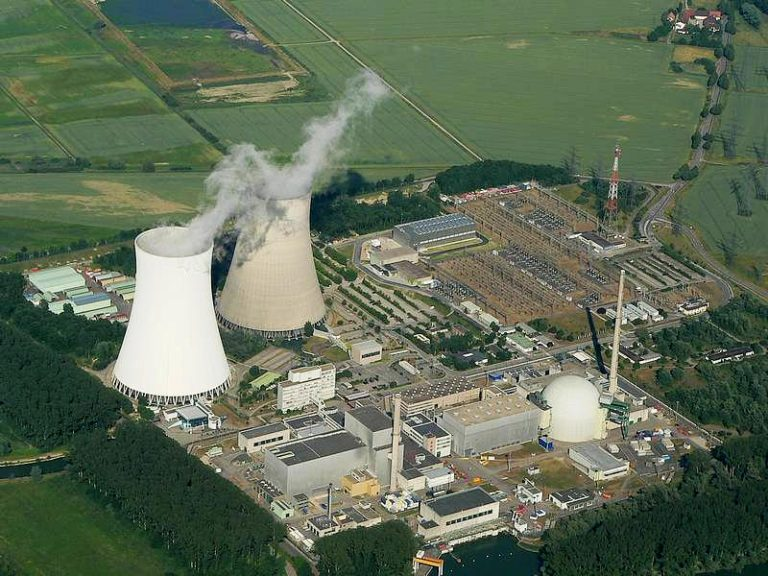
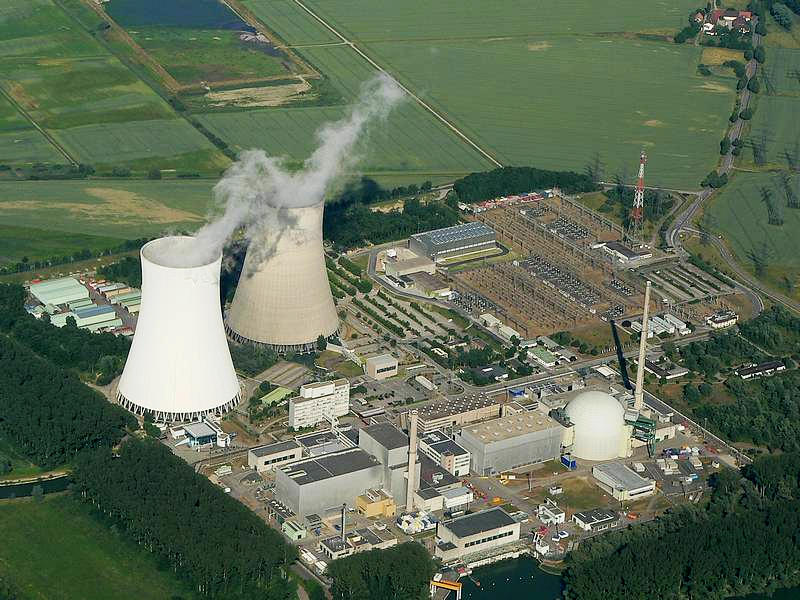
Phillippsburg Nuclear Power Plant by Lothar Neumann, Gernsbach

By Jo Nova

If the Germans just did nothing at all, it would have been Greener

Germany already had nuclear power in 2002, if they just kept it and didn’t build all the wind and solar plants, they wouldn’t have had to spend 697 Billion Euro on subsidies, and would have cut their emissions by 73% more.

If ever there is a statistic that says there is something rotten in the State of Climate Panic, this is surely it. I mean, does CO2 matter or doesn’t it? Do the Greens care at all, or even a bit? If there was a climate emergency and The Greens were worried about CO2, they might have protested that the EnergieWende was a reckless experiment. Instead the  But if the Greens were tools for communists, foreign states or banker-investors, then they might keep choosing options that benefit other countries, help Bankers or just make Big Government bigger.

Either the German Greens have utterly failed at the very task they set out to do, or they were really aiming at something else.

Ross Pomery writes at RealClearScience and  WattsUpWithThat

Study Quantifies Germany’s Disastrous Switch Away From Nuclear Power

At the dawn of the millennium, Germany launched an ambitious plan to transition to renewable energy. “Die Energiewende” initiated a massive expansion of solar and wind power, resulting in a commendable 25 percent reduction in carbon emissions by 2022…

In 2002, nuclear power supplied about a fifth of Germany’s electricity. Twenty-one years later, it supplied none. A layperson might think that cheap wind and solar could simply fill the gap, but it isn’t so simple.

Jan Emblemsvåg, a Professor of Civil Engineering at Norway’s NTNU just published a study comparing the ambitious German Energiewende renewable program with nuclear power:

“what if Germany had spent their money on nuclear power and not followed their policy from 2002 through 2022 (20 years); would Germany have achieved more emission reductions and lower expenses?”

Even German bureaucrats admit Energiewende “poses a threat to the German economy”:

German Federal Accounting Office (Bundesrechnungshof) writes about the German policy dubbed ‘Die Energiewende’ in German, and it concludes: ‘The Bundesrechnungshof warns that the energy transition in its current form poses a threat to the German economy and overburdens the financial capacity of electricity-consuming companies and households’ (Bundesrechnungshof Citation2021a).

A whole lot of wind (green) and solar (orange) power were added to the German grid and it was worse than useless:

Energiewende, Germany

Given these results, there can be no doubt whatsoever that if Germany had invested in NPPs [Nuclear Power Plants] instead of VREs [Variable Renewable Energy], Germany would have decarbonised more with far less nominal expenditures. The short conclusion is that Germany would have reached its climate goals with a substantial margin at half the expenditures of Energiewende.

The Germans have done this experiment so we don’t have to

Just burn that money in a pyre to the Weather Gods:

https://www.tandfonline.com/doi/full/10.1080/14786451.2024.2355642#d1e128

These costs do not included the added burden of expensive electricity on businesses and homes, the opportunity costs of money that could have been spent elsewhere, or the loss of talent, brains and industry to other countries.

Building new nuclear plants was still cheaper than wind and solar

The paper goes through another scenario where more nuclear plants were built with careful estimations of the costs and long times to construct plants and still concludes that the Germans would have saved $330 billion euro.

https://www.tandfonline.com/doi/full/10.1080/14786451.2024.2355642#d1e128

Not coincidentally, in 2024 Germany has some of the most expensive electricity in Europe, business confidence is low, and  VW have just announced that after 87 years in production, they might have to close their German factories.

Volkswagen, which was founded in 1937, said on Monday that it could no longer rule out unprecedented plant closures in Germany as it seeks ways to save several billion euros.

Chief executive Oliver Blume said: “The economic environment has become even tougher and new players are pushing into Europe. Germany as a business location is falling further behind in terms of competitiveness.”

Volkswagen employs around 650,000 workers globally, almost 300,000 of whom are in Germany, and the threat of factory closures sparked an immediate fierce backlash …

REFERENCE

Emblemsvåg, J. (2024). What if Germany had invested in nuclear power? A comparison between the German energy policy the last 20 years and an alternative policy of investing in nuclear power. International Journal of Sustainable Energy, 43(1). https://doi.org/10.1080/14786451.2024.2355642

Jo Nova: The Ridiculous Net Benefit of Net Zero

Jo nova writes:

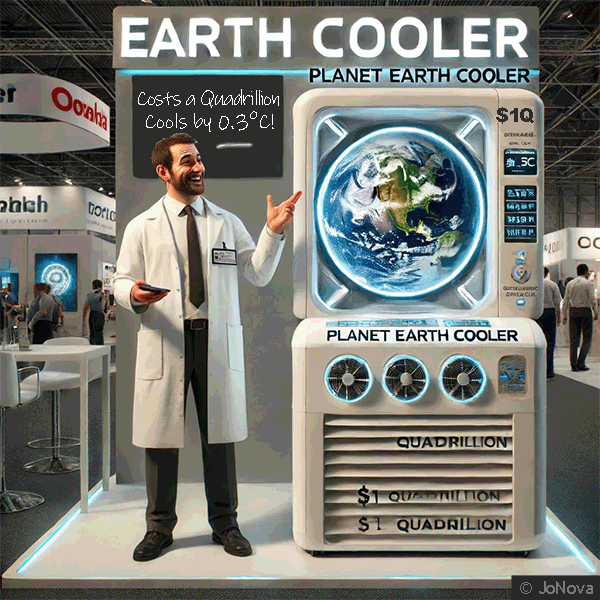
Bargain: Make the whole world “Net Zero”, spend a quadrillion dollars, and cool the world by 0.3 degrees!

Air conditioner for the Earth.


By Jo Nova

The deadliest climate question: How many degrees cooler will that be?

Ask it now, ask it later, before breakfast and while watching “the news”. Teach the children to ask in kindy.

We know the IPCC wildly exaggerates, but pretend they’re right and it still doesn’t make any sense. Richard Lindzen, Will Happer, and William van Wijngaarden took the IPCC at its word and calculate that even if we get to Net Zero by 2050, will only make the world a tiny bit cooler, assuming they’re right (which they’re not) and assuming the rest of the world joins in (which they aren’t).

Say we stop all coal, oil and gas, redesign our energy grids, cull the cows, give up our holidays, our cars and ride bikes to work, fill the oceans with windmills, and turn our thermostats down. We spend a quadrillion dollars on a Moonshot to stuff a perfectly good fertilizer in holes underground, and instead of getting to the moon, the world is barely 0.28 degrees C cooler. That’s a half of one lousy Fahrenheit less that it would have been. This ladies and gentlemen is the best case scenario for the global action plan against the 6th mass extinction.

This is why 100,000 people in private jets meet each year in Egypt, or Doha, or Azerbaijan. (Or so they say).

The whole United States of America could go Net Zero by 2050 and it would, at best, change global temperatures by three one-hundredths of a degree, which we can’t even measure. Rounded to the nearest tenth of a degree that’s a big 0.0°C. And if the Sun does a bit more, then it’s even less.

Net Zero Averted Temperature Increase

R. Lindzen, W. Happer, and W. A. van Wijngaarden

Abstract:

Using feedback-free estimates of the warming by increased atmospheric carbon dioxide (CO2) and observed rates of increase, we estimate that if the United States (U.S.) eliminated net CO2 emissions by the year 2050, this would avert a warming of 0.0084 ◦C (0.015 ◦F), which is below our ability to accurately measure. If the entire world forced net zero CO2 emissions by the year 2050, a warming of only 0.070 ◦C (0.13 ◦F) would be averted. If one assumes that the warming is a factor of 4 larger because of positive feedbacks, as asserted by the Intergovernmental Panel on Climate Change (IPCC), the warming averted by a net zero U.S. policy would still be very small, 0.034 ◦C (0.061 ◦F). For worldwide net zero emissions by 2050 and the 4-times larger IPCC climate sensitivity, the averted warming would be 0.28 ◦C (0.50 ◦F).

Read the entire short paper here at the CO2Coalition: Net Zero Averted Temperature Increase

And Christopher Monckton points out the cost to benefit ratio for this $2 Quadrillion dollar project is every billion dollars we spend cools the world by 20 millionths of a degree.

So let’s keep all the national science institutions that pointed out what a terrible deal this is for all our nations, and shut down the rest —  NOAA, NASA, Hadley, CSIRO, NIWA, BoM, Potsdam, NRC, ARC, and while we’re at it — the ABC, BBC, the CBC because they should have asked better questions, like “how many degrees will that cool us?”

Jo Nova: The EV Whirlpool Gets Stronger

Jo Nova writes:

EV Hell continues: Crash victims might have to be “left to die”, Hertz dumps another 10,000 cars, Tesla sacks whole charging team

EV doom. The collapse of an industry. AI assisted.

By Jo Nova

Chronicling the collapse of the Big-Government-made EV bubble

In today’s EV obituary column, Elon Musk has dropped a bombshell. Two months after Telsa chargers became the industry standard (which promised to save the other car makers) his profits fell, and he’s fired the entire EV charging team overnight. Hertz, meanwhile, has realized that dumping 20,000 electric cars in January was not enough, and it has to offload another 10,000 electric cars, which now amounts to half its EV fleet. And then comes the news that there might be a secondhand “timebomb” coming at the eight year mark when most EV battery warrantees run out and cars will become “impossible to sell”.

As if that’s not enough, this week the fire and rescue experts in NSW are warning in the politest possible way, that they might have to do a “tactical disengagement” of a car accident victim, which means leaving them to die in an EV fire if the battery looks likely to explode. They say that first responders need more training, as if this can be solved with a certificate, but the dark truth is that they’re talking about training the firemen and the truck drivers to recognize when they have to abandon the rescue.

EV crash victims could be left to die in battery fires without training for responders, inquiry told

Jennifer Dudley-Nicholson, The Driven

The NSW government’s Electric and Hybrid Vehicle Batteries Inquiry heard testimony from fire and rescue services, paramedics, the Motor Traders’ Association, and TAFE on Tuesday in its second public hearing.

In the most serious incidents, firefighters said crews could be forced to abandon rescues or crudely rescue passengers from vehicles, and were being left “flying blind” at battery fires.

VRA Rescue NSW Commissioner Brenton Charlton told the inquiry worse outcomes were also possible, including battery explosions in which a rescue operation would put emergency workers at risk.

“We need to prepare ourselves and our volunteers… for the point in time we have to do a tactical disengagement, meaning if someone’s trapped and it does high order (explode) you might not be able to do anything,” he said.

“That will be a tragic, horrible thing to take part in.”

Just like that, Elon Musk fired the whole Tesla EV charging team, throwing the industry into chaos because Tesla network is the best by far and the bedrock of the so called “transition”. Tesla had agreed to open its charging network to other EV makers only recently, and Joe Biden was delighted. Tesla is getting subsidies to expand it’s North American Charging Standard (NACS) system. But this move

Tesla layoffs shake confidence in the EV-charging future

By David Ferris, E&E News

In a single stroke, CEO Elon Musk called his company’s vaunted charging reliability into question when he laid off most or all of Tesla’s Supercharger team, the people who made Tesla the envy of the EV industry. The network they built is bigger, faster, smarter and more reliable than any other company’s — and has become the linchpin of the auto industry’s plan to persuade millions of Americans to buy EVs and turn the tide on climate change.

“It feels like the rug just got pulled out from under a lot of the industry alignment that has been built in the last 12 months,” said Matt Teske, an industry veteran and CEO of Chargeway, an EV-charging software platform. “And leaves us on shaky ground.”

In 2022, as traditional automakers finally started delivering a substantial number of EVs to the roadways, they ran into a problem. Their drivers couldn’t use Tesla’s chargers, because they were meant only for Teslas. And the public networks had an array of reliability problems.

Ford was the first automaker to hit on the solution. Last spring, it struck a deal with Tesla to use its 12,000 U.S. charging stations and committed to building Tesla’s charging technology called the North American Charging Standard, or NACS, into its future vehicles.

Other automakers followed suit in short order. By February, Tesla’s NACS had become the industry standard, with virtually every automaker planning to redesign their charging systems to meet Tesla’s specifications.

The Hertz debacle truly might become an obituary

Hertz logo

Originally Hertz was going to buy 100,000 wonder-cars which would be cheap to fix and popular with punters. But the future fleet only reached 60,000 cars and is now reversing back to 30,000 cars which tourists apparently don’t want to rent much, and which cost twice as much to repair.

Not surprisingly, it’s a financial ruin. Hertz shares have lost three quarters of their value since 2022.

The company was an $11 billion dollar company in 2021 when it announced the mass EV purchases — it is now a $1.4 billion dollar company.

Hertz drops more EVs

RENTAL car giant Hertz, has announced that it is selling off 10,000 more EVs than it planned in January when it set out to stem the tide of massive depreciation that hit its fleet of 60,000 EVs.

Rental car companies need to be able to sell off their ex-rentals for a reasonable sum, but just as Hertz realized it couldn’t afford to repair these cars, it also realized it couldn’t sell them either:

…the program came under stress when Tesla began discounting its cars last year.

This set off a tsunami of depreciation for existing Tesla owners; including Hertz, which had the biggest exposure of anyone. In turn, other EV makers followed suit with discounts and retained values for all EVs became a race to the bottom.

And as word spreads, possibly no one else will be able to sell them either. What is an 8 year old EV with no battery warrantee worth? It’s pot luck whether it will keep going or suddenly need a £15,000 repair…

The used electric car timebomb –  EVs could become impossible to sell on because battery guarantees won’t last – find out if you are affected

By TOBY WALNE, This is Money

Money Mail can today reveal a timebomb looming in the second-hand market for electric vehicles (EVs).

Our investigation found that many EVs could become almost impossible to resell because of their limited battery life.

Experts said that the average EV battery guarantee lasts just eight years. After this time, the battery may lose power more quickly and so reduce mileage between charges.

In some cases, the cost of a replacement battery is as much as £40,000. For certain EVs, the cost of replacing the battery could be ten times the value of the vehicle itself on the second-hand market.

Yet geniuses in government still want to push us all into EV’s.

With uncanny timing the Australian Albanese government is about to launch emissions standards we don’t need to force people to buy a product they don’t want, in the hope, so they say, of stopping some storms.

The insanity would be hard to fathom if EV’s weren’t also the ideal tool for spying, data collection, law enforcement, and political control. Benefits that can launch a thousand political careers…

Health of Fish Stocks Contradict Climate Alarmists Predictions

From wattsupwiththat.com

Health of Fish Stocks Contradict Climate Alarmists Predictions

By Vijay Jayaraj

The oceans are still very much a mystery to humankind, with a vast majority of it yet to be explored. Early in my career, I wanted to make an in-depth study of how climate affected marine life. After all, many media reports claimed that “oceans will become empty by 2048.”

So, as a graduate research assistant, I explored the adaptability of marine fish and invertebrates to fluctuations in ocean temperatures. I found that both are highly adaptable to changes in the water around them. That is the way they are made.

Now, evidence emerging from scientific studies shows that marine life may be benefiting from the relative warmth of modern temperatures.

Contrary to the hyperbole of climate reporters, there has been no alarming increase in global sea-surface temperatures. Even if temperatures increase substantially, fish are free to migrate to cooler waters and do, as documented by scientific studies.

Fish also have natural adaptive mechanisms. Since their initial emergence in Earth’s waters, fish have developed genetically in ways that allow them not only to survive but to thrive in a variety of environments. In addition to the generational genetic adaptability, fish also display short-term phenotypic plasticity which allows them to adapt to temperatures and other physical factors. When combined, these mechanisms act as significant protection against the ill-effects of the physical environment.

Despite this, it is not uncommon to see news of fisheries crashing under the weight of a climate crisis. However, real-world data contradict such negative reports, indicating instead that global fish catches will improve in the coming decades.

2016 scientific study “assembled the largest-of-its-kind database and coupled it to state-of-the-art bioeconomic models for more than 4,500 fisheries around the world.” The study found that global fisheries will profit from an increase in marine species. The degree of this commercial success will depend on a range of policy measures, including ones that enable increased catches for individuals and communities.

In 2020, there was a record 214 million tonnes of production from both wild catches and aquaculture. The State of World Fisheries and Aquaculture 2022 report says that this production is expected to grow 14 percent by 2030. Fish are expected to become more affordable and accessible, with prices decreasing between 2024-2029, according to two international bodies: the Organization for Economic Co-operation and Development (OECD) and United Nation’s Food and Agriculture Organization (FAO) that published the data in Agricultural Outlook.

As of 2017, around 65% of fish stocks were biologically sustainable. An index of population health is maximum sustainable yield (MSY), which is the point at which the stock can sustain itself without limits on fishing. The MSY calculation involves collaborative information gathering by marine biologists and fishers.

The 2022 report states that the number of catches from biologically sustainable stocks has been on the rise! This signals that catches can be increased without depleting the stock to levels that neither the species nor continued fishing is at risk. While some concerns remain for a few species, studies show that in regions where we have high-quality population data, the majority of fish stocks are either stable or improving.

In short, any threat to future catches is not “empty” seas but rather the effect of activities such as illegal fishing and overfishing. Fish as an important protein source is likely to remain available in large quantities. Reality contradicts the fallacious climate crisis that dominates popular media and politics.

This commentary was first published in American Thinker on February 10, 2024.

Vijay Jayaraj is a Research Associate at the CO2 Coalition, Arlington, Virginia.  He holds a master’s degree in environmental sciences from the University of East Anglia, U.K.

Jo Nova: Hertz To Sell One Third of EVs Because Customers Don’t Want Them.

What does this say really about the future of Electrical Vehicles?

From jonova.com

rollercoaster

By Jo Nova

With the western world hurtling into new cars that are more costly, inconvenient, slower to refuel, and prone to burning down carparks and cargo ships, it was only a matter of time before the cracks in the socialist car market started to show.

EV, electric car.

Around the world tonight headlines are sharing the news that Hertz is selling off 20,000 EVs, one third of their fleet, in order to buy some more fossil fuel cars. That can’t be inspiring news for customers thinking of giving up their gas guzzlers. As Oilprice said: Hertz’s Big Move Into EVs Turned Out To Be A Dud.  And as Reuters headlined: Rental giant Hertz dumps EVs, including Teslas, for gas cars.

It was the perfect storm in a bad way. Apparently the customers didn’t want to rent them, and when they did and they scratched them, they cost too much to fix. (Repair costs were twice as high).  Then the bottom fell out of the second-hand market, and to recover the depreciation losses, Hertz would have to raise the prices on a product customers already didn’t want. There was no way this was going to work.

The official dry Hertz announcement politely says that customers want fossil fueled cars and EV’s were too expensive to fix:

“..expenses related to collision and damage, primarily associated with EVs, remained high in the quarter”

“The Company expects to reinvest a portion of the proceeds from the sale of EVs into the purchase of internal combustion engine (“ICE”) vehicles to meet customer demand.”

Back in October 2021 it was all champagne and fireworks

Hertz put in an order for 100,000 EVs which was so exciting it pushed Tesla shares up 9% briefly to “a trillion dollar valuation”. (Two years later Tesla is worth 30% less.) At the time, Hertz expected to get the 100,000 cars by the end of 2022. Luckily for them, this didn’t happen. Instead they only got 50,000 by the end of 2022. This worked out to be about 11% of the Tesla total fleet. So these EV’s are not even very old. No one can say “the new models are better, because these are new models.

Some of the cars are already on the market. Two year old Telsa Model 3 EV’s are going for $22,000 US.

Hertz will book a $250 million dollar loss, and stocks in both Hertz and Tesla fell on the news.

With uncanny timing the Australian Albanese government is about to launch emissions standards we don’t need to coerce people to buy a product they don’t want, in the hope, they say, of changing the weather.

The insanity would be hard to fathom if EV’s weren’t also the ideal tool for spying, data collection, law enforcement, and political control. Benefits that can launch a thousand political careers…

Predicted Droughts Give Way To Floods, But It’s Not the BOM,s Fault!

From Jo Nova

The BOM predicted a hot dry summer right before the flooding rains came…

Hot Dry El Nino News.

By Jo Nova

Australians are angry the BOM didn’t see the flooding rains coming

Worse, we’re betting the nation on the BOM’s ability to predict the climate.

The Bureau of Meteorology (BOM) tells Australians that record breaking extremes are getting worse because of our cars and our air-conditioners (that’s “The State of the Climate“). But when the BOM can’t predict record breaking rain a month in advance, or even the day before, we know the BOM doesn’t understand what drives the climate.

Somehow the BOM expect Australians to spend trillions and rearrange their economy based on their fifty year prophesies, but not to mind when “this summer” goes right off the rails.

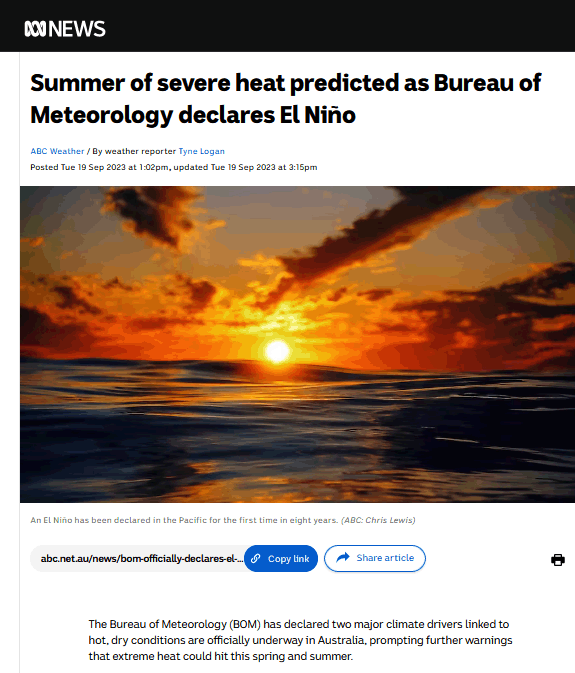
Back in September the BOM issued its El Nino alert, and Australians were told it would be a hot and dry and to prepare for a summer of bushfires. Farmer sold their lambs, and adjusted harvest accordingly.

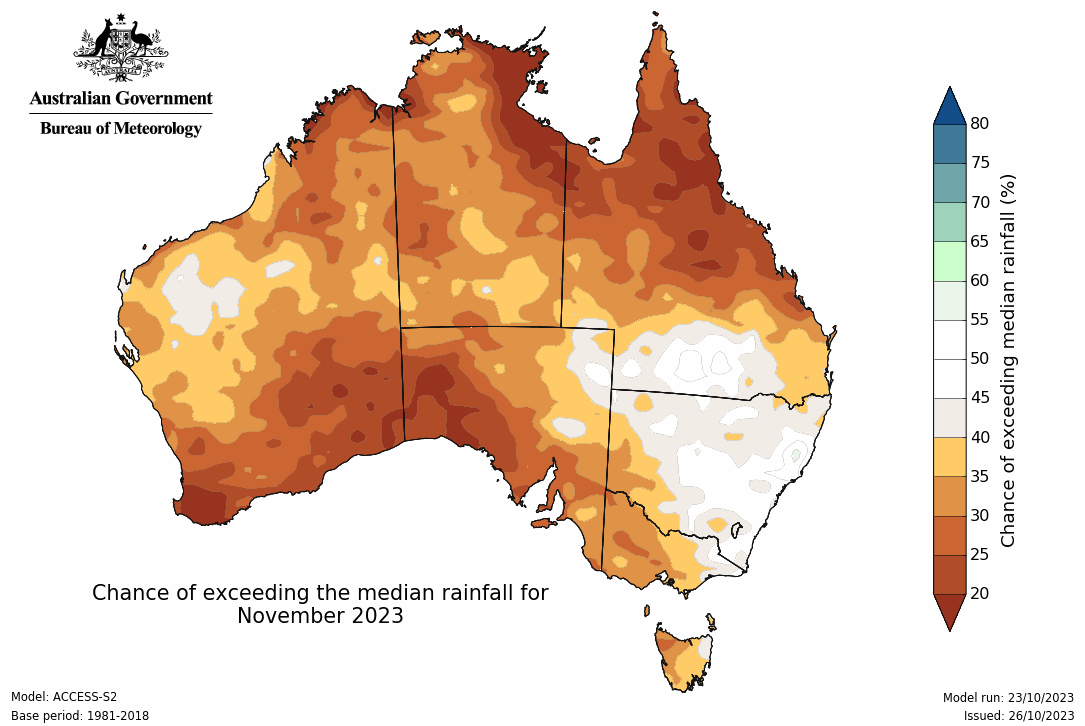
This was the BOM solemn prediction in late October, for the very next month of rainfall

Across most of Australia the odds were only 20-40% of getting average rain.


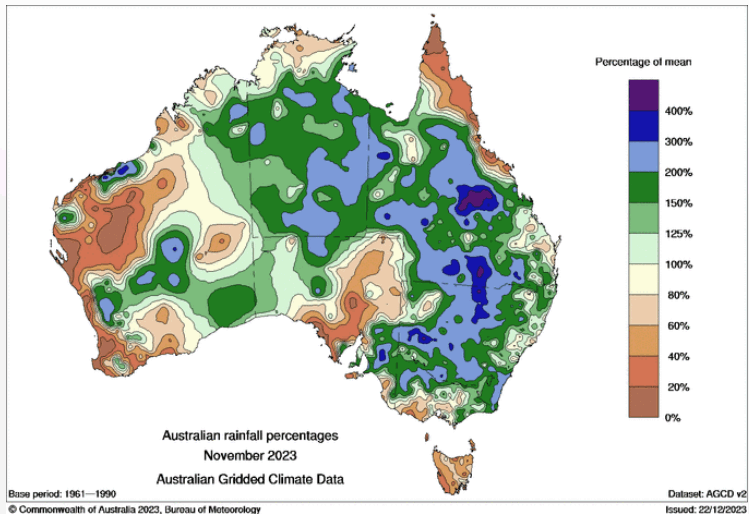
Instead this is what happened:

Bureau of MeteorologyAustralian rainfall percentages

BOM

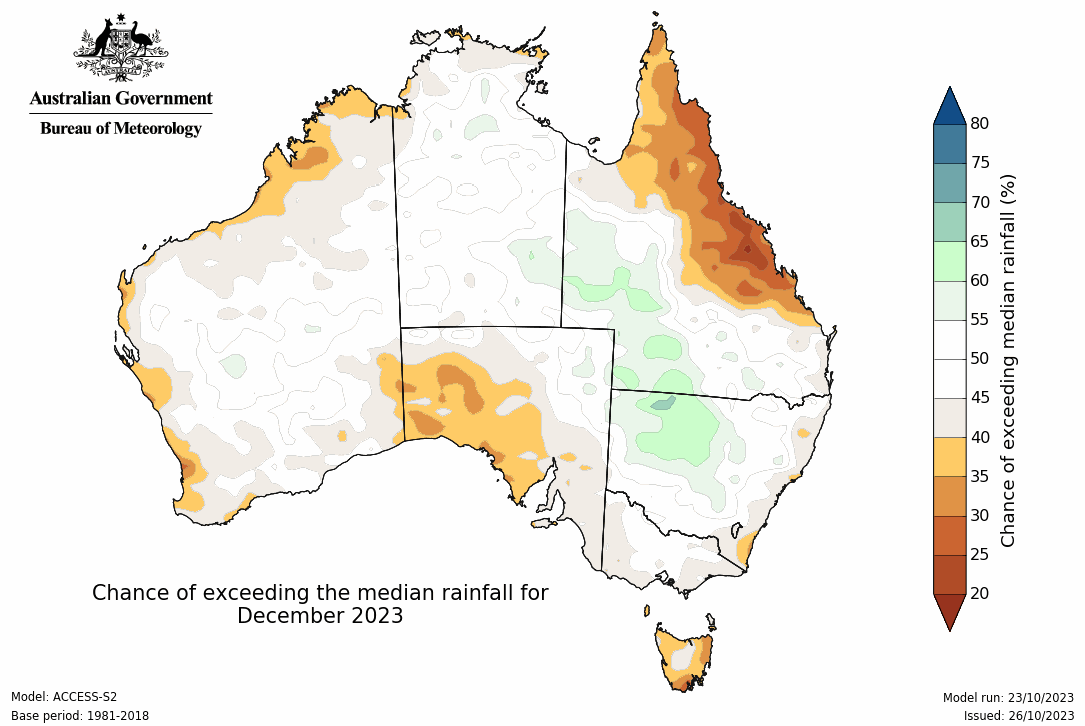
And in December most of the country was predicted to have a fifty fifty chance of getting “average” rain.


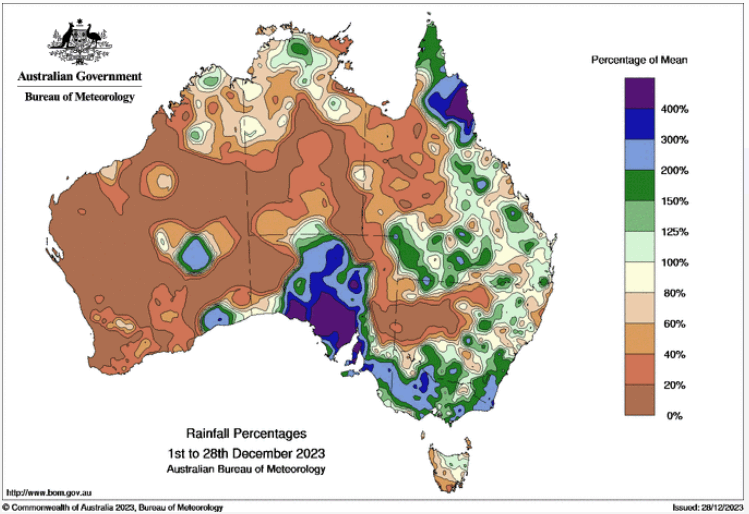
But the real weather gods had another idea, and all the places under any shades of green below got somewhere from 100% to 300% of the average rainfall. The indigo and purple zones got even more.

Bureau of Meteorology Australian rainfall percentages

BOM

This was a savage downpour — seven feet of rain in five days fell at one location:

No fewer than 12 locations across far north Queensland posted record rainfall totals.

Some areas received a year’s rainfall in a single day, isolating towns, closing highways and leaving hundreds stranded by surging floodwaters. Black Mountain near Cooktown recorded a cumulative 2189mm over the five days, while Mossman South, an hour northwest of Cairns, had 1935mm.

–The Australian

As the Mayor of Douglas Shire said:

“If this is so record-breaking, how did no one know this was going to happen … we need to have forecasts closer to what is going on.”

–The Australian

The BOM suddenly wants to absolve itself of liability

People have noticed there is now a mandatory check box forcing users to agree to a legal disclaimer clearing the BOM of all liability:

Users of the BOM app now have to agree to a 699-word “terms and conditions” statement that includes “information at this app … may not be accurate, current or complete”.

“To the maximum extent permitted by law, the bureau excludes any liability that may arise in connection with the BOM Weather app or any information or material presented therein or your access to or use of any of the same,’’ the bureau says in a “terms and conditions” statement that appears when a user attempts to download its app. — Mackenzie Scott, The Australian

They know they are in trouble.

I say the BOM can have immunity the same day Australians can also tick a box excluding ourselves from any and all costs, imposts and taxes related to any BOM predictions.

The Australian editors gives the BOM an escape valve it doesn’t deserve:

To be fair to the BOM, a hysterical and ill-informed media has allowed climate alarmism to infect reporting of what should be routine weather events.

For thirty years the Australian media has made hyperbolic scare stories about the weather while the BOM tacitly stood by and smiled. Where were they as the tenets of science were trashed, and critics were called “climate deniers”? If the BOM are victims of this hyperbole now, they reap what they sowed.

The BOM raised the stakes, and they don’t get to weasel out by saying “we used the best science” as if the best science wasn’t riddled with holes. If the science is good enough to throw away trillions of dollars, then the worst failures need a truckload of explanation.

Predicting the weather is hard. We could forgive the BOM for getting a complex immature science wrong, but not when they also tell us it’s just simple physics, they’re absolutely sure, and there is no doubt they’re wrong (give us your money!).

The European Rebellion Against Net Zero

Jo Nova writes on The Aussie Wire:

The European rebellion against the Sacred Quest for NetZero spreads — Green investors “shocked”

The European rebellion against the Sacred Quest for NetZero spreads — Green investors “shocked”
Spread the love
Fantasy NetZero

Turtle Castle image by SAIF 4

The following post on the topic of NetZero is syndicated from jonova.com.au

Rishi Sunak’s delay in the NetZero Quest was the crack in the Uniparty Wall

Thanks to NetZeroWatch

It threatens to ignite a climate election.  It matters, because now, suddenly, one party can point out the absurdities and the costs. They can be an Opposition, and mock the sacred cows. That doesn’t mean Sunak will do that, but the fork in the road has opened, the world is watching — and his party is suddenly up four points.

The Green funds cartel is “in shock” sayth Bloomberg, at the Sunak shift — so it must be pretty serious.  Green investors are using the words “dismay” and “bewilderment”, which they almost never use. Green investment relies almost entirely on crowd psychology and government subsidies, so normally bad news is padded and fluffed so it doesn’t look so bad. We wouldn’t want to lose momentum would we? Boy are they losing momentum.

Meanwhile Sweden has not only cut climate money a bit, it’s unshackled some taxes off fossil fuels as well, leaving the centre left apoplectic and threatening to move motions of no-confidence. It is unthinkable, apparently, but Sweden might even increase emissions.

Germany has suspended draconian building efficiency standards and stepped back from their full gas boiler ban. They had wanted to ban all new “fossil” heaters from 2024, but after fierce protests, have instead brought in a much diluted and delayed version due to be adopted in 2028.  President Emmanuel Macron must have been watching the German and British debacles. His new plan rules out a complete ban on gas boilers, and talks about protecting vulnerable people in rural areas, and even how the French love their cars.

What’s more scary than climate change? —  The rise of the far-right

The quote of the day is from a German politician who sums up the major driver of these policy shifts.

Earlier this month, German Finance Minister Christian Lindner told Politico that stricter energy efficiency rules for buildings could fuel the rise of the far-right, amid growing apathy across Europe over plans to reach net zero.

 CleanEnergyWire

So Climate Change might cause the sixth mass extinction of life on Earth, but nothing is more frightening than the possibility of the far-left losing power at elections.*

Polls have leapt for the conservative government in the UK since Rishi Sunak slowed the NetZero train

This is what all the Climate-believer politicians are afraid of. Deep down, they know the NetZero quest is not popular with the masses, even though they say it is all the time. If they thought climate policies were really winners with the workers, they wouldn’t be so afraid of their opponents catching the skeptical train would they? Instead, they are aghast when their opponents dare suggest other priorities might be higher than changing the weather.

Read the full article here

Renewable Paradise: Australia Set For Blackouts This Summer

From Jo Nova


Blackouts are coming: Australian grid so fragile, expensive, cement giant already shuts down nearly every day

Fantasy, dystopia, plane in the sky.

Image by Vicente Godoy from Pixabay

By Jo Nova

We can’t even run a cement factory all day anymore

Get your candles for summer! Unlike the last three years the Australian national grid won’t be rescued by another cooler La Nina this summer. Fears of rolling blackouts this summer are fraying nerves at The Australian Financial Review Energy & Climate Summit. The transition is described as stuttering, gridlocked, faltering, and the government as “desperate”.

Things are so bad, former CEO’s of major generators are warning that “the lights are going to go out” and accusing one Energy Minister of speaking “complete and utter horseshit” because they don’t think we need reliable peaking gas plants to replace coal power. Said Energy Minister has responded by refusing to even take his calls. That’s really going to work. Meanwhile Japan is getting nervous just watching us, afraid we have screwed things up so badly we can’t be relied on to keep sending them gas.

Not only is summer nerve-wracking, but things are already so bad, one of our largest cement producers is shutting down nearly every day because it can’t afford to pay for the peak electricity spikes even in springtime. Here in Renewable World it’s cheaper to let 5,500 workers sit around for 30 minutes than pay for electricity. The company was paying 54% more for electricity than the year before.

Riding the Express Train to the Renewable Faraway Tree

The numbers are staggering. Australia is racing headlong to the glorious 82 per cent renewables target by 2030. The catch is that the national grid at the moment uses coal for 62% of its electricity. The opposition energy spokesman is calling it “lunacy”, which it is.  To reach the land of sunshine and breezes, our grid manager, the AEMO, is theoretically going to close two-thirds of the country’s existing coal power generation in the next ten years.

To put this in perspective, since the last hot summer we’ve shut down Liddell Coal plant, and still haven’t fixed the coal turbine that blew up in Queensland two years ago. New renewable investment has ground to a halt when it clearly should be going gangbusters. No one wants to build new wind and solar plants until someone builds the 10,000 kilometers of high voltage lines to reach distant cheap windy real estate, and no one wants to live or farm next to those transmission towers, so the protests are fierce.

Energy Summit confirms stuttering transition is not on track

Decarbonising Australia’s fossil-fuelled electricity grid is proving slower and more costly than previously advertised, with reliability risks increasing as the exits of coal-fired power plants run ahead of cleaner and reliable replacement generation.

Nerves are frayed “We’re not having an honest conversation”:

‘Get your candles’: energy experts are ‘terrified’ about this summer

Angela MacDonald-Smith, Australian Financial Review

Former Snowy Hydro CEO Paul Broad said, “the lights are going to go out” in a return to normal conditions after three mild summers and said politicians were not listening to the warnings about the risks around supply, while the industry was not speaking up enough.

“That’s our problem,” he said. “We’re not having the honest conversations and us in the industry we’re not speaking up.”

Mr Broad, who abruptly exited Snowy Hydro last year after a run-in with Mr Bowen, accused Victorian Energy Minister Lily D’Ambrosio of speaking “complete and utter horseshit” in her refusal to recognise the need for peaking gas power plants in Victoria as coal power exits the system.

He listed Ms D’Ambrosio among energy sector figures who would no longer take his calls as he tried to get the message through, including former Australian Energy Market Operator Audrey Zibelman.

We can’t even run a cement factory all day anymore:

The startling reason Boral is stopping production almost every day

Chanticleer, The Australian Financial Review

Mr Bansal [the chief executive of Boral] told the Summit that Boral’s electricity price rose by 54 per cent in the 12 months to the second half of last year, and have not retreated, counter to expectations.

He said Boral had about 5500 “blue collar” workers who were being told to stand aside and do nothing for 30 minutes at a time when power prices made it too expensive to operate.

“At a certain price during the day, when the price goes up [to] a certain level, our manufacturing stops because we’ve worked out economically it’s actually better to have thousands of people waiting idle for the prices to come down then actually do the work,” he said.

“That’s a real issue we are facing every single day on 300 manufacturing sites across the country. So we are extremely nervous what that means.”

The chief at Boral pointed out that he’s not willing to sign up to 20 year electricity contracts because everything is so uncertain.

They still don’t understand the difference between reliable and unreliable power

It’s OK, the believers protest, Australia has added 20 gigawatts of solar.

“Australia has three-and-a-half-million solar systems installed and that represents around 20 gigawatts of potential output,” Westerman says.

“That’s more than seven Eraring power stations at full output and capable of meeting almost half the energy demand in the day when the sun is shining at its brightest.”

As if solar panels can be measured on the same page as a coal plant. For half an hour a day, on a good day, only in summer, and as long as the clouds don’t roll over, the peak output might be like seven coal plants. These people are crazy.