If you need to get into Queensland, here is a handy flow chart.

If you need to get into Queensland, here is a handy flow chart.
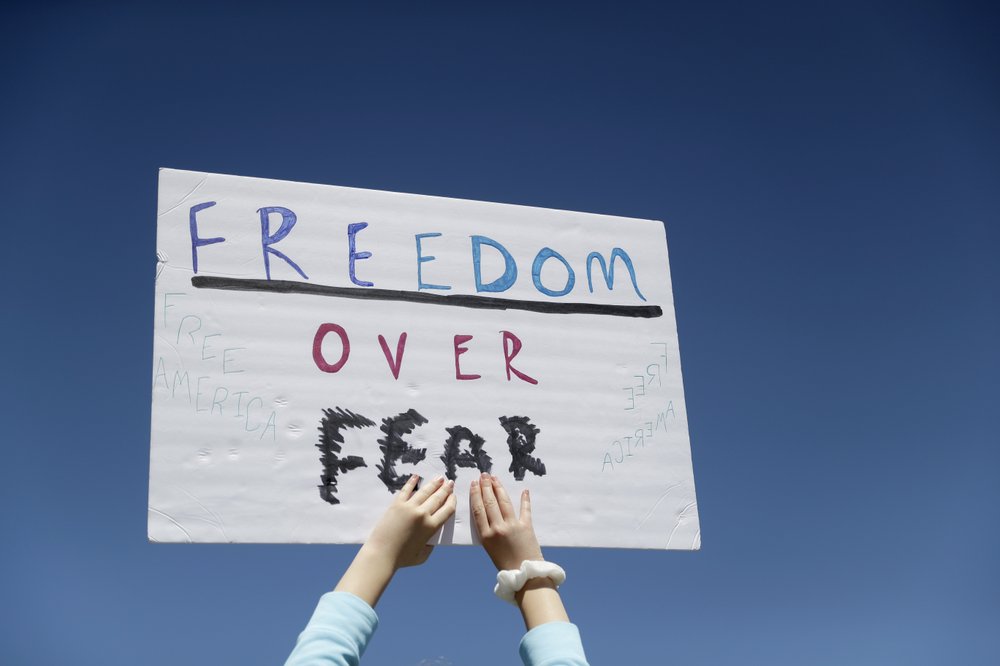
I warned at the beginning of the pandemic that we need to watch out for governments striking our rights in the name of “keeping us safe.”
So in Victoria they have curfew and house arrest, a compliant Parliament thinks that the Premier should do it for another 6 months, and police arrested a pregnant woman for posting details of an anti-lockdown protest on Facebook.
Apparently marches in support of Marxist groups such as Black Lives Matter are fine, but question the government’s handling of the pandemic and they will send in the storm troopers to arrest and intimidate you.
Meanwhile in northern NSW a woman carrying twins lost one of them because “Queensland hospitals are for Queenslanders; they have NSW hospitals for NSW people.” True, but if you live in Lismore, Brisbane is much closer than Sydney.
If you live in Mungundi which literally straddles the border,too bad if you want to buy groceries. After their only supermarket burnt down, resident could travel to Moree, their nearest town, but it’s out of the bubble and so anyone doing that would have to self-isolate for 14 days if they want to enter Queensland, which is where their town’s medical services are. That’s in a region that has not had a single case of coronavirus.
Building supplies companies and tradies in SE Qld are losing work because much of their business relies on projects in northern NSW outside the bubble.
The Queensland tourism industry is facing devastation because people from interstate are unable to travel there.
But at least they got the AFL Grand Final… because football is more important than lives. It’s called bread and circuses, a political tactic that goes back at least to the Roman Empire. Entertain the plebs so they won’t complain as you slaughter them.
What a happy coincidence for Anastasia. Her state election is a week after the Queendalnd AFL Grand Final for Queenslanders.
This is Australia in 2020, and maybe some of these things are necessary to contain a virus that is less deadly than the flu to all except the over 70’s and people with other severe and chronic illnesses. In the USA, this week the CDC downgraded the number of official deaths due to Covid from over 100,000 to about 5,000- because all of the others had other issues that contributed to their death.
I am not a conspiracy theorist- most people and organisations are too inept to run a proper conspiracy. Australia needs to wake up to the power grabs and the petty restrictions on our way of life.
UPDATE:
Shortly after posting this, I received an email from Service NSW offering a special service to businesses. They can give you a QR code for people to scan when entering a business. This sends their contact information straight to the NSW Government so that if they need to use the information, they can get it straight away. I would suggest that people refuse to use this “service.”

From caldronpool.com

Numbers of people from the United States, Australia, and the United Kingdom have been reassessing their lives, turning to God, and praying more during the coronavirus pandemic, recent surveys have revealed.
Numbers of people from the United States, Australia, and the United Kingdom have been reassessing their lives, turning to God, and praying more during the coronavirus pandemic, recent surveys have revealed.
In Australia, researchers have found individuals have been praying more during the COVID-19 crisis, suggesting the pandemic has led many to reassess their priorities in life, the Sydney Morning Herald reports.
Of 1002 people surveyed in July, more than 35% said they were praying more, 41% said they were thinking about God more than they had before, and up to 25% said they were reading the Bible more than they used to.
Almost half of the participants said they thought more about mortality and the meaning of life.
Social researcher Mark McCrindle told the SMH: “The research is showing that this COVID situation has rattled Australians and got them thinking about the big purpose of life. It’s got them re-prioritising their life.”
In March, a US-based national survey revealed that almost half of Americans believe the virus is a “wake-up call” from God.
The poll, which was commissioned by the Joshua Fund, an Israel-based evangelical organisation, found over 43% of Americans believe the global coronavirus pandemic and economic meltdown is a sign of coming judgement and/or a wake-up call for us to turn back to faith in God.
Of the respondents, 25% of self-identified non-Christians agreed.
Almost 22% of all non-Christians responding to the poll admitted that the crisis has caused them to start reading the Bible and listening to Bible teaching and sermons online, while more than 29% of the respondents also believe the crisis reveals that “we are living in what the Bible calls the last days.”
The Pew Research Center released similar findings after surveying 11,537 Americans between March 19 and 24. According to the report, “more than half of all U.S. adults (55%) say they have prayed for an end to the spread of coronavirus.”
“Large majorities of Americans who pray daily (86%) and of U.S. Christians (73%) have taken to prayer during the outbreak — but so have some who say they seldom or never pray and people who say they do not belong to any religion (15% and 24%, respectively),” Pew Research reported.
Meanwhile, in the UK, a survey revealed a ‘staggering‘ number of 18-24 year old’s have been turning to God during the pandemic.
The survey, conducted by Savanta ComRes, interviewed 2,244 UK adults aged 18-plus. The findings revealed 45% of 18 to 34-year-olds and 49% of 25 to 34-year-olds prayed more during the month of July. That figure rose to 55% in the month of August.
According to the Telegraph, Google data reveals the pandemic has prompted a surge of interest in God, with a 50% increase in searches for prayer.
In March 2020, the share of Google searches for prayer surged to the highest level ever recorded, surpassing all other major events that otherwise call for prayer, including Christmas and Easter.
Josh Williamson, pastor at Newquay Baptist Church said: “As the old saying goes, ‘there are no atheists in foxholes,’ and it also seems that is the case when a pandemic causes people to examine their own mortality.
“I’m not surprised that people are thinking about God as the reality of death looms large; deep down in all of us is the knowledge that God exists, but what happens is that people push down that knowledge by ignoring what is plainly known,” he said.
“A crisis has a way of bringing that knowledge back to the surface.”
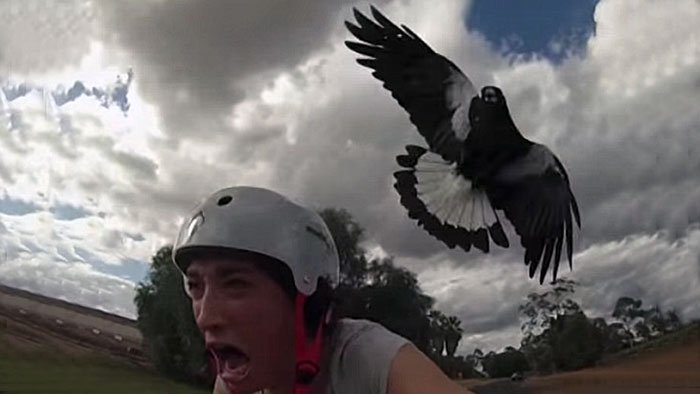
It’s magpie season in Australia. Every year, these normally friendly and intelligent birds become aggressive towards people who enter their territory. It is mainly the males who do this and it seems that they are protecting their newly hatched babies from invaders.
I usually count magpie season as going from August 1st to the end of September.
This year my first swoop happened on the 4th on the edge of town at the Civeo miners village. This is later than the previous few years where swooping started round about July 25th. That was probably due to warmer conditions in the drought.
Most magpies swoop and make a clacking noise with their beaks as they approach. It can be disconcerting but if you stay calm it is only a short while before they leave you alone.
There was a magpie we christened “Nut Job”. He lived at the other end of our bridge. He would swoop without warning and hit the helmet with some force on a bad day. He would also jump at the faces of little children. As this is across the highway from a school it was not very safe. He seems to have disappeared, whether due to natural causes or lead poisoning it is hard to say.
People try all kinds of things to ward them off. Holding a stick about your head works when walking. Cable ties on the helmet can work for cyclists. At the moment I keep the podcast turned up and look at the road ahead, pedalling as fast as I can.
So we have a couple of months of excitement ahead of us. At least you can see a magpie, not like a virus!
After 6 weeks of trialling Vibrant which is claimed to use a mix of bacteria to rid tanks of algae, I can only conclude it is a failure.
Today I scraped the algae off the sides of my tank ans resumed my previous routine of cleaning tank decorations and siphoning water and algae from the bottom of the tank.
What a disappointment.
It is a pleasre to be able to see my fish again, though.

Jo Nova writes that hard borders are popular in the West:
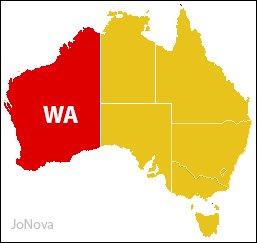 The electoral power of strong borders is vastly underestimated.
Western Australia has hard borders at the moment, and no coronavirus — other than a few cases getting caught in the mandatory quarantine. That’s 2.5 million people who are almost living a normal life. This is not to boast (we wish you could be here), but to point out how politically popular closed borders are in the current pandemic. The Premier is wildly popular, polling close to 90%. To all the people who said “states can’t close borders” the message is that it’s bonkers not to close borders. When the Commonwealth government joined the bizarre High Court push to force them open, the pushback was ferocious. A poll today showed that West Australians are fed up. The West Australian collected 245,000 signatories to a petition supporting the border closure.
Not only do 96% say the borders should stay shut, but when asked, a whopping 34% of Western Australians said the state should secede. How fast did it come to that?
Never, have I seen such vitriol towards the Commonwealth from WA. …the Commonwealth’s decision to effectively join hands with Palmer in the Federal and High courts risked making Morrison and the Federal Liberals public enemy No.1 here in WA. It beggars belief that the Morrison Government would ever let it get to this point, that the Federal Government would ever be part of any legal action to force WA to open its borders.
– Joe Spagnolo, Columnist, The West Australian (Paywalled)
Presumably that anger will be lower now that the Commonwealth has pulled out of one of the most stupid cases they were ever involved in.
The West Australian
Exclusive polling conducted by The West Australian showed 34 per cent of the 837 people surveyed this week support the move for WA to become a separate nation.
Close to three quarters of West Australians said that since the COVID-19 pandemic the Federal Government has put the needs of the eastern states ahead of West Australians. More than 35 per cent of those canvassed by Painted Dog Research strongly agreed with the statement that Canberra is too focused on the needs of the eastern states which has been to the detriment of WA.
Only last week Scott Morrison was saying he was sure WA would lose in the High Court and he had some mealy mouth words about doing it to protect us. But faced with a Liberal Party wipe out coming in WA elections, and the growing debacle of “open borders” on the East Coast, where infections are spreading, he finally backed down. The question is, what was he thinking in the first place?
Read the rest here
The tank looks largely unchanged from last week. Very sad.
I have again double dosed with “Vibrant” after doing the normal water change.
At this stage, barring any big improvement in the next week, it will be back to the old regime of rubbing algae off the glass with a scrubbing cloth and siphoning off the bottom.
We don’t throw zillions of dollars at multi-national car manufacturers any more, but it looks like we can still make quality goods in Australia.
From the ABC:
Posted 46mminutes ago, updated 32mminutes ago

They are a crucial frontline tool in the fight against coronavirus, and now one Sydney company has joined the fray, becoming the first to sell Australian-made medical swabs.
The development was the latest example of industry ingenuity as the Australian manufacturing sector adapts to the pandemic, as well as strengthening the case for more government support for research and development (R&D).
When Howard Wood co-founded 3D Printing Studios seven years ago, most of his business came from producing models for the construction sector.
Demand was steady, but hardly booming.
Recently, he said, something started to shift; more companies were coming to him for locally manufactured products.
“A few companies who do get stuff done in China are now using us to produce their parts,” he said.

As the pandemic exposed Australia’s reliance on overseas imports for essential medical supplies, Mr Wood saw a gap in the market for personal protective equipment.
He tried making face shields but found more success with swabs, after locating a design online from the Harvard Medical School.
Months of discussions with health departments and the Therapeutic Goods Administration are starting to bear fruit.
This month, the four-person company landed its first customer, with the Northern Territory Government placing an order for 10,000 swabs.
Mr Wood said it marks the first sale of Australian-made swabs in the country.
“We are thrilled, the prospect of producing this is very exciting,” he said.
Mr Wood is also in discussions with the Victorian and South Australian governments over orders of up to 1 million swabs, and has received a positive response from Sydney’s Westmead Hospital.
“They were very pleased with what we have produced,” he said.
The deals would more than double Mr Wood’s business.
He is already recruiting six more employees, with plans to move into a larger space and install a second printing machine.
“There are international opportunities in New Zealand and South East Asia, but we have enough to get on with in Australia for now.”
3D Printing Studios is the latest in a series of smaller companies to take advantage of the new landscape.
Gin distilleries have been producing hand sanitiser and other 3D printing companies have started making crucial components for ventilators.

It is the kind of growth those in the manufacturing sector have looked for after a long period of decline.
Australia imports more medical supplies than it exports by a ratio of 7:1 for diagnostic equipment, and 2:1 for instruments, according to the Australia Institute.
The combined trade deficit in those two sectors was around $2.6 billion in 2019.
The pitfalls of that reliance on imports were exposed earlier this year, prompting calls for a national rethink on the future of local manufacturing.
Emeritus Professor Roy Green, from the University of Technology Sydney, has seen many local companies fold trying to compete with imports.
He said the COVID-19 pandemic was an opportunity to turn the sector around, with the right governance.
“We have ended up with only 6 per cent of our GDP constituting of our manufacturing compared with 15 to 20 per cent elsewhere in the world.
“This is important not just to supply local needs, but it also contributes to the industries across our economy.”

Professor Green said investment in research and development is crucial to making a change.
“The decline in our R&D [research and development] spending as a country has dropped in the last few years to 1.79 per cent of GDP, whereas the OECD average is 2.4 per cent,” he said.
Next week, a Senate Committee is expected to report its findings on whether to cut tax incentives for R&D by $1.8 billion.
Professor Green said the incentive program was not perfect, but cutting funds sent the wrong message at a time when more investment was needed.
Federal Minister for Industry, Karen Andrews, said the Government has committed around $9.6 billion for R&D in the last financial year.
“Growing manufacturing in Australia is critical to our economic prosperity and to creating well-paying jobs,” she said.
Professor Green said many will be looking to the federal budget in October for signs the Morrison Government is “serious” about transforming the sector post-COVID.
But Mr Wood is already pushing ahead with plans to begin manufacturing a wider variety of medical equipment.

Researcher at Sydney University Plant Breeding Institute Dr Angela Pattison was surprised to learn last week that she had been nominated in the ‘Connecting Communities’ category of the 2020 NSW/ACT Regional Achievement and Community Awards.
Winners will be decided on September 23 and a gala presentation dinner held on November 20.
The Awards started in 2002, with the purpose of encouraging, acknowledging, and rewarding the valuable contributions individuals, communities and businesses are making throughout regional NSW and the ACT.
Dr Pattison has embarked on a project to study pre-colonial indigenous agriculture and the development and application of native grasses and grains.
Dr Pattison’s work, which has been underway for several years, has earned her the award nomination.
As part of her work, researchers and members of the Aboriginal community gathered at Tulladunna Reserve at Wee Waa in September last year to explore a new future for native grasses and grains, traditional foods of indigenous communities for thousands of years.
A feature of the day was the cooking of ‘Johnny cakes’ made from native grains, and some from wheat flour.
Dr Pattison’s work on native foods has drawn strong support. and she has a vision for the future of what can be a valuable industry.
“Dr Pattison, has a vision to create an Indigenous Foods Research Park for north west NSW and southern Queensland at Narrabri,” her nomination said.
“The ‘Food Park’ will unite local people from all walks of life with an interest in investigating and using native plant food species.
Read the full article at The Courier
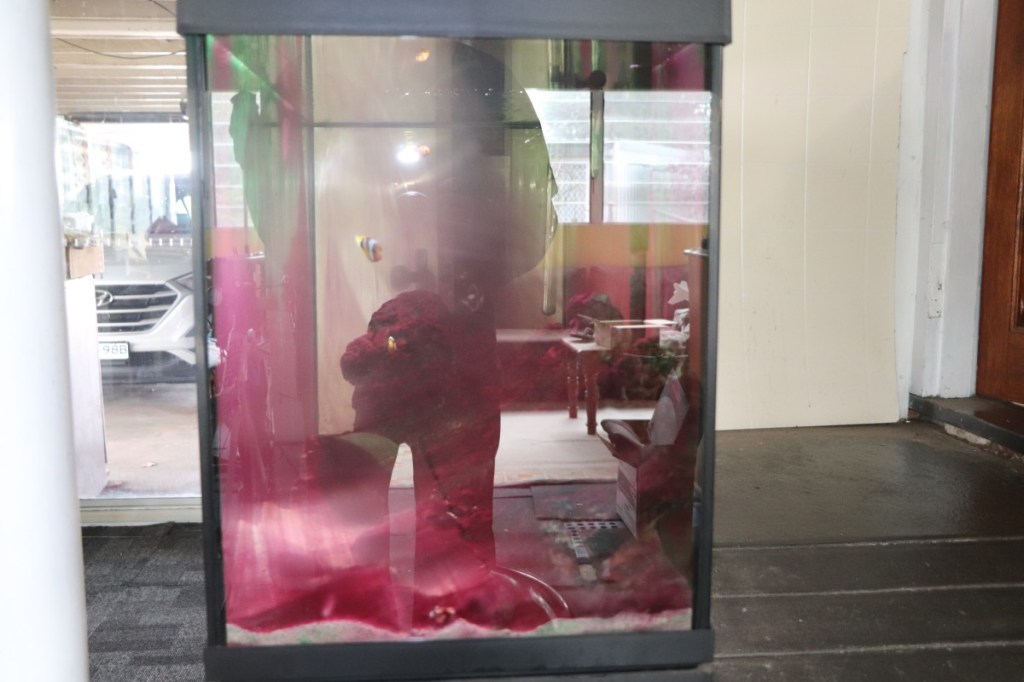
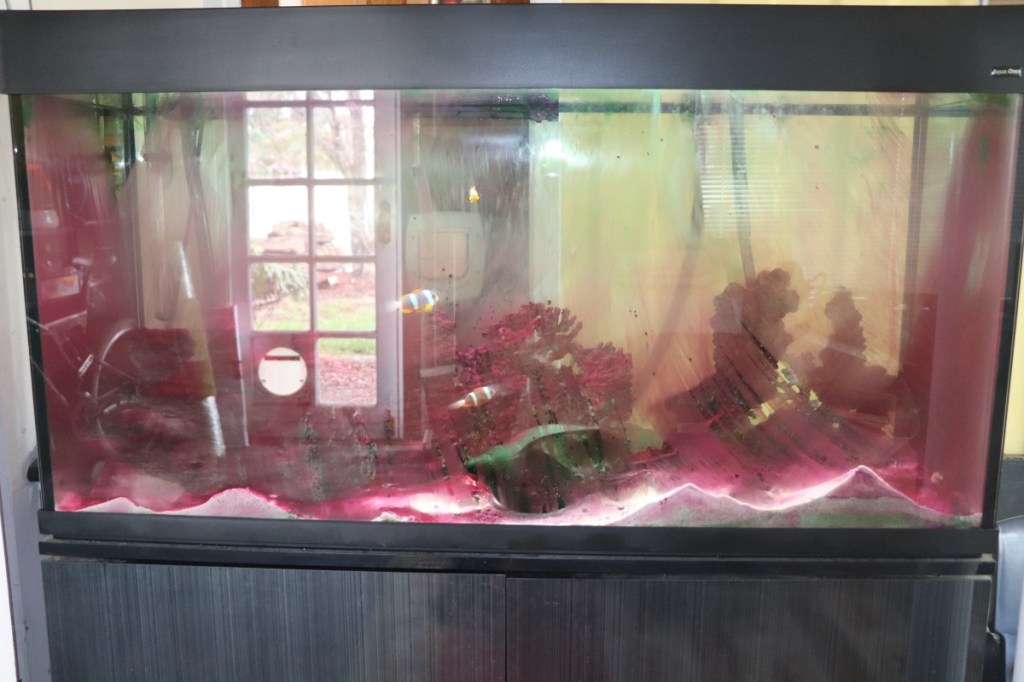
Very disappointing week with the Algae. After double dosing last week, the algae is actually worse this week!
I have double dosed again and we will see how it goes.

