Jo Nova: Prepare the escape pod — Kier Starmer says: “The consensus is gone”

Starship crashed. Fantasy.

Image by ThankYouFantasyPictures from Pixabay

By Jo Nova

The stench of failure is written all over Cop30 in Brazil

The USA, China and India are not attending. The UN has said the 1.5 degrees target is no longer possible. And the OECD admits “policy commitments have fallen from 10% annual growth to just 1%.

The Consensus is not only dead, but no one can hide the body under the rug any longer. Things are decomposing so fast, even Kier Starmer has flown all the way to the COP conference in Brazil to say “the consensus is gone”.

Kier Starmer didn’t even want to go to COP30 lest he look like he’s in the palm of the globalist Blob which would feed his nemesis – Nigel Farage. So he’s put in a last minute appearance and gone out of his way to avoid the usual fire and brimstone devotion by uttering a blasphemy. The consensus, after all, was the holy grail. It was the reason “to believe” and a reason to act even if we didn’t believe. The Blob always said: “We don’t want to fall behind” like being part of the herd was a benefit in and of itself.

For a bunch of Groupthinkers, this is big admission:

[The Guardian]  The UK prime minister told world leaders on Thursday at the Cop30 climate summit in Brazil that the “consensus is gone” on fighting climate change around the world, a decade after the landmark Paris agreement in 2015.

“Ten years ago, the world came together in Paris … united in our determination to tackle the climate crisis,” Starmer said. “The only question was how fast we could go. Today, however, sadly that consensus is gone.”

For Starmer, this might be the best escape route from the Net Zero bomb. As long as the fuse is lit and the carbon-clock is running, the globalist Blob parties face a wipe-out at the next election. But if “the consensus” is over, maybe he can pack the climate-talk away in a box for a few years and curb the fury over electricity prices. It’s what Mark Carney did to win in Canada. He scrapped the carbon tax on his first day in office and de-fanged the opposition. It may even placate the Groupthinking Greens, if he can convince them that no one else is acting and to wait for a better day.

Chris Bowen, the Australian Minister for Weather Control even agrees with Kier Starmer

But in renewable-crazy-land that just means that Australia has to do even more. The Guardian asked him about Kier Starmer’s words and he replied:

“I think that’s fair comment. Yes, it’s a contested space, but that makes supporting action in keeping with the science more important, not less important.

“It makes continued action by governments and industry who get it – that this is a scientific and environmental imperative, but also excellent economics – even more important. And that’s certainly our approach in Australia.”

Unlike the Reform Party in the UK, the opposition in Australia is a Lump of Jello, and doesn’t have a climate policy. So Chris Bowen is free to keep sprouting crazy witchery. He’s not afraid of the opposition because, effectively, there isn’t one.

Indeed, Bowen has to keep waving the flag, because the Australian government wants to host the next loser COP event this time next year. Thankfully, the opposition and the Nationals have both said “Let Turkey have it”. We want our billion dollars.

Even the OECD admits policy commitments have stalled. Globally, they only increased by 1% last year, when previously they would grow by 10% each year.

Global climate action losing momentum: OECD

By Ryann Cropp, The Australian Financial Review

The pace of global efforts to address climate change has ground to a halt, according to a report by the OECD that is likely to turbocharge Coalition wrangling over its commitment to emissions reduction.

The expansion of international climate policy commitments increased by just 1 per cent in 2024, with only 17.7 per cent of global emissions now covered by legally binding net zero pledges, according the Organisation for Economic Co-operation and Development’s annual Climate Action Monitor.

According to the OECD, the slowdown in climate commitments since 2021 contrasts significantly with the prior decade, when average emissions reduction policies expanded by about 10 per cent each year.

They have run out of excuses:

“This slowdown can no longer be explained by the COVID-19 pandemic or economic shocks: it reflects a loss of momentum in implementing effective policies,” the report said.

Now even the UN agrees that we will fail to hit their 1.5 degrees magical target, and that this is a “moral failure”:

It is, of course, our fault:

The failure to limit global warming to 1.5 degrees Celsius is an emergency and nations must now “lead or be led to ruin”, UN secretary-general António Guterres has said as the COP30 climate conference got underway in Brazil’s rainforest city Belém.

He added: “Every fraction of a degree means more hunger, displacement and loss — especially for those least responsible. This is moral failure — and deadly negligence.”

Mr Guterres, being a Blob man and the total socialist, paints this as capitalist greed:

“Too many corporations are making record profits from climate devastation, with billions spent on lobbying, deceiving the public and obstructing progress,” he said. “Too many leaders remain captive to these entrenched interests.”

After all, it’s not like the consensus died because millions of people in the largest economy on Earth were not convinced and voluntarily voted (twice!) for a man who called Climate Change a con and a hoax. Oh no…

Jo Nova- Govt. Admits Renewables Will Never Beat Coal

By Jo Nova

At the top of the Faraway Tree, the cheapest form of energy need more subsidies. Just keep pouring the money…

The Australian Energy Market Commission (AMEC) has finally quietly admitted that they’ve given up on wind and solar power becoming cheaper than coal. Instead, renewables are so uncompetitive they will need another ten years of subsidies, or however long it takes until the last coal plant shuts off.

It’s so revealing. Once upon a time they might have thought (or at least pretended) that subsidies were there to get the unreliable generators ‘over the development hump’ so they could compete in a free market. But after 20 years of subsidies, there are no new economies of scale left to wait for. We got to the bottom of the cost efficiency curve and we’re going up the other side. Costs are now rising as the new projects have to go to far flung fields and wait for impossible transmission towers to appear. Windmills kept getting bigger until there was a nasty surprise in the maintenance bills that wiped 36% off Siemens shares in a single day.

AMEC opine about getting back to a free market once the coal plants are forced off the grid by the Big Government subsidies. They might as well be telling the world that wind and solar will never be as cheap as coal is.

How could the new unfree market, post coal, possibly be cheaper than the old one?

Green energy subsidies here until nation exits coal, says Australian Energy Market Commission

Perry Williams, The Australian

Australia’s official energy policy adviser says government subsidies for renewables will likely be kept in place for as long as coal-fired power generation keeps operating, locking in underwriting schemes for at least another decade.

It’s not renewables fault, it’s because we need “an orderly transition” (to a forced, fixed, and unfree market):

The Australian Energy Market Commission said underwriting mechanisms were needed to ensure there was an orderly transition to green energy as coal generation exited the nation’s power grid.

Sorry, did we say the subsidies would end?

“Are we going to get past this at some point when we won’t have governments underwriting new capacity. Maybe once we’ve seen coal exit and we’ve built out this phase of the transition,” AEMC commissioner Tim Jordan told the Citi Australia and New Zealand Investment Conference on Tuesday.

All the talk of free markets is just an illusion:

“We can then return to a more market-led approach where underlying demand growth will determine whether new capacity enters.”

Mr Jordan said the industry and government should aim for “market principles to take over again” once the transition from coal to renewables was complete.

What do we call a free market when the cheapest competitor is banned?

If the green subsidies can’t end until coal power is gone, it looks more like their primary goal was not to help renewables so much as to destroy coal…

Jo Nova: Fossil Fuel Comeback

Fossil Fuel Fightback: The gears shift on the Renewable Crash Test Dummy — Eraring coal lives, wind and solar slump

Australia's Renewable Transition plane,

By Jo Nova

If the whole renewables fantasy was crumbling, it would look something like this

Despite the Labor Government throwing money at unreliable energy, renewables hopes are quietly unraveling. The largest energy retailer in the country just announced a nice 26% profit jump, based on fossil fueled gas, and they also announced they’d be keeping Australia’s largest coal plant open longer. The two year extension for Eraring, is now a four year extension. Despite reaping in gas profits and keeping the planet-destroying-plant operating, the share price promptly leapt 6% to a ten year high.

Significantly, Giles Parkinson at Reneweconomy also noticed that Origin’s annual report includes talk of batteries, but no wind or solar projects, which seems like an important oversight in a nation belting headlong towards the Green Utopia.

Meanwhile, for the first time I can recall, a fossil fuel CEO is daring to defend the industry. The shift in confidence in palpable.  Mike Wirth, the Chevron CEO, is not only saying “oil is not evil” but he clearly isn’t afraid of the Australian government. He’s so unafraid he also delivered a “stinging rebuke” — saying that high costs, red tape and environmental rules have made Australia so uncompetitive, investors are leaving to spend their money in the US and the middle east instead. Indeed, Chevron had a plan to double their Australian gas production but have abandoned that now. Australia used to be the world’s largest LNG exporter but Qatar and the US outpaced us.

In a similar theme, Ampol just surprised the market by spending $1 billion dollars to double the number of petrol stations it owns, making it the largest retailer in the country. The CEO Matt Halliday said the unthinkable: “The transition [to EVs] will take decades, and combustion engines are going to still make up a large chunk of the national car fleet beyond 2050.” It was a very unfashionable and backward thing to say, but shares leapt 8% on the news yesterday.

Australia’s biggest energy retailerhits go slow button on wind and solar, mulling options on Eraring

Giles Parkinson, Reneweconomy

Origin Energy, Australia’s biggest energy retailer, appears to have hit the go-slow button on the rollout of new renewable energy projects, and is still mulling options on the already extended Eraring coal generator, the country’s biggest, which is officially due to close in 2027.

Curiously, in its annual report, the company says: “With the Eraring Power Station’s closure planned for August 2027, failure to deliver our major renewable generation projects may affect Origin’s future supply capacity, financial prospects and reputation.” Yet it has made no commitment to build those projects in that timeframe.

Think of the irony of putting the nations biggest battery next to the nations biggest coal plant, as if it needed back up:

But this is made up entirely of big batteries, including the giant 700 MW, 2,800 MWh Eraring battery being next to the coal generator…

It [the annual report] includes no wind or solar projects. The technologies did not even rate a mention in the results presentation, apart from the giant 1.45 gigawatt (GW) Yanco Delta wind project in the south-west of NSW, which has gained grid access rights but is still to complete environmental approvals.

Read the rest of the article here

Peter Ridd: The Great Barrier Reef Is Doing Fine

My article from The Australian this morning below. But first, AIMS are agreeing that the reef is coming off record highs so the small drop should be viewed in that context. However, much of the media is still reporting the drop as a disaster.

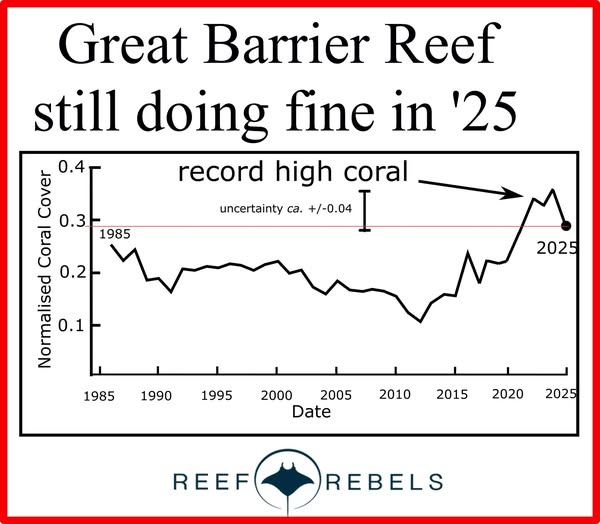
The latest 2025 statistics on the amount of coral on the Great Barrier Reef (GBR) show the reef is still doing fine despite having six allegedly cataclysmic coral bleaching events in the last decade. There should be no coral at all if those reports were true.

The normalised coral cover dropped from a record high number of 0.36 down to 0.29, but there is still twice as much coral as in 2012. The raw coral cover number for all the last five years has been higher than any of the previous years since records began in 1985. However, when one considers the uncertainty margin, the present figures are not significantly different from many of the previous years.

The Australian Institute of Marine Science collects coral data on around 100 of the 3000 individual coral reefs of the GBR. Analysis of the data at smaller scales shows the GBR is doing what it always does – change. There is a constant dynamic as cyclones, starfish plagues and bleaching events dramatically kill lots of coral in small areas, while it quietly regrows elsewhere.

Guess whether the ‘science’ institutions emphasise the death or regrowth.

The institutions often justify this embarrassingly high coral cover as just “weed coral”. But the type of coral that has exploded over the last few years is acropora, which is the most susceptible to hot-water bleaching. How can we have record amounts of the type of coral that should have been killed, again and again, from bleaching? The acropora takes five to ten years to regrow if it is killed.

There are two conclusions that must be drawn. First, not much coral has been killed by climate change bleaching – at least not compared to the capacity of coral to regrow. Second, the science institutions are not entirely trustworthy, and are in need of major reform.

And not just with regard to GBR or climate science. It is well recognised that most areas of scientific study are suffering a problem of reliability, which is damaging the reputation of science itself. It is well accepted that around half of the recent peer-reviewed science literature is flawed. Is there any other profession with such a high failure rate?

This last point has been noted in the United States, where American science is going through a process of genuine revolution. Scientists who were once victimised and ostracised have been appointed to lead science and medical research institutions. Among the more notable and encouraging appointments have been Professor Jay Bhattacharya who famously opposed the groupthink on Covid lockdowns, especially for children. He is now head of the National Institutes of Health and is proposing radical changes in the funding methodology to break the cycle of groupthink. He is also changing funding rules to encourage bright young scientists with new ideas rather than the present system which rewards older scientists who are wedded to conventional wisdom, and often enforce groupthink. In short, Bhattacharya is encouraging dissenters.

The US Department of Energy recently released a report on whether the conventional wisdom on climate change is entirely defensible. It is written by five eminent scientists, all with spectacular careers, who have consistently challenged the view that climate change is an existential threat. Their report includes data about GBR that shows there is little to worry about. Significantly, it systematically addresses many other aspects of Climate-Catastrophe Theory, such as wildfires and deaths from extreme weather events. And it points out the oft-ignored fact that carbon dioxide is a wonderful plant fertilizer which has already increased crop yields and plant growth.

Most importantly, rather than shutting down critics, the report’s writers are actively encouraging criticism, which they will respond to.

Science progresses through argument, logic, and quality assurance systems that make sure debate always takes place. Groupthink kills science, and groupthink is being challenged like never before in the US.

This revolution seems a long way off for Australia. But it will come, simply because US science, and science funding, dominates all other countries.

Imagine if Professor Ian Plimer, Australia’s most famous climate sceptic, was in charge of our climate science funding. Or if I were in charge of the Great Barrier Reef Marine Park Authority. Sounds crazy. But that is what has effectively happened in the US.

Australia’s science agencies would do well to contemplate whether they need to change their ways before the revolution comes to these shores. Better to adapt before the scientific guillotine falls.

Peter Ridd is an Adjunct Fellow at the Institute of Public Affairs.

Jo Nova: Secret comms devices, radios, hidden in solar inverters from China. Would you like a Blackout with that?

Image by Maria Godfrida from Pixabay

By Jo Nova

Nice grid you have there, shame if someone suddenly… switched it off

Two insiders at the US Dept of Energy say they have found covert devices inside solar panel inverters and batteries that would allow them to communicate with China. Even though firewalls have been put in place, these backdoor devices could operate around them.

Last August a Dutch white hat hacker got into 4 million panels in 150 countries in an effort to warn the West that major infrastructure was vulnerable. A month later an Australian cyber expert warned that a foreign hacker could turn our home batteries into “pager-bombs” too. If a hostile power turned off the overcharge protection on a sunny day, millions of solar panels would be pumping excess electricity into batteries that have no safety cut off. A few houses start to go off like popcorn, and an hour later we’re all living at the Western Front. How exactly would our firemen cope if 1 in 100 homes caught fire at the same time, and then we had a blackout? Anyone?

Individual solar panel inverters are generally too small to trigger national security assessments, but right now at lunchtime solar power is the largest single source of electricity in Australia — making 13 gigawatts out of 27. That’s half our national supply. In summer it’s worse.

We’ve turned our duck curve into a sitting duck…

Australian electricity Generation May 14th 2025

It’s a win every which way for China if we install more solar panels. Not only are we paying them for the panels, and sanctifying their slavery, but we set fire to our electricity prices, driving our factories to China where they burn our coal. Now to ice this Gridkill Gateau we hand them a backdoor for sabotage or extortion should they ever get the urge to use it.

No wonder China is funding climate activists in the US and UK. They’d be crazy if they weren’t doing it here too.

This is Fall of Rome type stuff, and we’ve got Chris ‘Blackout’ Bowen to save us…

The only good thing about this is that while we were destroying our industrial base with solar panels anyway, the hidden transmitters are so overtly hostile, so in-your-face nasty, that sleeping Westerners might even wake up. Holy smoke. Does anyone think those secret radios were put there to help us?

Reuters: Rogue communication devices found in Chinese solar power inverters

LONDON, May 14 (Reuters) – U.S. energy officials are reassessing the risk posed by Chinese-made devices that play a critical role in renewable energy infrastructure after unexplained communication equipment was found inside some of them, two people familiar with the matter said.

However, rogue communication devices not listed in product documents have been found in some Chinese solar power inverters by U.S experts who strip down equipment hooked up to grids to check for security issues, the two people said. Over the past nine months, undocumented communication devices, including cellular radios, have also been found in some batteries from multiple Chinese suppliers, one of them said.

The rogue components provide additional, undocumented communication channels that could allow firewalls to be circumvented remotely, with potentially catastrophic consequences, the two people said.

“We know that China believes there is value in placing at least some elements of our core infrastructure at risk of destruction or disruption,” said Mike Rogers, a former director of the U.S. National Security Agency. “I think that the Chinese are, in part, hoping that the widespread use of inverters limits the options that the West has to deal with the security issue.”

In November, solar power inverters in the U.S. and elsewhere were disabled from China, highlighting the risk of foreign influence over local electricity supplies and causing concern among government officials, three people familiar with the matter said.
Reuters was unable to determine how many inverters were switched off, or the extent of disruption to grids. The DOE declined to comment on the incident.

The Communist Party could have said that they would never sanction such a hostile act, and it must be a company acting alone, but they didn’t:

A spokesperson for the Chinese embassy in Washington said: “We oppose the generalisation of the concept of national security, distorting and smearing China’s infrastructure achievements.”

Infrastructure achievements indeed. A Freudian slip?

There is plenty of risk to share around:

The European Solar Manufacturing Council estimates over 200 GW of European solar power capacity is linked to inverters made in China – equivalent to more than 200 nuclear power plants. At the end of last year, there was 338 GW of installed solar power in Europe, according to industry association SolarPower Europe.

Though Europe is saved, somewhat, by having lots of interconnectors and not much sun. That is, apart from Portugal, Spain and Greece, and we still don’t know what caused that blackout that started in the solar farms?

In Australian Senator James Paterson was warning this was possible in August 2023, saying 58% of solar panel inverters in Australia were made by companies headquartered in China. And what have we done?  We installed another half a million solar PV units on homes in Australia.

Gangbusters on the gang-plank.

Fresh Evidence Emerges That Global Vegetation Growth Reaches New Highs Due to Increased CO2 Fertilisation

From wattsupwiththat.com

Global vegetation reached a new greening peak in 2020, continuing a long-term trend since 2000 according to new dramatic findings published by a team of scientists based in the United States. The work helps confirm other recent scientific work that points to massive global plant growth directly related to recent increases in natural and human-caused carbon dioxide. Plants have evolved to grow in an atmosphere much richer in CO2 than current near-denuded levels, and the recent growth and its myriad benefits for humankind should not be surprising. Needless to say, the news is absent from mainstream headlines since the ‘pollutant’ is temporarily being blamed for climate collapse in the interest of boosting the collectivist Net Zero fantasy.

The latest work on the ‘gas of life’ notes that the greening is linked to continuous growth in boreal and temperate vegetation. The scientists also suggest that the increase has been complemented by a tropical vegetation boost due to higher rainfall. Higher growth in northern regions would also have been helped by slightly warmer temperatures which have marginally increased growing seasons. The climate might be collapsing for ill-informed readers of the Guardian and listeners of the BBC, but nature continues to find ways to thrive. The scientists note that there is a “robust resilience and adaptation” of global vegetation in the face of a changing environment. Using a number of remote sensing devises, the year 2020 is pinpointed as an “historic landmark” since it registered as the greenest year in modern satellite records from 2001 to 2020.

This is not the first time that an acceleration in global greening over the last two decades has been observed. Last year a group of Chinese scientists found that about 55% of global land mass had shown an “accelerated rate” of vegetation growth. The Chinese team that included the Eco-Climatologist Professor Tiexi Chen stated that “global greening is an indisputable fact”. Climate change drought is a favourite fear mongering scare with activists but it was found that any water scarcity trend only slowed global greening, “but was far from triggering browning”.

The extent of the recent greening is shown in the map above and along with the latest results from the US team it reveals extensive growth in northern regions. But there has also been obvious de-desertification south of the Sahara and many famine-prone areas in eastern Africa have been given a welcome natural boost to food supplies. 

In addition, these ecological improvements boost wildlife and create healthier eco-systems. They go back further than the turn of the century with evidence of widespread greening stretching back to at least 1980. Some estimates suggest increased levels as high as 14%. In a detailed paper published in 2016 by 32 authors from eight countries, it was noted that there was a “persistent and widespread increase” in growing season greening over 25-50% of the global vegetated area.

In fact, the new greening of the planet is helping to feed the world. The authors of a recent science paper Charles Taylor and Wolfram Schlenker recently stated: “We consistently find a large fertilisation effect; a 1 part per million increase in COequates to a 0.4%, 0.6%, 1% yield for corn, soybean and wheat respectively”. A previous extreme environmentalist scare about rising populations and food scarcity was forced to take a back seat as crop yields soared due to hydrocarbon-produced artificial fertiliser and higher levels of atmospheric CO2. Ironically, a successful Net Zero and a resulting collapse in global food supplies could see the former much-missed scare return to centre stage.

It is difficult to see how the idea that there is a climate ‘emergency’ can continue to be taken seriously given that it lacks any substantial or convincing proof. The trend in almost all extreme weather events is not getting worse and this is accepted by the Intergovernmental Panel on Climate Change (IPCC). Increasingly discredited weather attribution linking individual events to humans conflicts with the IPCC fact-based view. Slightly warmer temperatures have benefited humans, a species that emerged from the sub-tropics and thrives best in warmer climes. Climate ‘refugees’ don’t exist and can’t even be defined. Climate tipping points exist only on the hard drives of climate models as does almost every prediction of Armageddon. Fake predictions heavy with dubious stats and temperature recordings are becoming the butt of jokes, if not in the mainstream media then across the more important social media arena. Meanwhile, corals, polar bears and whales multiply (the latter of course provided they stay away from the killing waters of offshore wind parks).

Screenshot

Even the deserts can’t be trusted to get bigger and create millions, perhaps billions, of climate refugees. According to a recent Yale Environment 360 article, CO2 is “fast tracking” photosynthesis in plants. By allowing them to use scarce water more efficiently, the CO2-rich air fertilises vegetation growth in even some of the driest places, it is observed. You can of course only have so much good news in Green Blob-funded operations like Yale and it also noted, “arid eco-systems matter”. We can but pray that nobody tells the Guardian about all this green encroachment and ruins its day. It recently reported that “desertification is turning the Earth barren” and the expansion of drylands is leaving entire countries “facing famine”.

Chris Morrison is the Daily Sceptic’s Environment Editor

Jo Nova: Renewable Fiasco: If Germany just kept nuclear power, it could have saved $600b and cut emissions by 73%

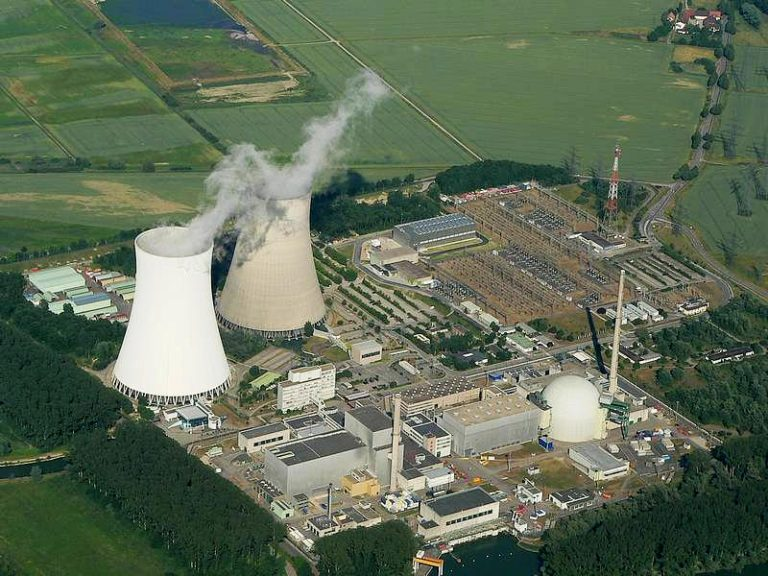
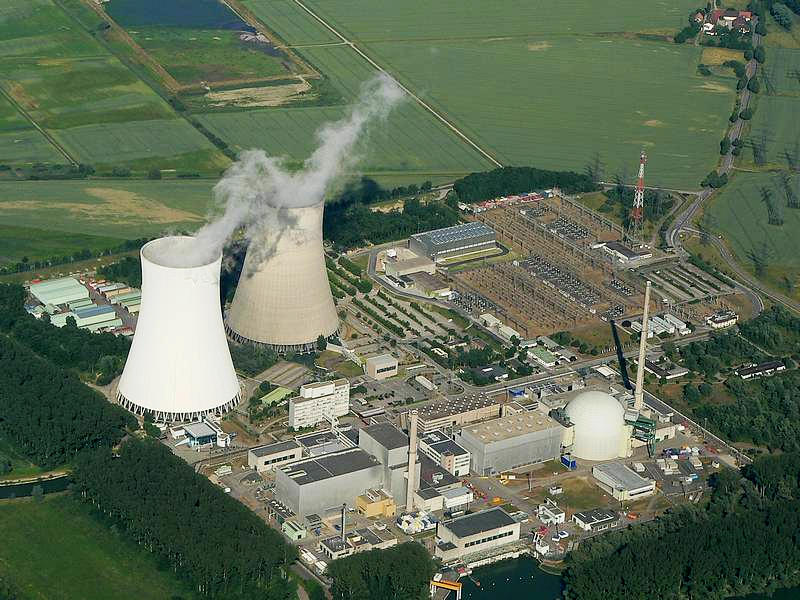
Phillippsburg Nuclear Power Plant by Lothar Neumann, Gernsbach

By Jo Nova

If the Germans just did nothing at all, it would have been Greener

Germany already had nuclear power in 2002, if they just kept it and didn’t build all the wind and solar plants, they wouldn’t have had to spend 697 Billion Euro on subsidies, and would have cut their emissions by 73% more.

If ever there is a statistic that says there is something rotten in the State of Climate Panic, this is surely it. I mean, does CO2 matter or doesn’t it? Do the Greens care at all, or even a bit? If there was a climate emergency and The Greens were worried about CO2, they might have protested that the EnergieWende was a reckless experiment. Instead the  But if the Greens were tools for communists, foreign states or banker-investors, then they might keep choosing options that benefit other countries, help Bankers or just make Big Government bigger.

Either the German Greens have utterly failed at the very task they set out to do, or they were really aiming at something else.

Ross Pomery writes at RealClearScience and  WattsUpWithThat

Study Quantifies Germany’s Disastrous Switch Away From Nuclear Power

At the dawn of the millennium, Germany launched an ambitious plan to transition to renewable energy. “Die Energiewende” initiated a massive expansion of solar and wind power, resulting in a commendable 25 percent reduction in carbon emissions by 2022…

In 2002, nuclear power supplied about a fifth of Germany’s electricity. Twenty-one years later, it supplied none. A layperson might think that cheap wind and solar could simply fill the gap, but it isn’t so simple.

Jan Emblemsvåg, a Professor of Civil Engineering at Norway’s NTNU just published a study comparing the ambitious German Energiewende renewable program with nuclear power:

“what if Germany had spent their money on nuclear power and not followed their policy from 2002 through 2022 (20 years); would Germany have achieved more emission reductions and lower expenses?”

Even German bureaucrats admit Energiewende “poses a threat to the German economy”:

German Federal Accounting Office (Bundesrechnungshof) writes about the German policy dubbed ‘Die Energiewende’ in German, and it concludes: ‘The Bundesrechnungshof warns that the energy transition in its current form poses a threat to the German economy and overburdens the financial capacity of electricity-consuming companies and households’ (Bundesrechnungshof Citation2021a).

A whole lot of wind (green) and solar (orange) power were added to the German grid and it was worse than useless:

Energiewende, Germany

Given these results, there can be no doubt whatsoever that if Germany had invested in NPPs [Nuclear Power Plants] instead of VREs [Variable Renewable Energy], Germany would have decarbonised more with far less nominal expenditures. The short conclusion is that Germany would have reached its climate goals with a substantial margin at half the expenditures of Energiewende.

The Germans have done this experiment so we don’t have to

Just burn that money in a pyre to the Weather Gods:

https://www.tandfonline.com/doi/full/10.1080/14786451.2024.2355642#d1e128

These costs do not included the added burden of expensive electricity on businesses and homes, the opportunity costs of money that could have been spent elsewhere, or the loss of talent, brains and industry to other countries.

Building new nuclear plants was still cheaper than wind and solar

The paper goes through another scenario where more nuclear plants were built with careful estimations of the costs and long times to construct plants and still concludes that the Germans would have saved $330 billion euro.

https://www.tandfonline.com/doi/full/10.1080/14786451.2024.2355642#d1e128

Not coincidentally, in 2024 Germany has some of the most expensive electricity in Europe, business confidence is low, and  VW have just announced that after 87 years in production, they might have to close their German factories.

Volkswagen, which was founded in 1937, said on Monday that it could no longer rule out unprecedented plant closures in Germany as it seeks ways to save several billion euros.

Chief executive Oliver Blume said: “The economic environment has become even tougher and new players are pushing into Europe. Germany as a business location is falling further behind in terms of competitiveness.”

Volkswagen employs around 650,000 workers globally, almost 300,000 of whom are in Germany, and the threat of factory closures sparked an immediate fierce backlash …

REFERENCE

Emblemsvåg, J. (2024). What if Germany had invested in nuclear power? A comparison between the German energy policy the last 20 years and an alternative policy of investing in nuclear power. International Journal of Sustainable Energy, 43(1). https://doi.org/10.1080/14786451.2024.2355642

Jo Nova: The Ridiculous Net Benefit of Net Zero

Jo nova writes:

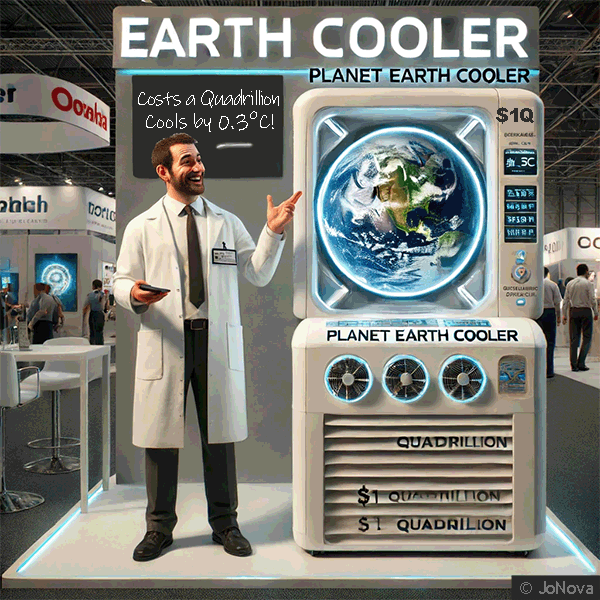
Bargain: Make the whole world “Net Zero”, spend a quadrillion dollars, and cool the world by 0.3 degrees!

Air conditioner for the Earth.


By Jo Nova

The deadliest climate question: How many degrees cooler will that be?

Ask it now, ask it later, before breakfast and while watching “the news”. Teach the children to ask in kindy.

We know the IPCC wildly exaggerates, but pretend they’re right and it still doesn’t make any sense. Richard Lindzen, Will Happer, and William van Wijngaarden took the IPCC at its word and calculate that even if we get to Net Zero by 2050, will only make the world a tiny bit cooler, assuming they’re right (which they’re not) and assuming the rest of the world joins in (which they aren’t).

Say we stop all coal, oil and gas, redesign our energy grids, cull the cows, give up our holidays, our cars and ride bikes to work, fill the oceans with windmills, and turn our thermostats down. We spend a quadrillion dollars on a Moonshot to stuff a perfectly good fertilizer in holes underground, and instead of getting to the moon, the world is barely 0.28 degrees C cooler. That’s a half of one lousy Fahrenheit less that it would have been. This ladies and gentlemen is the best case scenario for the global action plan against the 6th mass extinction.

This is why 100,000 people in private jets meet each year in Egypt, or Doha, or Azerbaijan. (Or so they say).

The whole United States of America could go Net Zero by 2050 and it would, at best, change global temperatures by three one-hundredths of a degree, which we can’t even measure. Rounded to the nearest tenth of a degree that’s a big 0.0°C. And if the Sun does a bit more, then it’s even less.

Net Zero Averted Temperature Increase

R. Lindzen, W. Happer, and W. A. van Wijngaarden

Abstract:

Using feedback-free estimates of the warming by increased atmospheric carbon dioxide (CO2) and observed rates of increase, we estimate that if the United States (U.S.) eliminated net CO2 emissions by the year 2050, this would avert a warming of 0.0084 ◦C (0.015 ◦F), which is below our ability to accurately measure. If the entire world forced net zero CO2 emissions by the year 2050, a warming of only 0.070 ◦C (0.13 ◦F) would be averted. If one assumes that the warming is a factor of 4 larger because of positive feedbacks, as asserted by the Intergovernmental Panel on Climate Change (IPCC), the warming averted by a net zero U.S. policy would still be very small, 0.034 ◦C (0.061 ◦F). For worldwide net zero emissions by 2050 and the 4-times larger IPCC climate sensitivity, the averted warming would be 0.28 ◦C (0.50 ◦F).

Read the entire short paper here at the CO2Coalition: Net Zero Averted Temperature Increase

And Christopher Monckton points out the cost to benefit ratio for this $2 Quadrillion dollar project is every billion dollars we spend cools the world by 20 millionths of a degree.

So let’s keep all the national science institutions that pointed out what a terrible deal this is for all our nations, and shut down the rest —  NOAA, NASA, Hadley, CSIRO, NIWA, BoM, Potsdam, NRC, ARC, and while we’re at it — the ABC, BBC, the CBC because they should have asked better questions, like “how many degrees will that cool us?”

Jo Nova: The EV Whirlpool Gets Stronger

Jo Nova writes:

EV Hell continues: Crash victims might have to be “left to die”, Hertz dumps another 10,000 cars, Tesla sacks whole charging team

EV doom. The collapse of an industry. AI assisted.

By Jo Nova

Chronicling the collapse of the Big-Government-made EV bubble

In today’s EV obituary column, Elon Musk has dropped a bombshell. Two months after Telsa chargers became the industry standard (which promised to save the other car makers) his profits fell, and he’s fired the entire EV charging team overnight. Hertz, meanwhile, has realized that dumping 20,000 electric cars in January was not enough, and it has to offload another 10,000 electric cars, which now amounts to half its EV fleet. And then comes the news that there might be a secondhand “timebomb” coming at the eight year mark when most EV battery warrantees run out and cars will become “impossible to sell”.

As if that’s not enough, this week the fire and rescue experts in NSW are warning in the politest possible way, that they might have to do a “tactical disengagement” of a car accident victim, which means leaving them to die in an EV fire if the battery looks likely to explode. They say that first responders need more training, as if this can be solved with a certificate, but the dark truth is that they’re talking about training the firemen and the truck drivers to recognize when they have to abandon the rescue.

EV crash victims could be left to die in battery fires without training for responders, inquiry told

Jennifer Dudley-Nicholson, The Driven

The NSW government’s Electric and Hybrid Vehicle Batteries Inquiry heard testimony from fire and rescue services, paramedics, the Motor Traders’ Association, and TAFE on Tuesday in its second public hearing.

In the most serious incidents, firefighters said crews could be forced to abandon rescues or crudely rescue passengers from vehicles, and were being left “flying blind” at battery fires.

VRA Rescue NSW Commissioner Brenton Charlton told the inquiry worse outcomes were also possible, including battery explosions in which a rescue operation would put emergency workers at risk.

“We need to prepare ourselves and our volunteers… for the point in time we have to do a tactical disengagement, meaning if someone’s trapped and it does high order (explode) you might not be able to do anything,” he said.

“That will be a tragic, horrible thing to take part in.”

Just like that, Elon Musk fired the whole Tesla EV charging team, throwing the industry into chaos because Tesla network is the best by far and the bedrock of the so called “transition”. Tesla had agreed to open its charging network to other EV makers only recently, and Joe Biden was delighted. Tesla is getting subsidies to expand it’s North American Charging Standard (NACS) system. But this move

Tesla layoffs shake confidence in the EV-charging future

By David Ferris, E&E News

In a single stroke, CEO Elon Musk called his company’s vaunted charging reliability into question when he laid off most or all of Tesla’s Supercharger team, the people who made Tesla the envy of the EV industry. The network they built is bigger, faster, smarter and more reliable than any other company’s — and has become the linchpin of the auto industry’s plan to persuade millions of Americans to buy EVs and turn the tide on climate change.

“It feels like the rug just got pulled out from under a lot of the industry alignment that has been built in the last 12 months,” said Matt Teske, an industry veteran and CEO of Chargeway, an EV-charging software platform. “And leaves us on shaky ground.”

In 2022, as traditional automakers finally started delivering a substantial number of EVs to the roadways, they ran into a problem. Their drivers couldn’t use Tesla’s chargers, because they were meant only for Teslas. And the public networks had an array of reliability problems.

Ford was the first automaker to hit on the solution. Last spring, it struck a deal with Tesla to use its 12,000 U.S. charging stations and committed to building Tesla’s charging technology called the North American Charging Standard, or NACS, into its future vehicles.

Other automakers followed suit in short order. By February, Tesla’s NACS had become the industry standard, with virtually every automaker planning to redesign their charging systems to meet Tesla’s specifications.

The Hertz debacle truly might become an obituary

Hertz logo

Originally Hertz was going to buy 100,000 wonder-cars which would be cheap to fix and popular with punters. But the future fleet only reached 60,000 cars and is now reversing back to 30,000 cars which tourists apparently don’t want to rent much, and which cost twice as much to repair.

Not surprisingly, it’s a financial ruin. Hertz shares have lost three quarters of their value since 2022.

The company was an $11 billion dollar company in 2021 when it announced the mass EV purchases — it is now a $1.4 billion dollar company.

Hertz drops more EVs

RENTAL car giant Hertz, has announced that it is selling off 10,000 more EVs than it planned in January when it set out to stem the tide of massive depreciation that hit its fleet of 60,000 EVs.

Rental car companies need to be able to sell off their ex-rentals for a reasonable sum, but just as Hertz realized it couldn’t afford to repair these cars, it also realized it couldn’t sell them either:

…the program came under stress when Tesla began discounting its cars last year.

This set off a tsunami of depreciation for existing Tesla owners; including Hertz, which had the biggest exposure of anyone. In turn, other EV makers followed suit with discounts and retained values for all EVs became a race to the bottom.

And as word spreads, possibly no one else will be able to sell them either. What is an 8 year old EV with no battery warrantee worth? It’s pot luck whether it will keep going or suddenly need a £15,000 repair…

The used electric car timebomb –  EVs could become impossible to sell on because battery guarantees won’t last – find out if you are affected

By TOBY WALNE, This is Money

Money Mail can today reveal a timebomb looming in the second-hand market for electric vehicles (EVs).

Our investigation found that many EVs could become almost impossible to resell because of their limited battery life.

Experts said that the average EV battery guarantee lasts just eight years. After this time, the battery may lose power more quickly and so reduce mileage between charges.

In some cases, the cost of a replacement battery is as much as £40,000. For certain EVs, the cost of replacing the battery could be ten times the value of the vehicle itself on the second-hand market.

Yet geniuses in government still want to push us all into EV’s.

With uncanny timing the Australian Albanese government is about to launch emissions standards we don’t need to force people to buy a product they don’t want, in the hope, so they say, of stopping some storms.

The insanity would be hard to fathom if EV’s weren’t also the ideal tool for spying, data collection, law enforcement, and political control. Benefits that can launch a thousand political careers…

Health of Fish Stocks Contradict Climate Alarmists Predictions

From wattsupwiththat.com

Health of Fish Stocks Contradict Climate Alarmists Predictions

By Vijay Jayaraj

The oceans are still very much a mystery to humankind, with a vast majority of it yet to be explored. Early in my career, I wanted to make an in-depth study of how climate affected marine life. After all, many media reports claimed that “oceans will become empty by 2048.”

So, as a graduate research assistant, I explored the adaptability of marine fish and invertebrates to fluctuations in ocean temperatures. I found that both are highly adaptable to changes in the water around them. That is the way they are made.

Now, evidence emerging from scientific studies shows that marine life may be benefiting from the relative warmth of modern temperatures.

Contrary to the hyperbole of climate reporters, there has been no alarming increase in global sea-surface temperatures. Even if temperatures increase substantially, fish are free to migrate to cooler waters and do, as documented by scientific studies.

Fish also have natural adaptive mechanisms. Since their initial emergence in Earth’s waters, fish have developed genetically in ways that allow them not only to survive but to thrive in a variety of environments. In addition to the generational genetic adaptability, fish also display short-term phenotypic plasticity which allows them to adapt to temperatures and other physical factors. When combined, these mechanisms act as significant protection against the ill-effects of the physical environment.

Despite this, it is not uncommon to see news of fisheries crashing under the weight of a climate crisis. However, real-world data contradict such negative reports, indicating instead that global fish catches will improve in the coming decades.

2016 scientific study “assembled the largest-of-its-kind database and coupled it to state-of-the-art bioeconomic models for more than 4,500 fisheries around the world.” The study found that global fisheries will profit from an increase in marine species. The degree of this commercial success will depend on a range of policy measures, including ones that enable increased catches for individuals and communities.

In 2020, there was a record 214 million tonnes of production from both wild catches and aquaculture. The State of World Fisheries and Aquaculture 2022 report says that this production is expected to grow 14 percent by 2030. Fish are expected to become more affordable and accessible, with prices decreasing between 2024-2029, according to two international bodies: the Organization for Economic Co-operation and Development (OECD) and United Nation’s Food and Agriculture Organization (FAO) that published the data in Agricultural Outlook.

As of 2017, around 65% of fish stocks were biologically sustainable. An index of population health is maximum sustainable yield (MSY), which is the point at which the stock can sustain itself without limits on fishing. The MSY calculation involves collaborative information gathering by marine biologists and fishers.

The 2022 report states that the number of catches from biologically sustainable stocks has been on the rise! This signals that catches can be increased without depleting the stock to levels that neither the species nor continued fishing is at risk. While some concerns remain for a few species, studies show that in regions where we have high-quality population data, the majority of fish stocks are either stable or improving.

In short, any threat to future catches is not “empty” seas but rather the effect of activities such as illegal fishing and overfishing. Fish as an important protein source is likely to remain available in large quantities. Reality contradicts the fallacious climate crisis that dominates popular media and politics.

This commentary was first published in American Thinker on February 10, 2024.

Vijay Jayaraj is a Research Associate at the CO2 Coalition, Arlington, Virginia.  He holds a master’s degree in environmental sciences from the University of East Anglia, U.K.