Jo Nova: The EV Whirlpool Gets Stronger

Jo Nova writes:

EV Hell continues: Crash victims might have to be “left to die”, Hertz dumps another 10,000 cars, Tesla sacks whole charging team
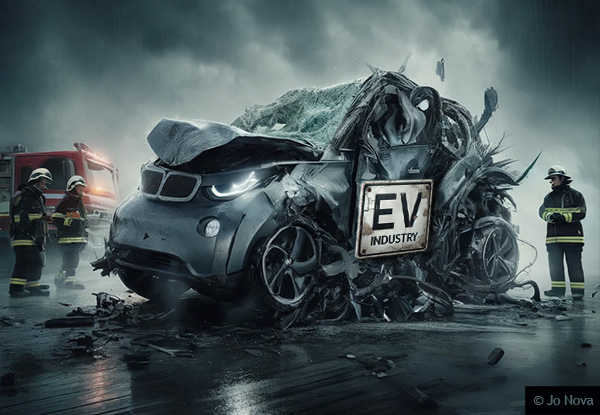
EV doom. The collapse of an industry. AI assisted.

By Jo Nova

Chronicling the collapse of the Big-Government-made EV bubble

In today’s EV obituary column, Elon Musk has dropped a bombshell. Two months after Telsa chargers became the industry standard (which promised to save the other car makers) his profits fell, and he’s fired the entire EV charging team overnight. Hertz, meanwhile, has realized that dumping 20,000 electric cars in January was not enough, and it has to offload another 10,000 electric cars, which now amounts to half its EV fleet. And then comes the news that there might be a secondhand “timebomb” coming at the eight year mark when most EV battery warrantees run out and cars will become “impossible to sell”.

As if that’s not enough, this week the fire and rescue experts in NSW are warning in the politest possible way, that they might have to do a “tactical disengagement” of a car accident victim, which means leaving them to die in an EV fire if the battery looks likely to explode. They say that first responders need more training, as if this can be solved with a certificate, but the dark truth is that they’re talking about training the firemen and the truck drivers to recognize when they have to abandon the rescue.

EV crash victims could be left to die in battery fires without training for responders, inquiry told

Jennifer Dudley-Nicholson, The Driven

The NSW government’s Electric and Hybrid Vehicle Batteries Inquiry heard testimony from fire and rescue services, paramedics, the Motor Traders’ Association, and TAFE on Tuesday in its second public hearing.

In the most serious incidents, firefighters said crews could be forced to abandon rescues or crudely rescue passengers from vehicles, and were being left “flying blind” at battery fires.

VRA Rescue NSW Commissioner Brenton Charlton told the inquiry worse outcomes were also possible, including battery explosions in which a rescue operation would put emergency workers at risk.

“We need to prepare ourselves and our volunteers… for the point in time we have to do a tactical disengagement, meaning if someone’s trapped and it does high order (explode) you might not be able to do anything,” he said.

“That will be a tragic, horrible thing to take part in.”

Just like that, Elon Musk fired the whole Tesla EV charging team, throwing the industry into chaos because Tesla network is the best by far and the bedrock of the so called “transition”. Tesla had agreed to open its charging network to other EV makers only recently, and Joe Biden was delighted. Tesla is getting subsidies to expand it’s North American Charging Standard (NACS) system. But this move

Tesla layoffs shake confidence in the EV-charging future

By David Ferris, E&E News

In a single stroke, CEO Elon Musk called his company’s vaunted charging reliability into question when he laid off most or all of Tesla’s Supercharger team, the people who made Tesla the envy of the EV industry. The network they built is bigger, faster, smarter and more reliable than any other company’s — and has become the linchpin of the auto industry’s plan to persuade millions of Americans to buy EVs and turn the tide on climate change.

“It feels like the rug just got pulled out from under a lot of the industry alignment that has been built in the last 12 months,” said Matt Teske, an industry veteran and CEO of Chargeway, an EV-charging software platform. “And leaves us on shaky ground.”

In 2022, as traditional automakers finally started delivering a substantial number of EVs to the roadways, they ran into a problem. Their drivers couldn’t use Tesla’s chargers, because they were meant only for Teslas. And the public networks had an array of reliability problems.

Ford was the first automaker to hit on the solution. Last spring, it struck a deal with Tesla to use its 12,000 U.S. charging stations and committed to building Tesla’s charging technology called the North American Charging Standard, or NACS, into its future vehicles.

Other automakers followed suit in short order. By February, Tesla’s NACS had become the industry standard, with virtually every automaker planning to redesign their charging systems to meet Tesla’s specifications.

The Hertz debacle truly might become an obituary

Hertz logo

Originally Hertz was going to buy 100,000 wonder-cars which would be cheap to fix and popular with punters. But the future fleet only reached 60,000 cars and is now reversing back to 30,000 cars which tourists apparently don’t want to rent much, and which cost twice as much to repair.

Not surprisingly, it’s a financial ruin. Hertz shares have lost three quarters of their value since 2022.

The company was an $11 billion dollar company in 2021 when it announced the mass EV purchases — it is now a $1.4 billion dollar company.

Hertz drops more EVs

RENTAL car giant Hertz, has announced that it is selling off 10,000 more EVs than it planned in January when it set out to stem the tide of massive depreciation that hit its fleet of 60,000 EVs.

Rental car companies need to be able to sell off their ex-rentals for a reasonable sum, but just as Hertz realized it couldn’t afford to repair these cars, it also realized it couldn’t sell them either:

…the program came under stress when Tesla began discounting its cars last year.

This set off a tsunami of depreciation for existing Tesla owners; including Hertz, which had the biggest exposure of anyone. In turn, other EV makers followed suit with discounts and retained values for all EVs became a race to the bottom.

And as word spreads, possibly no one else will be able to sell them either. What is an 8 year old EV with no battery warrantee worth? It’s pot luck whether it will keep going or suddenly need a £15,000 repair…

The used electric car timebomb –  EVs could become impossible to sell on because battery guarantees won’t last – find out if you are affected

By TOBY WALNE, This is Money

Money Mail can today reveal a timebomb looming in the second-hand market for electric vehicles (EVs).

Our investigation found that many EVs could become almost impossible to resell because of their limited battery life.

Experts said that the average EV battery guarantee lasts just eight years. After this time, the battery may lose power more quickly and so reduce mileage between charges.

In some cases, the cost of a replacement battery is as much as £40,000. For certain EVs, the cost of replacing the battery could be ten times the value of the vehicle itself on the second-hand market.

Yet geniuses in government still want to push us all into EV’s.

With uncanny timing the Australian Albanese government is about to launch emissions standards we don’t need to force people to buy a product they don’t want, in the hope, so they say, of stopping some storms.

The insanity would be hard to fathom if EV’s weren’t also the ideal tool for spying, data collection, law enforcement, and political control. Benefits that can launch a thousand political careers…


Health of Fish Stocks Contradict Climate Alarmists Predictions

From wattsupwiththat.com

Health of Fish Stocks Contradict Climate Alarmists Predictions

By Vijay Jayaraj

The oceans are still very much a mystery to humankind, with a vast majority of it yet to be explored. Early in my career, I wanted to make an in-depth study of how climate affected marine life. After all, many media reports claimed that “oceans will become empty by 2048.”

So, as a graduate research assistant, I explored the adaptability of marine fish and invertebrates to fluctuations in ocean temperatures. I found that both are highly adaptable to changes in the water around them. That is the way they are made.

Now, evidence emerging from scientific studies shows that marine life may be benefiting from the relative warmth of modern temperatures.

Contrary to the hyperbole of climate reporters, there has been no alarming increase in global sea-surface temperatures. Even if temperatures increase substantially, fish are free to migrate to cooler waters and do, as documented by scientific studies.

Fish also have natural adaptive mechanisms. Since their initial emergence in Earth’s waters, fish have developed genetically in ways that allow them not only to survive but to thrive in a variety of environments. In addition to the generational genetic adaptability, fish also display short-term phenotypic plasticity which allows them to adapt to temperatures and other physical factors. When combined, these mechanisms act as significant protection against the ill-effects of the physical environment.

Despite this, it is not uncommon to see news of fisheries crashing under the weight of a climate crisis. However, real-world data contradict such negative reports, indicating instead that global fish catches will improve in the coming decades.

2016 scientific study “assembled the largest-of-its-kind database and coupled it to state-of-the-art bioeconomic models for more than 4,500 fisheries around the world.” The study found that global fisheries will profit from an increase in marine species. The degree of this commercial success will depend on a range of policy measures, including ones that enable increased catches for individuals and communities.

In 2020, there was a record 214 million tonnes of production from both wild catches and aquaculture. The State of World Fisheries and Aquaculture 2022 report says that this production is expected to grow 14 percent by 2030. Fish are expected to become more affordable and accessible, with prices decreasing between 2024-2029, according to two international bodies: the Organization for Economic Co-operation and Development (OECD) and United Nation’s Food and Agriculture Organization (FAO) that published the data in Agricultural Outlook.

As of 2017, around 65% of fish stocks were biologically sustainable. An index of population health is maximum sustainable yield (MSY), which is the point at which the stock can sustain itself without limits on fishing. The MSY calculation involves collaborative information gathering by marine biologists and fishers.

The 2022 report states that the number of catches from biologically sustainable stocks has been on the rise! This signals that catches can be increased without depleting the stock to levels that neither the species nor continued fishing is at risk. While some concerns remain for a few species, studies show that in regions where we have high-quality population data, the majority of fish stocks are either stable or improving.

In short, any threat to future catches is not “empty” seas but rather the effect of activities such as illegal fishing and overfishing. Fish as an important protein source is likely to remain available in large quantities. Reality contradicts the fallacious climate crisis that dominates popular media and politics.

This commentary was first published in American Thinker on February 10, 2024.

Vijay Jayaraj is a Research Associate at the CO2 Coalition, Arlington, Virginia.  He holds a master’s degree in environmental sciences from the University of East Anglia, U.K.

Jo Nova: Hertz To Sell One Third of EVs Because Customers Don’t Want Them.

What does this say really about the future of Electrical Vehicles?

From jonova.com

rollercoaster

By Jo Nova

With the western world hurtling into new cars that are more costly, inconvenient, slower to refuel, and prone to burning down carparks and cargo ships, it was only a matter of time before the cracks in the socialist car market started to show.

EV, electric car.

Around the world tonight headlines are sharing the news that Hertz is selling off 20,000 EVs, one third of their fleet, in order to buy some more fossil fuel cars. That can’t be inspiring news for customers thinking of giving up their gas guzzlers. As Oilprice said: Hertz’s Big Move Into EVs Turned Out To Be A Dud.  And as Reuters headlined: Rental giant Hertz dumps EVs, including Teslas, for gas cars.

It was the perfect storm in a bad way. Apparently the customers didn’t want to rent them, and when they did and they scratched them, they cost too much to fix. (Repair costs were twice as high).  Then the bottom fell out of the second-hand market, and to recover the depreciation losses, Hertz would have to raise the prices on a product customers already didn’t want. There was no way this was going to work.

The official dry Hertz announcement politely says that customers want fossil fueled cars and EV’s were too expensive to fix:

“..expenses related to collision and damage, primarily associated with EVs, remained high in the quarter”

“The Company expects to reinvest a portion of the proceeds from the sale of EVs into the purchase of internal combustion engine (“ICE”) vehicles to meet customer demand.”

Back in October 2021 it was all champagne and fireworks

Hertz put in an order for 100,000 EVs which was so exciting it pushed Tesla shares up 9% briefly to “a trillion dollar valuation”. (Two years later Tesla is worth 30% less.) At the time, Hertz expected to get the 100,000 cars by the end of 2022. Luckily for them, this didn’t happen. Instead they only got 50,000 by the end of 2022. This worked out to be about 11% of the Tesla total fleet. So these EV’s are not even very old. No one can say “the new models are better, because these are new models.

Some of the cars are already on the market. Two year old Telsa Model 3 EV’s are going for $22,000 US.

Hertz will book a $250 million dollar loss, and stocks in both Hertz and Tesla fell on the news.

With uncanny timing the Australian Albanese government is about to launch emissions standards we don’t need to coerce people to buy a product they don’t want, in the hope, they say, of changing the weather.

The insanity would be hard to fathom if EV’s weren’t also the ideal tool for spying, data collection, law enforcement, and political control. Benefits that can launch a thousand political careers…

Predicted Droughts Give Way To Floods, But It’s Not the BOM,s Fault!

From Jo Nova

#d6b15c">The BOM predicted a hot dry summer right before the flooding rains came…

Hot Dry El Nino News.

By Jo Nova

Australians are angry the BOM didn’t see the flooding rains coming

Worse, we’re betting the nation on the BOM’s ability to predict the climate.

The Bureau of Meteorology (BOM) tells Australians that record breaking extremes are getting worse because of our cars and our air-conditioners (that’s “The State of the Climate“). But when the BOM can’t predict record breaking rain a month in advance, or even the day before, we know the BOM doesn’t understand what drives the climate.

Somehow the BOM expect Australians to spend trillions and rearrange their economy based on their fifty year prophesies, but not to mind when “this summer” goes right off the rails.

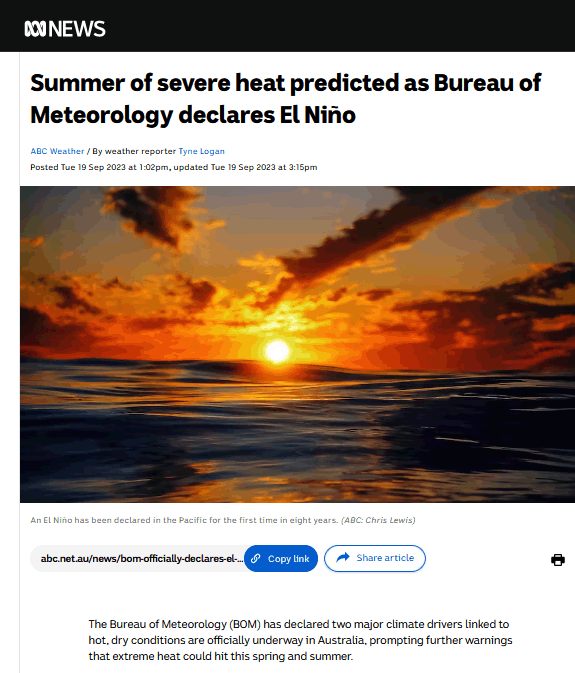
Back in September the BOM issued its El Nino alert, and Australians were told it would be a hot and dry and to prepare for a summer of bushfires. Farmer sold their lambs, and adjusted harvest accordingly.

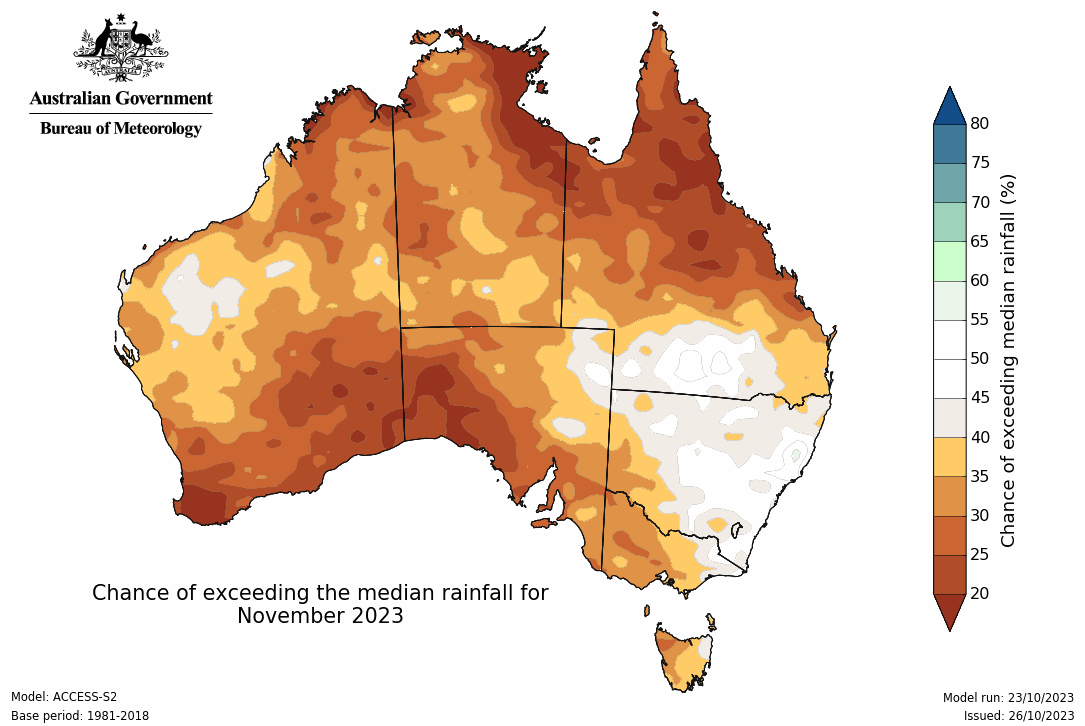
This was the BOM solemn prediction in late October, for the very next month of rainfall

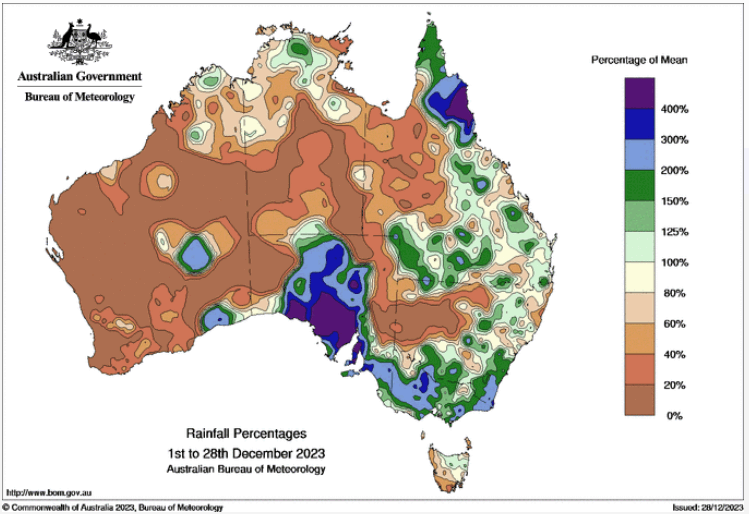
Across most of Australia the odds were only 20-40% of getting average rain.


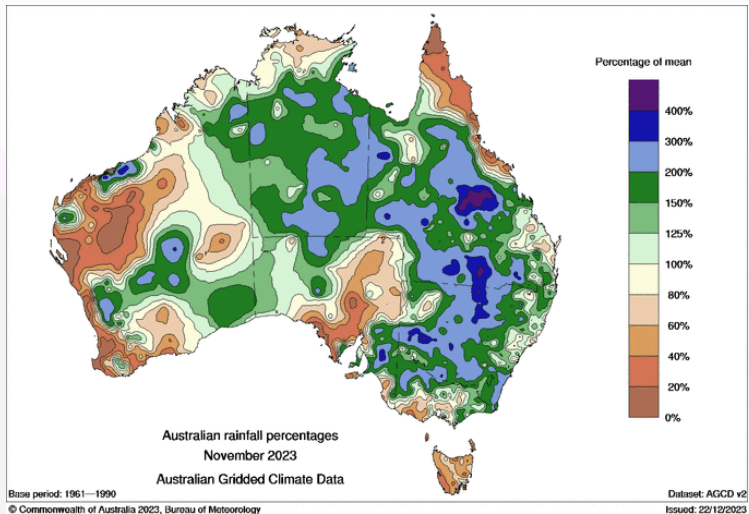
Instead this is what happened:

Bureau of MeteorologyAustralian rainfall percentages

BOM

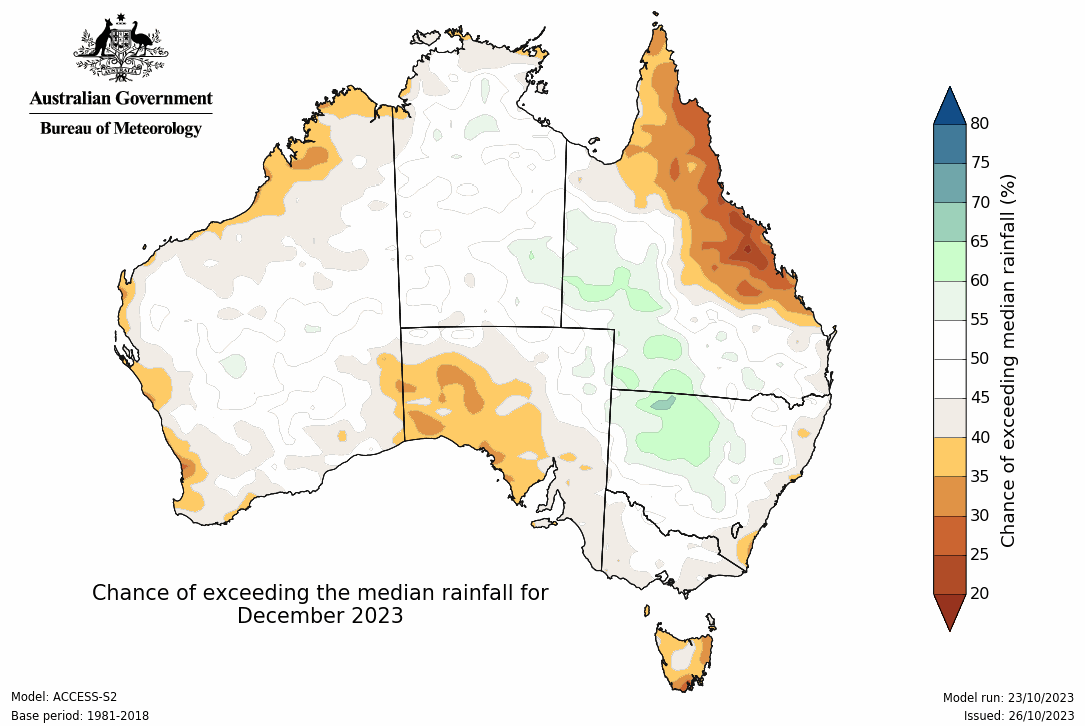
And in December most of the country was predicted to have a fifty fifty chance of getting “average” rain.


But the real weather gods had another idea, and all the places under any shades of green below got somewhere from 100% to 300% of the average rainfall. The indigo and purple zones got even more.

Bureau of Meteorology Australian rainfall percentages

BOM

This was a savage downpour — seven feet of rain in five days fell at one location:

No fewer than 12 locations across far north Queensland posted record rainfall totals.

Some areas received a year’s rainfall in a single day, isolating towns, closing highways and leaving hundreds stranded by surging floodwaters. Black Mountain near Cooktown recorded a cumulative 2189mm over the five days, while Mossman South, an hour northwest of Cairns, had 1935mm.

–The Australian

As the Mayor of Douglas Shire said:

“If this is so record-breaking, how did no one know this was going to happen … we need to have forecasts closer to what is going on.”

–The Australian

The BOM suddenly wants to absolve itself of liability

People have noticed there is now a mandatory check box forcing users to agree to a legal disclaimer clearing the BOM of all liability:

Users of the BOM app now have to agree to a 699-word “terms and conditions” statement that includes “information at this app … may not be accurate, current or complete”.

“To the maximum extent permitted by law, the bureau excludes any liability that may arise in connection with the BOM Weather app or any information or material presented therein or your access to or use of any of the same,’’ the bureau says in a “terms and conditions” statement that appears when a user attempts to download its app. — Mackenzie Scott, The Australian

They know they are in trouble.

I say the BOM can have immunity the same day Australians can also tick a box excluding ourselves from any and all costs, imposts and taxes related to any BOM predictions.

The Australian editors gives the BOM an escape valve it doesn’t deserve:

To be fair to the BOM, a hysterical and ill-informed media has allowed climate alarmism to infect reporting of what should be routine weather events.

For thirty years the Australian media has made hyperbolic scare stories about the weather while the BOM tacitly stood by and smiled. Where were they as the tenets of science were trashed, and critics were called “climate deniers”? If the BOM are victims of this hyperbole now, they reap what they sowed.

The BOM raised the stakes, and they don’t get to weasel out by saying “we used the best science” as if the best science wasn’t riddled with holes. If the science is good enough to throw away trillions of dollars, then the worst failures need a truckload of explanation.

Predicting the weather is hard. We could forgive the BOM for getting a complex immature science wrong, but not when they also tell us it’s just simple physics, they’re absolutely sure, and there is no doubt they’re wrong (give us your money!).

The European Rebellion Against Net Zero

Jo Nova writes on The Aussie Wire:

The European rebellion against the Sacred Quest for NetZero spreads — Green investors “shocked”

The European rebellion against the Sacred Quest for NetZero spreads — Green investors “shocked”
Spread the love
Fantasy NetZero

Turtle Castle image by SAIF 4

The following post on the topic of NetZero is syndicated from jonova.com.au

Rishi Sunak’s delay in the NetZero Quest was the crack in the Uniparty Wall

Thanks to NetZeroWatch

It threatens to ignite a climate election.  It matters, because now, suddenly, one party can point out the absurdities and the costs. They can be an Opposition, and mock the sacred cows. That doesn’t mean Sunak will do that, but the fork in the road has opened, the world is watching — and his party is suddenly up four points.

The Green funds cartel is “in shock” sayth Bloomberg, at the Sunak shift — so it must be pretty serious.  Green investors are using the words “dismay” and “bewilderment”, which they almost never use. Green investment relies almost entirely on crowd psychology and government subsidies, so normally bad news is padded and fluffed so it doesn’t look so bad. We wouldn’t want to lose momentum would we? Boy are they losing momentum.

Meanwhile Sweden has not only cut climate money a bit, it’s unshackled some taxes off fossil fuels as well, leaving the centre left apoplectic and threatening to move motions of no-confidence. It is unthinkable, apparently, but Sweden might even increase emissions.

Germany has suspended draconian building efficiency standards and stepped back from their full gas boiler ban. They had wanted to ban all new “fossil” heaters from 2024, but after fierce protests, have instead brought in a much diluted and delayed version due to be adopted in 2028.  President Emmanuel Macron must have been watching the German and British debacles. His new plan rules out a complete ban on gas boilers, and talks about protecting vulnerable people in rural areas, and even how the French love their cars.

What’s more scary than climate change? —  The rise of the far-right

The quote of the day is from a German politician who sums up the major driver of these policy shifts.

Earlier this month, German Finance Minister Christian Lindner told Politico that stricter energy efficiency rules for buildings could fuel the rise of the far-right, amid growing apathy across Europe over plans to reach net zero.

 CleanEnergyWire

So Climate Change might cause the sixth mass extinction of life on Earth, but nothing is more frightening than the possibility of the far-left losing power at elections.*

Polls have leapt for the conservative government in the UK since Rishi Sunak slowed the NetZero train

This is what all the Climate-believer politicians are afraid of. Deep down, they know the NetZero quest is not popular with the masses, even though they say it is all the time. If they thought climate policies were really winners with the workers, they wouldn’t be so afraid of their opponents catching the skeptical train would they? Instead, they are aghast when their opponents dare suggest other priorities might be higher than changing the weather.

Read the full article here

Renewable Paradise: Australia Set For Blackouts This Summer

From Jo Nova


#d6b15c">Blackouts are coming: Australian grid so fragile, expensive, cement giant already shuts down nearly every day

Fantasy, dystopia, plane in the sky.

Image by Vicente Godoy from Pixabay

By Jo Nova

We can’t even run a cement factory all day anymore

Get your candles for summer! Unlike the last three years the Australian national grid won’t be rescued by another cooler La Nina this summer. Fears of rolling blackouts this summer are fraying nerves at The Australian Financial Review Energy & Climate Summit. The transition is described as stuttering, gridlocked, faltering, and the government as “desperate”.

Things are so bad, former CEO’s of major generators are warning that “the lights are going to go out” and accusing one Energy Minister of speaking “complete and utter horseshit” because they don’t think we need reliable peaking gas plants to replace coal power. Said Energy Minister has responded by refusing to even take his calls. That’s really going to work. Meanwhile Japan is getting nervous just watching us, afraid we have screwed things up so badly we can’t be relied on to keep sending them gas.

Not only is summer nerve-wracking, but things are already so bad, one of our largest cement producers is shutting down nearly every day because it can’t afford to pay for the peak electricity spikes even in springtime. Here in Renewable World it’s cheaper to let 5,500 workers sit around for 30 minutes than pay for electricity. The company was paying 54% more for electricity than the year before.

Riding the Express Train to the Renewable Faraway Tree

The numbers are staggering. Australia is racing headlong to the glorious 82 per cent renewables target by 2030. The catch is that the national grid at the moment uses coal for 62% of its electricity. The opposition energy spokesman is calling it “lunacy”, which it is.  To reach the land of sunshine and breezes, our grid manager, the AEMO, is theoretically going to close two-thirds of the country’s existing coal power generation in the next ten years.

To put this in perspective, since the last hot summer we’ve shut down Liddell Coal plant, and still haven’t fixed the coal turbine that blew up in Queensland two years ago. New renewable investment has ground to a halt when it clearly should be going gangbusters. No one wants to build new wind and solar plants until someone builds the 10,000 kilometers of high voltage lines to reach distant cheap windy real estate, and no one wants to live or farm next to those transmission towers, so the protests are fierce.

Energy Summit confirms stuttering transition is not on track

Decarbonising Australia’s fossil-fuelled electricity grid is proving slower and more costly than previously advertised, with reliability risks increasing as the exits of coal-fired power plants run ahead of cleaner and reliable replacement generation.

Nerves are frayed “We’re not having an honest conversation”:

‘Get your candles’: energy experts are ‘terrified’ about this summer

Angela MacDonald-Smith, Australian Financial Review

Former Snowy Hydro CEO Paul Broad said, “the lights are going to go out” in a return to normal conditions after three mild summers and said politicians were not listening to the warnings about the risks around supply, while the industry was not speaking up enough.

“That’s our problem,” he said. “We’re not having the honest conversations and us in the industry we’re not speaking up.”

Mr Broad, who abruptly exited Snowy Hydro last year after a run-in with Mr Bowen, accused Victorian Energy Minister Lily D’Ambrosio of speaking “complete and utter horseshit” in her refusal to recognise the need for peaking gas power plants in Victoria as coal power exits the system.

He listed Ms D’Ambrosio among energy sector figures who would no longer take his calls as he tried to get the message through, including former Australian Energy Market Operator Audrey Zibelman.

We can’t even run a cement factory all day anymore:

The startling reason Boral is stopping production almost every day

Chanticleer, The Australian Financial Review

Mr Bansal [the chief executive of Boral] told the Summit that Boral’s electricity price rose by 54 per cent in the 12 months to the second half of last year, and have not retreated, counter to expectations.

He said Boral had about 5500 “blue collar” workers who were being told to stand aside and do nothing for 30 minutes at a time when power prices made it too expensive to operate.

“At a certain price during the day, when the price goes up [to] a certain level, our manufacturing stops because we’ve worked out economically it’s actually better to have thousands of people waiting idle for the prices to come down then actually do the work,” he said.

“That’s a real issue we are facing every single day on 300 manufacturing sites across the country. So we are extremely nervous what that means.”

The chief at Boral pointed out that he’s not willing to sign up to 20 year electricity contracts because everything is so uncertain.

They still don’t understand the difference between reliable and unreliable power

It’s OK, the believers protest, Australia has added 20 gigawatts of solar.

“Australia has three-and-a-half-million solar systems installed and that represents around 20 gigawatts of potential output,” Westerman says.

“That’s more than seven Eraring power stations at full output and capable of meeting almost half the energy demand in the day when the sun is shining at its brightest.”

As if solar panels can be measured on the same page as a coal plant. For half an hour a day, on a good day, only in summer, and as long as the clouds don’t roll over, the peak output might be like seven coal plants. These people are crazy.

The Climate Is Always Changing

Jo Nova writes:

#d6b15c">2,500 years of wild climate change in southern Europe: It was warmer in Roman Times than now

Pyrenes, Cave, Medieval, Little Ice Age, Roman Times. Temperature.By Jo Nova

Nothing at all about the modern era stands out as unusual at all

Thanks to David Whitehouse at NetZeroWatch who has found a remarkable paper: Pyrenean caves reveal a warmer past

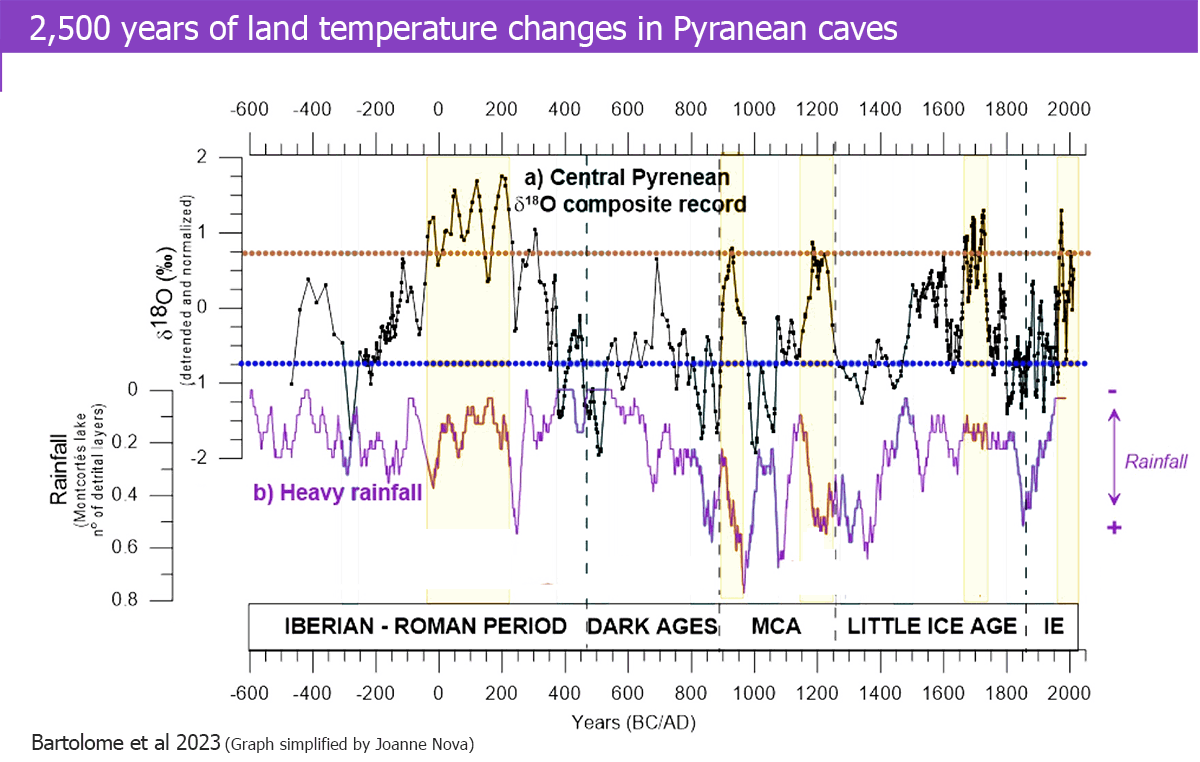
The new study on stalagmites in caves of the Pyrenees shows that modern climate change is nothing compared to normal fluctuations in the last 2,500 years, when it was at times  much hotter, colder, and more volatile. Rapid shifts between temperatures were common.

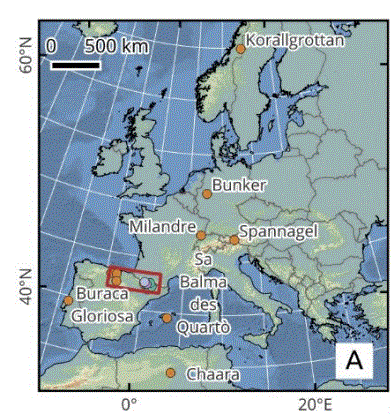
The researchers looked at 8 stalagmites in 4 caves and local lake levels, but they also compared their results with other European temperature proxies and reconstructions and the pattern is consistent across the region. The Roman Warm Period was much hotter than today, and for hundreds of years as well, even though coal plants were rare. Apparently, there was a reason Romans were dressed in togas.

The Dark Ages were very cold, especially around 520 – 550AD — which may be related to what the researchers call a “cataclysmic” volcanic eruption that took place in Iceland in 536AD. It was followed by two other massive volcanoes in 540 and  547AD. This effect is apparently visible in European tree rings which showed “an unprecedented, long-lasting and spatially synchronized cooling”.

Indeed, the researchers declare that volcanoes and solar variability appear to be the main drivers of the climate in SouthWestern Europe.

So finally we see one long continuous proxy record from ancient Greek times right through until 2010. The big question is why these sorts of studies are not done everywhere and all the time. It’s not like we don’t have plenty of caves with stalagmites to analyze. If the climate really was “the biggest threat to life on Earth” why are these extraordinary datasets not the top item on the wish-list of every institution that claims they cares about the climate?

There will be more to say on this remarkable paper:

Pyrenes, Cave, Medieval, Little Ice Age, Roman Times. Temperature.

Click to enlarge. Oxygen isotopes are used to estimate temperatures.


Some passages from the paper discuss how these results match other studies from Europe

The cold event at ca. 540 AD (the coldest of the speleothem record) may be related to a cataclysmic volcanic eruption that took place in Iceland in 536 AD and spewed ash across the Northern Hemisphere, together with the effect of two other massive eruptions in 540 and 547 AD (Sigl et al., 2015). An unprecedented, long-lasting and spatially synchronized cooling was observed in European tree-ring records associated with these large volcanic eruptions, corresponding to the LALIA period (Büntgen et al., 2016).

Some passages from the paper discuss how these results compare with many other studies from Europe and with stark moments in history.

5.2.2. Temperature variability in W Europe and the W Mediterranean during last 2500 years
There are very few high-resolution speleothem records in Europe covering the CE (Comas-Bru et al., 2020). We compare the Central Pyrenean speleothem composite with nine selected speleothems records in Europe  and northern Africa which cover with robust chronology and decadal resolution the last 2500 years (Fig.  5). One of these records is interpreted as NAO variability (Baker et al., 2015), three are paleo-precipitation reconstructions (Ait Brahim et al., 2019; Cisneros et al., 2021; Thatcher et al., 2022) and the other five are  reflecting paleo-temperature variations (Affolter et al., 2019; Fohlmeister et al., 2012; Mangini et al., 2005;  Martín-Chivelet et al., 2011; Sundqvist et al., 2010). Considering these differences in the interpretation and the fact these records are from different regions with different climates (from Sweden to Morocco), dissimilar profiles of paleoclimate variability can be expected. Still, some features are comparable and can be discussed to obtain a super-regional picture.

A. The Roman period in Europe-W Mediterranean. In Europe, and particularly in the Mediterranean region, the RP is well-known as a warm period (e.g., McCormick et al., 2012). The average sea-surface temperature in the western Mediterranean Sea was 2°C higher than the average temperature of the late centuries (Margaritelli et al., 2020). Our composite, with high values of normalized  18O values during the whole RP, and particularly from 0-200 AD, agrees with the scenario of warm temperatures (Fig. 5i). Speleothem data from the Balearic Islands (Cisneros et al., 2021) indicate a transition from humid to dry conditions along the Iberian-RP (Fig. 5c). The dry period at the end of the RP in the Balearic record, appears in agreement with a new speleothem record from northern Italy (Hu et al., 2022), suggesting that the observed drying trend was a possible contribution to the collapse of the Roman Empire in 476 AD. Record from Morocco (Ait Brahim et al., 2019), contrarily, marks a humid trend at the end of the RP (Fig. 5d). Similarly, an increase in humidity was observed in southern Iberia during the Iberian-Roman Period (Jiménez-Moreno et al., 2013; Martín-Puertas et al., 2009) thus reflecting a large spatial heterogeneity in precipitation during the RP when comparing records from the north and south of the Mediterranean basin.

REFERENCES

Bartolomé, M., Moreno, A., Sancho, C., Cacho, I., Stoll, H., Haghipour, N., Belmonte, Á., Spötl, C., Hellstrom, J., Edwards, R. L., and Cheng, H.: Reconstructing land temperature changes of the past 2,500 years using speleothems from Pyrenean caves (NE Spain), Clim. Past Discuss. [preprint], https://doi.org/10.5194/cp-2023-54, in review, 2023.

No changes in global droughts since 1902 when horses and carts were common

From Jo Nova:

No changes in global droughts since 1902 when horses and carts were common

By Jo Novadesert,tree, sand, drought, dry, doom, death. dystopian.

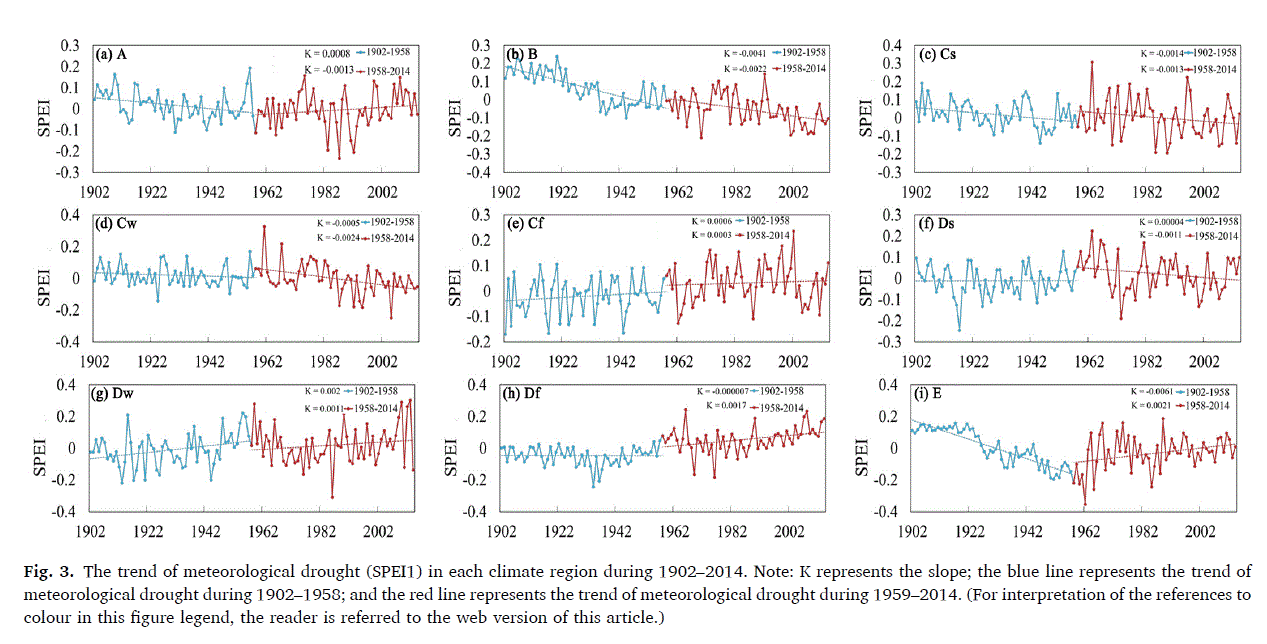
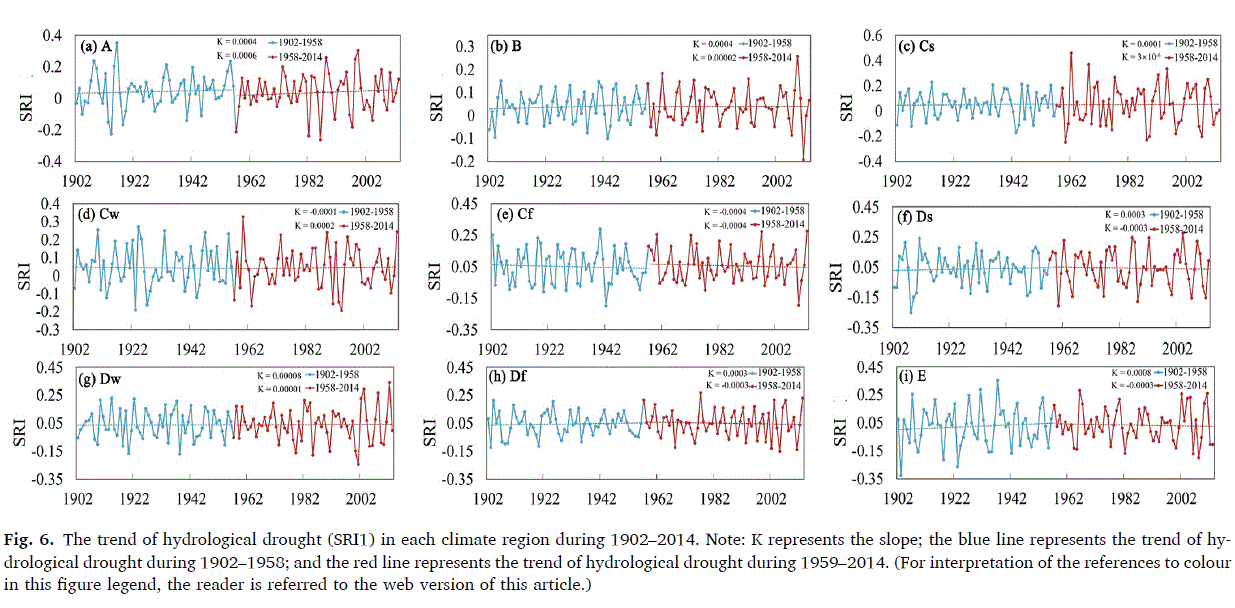
Any which way you look at global drought measures in the last 120 years this is not the CO2 doom scenario of the IPCC prophesies either in rainfall patterns or in water supplies. The graphs below show rainfall trends shifting slightly due to unknown forces and looking for all the world, like CO2 is irrelevant. Despite the scare campaigns about floods and droughts, and the threats of climate wars over dwindling rivers, there has been no trend in hydrological droughts since the Wright Brothers first flew a plane.

Kenneth Richards at NoTricksZone reported on Shi et al, a paper which looked at trends from 1902 to 2014 in all nine climate zones of the world.

The first graph shows a mixed bag of trends in Meteorological Droughts, none of which are obviously linked to human emissions of CO2. Remember, half of all human emissions since we crawled out of caves has been emitted after 1995. According to CDIAC fully 250,000 Mt of CO2 was emitted up to that year, then we have doubled that in the years since then. If CO2 was a planet transforming molecule, surely we’d see something in the last 25 years?

The bottom line is that if we had climate models with any understanding of rainfall they would be able to predict wet and dry seasons, and trends in droughts, floods, streamflow, and rivers. Instead, like stone-age heathen victims, we wail and lament any time a flood or a drought happens anywhere. We blame camels or cows,  trucks and planes. We change our light globes and hope our houses don’t get washed away on the same floodplains that were inundated 100 years ago.

The first graphs show Meteorological Droughts trends in the nine climate regions (a lack of rain):

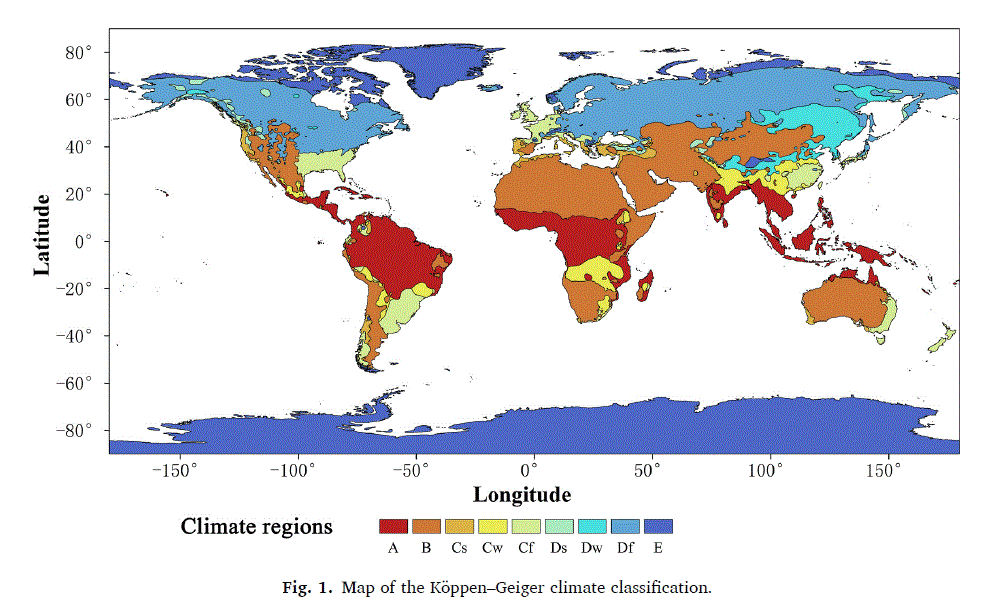
The regions codes are on the map below. (Click to enlarge).

Global drought last century. Graphed.

Meteorological Drought trends. (Click to Enlarge) Shi et al 2023

The second set of graphs are the hydrological drought trends (a lack of water supply):

Global drought last century. Graphed.

Hydrological Drought trends. (Click to Enlarge) Shi et al 2023

These are the climate zones the study used:

Global drought last century. Graphed.

Classification of different drought regions of the world. Shi et al 2023

(Essentially Australia is B, Cf and A,  The USA is B, Cf and Df. The UK, France, Germany and NZ are Cf).

#302226;font-family: Candara, Verdana, sans-serif">DEFINITIONS

According to NOAA, a Meteorological Drought is a lack of rain suffered for an extended time, whereas a Hydrological Drought is a lack of water supply such as stream flow, reservoir and lake levels, and ground water.

#302226;font-family: Candara, Verdana, sans-serif">REFERENCE

Haiyun Shi et al (2023) A global perspective on propagation from meteorological drought to hydrological drought during 1902–2014, Atmospheric Research
Volume 280, 15 December 2022, 106441, https://doi.org/10.1016/j.atmosres.2022.106441


NASA: Heat in Northern Hemisphere Caused By Water Vapour Not CO2

From wattsupwththat.com:


What NASA and the European Space Agency are admitting but the media are failing to report about our current heat wave


Reposted from American Thinker

By Thomas Lifson

Bumped from Sunday:

The current heat wave is being relentlessly blamed on increasing levels of carbon dioxide in the atmosphere, but there is a much more plausible explanation, one that is virtually endorsed by two of the world’s leading scientific organizations. It turns out that levels of water vapor in the atmosphere have dramatically increased over the last year-and-a-half, and water vapor is well recognized as a greenhouse gas, whose heightened presence leads to higher temperatures, a mechanism that dwarfs any effect CO2 may have.

So, why has atmospheric water vapor increased so dramatically? Because of a historic, gigantic volcanic eruption last year that I – probably along with you — had never heard of. The mass media ignored it because it took place 490 feet underwater in the South Pacific. Don’t take it from me, take it from NASA (and please do follow the link to see time lapse satellite imagery of the underwater eruption and subsequent plume of gasses and water injected into the atmosphere):

still from the time lapse photos


When the Hunga Tonga-Hunga Ha’apai volcano erupted on Jan. 15, it sent a tsunami racing around the world and set off a sonic boom that circled the globe twice. The underwater eruption in the South Pacific Ocean also blasted an enormous plume of water vapor into Earth’s stratosphere – enough to fill more than 58,000 Olympic-size swimming pools. The sheer amount of water vapor could be enough to temporarily affect Earth’s global average temperature.

“We’ve never seen anything like it,” said Luis Millán, an atmospheric scientist at NASA’s Jet Propulsion Laboratory in Southern California. He led a new study examining the amount of water vapor that the Tonga volcano injected into the stratosphere, the layer of the atmosphere between about 8 and 33 miles (12 and 53 kilometers) above Earth’s surface.

In the study, published in Geophysical Research Letters, Millán and his colleagues estimate that the Tonga eruption sent around 146 teragrams (1 teragram equals a trillion grams) of water vapor into Earth’s stratosphere – equal to 10% of the water already present in that atmospheric layer. That’s nearly four times the amount of water vapor that scientists estimate the 1991 Mount Pinatubo eruption in the Philippines lofted into the stratosphere. [emphases added]

NASA published the above in August 2022. Half a year later, a newer study increased the estimate of the water vapor addition to the atmosphere by 30%. From the European Space Agency:

In a recent paper published in Nature, a team of scientists showed the unprecedented increase in the global stratospheric water mass by 13% (relative to climatological levels) and a five-fold increase of stratospheric aerosol load – the highest in the last three decades.

Using a combination of satellite data, including data from ESA’s Aeolus satellite, and ground-based observations, the team found that due to the extreme altitude, the volcanic plume circumnavigated the Earth in just one week and dispersed nearly pole-to-pole in three months. [emphasis added]

Another scientific paper explains the “net warming of the climate system” on a delayed basis.  NASA’s Jet Propulsion Laboratory further explains:

Volcanic eruptions rarely inject much water into the stratosphere. In the 18 years that NASA has been taking measurements, only two other eruptions – the 2008 Kasatochi event in Alaska and the 2015 Calbuco eruption in Chile – sent appreciable amounts of water vapor to such high altitudes. But those were mere blips compared to the Tonga event, and the water vapor from both previous eruptions dissipated quickly. The excess water vapor injected by the Tonga volcano, on the other hand, could remain in the stratosphere for several years.

This extra water vapor could influence atmospheric chemistry, boosting certain chemical reactions that could temporarily worsen depletion of the ozone layer. It could also influence surface temperatures. Massive volcanic eruptions like Krakatoa and Mount Pinatubo typically cool Earth’s surface by ejecting gases, dust, and ash that reflect sunlight back into space. In contrast, the Tonga volcano didn’t inject large amounts of aerosols into the stratosphere, and the huge amounts of water vapor from the eruption may have a small, temporary warming effect, since water vapor traps heat. The effect would dissipate when the extra water vapor cycles out of the stratosphere [Emphases added]

So there you have it: we are in for extra atmospheric heat “for several years” until the extra water vapor injected by this largest-ever-recorded underwater volcano eruption dissipates.

Jeff Childers, who brought this scientific data to my notice, writes:

 Here’s why corporate media is ignoring the most dramatic climate even[t] in modern history: because you can’t legislate underwater volcanoes. You can try, but they won’t listen. So what’s the fun in that? Corporate media only exists to further political ends. Since volcanoes aren’t subject to politics, why bother?

 He brings up the work of Ethical Skeptic:

Ethical is suggesting that the water is heating the air — instead of the other way around. And the Earth’s core is heating the water.  It’s a theory that explains everything.

Meanwhile, “science” is baffled. From just a month ago, in mid-June:

See? But though scientists are baffled, corporate media and its repulsive allies are busily blaming ocean warming on carbon dioxide — a ludicrous notion.

I am the first to admit that none of this – not the atmospheric CO2 theory of global warming, nor the effect of the largest ever known undersea volcanic eruption – is scientifically proven. But before we impoverish ourselves trying to reduce CO2 emissions (while watching China dramatically increase them), let’s practice real science and not jump to conclusions based on an imaginary “consensus.”

Jo Nova: It’s Not That Hot

Climate panickers think that if it’s summer, it must be the hottest ever. The Medieval Warm Period was warmer than where we are now, and no nasty coal and oil to blame then.

Jo Nova writes:

European heatwaves: Soldiers died in the heat in 1160, Rivers ran dry in 1303, animals fell dead in 1393

By Jo Nova

Medieval “climate change” was filled with heatwaves, droughts, and crop failures

One thousand years ago, “rivers ran dry under the protracted heat, the fish were left dry in heaps and putrefied in a few hours.”  Men and animals venturing in the sun in the summer of 1022 fell down dying.”

It was so hot in 1132 that the rivers ran dry and “the ground was baked to the hardness of stone”.  Around 1200 at the Battle of Bela “there were more victims made by the sun than by weapons”. In 1303 and 1304, the Seine, the Loire, the Rhine, and the Danube could all be crossed with dry feet, and they dried up again in 1538-1541. In 1393 and 1394 the crops were “scorched up” and “great numbers of animals fell dead”. In 1625 in Scotland, it was so hot “meat could be cooked merely by exposing it to the Sun.”

And so it goes — history that was known in the 1800’s appears to be disappearing, leaving us with a generation of snowflakes who think they are the only humans who ever faced hot weather. They with their airconditioned bedrooms, mobile phones and filtered water.

In 879, agricultural laborers, who must have been as tough as nails, were struck down after “just a few minutes in the sun”.

Thanks to Tony Heller at RealClimateScience who has a resource page: “1500 Years of Heatwaves”

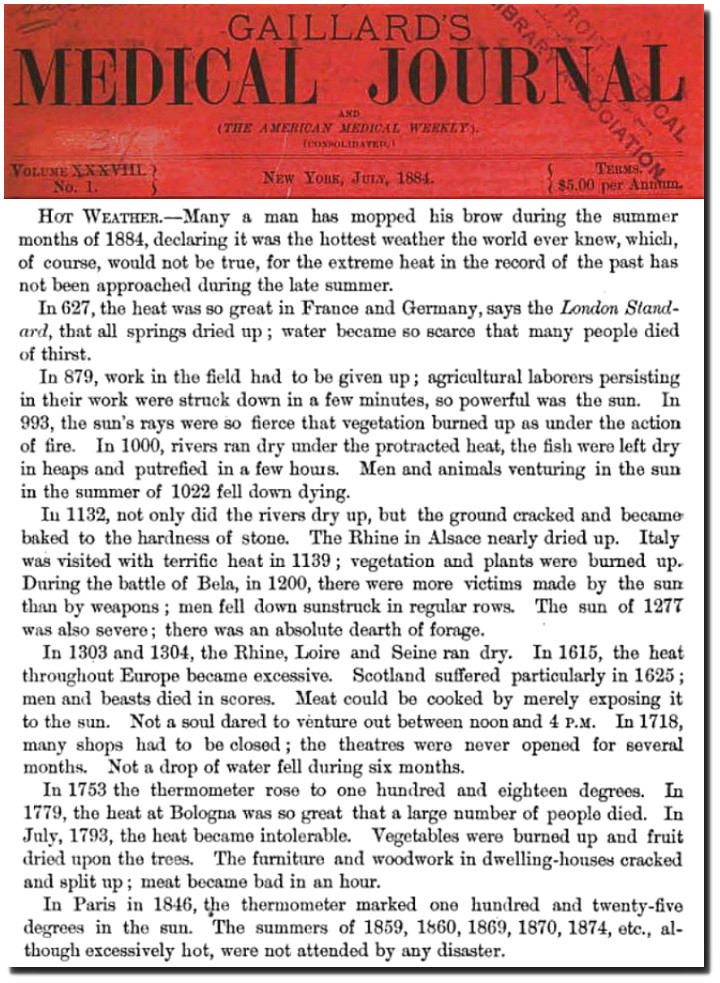
Gaillard’s Medical Journal – Google Books

Heatwaves of Europe in Medieval times.

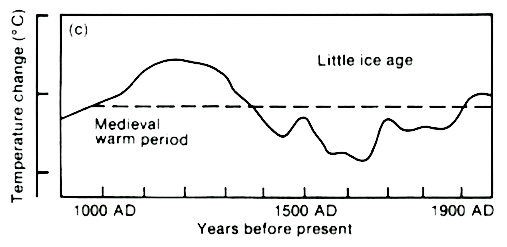
The Medieval Warm Period was a global phenomenon, see the graphs, the pollen, the sea sediments and tree rings. And the IPCC knew it in 1990 too.

IPCC FAR Report, Medieval Warm Period.

1990 IPCC FAR Report, Medieval Warm Period.

They’ve been rubbing out the Medieval Warm Period ever since. Even though Hubert Lamb did the graph in 1982, scores of different proxies have gone on to support it on every continent.  References at the link above plus at the tag Medieval Warm Period.

h/t also Paul Homewood at Notalotofpeopleknowthat

Text copied below:

“Hot Weather.—Many a man has mopped his brow during the summer months of 1884, declaring it was the hottest weather the world ever knew, which, of course, would not be true, for the extreme heat in the record of the past has not been approached during the late summer.

In 627, the heat was so great in France and Germany, says the London Standard, that all springs dried up; water became so scarce that many people died of thirst.

In 879, work in the field had to be given up; agricultural laborers persisting in their work were struck down in a few minutes, so powerful was the sun. In 993, the sun’s rays were so fierce that vegetation burned up as under the action of fire. In 1000, rivers ran dry under the protracted heat, the fish were left dry in heaps and putrefied in a few hours. Men and animals venturing in the sun in the summer of 1022 fell down dying.

In 1132, not only did the rivers dry up, but the ground cracked and became baked to the hardness of stone. The Rhine in Alsace nearly dried up. Italy was visited with terrific heat in 1189; vegetation and plants were burned up. During the battle of Bela, in 1200, there were more victims made by the sun than by weapons ; men fell down sunstruck in regular rows. The sun of 1277 was also severe; there was an absolute dearth of forage.

In 1303 and 1304, the Rhine, Loire and Seine ran dry. In 1615, the heat throughout Europe became excessive. Scotland suffered particularly in 1625 ; men and beasts died in scores. Meat could be cooked by merely exposing it to the sun. Not a soul dared to venture out between noon and 4 p.m. In 1718, many shops had to be closed; the theatres were never opened for several months. Not a drop of water fell during six months.

In 1753 the thermometer rose to one hundred and eighteen degrees. In 1779, the heat at Bologna was so great that a large number of people died. In July, 1793, the heat became intolerable. Vegetables were burned up and fruit dried upon the trees. The furniture and woodwork in dwelling-houses cracked and split up; meat became bad in an hour.

In Paris in 1846, the thermometer marked one hundred and twenty-five degrees in the sun. The summers of 1859, 1860, 1869, 1870, 1874, etc., although excessively hot, were not attended by any disaster.”