The Climate Is Always Changing

Jo Nova writes:

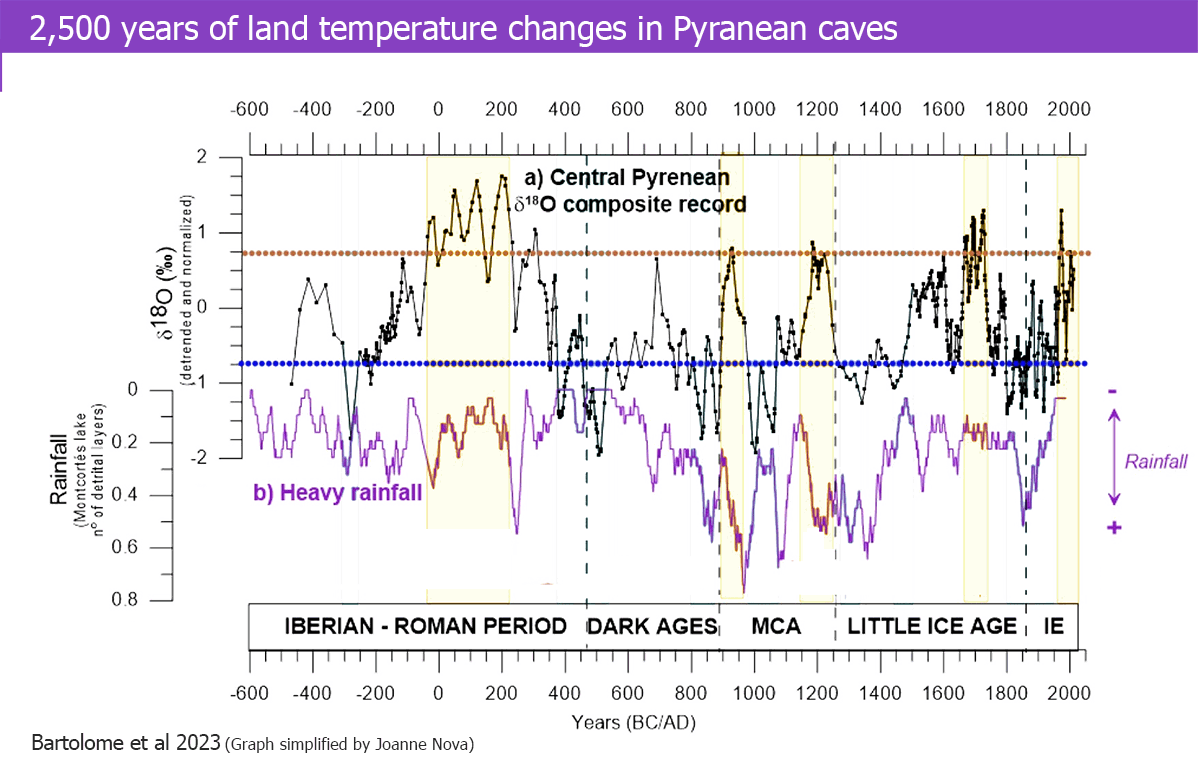
2,500 years of wild climate change in southern Europe: It was warmer in Roman Times than now

Pyrenes, Cave, Medieval, Little Ice Age, Roman Times. Temperature.By Jo Nova

Nothing at all about the modern era stands out as unusual at all

Thanks to David Whitehouse at NetZeroWatch who has found a remarkable paper: Pyrenean caves reveal a warmer past

The new study on stalagmites in caves of the Pyrenees shows that modern climate change is nothing compared to normal fluctuations in the last 2,500 years, when it was at times  much hotter, colder, and more volatile. Rapid shifts between temperatures were common.

The researchers looked at 8 stalagmites in 4 caves and local lake levels, but they also compared their results with other European temperature proxies and reconstructions and the pattern is consistent across the region. The Roman Warm Period was much hotter than today, and for hundreds of years as well, even though coal plants were rare. Apparently, there was a reason Romans were dressed in togas.

The Dark Ages were very cold, especially around 520 – 550AD — which may be related to what the researchers call a “cataclysmic” volcanic eruption that took place in Iceland in 536AD. It was followed by two other massive volcanoes in 540 and  547AD. This effect is apparently visible in European tree rings which showed “an unprecedented, long-lasting and spatially synchronized cooling”.

Indeed, the researchers declare that volcanoes and solar variability appear to be the main drivers of the climate in SouthWestern Europe.

So finally we see one long continuous proxy record from ancient Greek times right through until 2010. The big question is why these sorts of studies are not done everywhere and all the time. It’s not like we don’t have plenty of caves with stalagmites to analyze. If the climate really was “the biggest threat to life on Earth” why are these extraordinary datasets not the top item on the wish-list of every institution that claims they cares about the climate?

There will be more to say on this remarkable paper:

Pyrenes, Cave, Medieval, Little Ice Age, Roman Times. Temperature.

Click to enlarge. Oxygen isotopes are used to estimate temperatures.


Some passages from the paper discuss how these results match other studies from Europe

The cold event at ca. 540 AD (the coldest of the speleothem record) may be related to a cataclysmic volcanic eruption that took place in Iceland in 536 AD and spewed ash across the Northern Hemisphere, together with the effect of two other massive eruptions in 540 and 547 AD (Sigl et al., 2015). An unprecedented, long-lasting and spatially synchronized cooling was observed in European tree-ring records associated with these large volcanic eruptions, corresponding to the LALIA period (Büntgen et al., 2016).

Some passages from the paper discuss how these results compare with many other studies from Europe and with stark moments in history.

5.2.2. Temperature variability in W Europe and the W Mediterranean during last 2500 years
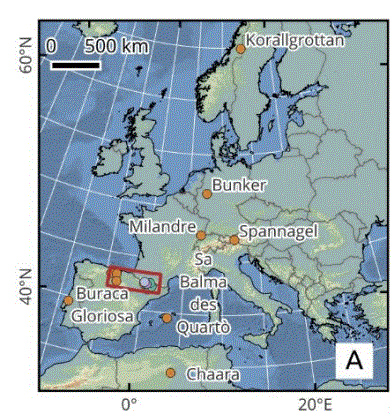
There are very few high-resolution speleothem records in Europe covering the CE (Comas-Bru et al., 2020). We compare the Central Pyrenean speleothem composite with nine selected speleothems records in Europe  and northern Africa which cover with robust chronology and decadal resolution the last 2500 years (Fig.  5). One of these records is interpreted as NAO variability (Baker et al., 2015), three are paleo-precipitation reconstructions (Ait Brahim et al., 2019; Cisneros et al., 2021; Thatcher et al., 2022) and the other five are  reflecting paleo-temperature variations (Affolter et al., 2019; Fohlmeister et al., 2012; Mangini et al., 2005;  Martín-Chivelet et al., 2011; Sundqvist et al., 2010). Considering these differences in the interpretation and the fact these records are from different regions with different climates (from Sweden to Morocco), dissimilar profiles of paleoclimate variability can be expected. Still, some features are comparable and can be discussed to obtain a super-regional picture.

A. The Roman period in Europe-W Mediterranean. In Europe, and particularly in the Mediterranean region, the RP is well-known as a warm period (e.g., McCormick et al., 2012). The average sea-surface temperature in the western Mediterranean Sea was 2°C higher than the average temperature of the late centuries (Margaritelli et al., 2020). Our composite, with high values of normalized  18O values during the whole RP, and particularly from 0-200 AD, agrees with the scenario of warm temperatures (Fig. 5i). Speleothem data from the Balearic Islands (Cisneros et al., 2021) indicate a transition from humid to dry conditions along the Iberian-RP (Fig. 5c). The dry period at the end of the RP in the Balearic record, appears in agreement with a new speleothem record from northern Italy (Hu et al., 2022), suggesting that the observed drying trend was a possible contribution to the collapse of the Roman Empire in 476 AD. Record from Morocco (Ait Brahim et al., 2019), contrarily, marks a humid trend at the end of the RP (Fig. 5d). Similarly, an increase in humidity was observed in southern Iberia during the Iberian-Roman Period (Jiménez-Moreno et al., 2013; Martín-Puertas et al., 2009) thus reflecting a large spatial heterogeneity in precipitation during the RP when comparing records from the north and south of the Mediterranean basin.

REFERENCES

Bartolomé, M., Moreno, A., Sancho, C., Cacho, I., Stoll, H., Haghipour, N., Belmonte, Á., Spötl, C., Hellstrom, J., Edwards, R. L., and Cheng, H.: Reconstructing land temperature changes of the past 2,500 years using speleothems from Pyrenean caves (NE Spain), Clim. Past Discuss. [preprint], https://doi.org/10.5194/cp-2023-54, in review, 2023.

No changes in global droughts since 1902 when horses and carts were common

From Jo Nova:

No changes in global droughts since 1902 when horses and carts were common

By Jo Novadesert,tree, sand, drought, dry, doom, death. dystopian.

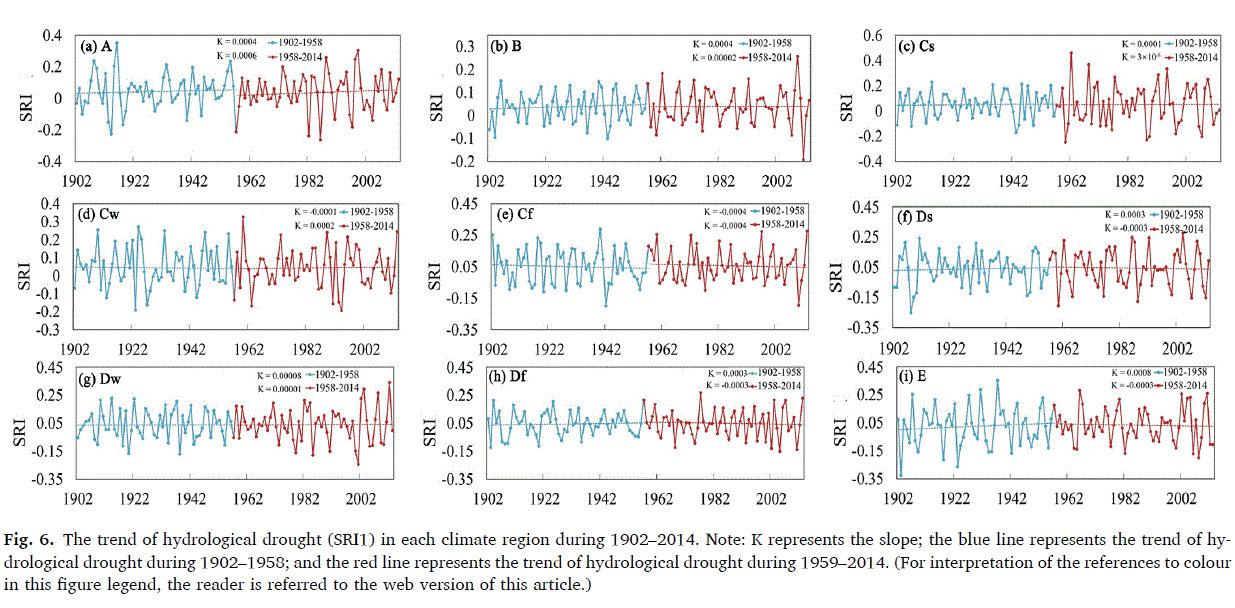
Any which way you look at global drought measures in the last 120 years this is not the CO2 doom scenario of the IPCC prophesies either in rainfall patterns or in water supplies. The graphs below show rainfall trends shifting slightly due to unknown forces and looking for all the world, like CO2 is irrelevant. Despite the scare campaigns about floods and droughts, and the threats of climate wars over dwindling rivers, there has been no trend in hydrological droughts since the Wright Brothers first flew a plane.

Kenneth Richards at NoTricksZone reported on Shi et al, a paper which looked at trends from 1902 to 2014 in all nine climate zones of the world.

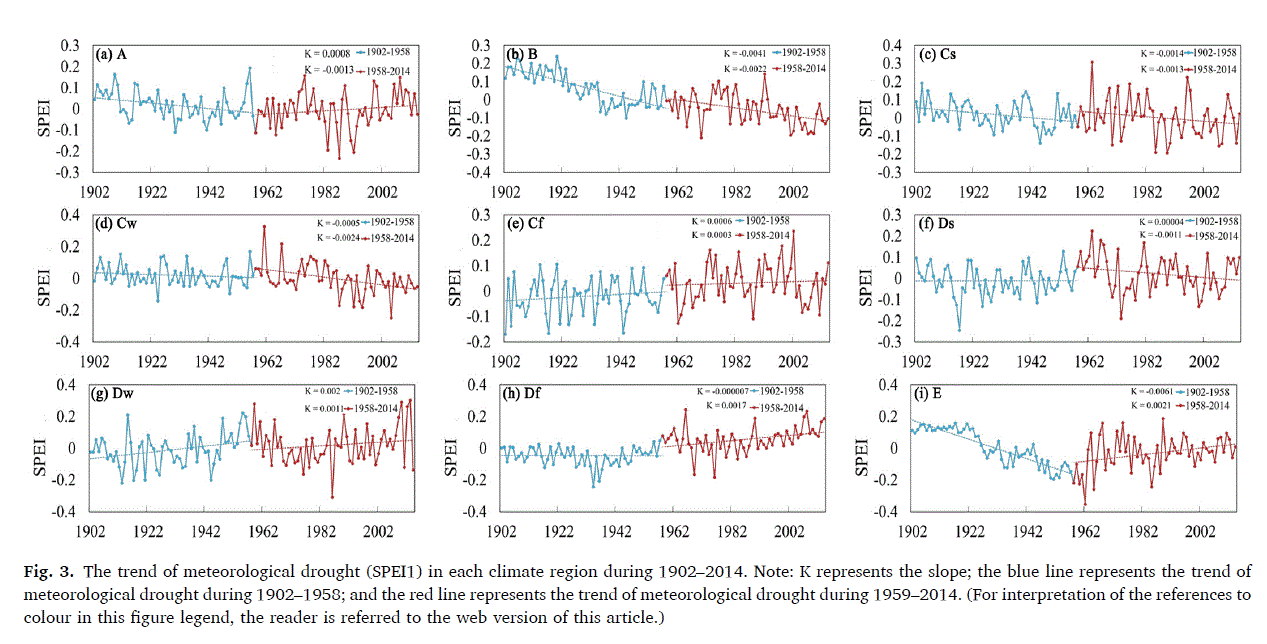
The first graph shows a mixed bag of trends in Meteorological Droughts, none of which are obviously linked to human emissions of CO2. Remember, half of all human emissions since we crawled out of caves has been emitted after 1995. According to CDIAC fully 250,000 Mt of CO2 was emitted up to that year, then we have doubled that in the years since then. If CO2 was a planet transforming molecule, surely we’d see something in the last 25 years?

The bottom line is that if we had climate models with any understanding of rainfall they would be able to predict wet and dry seasons, and trends in droughts, floods, streamflow, and rivers. Instead, like stone-age heathen victims, we wail and lament any time a flood or a drought happens anywhere. We blame camels or cows,  trucks and planes. We change our light globes and hope our houses don’t get washed away on the same floodplains that were inundated 100 years ago.

The first graphs show Meteorological Droughts trends in the nine climate regions (a lack of rain):

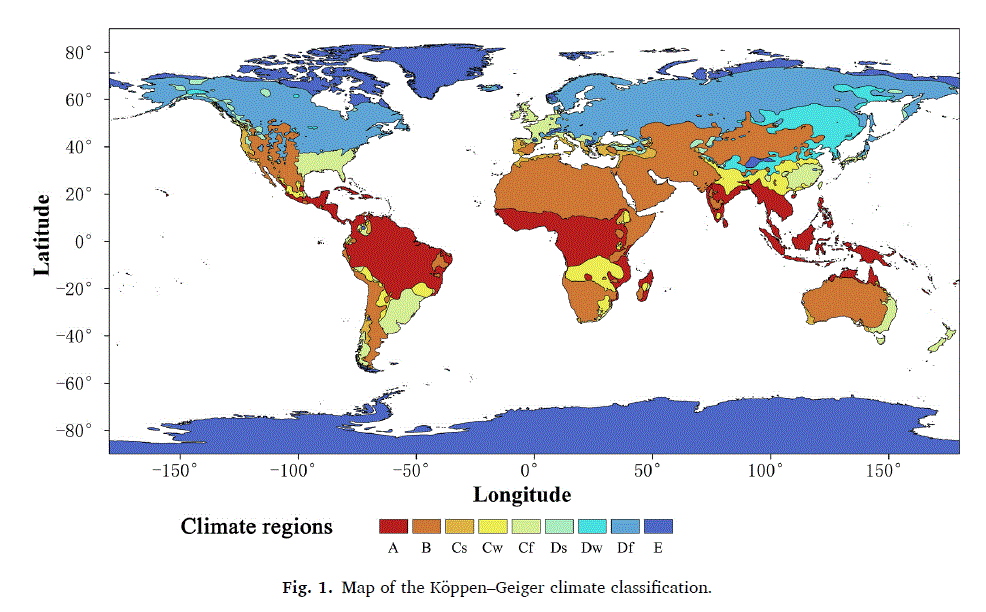
The regions codes are on the map below. (Click to enlarge).

Global drought last century. Graphed.

Meteorological Drought trends. (Click to Enlarge) Shi et al 2023

The second set of graphs are the hydrological drought trends (a lack of water supply):

Global drought last century. Graphed.

Hydrological Drought trends. (Click to Enlarge) Shi et al 2023

These are the climate zones the study used:

Global drought last century. Graphed.

Classification of different drought regions of the world. Shi et al 2023

(Essentially Australia is B, Cf and A,  The USA is B, Cf and Df. The UK, France, Germany and NZ are Cf).

DEFINITIONS

According to NOAA, a Meteorological Drought is a lack of rain suffered for an extended time, whereas a Hydrological Drought is a lack of water supply such as stream flow, reservoir and lake levels, and ground water.

REFERENCE

Haiyun Shi et al (2023) A global perspective on propagation from meteorological drought to hydrological drought during 1902–2014, Atmospheric Research
Volume 280, 15 December 2022, 106441, https://doi.org/10.1016/j.atmosres.2022.106441


NASA: Heat in Northern Hemisphere Caused By Water Vapour Not CO2

From wattsupwththat.com:


What NASA and the European Space Agency are admitting but the media are failing to report about our current heat wave


Reposted from American Thinker

By Thomas Lifson

Bumped from Sunday:

The current heat wave is being relentlessly blamed on increasing levels of carbon dioxide in the atmosphere, but there is a much more plausible explanation, one that is virtually endorsed by two of the world’s leading scientific organizations. It turns out that levels of water vapor in the atmosphere have dramatically increased over the last year-and-a-half, and water vapor is well recognized as a greenhouse gas, whose heightened presence leads to higher temperatures, a mechanism that dwarfs any effect CO2 may have.

So, why has atmospheric water vapor increased so dramatically? Because of a historic, gigantic volcanic eruption last year that I – probably along with you — had never heard of. The mass media ignored it because it took place 490 feet underwater in the South Pacific. Don’t take it from me, take it from NASA (and please do follow the link to see time lapse satellite imagery of the underwater eruption and subsequent plume of gasses and water injected into the atmosphere):

still from the time lapse photos


When the Hunga Tonga-Hunga Ha’apai volcano erupted on Jan. 15, it sent a tsunami racing around the world and set off a sonic boom that circled the globe twice. The underwater eruption in the South Pacific Ocean also blasted an enormous plume of water vapor into Earth’s stratosphere – enough to fill more than 58,000 Olympic-size swimming pools. The sheer amount of water vapor could be enough to temporarily affect Earth’s global average temperature.

“We’ve never seen anything like it,” said Luis Millán, an atmospheric scientist at NASA’s Jet Propulsion Laboratory in Southern California. He led a new study examining the amount of water vapor that the Tonga volcano injected into the stratosphere, the layer of the atmosphere between about 8 and 33 miles (12 and 53 kilometers) above Earth’s surface.

In the study, published in Geophysical Research Letters, Millán and his colleagues estimate that the Tonga eruption sent around 146 teragrams (1 teragram equals a trillion grams) of water vapor into Earth’s stratosphere – equal to 10% of the water already present in that atmospheric layer. That’s nearly four times the amount of water vapor that scientists estimate the 1991 Mount Pinatubo eruption in the Philippines lofted into the stratosphere. [emphases added]

NASA published the above in August 2022. Half a year later, a newer study increased the estimate of the water vapor addition to the atmosphere by 30%. From the European Space Agency:

In a recent paper published in Nature, a team of scientists showed the unprecedented increase in the global stratospheric water mass by 13% (relative to climatological levels) and a five-fold increase of stratospheric aerosol load – the highest in the last three decades.

Using a combination of satellite data, including data from ESA’s Aeolus satellite, and ground-based observations, the team found that due to the extreme altitude, the volcanic plume circumnavigated the Earth in just one week and dispersed nearly pole-to-pole in three months. [emphasis added]

Another scientific paper explains the “net warming of the climate system” on a delayed basis.  NASA’s Jet Propulsion Laboratory further explains:

Volcanic eruptions rarely inject much water into the stratosphere. In the 18 years that NASA has been taking measurements, only two other eruptions – the 2008 Kasatochi event in Alaska and the 2015 Calbuco eruption in Chile – sent appreciable amounts of water vapor to such high altitudes. But those were mere blips compared to the Tonga event, and the water vapor from both previous eruptions dissipated quickly. The excess water vapor injected by the Tonga volcano, on the other hand, could remain in the stratosphere for several years.

This extra water vapor could influence atmospheric chemistry, boosting certain chemical reactions that could temporarily worsen depletion of the ozone layer. It could also influence surface temperatures. Massive volcanic eruptions like Krakatoa and Mount Pinatubo typically cool Earth’s surface by ejecting gases, dust, and ash that reflect sunlight back into space. In contrast, the Tonga volcano didn’t inject large amounts of aerosols into the stratosphere, and the huge amounts of water vapor from the eruption may have a small, temporary warming effect, since water vapor traps heat. The effect would dissipate when the extra water vapor cycles out of the stratosphere [Emphases added]

So there you have it: we are in for extra atmospheric heat “for several years” until the extra water vapor injected by this largest-ever-recorded underwater volcano eruption dissipates.

Jeff Childers, who brought this scientific data to my notice, writes:

 Here’s why corporate media is ignoring the most dramatic climate even[t] in modern history: because you can’t legislate underwater volcanoes. You can try, but they won’t listen. So what’s the fun in that? Corporate media only exists to further political ends. Since volcanoes aren’t subject to politics, why bother?

 He brings up the work of Ethical Skeptic:

Ethical is suggesting that the water is heating the air — instead of the other way around. And the Earth’s core is heating the water.  It’s a theory that explains everything.

Meanwhile, “science” is baffled. From just a month ago, in mid-June:

See? But though scientists are baffled, corporate media and its repulsive allies are busily blaming ocean warming on carbon dioxide — a ludicrous notion.

I am the first to admit that none of this – not the atmospheric CO2 theory of global warming, nor the effect of the largest ever known undersea volcanic eruption – is scientifically proven. But before we impoverish ourselves trying to reduce CO2 emissions (while watching China dramatically increase them), let’s practice real science and not jump to conclusions based on an imaginary “consensus.”

Jo Nova: It’s Not That Hot

Climate panickers think that if it’s summer, it must be the hottest ever. The Medieval Warm Period was warmer than where we are now, and no nasty coal and oil to blame then.

Jo Nova writes:

European heatwaves: Soldiers died in the heat in 1160, Rivers ran dry in 1303, animals fell dead in 1393

By Jo Nova

Medieval “climate change” was filled with heatwaves, droughts, and crop failures

One thousand years ago, “rivers ran dry under the protracted heat, the fish were left dry in heaps and putrefied in a few hours.”  Men and animals venturing in the sun in the summer of 1022 fell down dying.”

It was so hot in 1132 that the rivers ran dry and “the ground was baked to the hardness of stone”.  Around 1200 at the Battle of Bela “there were more victims made by the sun than by weapons”. In 1303 and 1304, the Seine, the Loire, the Rhine, and the Danube could all be crossed with dry feet, and they dried up again in 1538-1541. In 1393 and 1394 the crops were “scorched up” and “great numbers of animals fell dead”. In 1625 in Scotland, it was so hot “meat could be cooked merely by exposing it to the Sun.”

And so it goes — history that was known in the 1800’s appears to be disappearing, leaving us with a generation of snowflakes who think they are the only humans who ever faced hot weather. They with their airconditioned bedrooms, mobile phones and filtered water.

In 879, agricultural laborers, who must have been as tough as nails, were struck down after “just a few minutes in the sun”.

Thanks to Tony Heller at RealClimateScience who has a resource page: “1500 Years of Heatwaves”

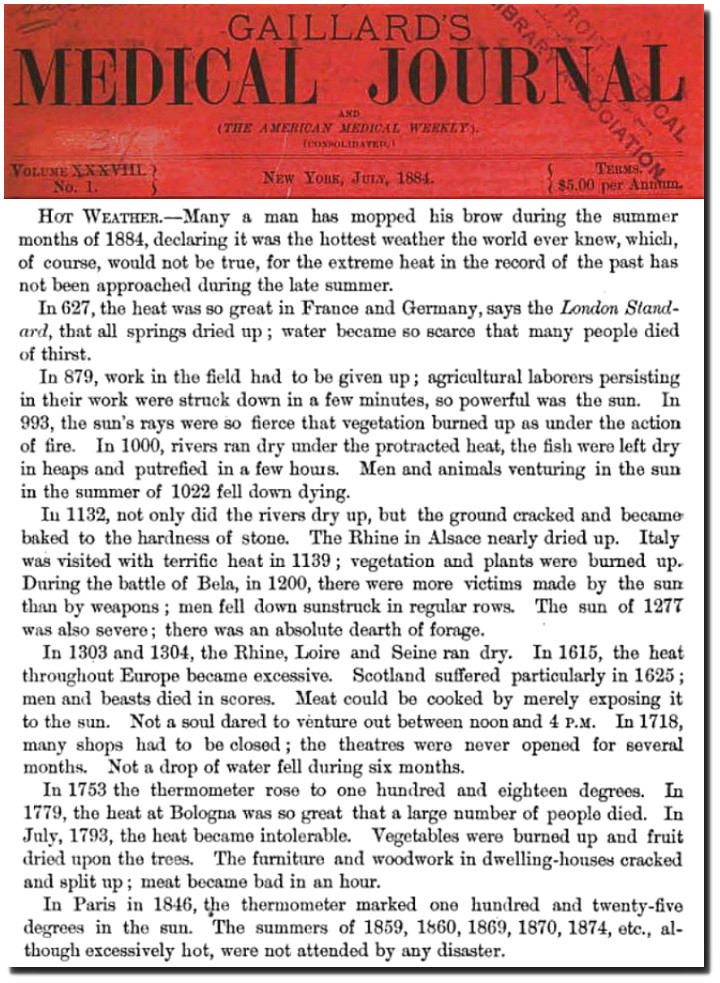
Gaillard’s Medical Journal – Google Books

Heatwaves of Europe in Medieval times.

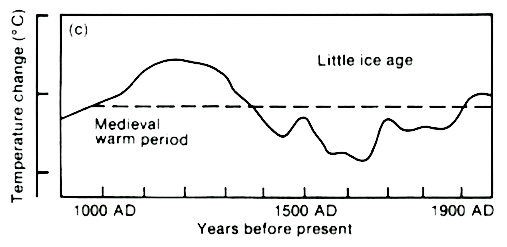
The Medieval Warm Period was a global phenomenon, see the graphs, the pollen, the sea sediments and tree rings. And the IPCC knew it in 1990 too.

IPCC FAR Report, Medieval Warm Period.

1990 IPCC FAR Report, Medieval Warm Period.

They’ve been rubbing out the Medieval Warm Period ever since. Even though Hubert Lamb did the graph in 1982, scores of different proxies have gone on to support it on every continent.  References at the link above plus at the tag Medieval Warm Period.

h/t also Paul Homewood at Notalotofpeopleknowthat

Text copied below:

“Hot Weather.—Many a man has mopped his brow during the summer months of 1884, declaring it was the hottest weather the world ever knew, which, of course, would not be true, for the extreme heat in the record of the past has not been approached during the late summer.

In 627, the heat was so great in France and Germany, says the London Standard, that all springs dried up; water became so scarce that many people died of thirst.

In 879, work in the field had to be given up; agricultural laborers persisting in their work were struck down in a few minutes, so powerful was the sun. In 993, the sun’s rays were so fierce that vegetation burned up as under the action of fire. In 1000, rivers ran dry under the protracted heat, the fish were left dry in heaps and putrefied in a few hours. Men and animals venturing in the sun in the summer of 1022 fell down dying.

In 1132, not only did the rivers dry up, but the ground cracked and became baked to the hardness of stone. The Rhine in Alsace nearly dried up. Italy was visited with terrific heat in 1189; vegetation and plants were burned up. During the battle of Bela, in 1200, there were more victims made by the sun than by weapons ; men fell down sunstruck in regular rows. The sun of 1277 was also severe; there was an absolute dearth of forage.

In 1303 and 1304, the Rhine, Loire and Seine ran dry. In 1615, the heat throughout Europe became excessive. Scotland suffered particularly in 1625 ; men and beasts died in scores. Meat could be cooked by merely exposing it to the sun. Not a soul dared to venture out between noon and 4 p.m. In 1718, many shops had to be closed; the theatres were never opened for several months. Not a drop of water fell during six months.

In 1753 the thermometer rose to one hundred and eighteen degrees. In 1779, the heat at Bologna was so great that a large number of people died. In July, 1793, the heat became intolerable. Vegetables were burned up and fruit dried upon the trees. The furniture and woodwork in dwelling-houses cracked and split up; meat became bad in an hour.

In Paris in 1846, the thermometer marked one hundred and twenty-five degrees in the sun. The summers of 1859, 1860, 1869, 1870, 1874, etc., although excessively hot, were not attended by any disaster.”

Jo Nova: Climate experts wrong on Australian frosts, and media say nothing

From Jo Nova:

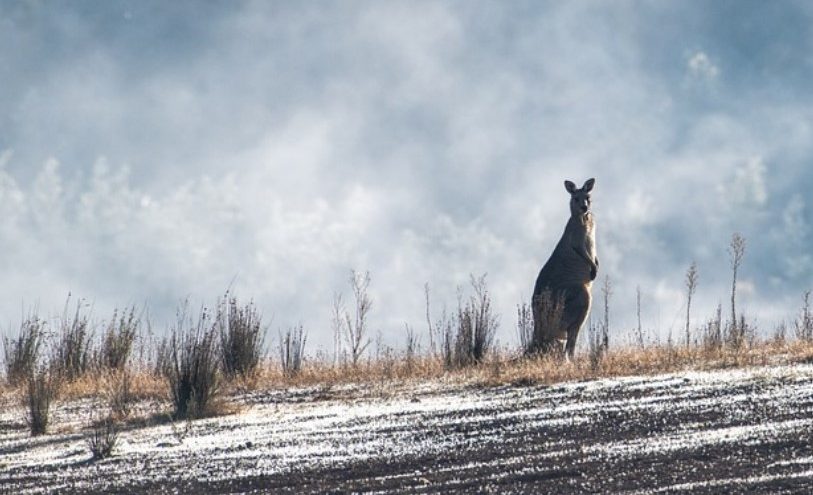
A Kangaroo on the Frost, Australia

Image by Penny from Pixabay

Climate experts wrong on Australian frosts, and media say nothing

The IPCC experts were sure would be less frosts in Australia, but buried in a government funded ABC weather report was the virtually unknown admission that the frost season is actually growing across southern Australia, not shrinking. And in some places by an astonishing 40 extra days a year. What’s more, the researchers have known about this long term trend for years but didn’t think to mention it, and the ABC didn’t have a problem with that either. (It’s not like farmers need to know these things?)

When asked for an explanation for the increase in frosts, the ANU climate expert said “I think this is one of those climate surprises,” as if the IPCC unexpectedly won a game of Bingo, instead of getting a core weather trend 100% wrong.

We note the ABC feigned journalism to cover up for the Bureau of Meteorology and IPCC failures. Where were the headlines: “Climate Change causes more frosts, not less”, or “IPCC models dangerously misleading on frosts?” Did any Australian farmers and investors buy up properties and plant the wrong crops based on the global warming misinformation repeated or tacitly endorsed by the ABC, BoM and CSIRO?

Frost damage costs Australian farmers around $400 million each year. (Perhaps if we sold the ABC we could cover that).

Frost expected across nearly every state and territory in Australia this weekend

By Tyne Logan, ABC Australia

Buried under 450 words of weather, trite caveats, and preamble the ABC journalist finally gets to a new virtually unknown climate trend that affects farmers, investors, researchers, and rural Australia:

The latest Intergovernmental Panel on Climate Change report projected, with high confidence, that frost events would decrease, in general, across southern Australia in the future with climate change.

ANU climate applications scientist Steven Crimp said some parts of New South Wales were now experiencing five more frost events on average each year, compared to 1960.

And he has known for years:

He said this was based on local weather station data between 1960 and 2018, but the trend was unlikely to have changed much in the past five years.

“I think this is one of those climate surprises,” he said.

Scientifically they are not caught unaware because climate models are useless politicized fantasies, it’s because there is more “climate-nuance” around now:

“Despite the sort of overall warming trend in our temperatures, the extremes of our temperatures, be they hot or cold, are acting in a slightly more nuanced and complex way, which can be quite surprising at times,” he said.

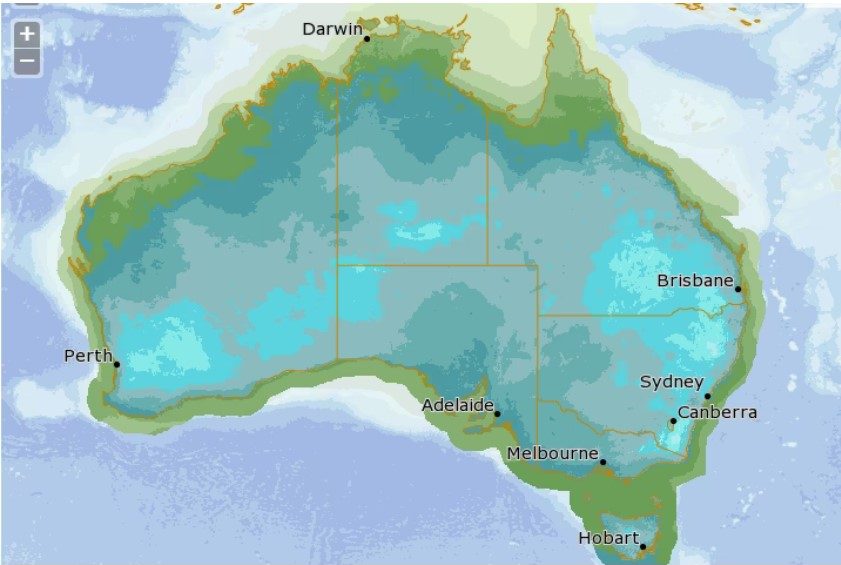
Below zero temperatures in Australia.

BOM forecast overnight minimum temperatures to fall well below zero across large swathes of the country [last] Sunday.

But jokes aside, this actually seems like a trend that matters:

Dr Crimp said they had also found the frost season was lengthening across southern Australia.

“So if we think about the east coast first, we see an earlier start and a later finish to that frost window,” he said. “In some cases, the extension of that frost window is greater than 40 days.

“But in Western Australia in particular, we see that it’s less to do with the later frost occurrence, but more earlier frost occurrence.”

The frosts are due to the dry conditions, says Dr Crimp, putting in an admirable effort at scientific-word-salad to cover up for what he’s not allowed to say — that they have no idea.

Why aren’t frost days decreasing?

Dr Crimp said, ironically, the observations could be explained by the types of weather system that brought warmer, drier weather. That was high pressure systems which often produced the clear, still nights needed for frost to settle.

“As anyone knows who’s outside at night in winter, you have to have those clear night skies and the atmosphere needs to be very dry,” he said.

“That way the surface of the Earth loses heat very rapidly and any moisture in the air then condenses as a frost. “So because we are getting those dry conditions that are starting to emerge, that is more conducive for frosts to occur.”

But the truth is that, on average, and a priori — global warming would increase humidity and global cooling would  dry the air out. And carbon dioxide is supposed to work at night time too — increasing minimum temperatures. All these factors make frosts less likely.

And yet the frosts happen.

Finland Electricity Prices Drops to BELOW ZERO Due to Efficiency of Nuclear Power Plants

From Geller Report

Finland Electricity Prices Drops to BELOW ZERO Due to Efficiency of Nuclear Power Plants

This is what common sense looks like.

Insider: Finland was dealing with an unusual problem on Wednesday: clean electricity that was so abundant it sent energy prices into the negative. While much of Europe was facing an energy crisis, the Nordic country reported that its spot energy prices dropped below zero before noon (Insider).

Marian L Tupy: Finnish electricity price drops BELOW ZERO after the latest nuclear reactor is switched on. That is what the world could have looked like if the greens did not stop humanity from expanding nuclear power. Remember: nuclear power = no CO2 emissions (Twitter)

Finnish Nuclear Plant Throttles Output After Electricity Prices “Become Too Cheap”

As we detailed in early May, the transition from testing to regular output last month saw Finland’s first nuclear power-plant drive electricity prices dramatically lower.

by Tyler Durden, Zero Hedge, May 25, 2023 – 02:45 AM

As yle reports, the Olkiluoto 3 nuclear reactor in Eurajoki, southwest Finland, started regular electricity production in mid-April, about 14 years behind schedule

Since then prices for power in Finland have continued to plunge as the efficiency of the plant flooded the grid with ‘new’ energy.

So much in fact that early on Wednesday of last week, the market price for electricity dropped below zero cents per kilowatt-hour (kWh) and for hours after that the price was only 0.3 cents per kWh at its highest, according to the country’s grid operator, Fingrid.

That was unacceptable and prompted the plant’s owner, Teollisuuden Voima (TVO) to significantly cut back its output…

Electricity production must also be profitable for nuclear power plants, and when the price is particularly low, there may be situations where output is limited,” TVO communications manager, Johanna Aho, said.

According to Aho, cutting back on nuclear power production due to excessively low electricity prices is very rare, but not unheard of.

Janne Kauppi, an energy markets advisor at Finnish Energy, agreed with that sentiment.

“There haven’t been many situations where nuclear power output has been regulated specifically because of low prices,” Kauppi explained.

“When prices go negative on the electricity market, basically anyone who can adjust their production will do it, so that they don’t have to pay for their own production,” Kauppi noted.

The Finnish example is a testament to how nuclear can play a part in solving the current energy crisis, with consumers still paying sky-high fees for energy in many European countries.

However, the hypocrisy is of course that when power prices were extremely high in 2022, hurting consumers – it was all Russia’s fault; but now that prices are plummeting, operators can’t have that and withdraw supply to hurt consumers.

Do you see a pattern here?


Jo Nova: Exxon says NetZero degrades global standard of living so much there’s only a remote chance it will happen

By Jo Nova

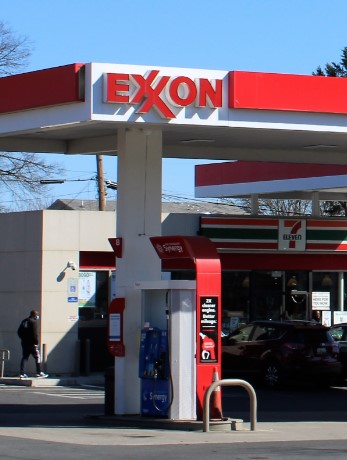
Exxon petrol gas station.

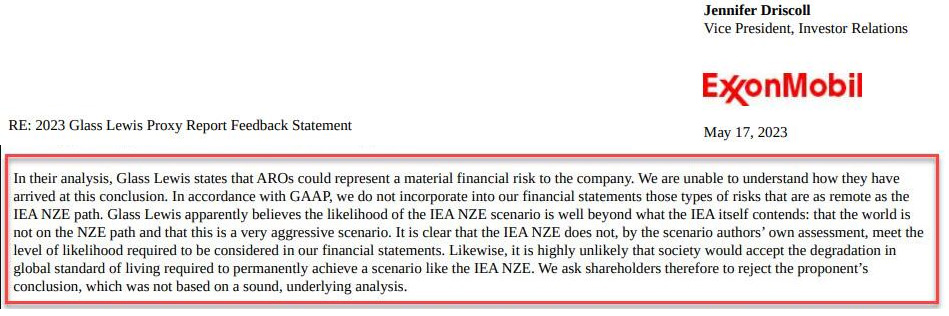
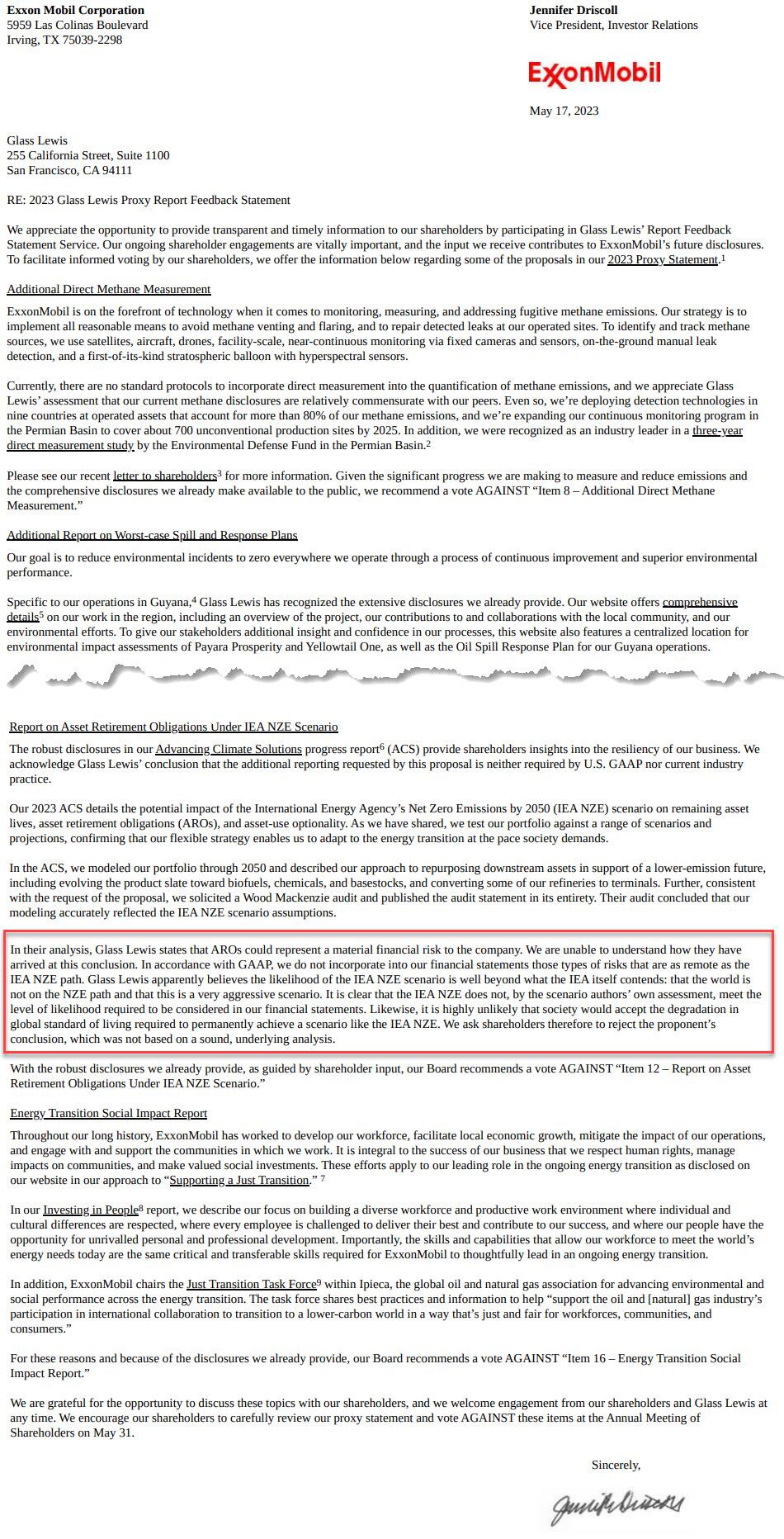
Exxon was told to jump through circus hoops like a performing seal and report the risks of NetZero to Exxon shareholders. But Exxon pushed back by pointing out that NetZero-by-2050 is so impossible it will never happen, and therefore the risks are not even worth assessing. Furthermore, and rather damningly, Exxon said, society would be unlikely to “accept the degradation in the global standard of living required“.  Exxon has taken was was supposed to be another PR win for the narrative and turned it into a media weapon.

This is exactly why the Big-Gov-Corporatist cartel wants to co-opt or destroy independent profitable corporations. In this case, companies that don’t need Big-Gov are free to point out the hypocritical inanity and absurdities which the lap-dog dependent industries like wind power and solar cannot.

Sadly, companies like Exxon still need to be brave because Big-Gov is so big, it is always the largest potential client and holds the sword of mendacious legislation, licensing and regulation as well.

Exxon Crushes Progressive Dreams That “Net Zero” Has Any Chance By 2050: It Would Mean Collapse In “Global Standard Of Living”

By Tyler Durden, ZeroHedge

The US supermajor pushed back against investors pressing the company to report on the risks to its business from restrictions on greenhouse gas emissions and potential environmental disasters when in a reply to proxy advisor Glass Lewis, Exxon said the prospect of the world achieving net-zero carbon dioxide emissions by 2050 is remote and should not be further evaluated in its financial statements.

A shareholder proposal seeking a report on the cost of having to abandon projects faces a shareholder vote on May 31. Glass Lewis backed the initiative, concluding Exxon could face material financial risks from the net-zero scenario.

Exxon disagreed, and said the world is not on a path to achieve net-zero emissions in 2050 as limiting energy production to levels below consumption demand would lead to a spike in energy prices, as observed in Europe following oil sanctions against Russia over Ukraine.

Exxon, is of course, correct however that won’t stop the green fanatics from beating the drum that somehow the world can transition to “green” energy (at a cost of some $150 trillion mind you) in the next 27 years without an energy cataclysm.

Click to enlarge — Source Exxon (via ZeroHedge)

Moments like this expose why the Government-Corporate cartel doesn’t choose to support any “low emissions” industry that is financially viable in and of itself. They can’t support clean high temperature coal plants, even though it would be a sensible and cost effective way to reduce CO2. These new plants could have independent voices which might say inconvenient things and we can’t have that.

Companies that sell useful products don’t need the government like unreliable, uncompetitive wind and solar plants always will. But companies that depend on government rules, subsidies and largess will always be cheerleaders for the biggest government possible. They will always obey.

The not-so-sustainable EV’s that have to be written off after a scratch

Jo Nova shares another flaw in Electric Vehicles and the sustainability claims made for them:

The not-so-sustainable EV’s that have to be written off after a scratch

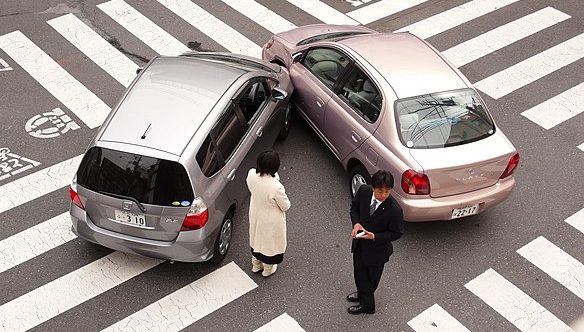
car accident.By Jo Nova

Save the world with disposable EV’s?

After children in the Congo have dug out the cobalt for the blessed batteries we’d hope the cars would be sustained as long as possible. Alas, apparently there is just one more design flaw on top of the low mileagedelays, expense, spontaneous fires, and the need for a whole new grid.

After a minor accident, no one quite knows how to assess the safety of the battery, so it’s easier to throw it away. That means more waste in the landfill and higher insurance premiums to cover the cost of writing off near new cars. Where are the Greens? If child slaves and emissions matter, isn’t it better to reduce consumption by saving your old car from landfill, especially if your new one might end up there as well? Reduce, reuse, recycle…

Meanwhile the UN is demanding Net Zero targets, which are not even theoretically possible, be achieved ten years sooner.  Half the technologies we need are not even invented yet. Infinity-minus-ten is a number that won’t get you to work, but it powers whole careers at the UN.

h/t David and Notalotofpeopleknowthat

Scratched EV battery? Your insurer may have to junk the whole car

By Nick Carey, Paul Lienert and Sarah Mcfarlane, Reuters

LONDON/DETROIT, March 20- For many electric vehicles, there is no way to repair or assess even slightly damaged battery packs after accidents, forcing insurance companies to write off cars with few miles – leading to higher premiums and undercutting gains from going electric.

And now those battery packs are piling up in scrapyards in some countries, a previously unreported and expensive gap in what was supposed to be a “circular economy.”

“We’re buying electric cars for sustainability reasons,” said Matthew Avery, research director at automotive risk intelligence company Thatcham Research. “But an EV isn’t very sustainable if you’ve got to throw the battery away after a minor collision.”

Amazing what uncertainty can do to the value of a good car:

Allianz [an insurer] has seen scratched battery packs where the cells inside are likely undamaged, but without diagnostic data it has to write off those vehicles. …

It already costs more to insure most EVs than traditional cars. According to online brokerage Policygenius, the average U.S. monthly EV insurance payment in 2023 is $206, 27% more than for a combustion-engine model.

The Reuters team found many low mileage EV’s at salvage yards in Europe:

At Synetiq, the UK’s largest salvage company, head of operations Michael Hill said over the last 12 months the number of EVs in the isolation bay – where they must be checked to avoid fire risk – at the firm’s Doncaster yard has soared, from perhaps a dozen every three days to up to 20 per day.

“We’ve seen a really big shift and it’s across all manufacturers,” Hill said.

The UK currently has no EV battery recycling facilities, so Synetiq has to remove the batteries from written-off cars and store them in containers. Hill estimated at least 95% of the cells in the hundreds of EV battery packs – and thousands of hybrid battery packs – Synetiq has stored at Doncaster are undamaged and should be reused.

It’s just another bump on the road to Renewable World that shows that no one really cares how “clean-n-green” anything is. Your emission of CO2 are irrelevant, it’s only the power, control and profits that matter.


People Don’t Believe The Climate Change Religion

At last the people can see that the emperor has no clothes.

Jo Nova writes:

This is Kryptonite for fake science preachers: 60% of voters agree Climate Change is a religion

By Jo Nova

The faith in Wind Power. It's like a religion.

The expert science bubble has popped. New polling shows 60% of US voters agree that that Climate Change is a religion and has nothing to do with the climate. Even more shocking is that 47% of US voters strongly agree.   

It’s an Exocet for the priests of Climate Science. Their power depends on people believing “they are The Science”, and The Science is sacred. But word is spreading that the experts are more like prophets-of-gloom than disciplined researchers. And once the idea is seeded, it won’t go away. People who didn’t notice before will suddenly see the failed predictions, the ice age that never came, the droughts that become floods and the snow that children wouldn’t know. Humans are excellent at pattern matching, just give them the right pattern to look for…

This is an idea that has barely been mentioned in mainstream TV yet half the nation are already 100% sold.

Ten days ago Vivek Ramaswamy talked about the climate religion on Fox News, and so Rasmussen asked the punters. And thus the emperor has no clothes —  fully six out of ten agree that “Climate is a religion”.

Vivek Ramaswamy  on FoxNews:

…the climate religion actually has nothing to do with the climate. It is all about power, control, dominion and apologizing for America’s own success. And the reason why is that this religion looks the other way when PetroChina picks up the projects that American companies drop. Last time I checked, it was global climate change, and also it’s hostile to nuclear energy, which is truly bizarre because that’s the best form of carbon-free energy production known to mankind.

This Rasmussen question is Kryptonite

There is no pussy footing around the question, no ambiguity, no caveats:

“Do you agree or disagree with this statement: Climate change has become a religion that actually has nothing to do with the climate and is really about power and control?”

AGREE – by Party

      • DEM: 45%
      • IND: 59%
      • GOP: 79%                        All Voters: 60%

Even nearly half the democrats agree.  Does anything show better that democracy is not about voters anymore? There are no vote winners for pushing the climate faith, instead there is a vast untapped sea of voters who think climate change is a money making scam. They want someone to vote for, not a politician who says I’ll be less of liar than the other guy.

Strong questions bring out strong answers

In a world of wishy-washy surveys, just saying the flagrant bleeding truth in full technicolor will bring out a stronger response than tip-toeing around the point.  Sometimes just asking the question provokes the answer. How many people heard the question and went — oh yeah, now that you mention it…

The last dynamite poll in the world of surveys was in late 2015 when Donald Trump stepped out and said “climate change is a total hoax”, and when asked, 31% of US voters agreed, which was astonishing in an era when three quarters of Americans would also say “climate change is happening” and “was a threat” to the US.

Now, half the voters are so cynical they believe the media is actively trying to deceive them.  And the meme is even more dangerous because it’s closer to the truth — “climate is a religion” not only includes the hoax, but also explains the blind passion of the teenage throwers of soup and glue. They are not hoaxers, they’re just deluded kids.

Live by the smear, die by the smear

For 30 years the Climate Crisis Team have talked about the dark influence of fossil fuel money, like it was Gore’s Law of Physics, and it worked to inure sleepy people against skeptical points. But now the tables are turning and the insidious suggestion that “it’s all about power, control and money” will work every bit as well against those who never once spoke up to stop the namecalling and demonization of other scientists.

They could have told the world there are no sacred cows in science, instead they created the cows —  “there is a consensus!”. They could have said that science is not a religion because there is no bible, but instead they held up the IPCC reports like The Word of Mother Nature. Instead of debating skeptics, with their overwhelming evidence, they called them deniers and fled from the room.

97% of climate scientists acted like science was a religion. Karma comes back to get them.

h/t ColA via Gateway Pundit