Rainbow Rabbi and Friends Declare They Have No Faith

The ABC was very excited about “religious leaders” meeting to declare they have no faith in coal. As expected it was the usual suspects of the extreme religious left who actually have very little faith in Jesus, together with a rainbow rabbi and a couple of Imams. Hardly representative of anybody really.

Jo Nova writes:

ManBearPriestMonks are the new climate experts: they declare faith in IPCC instead of God

Religious leaders dump coal, declare “no faith”

There goes my world. Who knew they had faith in coal?

So forget science, climate change is a moral problem. Is climate sensitivity 1 degree or 3? Ask a priest.

A group called Australians Religious Response to Climate Change (ARRCC) has badgered 150 soft targets in the religious world to sign a grandiose letter making coal into the new Lucifer.

The Guardian

In an open letter headed “no faith in coal”, the leaders say the climate crisis is a profoundly moral problem and Australia’s response will be crucial in addressing it.

Signatories to the letter include bishops, rabbis, theologians, the grand mufti of Australia and the heads of the Uniting Church, the Federation of Australian Buddhist Councils, Muslims Australia and the National Council of Churches.

Remember the alarmist maxim: ask a plumber to do the plumbing, a heart expert to do the surgery and when you want to predict the climate, ask an Imam.

Or failing that — ask a school student — which is what the religious leaders have done. Let’s quote their letter:

As you know, thousands of school students have been protesting in our streets about this emergency. They have three demands. We are writing to urge you to agree to them:

  1. Stopping the proposed Adani coal mine
  2. Committing to no new coal or gas projects in Australia
  3. Moving to 100% renewable energy by the year 2030.

Let’s ask innumerate teenage girls to set national energy policy. What could possibly go wrong?

It’s not like they are easily fooled slaves to fashion who make great cheerleaders.

The sound of breaking commandments:

I count five:

  1. Thou shalt have no other Gods (since when was the IPCC sacred?)
  2. Thou shalt not take the name of the Lord in vain (don’t use God for Renewable industry advertising)
  3. Honour thy father and mother (not the teenage false saints)
  4. Thou shalt not bear false witness  (praise not the scientists who hide declines)
  5. Thou shalt not steal.  (see the Australian Renewable Energy Target — solar panels.)

The BishopRabbi economist says automation is bad for jobs

Solar power apparently makes more jobs:

The Adani mine in Central and North Queensland is an excellent example. People there need new, reliable jobs. Yet serious investment in solar would yield far more jobs than the Adani mine would, as it is less automated. And rejecting new coal will also help to protect jobs that depend on the Great Barrier Reef. There are currently 60,000 people whose livelihood depends on the Reef.

Let’s get rid of washing machines too and then women can be full time housewives again. That’ll create lots of jobs.

Solar power makes jobs in the same way that freight by horse and buggy does: a small high-maintenance unit can’t be used in an efficient way with economies of scales. Those economies being what makes trucks cheaper.

So the nice but weak religious leaders have handed their moral power to children and activists. There’s no reason they shouldn’t speak up on climate change, but if they care about their flock, they might want to research the positions they advocate. That means reading the arguments for and against. Instead they blindly follow a group that treats the IPCC as a God — the ARRCC describes its policy as pretty much everything the IPCC ever said.

Thou shalt not question foreign committees

After donating their brains to the IPCC the ARRCC rationalizes why any outcome at all proves they are right:

How the climate is changing

While the numbers above may seem small, their impact is much greater than just a global warming of temperatures by 1-2 degrees. This is firstly because this amount is just an average – the changes in temperature is unevenly distributed across the globe Some places around the world will experience much greater increases than this and some places will actually experience a DECREASE in temperatures.

This phenomenon of cooling and warming at the same time is partly explained by the effect that warming has on ocean temperatures and currents. As the air and land temperatures warm, so too does the average ocean temperature. The increased air and ocean temperatures causes accelerated melting of the ice in the arctic and Antarctic, resulting in an increase of cold water flowing into the oceans. The colder waters interact with the warmer waters to change the patterns of ocean currents, which sees some of this colder water flowing to places that in past have experienced warm ocean currents. As ocean temperatures mediate coastal land temperatures, the colder waters will cause colder temperatures.

So, religious geniuses, tell us what outcome would prove the theory wrong? If temperatures stayed exactly the same? And what does God/Budda/Mohammed say about scientists who are hiding datadeclineshistoryadjustments and methods?

Changing air and water temperatures also affects the weather. As ocean currents change this affects the air currents that flow above the oceans, changing cloud formation and wind patterns. The overall effect of these changing air currents is that most places around the world will actually experience much less frequent rain fall. However when rain does occur, it will happen with much greater intensity. This leads to a pattern of both droughts and floods. It also means that sometimes actual rainfall seasons will change, with dry weather during traditional wet seasons, and very wet weather during traditional dry seasons. The main effect though is to make the rainfall very unpredictable based on past experiences. Changing rainfall patterns also have an effect on traditional water catchment areas and existing river systems, which can affect previously reliable sources of fresh water.

Let’s all pay homage to the pagan rites of climate superstition: Droughts, heatwaves, random noise is “proof” of anything you like. They’re not worse than ones we had 1,000 years ago. Floods are not worse either.

A third effect of changing water temperatures and currents is an increase in the frequency and severity of extreme weather events such as tropical storms.

Except tropical storms are not occurring more frequently, and the worst storms were hundreds of years ago.

ManbearMonkPriest says skeptics are wrong because of a flawed keyword study of pal reviewed abstracts in a biased-funding safe space for b-grade thinkers. That and because name-calling “denier” sounds so scientific.

Sceptical arguments

The above impacts are not just predictions but things that are being observed right now around the world. However there is still a significant and often vocal body of people who are either sceptical of climate change science or outright deniers.

The prominent people amongst this group are rarely climatologists or even scientists at all – they are generally social scientists such as economists, politicians, people connected with big business or social commentators.

Prominent? Tell that to Professor Richard Lindzen.

While there are a few scientists among this group of people, research by Cook et al in 2013 (“Quantifying the consensus on anthropogenic global warming in the scientific literature”) found that 97% of published climatologists believe in the existence of human-induced climate change. That is, 97% of all scientists whose field of expertise is climate, and who have gone through the process of having their research peer-reviewed by other qualified scientists and published in a scholarly journal believe that climate change is happening and that it is directly linked to human activity. There have now been several pieces of research showing that sceptical scientists and think tanks indirectly receive substantial funding from fossil fuel industries.

Yes, and some unnamed research about unnamed people and unlisted sums claims they are paid hacks. These 150 gullible patsies will believe anything. They give religion a bad name.

Unfortunately the science of climate change is most often misrepresented in the media as a ‘debate’ between roughly even numbers of believers and sceptics, giving the impression that the scientific jury is still out. If the portrayal were more accurate, the picture would reflect an almost total consensus on the science, with only the tiniest minority of dissenters.

The media IS misleading. Skeptics outnumber and outrank believers. They won real Nobel PrizesNASA awards, they walked on the moon they are MIT Professors of MeteorologyHalf of meteorologists — fergoodnesssake — are skeptics, and survey after survey shows that two-thirds of geoscientists and engineers are skeptics.

There is no consensus among scientists, there never was, and it wouldn’t prove anything even if there was.
New Study Shows Wind Farms Are Noisy

With the rush on for so-called renewable energy, you would think that there would be heaps of studies on possible side-effects of wind farms such as possible health effects of these monstrosities. Some years ago while I still believed that the ABC was capable of producing genuine information on science, there was a commentator on the Science Show who put down all the complaints to psychology, fear and climate denial.

Apparently there has now been a “world first” study on a tiny sample of houses that has discovered that even several kilometres away there are audible pulses of sound which must have some potential effect when it’s there constantly. Still, somebody has to take a shot to save the planet.

Jo Nov reports:

Finally “world first” study on nine houses shows wind towers make pulsing noise for 3.5 km

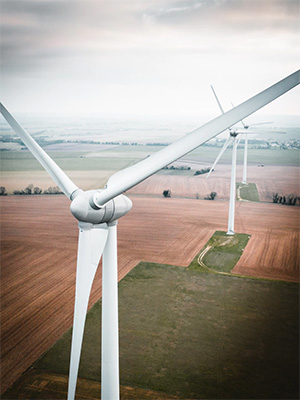
Wind Turbine pic near farms. Generic. Gonz - DDl

Generic wind turbine near farm. Photo: @gonz_ddl

Finally, a study looks at data on nine houses within ten kilometers of an old (probably small) wind turbine. What’s amazing about this research is not the result but that this study is so tiny, yet it’s still a “world first”.

There are already probably around400,000 wind turbinesinstalled around the world.* So you might think that there would have been scores of studies involving hundreds of people and followed up for a year or two. They would have looked at the effect of wind turbines upwind, downwind, side wind, in low wind, high wind, and at different times of day. They’d check for altered sleep patterns, lack of deep sleep, REM sleep, cognitive performance, blood pressure, cortisol levels, and school marks. Dream on. It’s like everything with climate change — who needs data?

Renewables are a$300 billion annual global industry. This work was done with a $1.4 million National Health and Medical Research Council grant. Where is the precautionary principle when we need it?

Can wind turbines disturb sleep? Research finds pulsing audible in homes up to 3.5km away

Nicola Hasham,Sydney Morning Herald

…the first results from ongoing Flinders University research into turbine noise and sleep found that low-frequency pulsing from a South Australian wind farm was audible about 16 per cent of the time inside homes up to 3.5 kilometres from a turbine, including 22 per cent of the time at night. The noise was audible 24 per cent of the time outside the homes. Recordings detected what complainants commonly describe as a pulsating, thumping or rumbling sound. The noise is technically known as amplitude modulation, and relates to a change in noise level that occurs approximately once per second as the turbine blade rotates. Field data was recorded at nine homes within 8.8 kilometres of the wind farm. Microphones were placed inside and outside homes and recorded almost 18,000 10-minute samples between 2012 and 2015. The data was recently analysed and the results published online last month in the Journal of Sound and Vibration.

In 2016 the research team was awarded a $1.4 million National Health and Medical Research Council grant for a separate wind farm noise study including lab tests and sleep measurement

If the world put just 0.5% of the annual “renewables investment” into researching the health effects that would be $15m a year.

There have been almost no studies into the health impact of wind farms. Remember the one in 2014 in Australia which was also a world first, andinvolved an eight week study on six people in three houses.It was a tiny study too — why we haven’t done this one hundred times bigger? Are we afraid of what the results might show?

Read the rest of the article here

The Great Extinction Myth Exploded

A few weeks ago when the UN report about biodiversity was released, the media unquestioningly reported that millions of species were going extinct and humans are the problem.

My initial, cynical reaction was, “Gee they have discovered that nobody is listening to the climate change scare any more so they’ve found a new scare.”

It also runs counter to what we are seeing around the world. Every year more and more land is converted to national parks, and for some years now the amount of land being reforested exceeds the area being cleared. Agriculture is becoming more efficient, food is more plentiful, people are moving to cities. Even with a still increasing global population we will have plenty of potential food for decades to come.

In fact, the only bleak spots are those caused by the demands of environmentalists. For example the EU has mandated a certain amount of so-called bio-diesel to be used in vehicles, leading to massive clearing of forests in Indonesia and Malaysia to plant palm trees. The other folly is the requirement to use ethanol in petrol in many developed countries. The main source of this is from corn in North America, leading to an increase in the price of corn, a staple food for millions of poor people, of between 5% and 10%

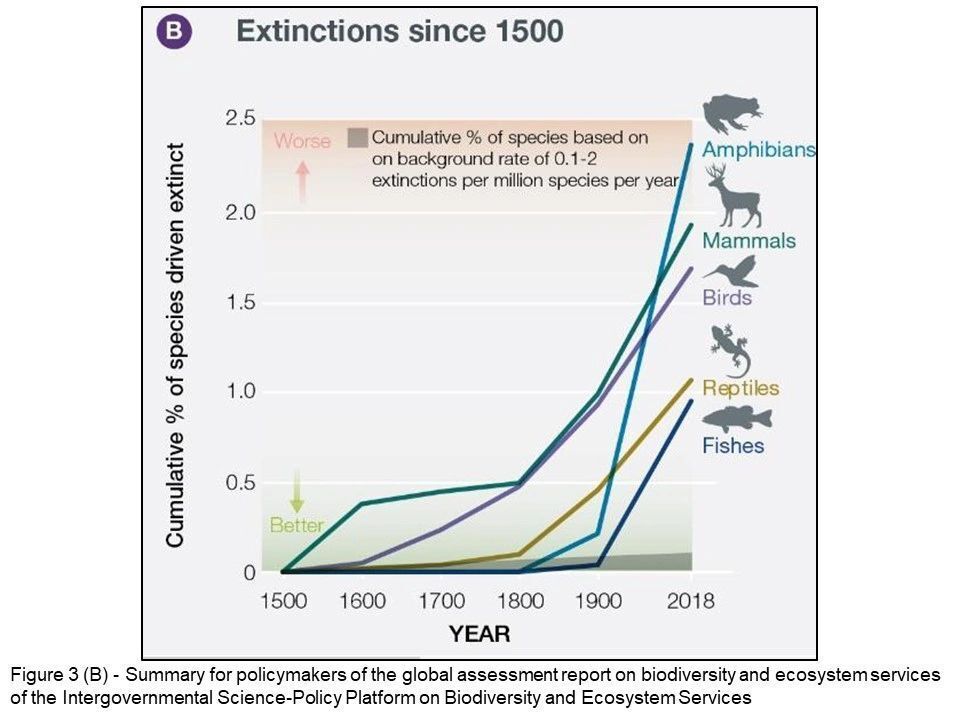
Anyway the extinction report claims that millions of species are going extinct in our time. Here is the only graph in the Summary for Policy Makers

Scary graph, until you look at the labels on the axes. “Cumulative % of species driven extinct.” It is not clear exactly what that means, but it does seem to be adding all the previous values as you go. That curve can never go down. It’s a bit like the old “hockey stick” of Al Gore fame.

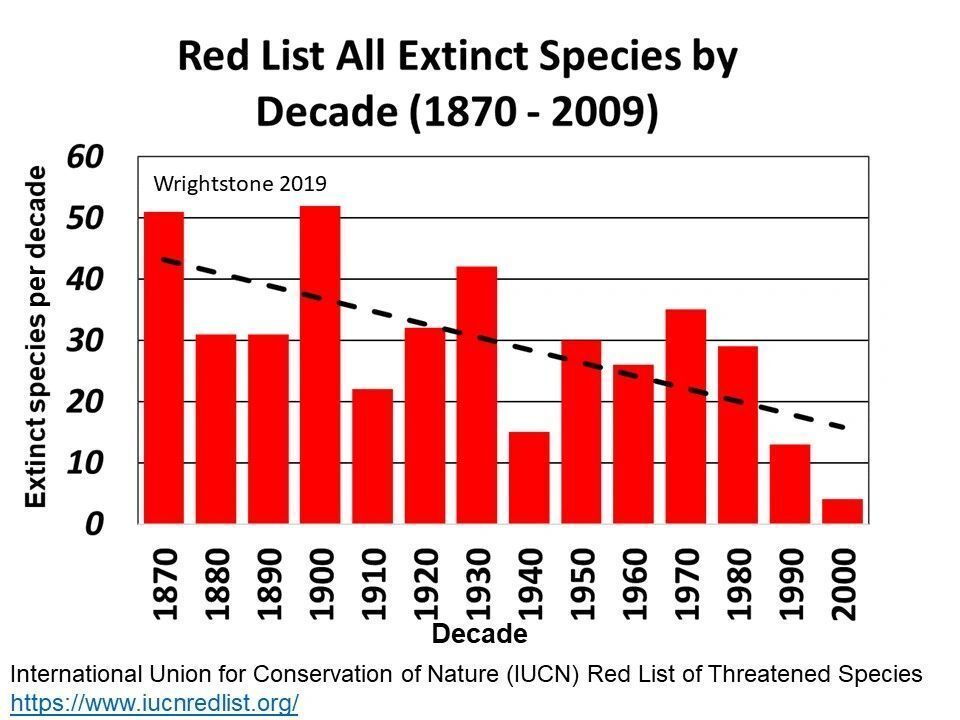
Here is the actual number of extinctions per decade recorded by the International Union for the Conservation of Nature.

So, it’s not quite zero, but we are heading in the right direction- the opposite direction to the one the UN would have us believe.

Oh look that decline is happening right through the period of time when so-called human caused global warming is happening.

These graphs are from a much more detailed article by Gregory Wrightson which I encourage you to read.

The so-called “Mass Extinction” is, sadly, another example of science being politicised and twisted to cause alarm.

Jo Nova: Burn More Petrol To Make More Chocolate

Jo Nova writes:

The fake scare of the season — “climate change is impacting chocolate production”.

Chocolate is produced from the beans that grow on cocoa trees. These plants can only grow in a fairly narrow range of conditions, which makes them vulnerable to changes in the environment.

Unfortunately, climate change is threatening some of these key growing regions. According to the IPCC, rising temperatures and a relative reduction in rainfall could make areas like West Africa less suitable for cocoa production in the future. Changes to the climate are also pushing cocoa-growing regions to higher altitudes in some parts of the world, which can make some crops unsustainable.

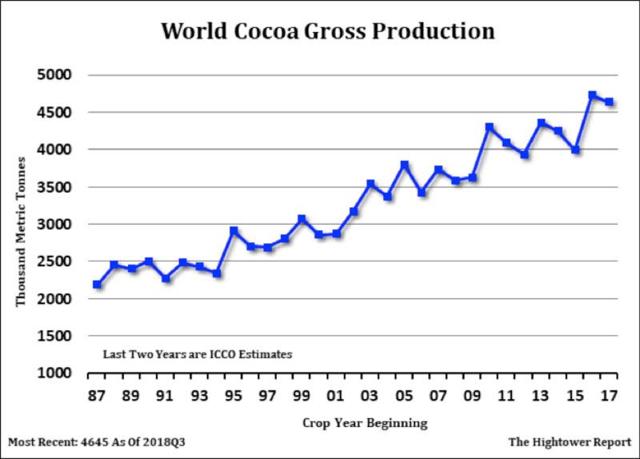
We can see just how hard cocoa crops have been hit by record heat and 500 billion tons of carbon.

Cocoa global production, graph.

Global Cocoa production

Since 1989 humans have put out more than 50% of all anthropogenic CO2 emissions since homo sapiens went sapien. There is an undeniable trend here.

Climate Catastrophes and Extreme Weather

Climate alarmists like to go on about how climate change will be deadly as more “extreme weather” events kill people.

As usual the truth is different as Bjorn Lomborg point out.

From wattsupwiththat.com


Inverse Hockey-Stick: climate related death risk for an individuals down 99% since 1920


Bjørn Lomborg writes on Facebook about some new and surprising data that turn climate alarmist claims upside down.

Fewer and fewer people die from climate-related natural disasters.

This is clearly opposite of what you normally hear, but that is because we’re often just being told of one disaster after another – telling us how *many* events are happening. The number of reported events is increasing, but that is mainly due to better reporting, lower thresholds and better accessibility (the CNN effect). For instance, for Denmark, the database only shows events starting from 1976.

Instead, look at the number of dead per year, which is much harder to fudge. Given that these numbers fluctuate enormously from year to year (especially in the past, with huge droughts and floods in China), they are here presented as averages of each decade (1920-29, 1930-39 etc, with last decade as 2010-18). The data is from the most respected global database, the International Disaster Database. There is some uncertainty about complete reporting from early decades, which is why this graph starts in 1920, and if anything this uncertainty means the graph *underestimates* the reduction in deaths. 

Notice, this does *not* mean that there is no global warming or that possibly a climate signal could eventually lead to further deaths. Instead, it shows that our increased wealth and adaptive capacity has vastly outdone any negative impact from climate when it comes to human climate vulnerability.

Notice that the reduction in absolute deaths has happened while the global population has increased four-fold. The individual risk of dying from climate-related disasters has declined by 98.9%. Last year, fewer people died in climate disasters than at any point in the last three decades (1986 was a similarly fortunate year).

Somewhat surprisingly, while climate-related deaths have been declining strongly for 70 years, non-climate deaths have not seen a similar decline, and should probably get more of our attention.

If we look at the death risk for an individual, seen below, the risk reduction is even bigger – dropped almost 99% since the 1920s.


Data Source: The International Disaster Database,http://emdat.be/emdat_db/

Jo Nova- The Price of Renewable Energy in Australia


Nearly a billion dollars for electricity for just one day — $500 per family

The Electro-pyre conflagration escalates.

The cost of electricity on Thursday in two states of Australia reached a tally of $932 million dollars for a single day of electricity. Thanks to David Bidstrup on Catallaxy for calculating it.

As Bruce of Newcastle says ““Three days and you could buy a HELE plant with the money wasted.” That’s a power plant that could last 70 years, and provide electricity at under $50/MW. (Forget all the high charges for 30 years to pay of the capital (in red below), we could just buy the damn thing outright, paid off in full from day one.)

Cost of Coal plants, lifetime, USA. Institute for Energy Research (IER):

Cost of old coal plants in the USA. From the report by Stacy and Taylor, of the Institute for Energy Research (IER)

Burned at the stake: $500 per family

In Victoria, per capita, that means it cost $110 for one day’s electricity. For South Australians, Thursday’s electricity bill was $140 per person. (So each household of four just effectively lost $565.) In both these states those charges will presumably be paid in future price rises, shared unevenly between subsidized solar users and suffering non-solar hostages. The costs will be buried such that duped householders will not be aware of what happened. Coles and Woolworths will have to add a few cents to everything to cover their bills, and the government will have to cut services or increase taxes. No one will know how many jobs are not offered or opportunities lost. This is the road to Venezuela.

If Hazelwood had still been open, the whole bidstack would have changed, quite probably saving electricity consumers in those two states hundreds of dollars. Eight million Australians could have had a weekend away, gone to a ball, or bought brand new fishing gear. And this is just one single day of electricity. If Liddell closes, things will get worse, no matter how much unreliable not-there-when-you-need-it capacity we add to the system. Indeed, the more fairy capacity we add, the worse it gets. NSW will soon join the SA-Vic club.

This is what happens when an electricity grid is run by kindergarten arts graduates who struggle with numbers bigger than two.

This is utterly and completely a renewables fail

The socialist Labor-Greens are already trying to blame it on coal, but we ran coal plants for decades without these disasters. Right now, no one is investing in coal because of bipartisan stupidity. What company would pay the maintenance fees on infrastructure so hated by the political class? The coal plants are being run into the ground. Maintenance is even being delayed to keep the plants running through peaks like this.

No country on Earth with lots of renewables has cheap electricity. How many times do I have to repeat it? This is my mantra for 2019.

In Australia when we had mainly coal and no renewables our electricity was cheap and reliable. Now we are still mainly coal, but all it takes is a poisonous small infiltration of subsidized unreliable renewables to destroy the former economic incentives, the whole market, the system: our lifestyle.

The Liberal Party needs to grow a spine

This is surely a crisis. As long as the Liberals are a Tweedledum version of the Labor party, they can’t solve this and deserve to lose. New renewables installations must be stopped immediately — put on hold indefinitely — until they no longer need forced subsidies, until the RET is gone, the carbon taxes, the hidden emissions trading scheme and we have a proper free market. Then new renewables can be permitted to compete with all generation alternatives, though all new generators will also have to be responsible for paying for extra transmission lines, back up batteries, and any other frequency stabilization required. On net a generator must be able to guarantee that when the people call on it, it can provide, lets say, 80% of total nameplate capacity. When that day comes (thirty, fifty, years from now or maybe never) I will be happy to support renewables. Until then, we are global patsies handing over glorious profits to energy giants, renewables companies, Chinese manufacturers, and large financial institutions.

Lets have a plebescite: How many Australians would rather have a weekend away with their family or make the world 0.00 degrees cooler in 100 years in a symbolic display to assuage the Gods of  Storms?

Australia’s Economic Suicide

So why are we still in the self-destructive “renewables” obsession which is driving up power prices for no benefit at all to anyone except the subsidy seekers?

Forget Paris: 1,600 New Coal-fired Power Plants are Planned or Under Construction in 62 Countries

Here’s a small sample of how many coal plants there are in the world today.

  • The EU has 468 plants building 27 more for a total of 495
  • Turkey has 56 plants building 93 more total 149
  • South Africa has 79 building 24 more total 103
  • India has 589 building 446 more total 1036
  • Philippines has 19 building 60 more total 79
  • South Korea has 58 building 26 more total 84
  • Japan has 90 building 45 more total 135
  • AND CHINA has 2363 building 1171 total 3534

Here come our AUSTRALIAN politicians that are going to shut down our 6 remaining plants and save the planet!!

Source and read more: https://wattsupwiththat.com/2017/07/03/forget-paris-1600-new-coal-power-plants-built-around-the-world/

AuthorAdminPosted onJanuary 21, 2019CategoriesUncategorised

Coral Reefs Can Take The Heat, Unlike Experts Crying Wolf

Interesting article from reef scientist Peter Ridd about why coral bleaching is not the disaster some would have you believe. From Watts Up With That


Coral Reefs Can Take The Heat, Unlike Experts Crying Wolf

  • Date: 26/12/18
  • Peter Ridd, The Australian

This unreliability of the science is now a widely accepted scandal in many other areas of study and it has a name: the replication crisis. When checks are made to replicate or confirm scientific results, it is regularly found that about half have flaws.

Scientists from James Cook University have just published a paper on the bleaching and death of corals on the Great Barrier Reef and were surprised that the death rate was less than they expected, because of the adaptability of corals to changing temperatures.

It appears as though they exaggerated their original claims and are quietly backtracking.

To misquote Oscar Wilde, to exaggerate once is a misfortune, to do it twice looks careless, but to do it repeatedly looks like unforgivable systemic unreliability by some of our major science organisations.

The very rapid adaptation of corals to high temperatures is a well-known phenomenon; besides, if you heat corals in a given year, they tend to be less susceptible in the future to overheating. This is why corals are one of the least likely species to be affected by climate change, irrespective of whether you believe the climate is changing by natural fluctuations or because of human influence.

Corals have a unique way of dealing with changing temperature, by changing the microscopic plants that live inside them. These microscopic plants, called zooxanthellae, give the coral energy from the sun through photosynthesis in exchange for a comfortable home inside the coral. When the water gets hot, these little plants effectively become poisonous to the coral and the coral throws them out, which turns the coral white — that is, it bleaches.

But most of the time, the coral will recover from the bleaching. And here’s the trick: the corals take in new zooxanthellae, that floats around in the water quite naturally, and can selectselecting different species that are better suited to hot weather.

Most other organisms have to change their genetic make-up to deal with temperature changes — something that can take many generations. But corals can do it in a few weeks by just changing the plants that live in them.

They have learned a thing or two in a couple of hundred million years of evolution.

The problem here is that the world has been completely misled about the effects of bleaching by scientists who rarely mention the spectacular regrowth that occurs. For example, the 2016 bleaching event supposedly killed 93 per cent, or half, or 30 per cent of the reef, depending on which headline and scientist you want to believe.

However, the scientists looked only at coral in very shallow water — less than 2m below the surface — which is only a small fraction of all the coral, but by far the most susceptible to getting hot in the tropical sun.

A recent study found that deep-water coral (down to more than 40m) underwent far less bleaching, as one would expect. I estimate that less than 8 per cent of the Barrier Reef coral died. That might still sound like a lot, but considering that there was a 250 per cent increase in coral between 2011 and 2016 for the entire southern zone, an 8 per cent decrease is nothing to worry about. Coral recovers fast.

But this is just the tip of the exaggeration iceberg. Some very eminent scientists claim that bleaching never happened before the 1980s and is entirely a man-made phenomenon. This was always a ridiculous proposition.

A recent study of 400-year-old corals has found that bleaching has always occurred and is no more common now than in the past. Scientists have also claimed that there has been a 15 per cent reduction in the growth rate of corals. However, some colleagues and I demonstrated that there were ­serious errors in their work and that, if anything, there has been a slight increase in the coral growth rate over the past 100 years.

This is what one would expect in a gently warming climate. Corals grow up to twice as fast in the hotter water of Papua New Guinea and the northern Barrier Reef than in the southern reef. I could quote many more examples.

Read the full GWPF story  here.

Peter Ridd was, until fired this year, a physicist at James Cook University’s marine geophysical laboratory.