Remember That Harmless Vaccine They Made You Take?

From vigilantfox.com

STUDY: Pfizer mRNA Found in Over 88% of Human Placentas, Sperm & Blood — 50% of Unvaccinated Pregnant Women

This is the clearest evidence to date that the COVID injection does not degrade “within hours.” The implications are enormous.

Dec 05, 2025

This article originally appeared on Focal Points and was republished with permission.

Guest post by Nicolas Hulscher, MPH

Human biodistribution study shows Pfizer mRNA penetrates fetal and reproductive tissues, persists long-term in the body, and presents clear evidence of shedding.

For years, the public was told a simple story: the mRNA “stays in the arm,” degrades within hours, never enters the bloodstream, never crosses the placenta, never reaches the reproductive system, and certainly cannot be shed or transferred to others. These claims were repeated endlessly by agencies, fact-checkers, news outlets, and medical institutions, despite the fact that no long-term human biodistribution studies had ever been performed.

A new peer-reviewed study published in Annals of Case Reports titled, Detection of Pfizer BioNTech Messenger RNA COVID-19 Vaccine in Human Blood, Placenta and Semenends that narrative.

Researchers from Bar-Ilan University and several Israeli medical centers used nested PCR combined with Sanger sequencing—a far more sensitive and specific method than the standard qPCR used in earlier studies—to test for Pfizer mRNA in human tissues from 34 participants, including 22 pregnant women, 4 male sperm donors (8 samples), and 8 additional adults.

Their findings are deeply worrisome: 88% of pregnant women vaccinated within the last 100 days showed detectable Pfizer mRNA in both blood and placental tissue. Among male sperm donors, 100% of those who produced sperm had vaccine mRNA in their sperm cells, and 50% had it detectable in seminal fluid—long after vaccination.

Even more concerning, Pfizer mRNA was detected in 50% of the unvaccinated women tested —two in both placenta and blood, and one in blood alone; a result that forces the scientific community to confront the reality of shedding, something officials categorically deny.

Most striking of all, mRNA was still present in 50% of individuals more than 200 days after injection.

Read the rest of the article here

Earth’s Inner Core “Fine Tuned” for Life

The more we find out about the earth, the more it is clear that it is very cleverly designed for the purpose of supporting life.

From Creation Evolution Headlines:

Earth’s Core Is Fine-Tuned for Surface Habitability

New simulations of the Earth’s core
indicate extremely precise conditions
for its formation, exposing flaws in
cosmological evolutionary theory

Magnetic Miracles
Earth’s Inner Core and the Glory of God

by Sarah Buckland-Reynolds, PhD

A landmark study by four UK scientists, published this month in Nature Communications, unveils yet another striking geoscience discovery that points to fine-tuned design and challenges long-held evolutionary assumptions.

Constraining Earth’s core composition from inner core nucleation (Wilson et al, Nature Communications, 4 Sept 2025).

As it turns out, this latest example of fine-tuned design was beneath our feet all along: within the Earth’s inner core.

The Research

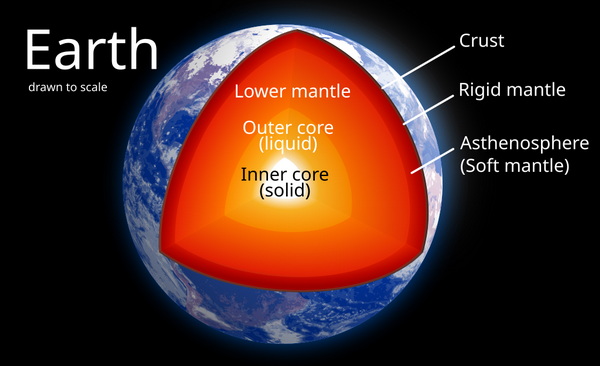
Researchers, Wilson et al from the University of Oxford, Leeds, and University College London, simulated the conditions required for Earth’s solid inner core to form, resulting in it’s present structure, temperature and magnetism. After testing numerous combinations of elements, the team found that core nucleation and crystallization would only occur with precisely 3.8% carbon in its makeup; otherwise, Earth’s core would have remained molten.

Comparative simulations showed that no other elemental mix could sustain a stable magnetic field, leaving the planet vulnerable to solar wind and charged particles—potentially even stripping away its atmosphere. Despite beginning from evolutionary assumptions of an initially molten core—and acknowledging unaccounted complexities—Wilson et al.’s research nonetheless points powerfully to fine-tuned design and raises fresh challenges to long-standing evolutionary views on Earth’s core formation.

The Core of the Matter: Functionality Beyond the Depths

Research into the Earth’s core is highly relevant, as the role of its size, state and composition is known to directly impact Earth’s habitability. Research on Earth’s core is vital, since its size, state, and composition directly affect the planet’s habitability. Earth’s magnetic field—essential for preserving the atmosphere, deflecting harmful solar wind, and guiding migratory species—depends on the core’s composition, which drives convection in the outer core.

According to cosmological evolutionary theory, Earth’s core began in a molten state, due to radioactive heating. Yet for the inner core to crystallize, a precise mechanism was required. To address this, the researchers drew on seismology and melting-point data, which indicate that the core is less dense than pure iron. This suggested that Earth’s present magnetic strength depends on a mixture of elements.  The authors acknowledged, however, that multiple possible combinations remain consistent with traditional constraints, leaving some ambiguity.] However, their research found that of all simulated possibilities, only a 3.8% carbon composition (with a supercooling temperature of 266K) could account for the processes of nucleation and the estimated present size of the Earth’s core.

Even without challenging the unobservable assumption of an initially molten core, this article demonstrates that the very existence of the solid inner core requires a finely tuned chemical composition for today’s geophysical processes to function. Although the Scriptures are not clear about the solid vs. molten state of the Earth’s core at creation, this discovery shows that a precise composition of the core would have been necessary to give rise to the magnetic properties of Earth that life relies on. In an evolutionary framework, the question arises: How did nature “know” the amount of each element required for the core to produce the thermal profile necessary for Earth’s magnetism?

Read the rest of the article here

Peter Ridd: The Great Barrier Reef Is Doing Fine

My article from The Australian this morning below. But first, AIMS are agreeing that the reef is coming off record highs so the small drop should be viewed in that context. However, much of the media is still reporting the drop as a disaster.

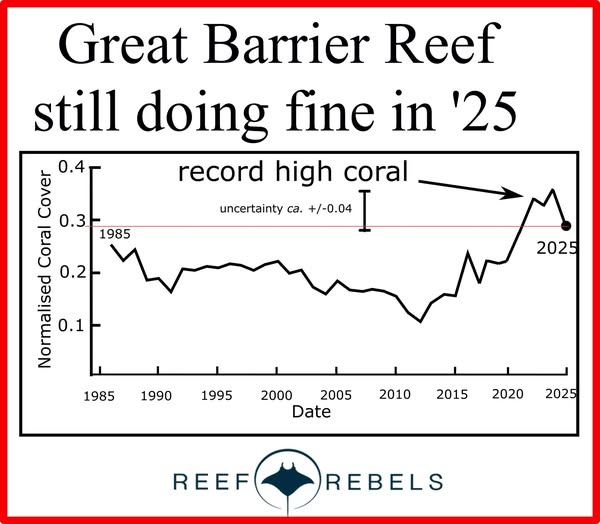
The latest 2025 statistics on the amount of coral on the Great Barrier Reef (GBR) show the reef is still doing fine despite having six allegedly cataclysmic coral bleaching events in the last decade. There should be no coral at all if those reports were true.

The normalised coral cover dropped from a record high number of 0.36 down to 0.29, but there is still twice as much coral as in 2012. The raw coral cover number for all the last five years has been higher than any of the previous years since records began in 1985. However, when one considers the uncertainty margin, the present figures are not significantly different from many of the previous years.

The Australian Institute of Marine Science collects coral data on around 100 of the 3000 individual coral reefs of the GBR. Analysis of the data at smaller scales shows the GBR is doing what it always does – change. There is a constant dynamic as cyclones, starfish plagues and bleaching events dramatically kill lots of coral in small areas, while it quietly regrows elsewhere.

Guess whether the ‘science’ institutions emphasise the death or regrowth.

The institutions often justify this embarrassingly high coral cover as just “weed coral”. But the type of coral that has exploded over the last few years is acropora, which is the most susceptible to hot-water bleaching. How can we have record amounts of the type of coral that should have been killed, again and again, from bleaching? The acropora takes five to ten years to regrow if it is killed.

There are two conclusions that must be drawn. First, not much coral has been killed by climate change bleaching – at least not compared to the capacity of coral to regrow. Second, the science institutions are not entirely trustworthy, and are in need of major reform.

And not just with regard to GBR or climate science. It is well recognised that most areas of scientific study are suffering a problem of reliability, which is damaging the reputation of science itself. It is well accepted that around half of the recent peer-reviewed science literature is flawed. Is there any other profession with such a high failure rate?

This last point has been noted in the United States, where American science is going through a process of genuine revolution. Scientists who were once victimised and ostracised have been appointed to lead science and medical research institutions. Among the more notable and encouraging appointments have been Professor Jay Bhattacharya who famously opposed the groupthink on Covid lockdowns, especially for children. He is now head of the National Institutes of Health and is proposing radical changes in the funding methodology to break the cycle of groupthink. He is also changing funding rules to encourage bright young scientists with new ideas rather than the present system which rewards older scientists who are wedded to conventional wisdom, and often enforce groupthink. In short, Bhattacharya is encouraging dissenters.

The US Department of Energy recently released a report on whether the conventional wisdom on climate change is entirely defensible. It is written by five eminent scientists, all with spectacular careers, who have consistently challenged the view that climate change is an existential threat. Their report includes data about GBR that shows there is little to worry about. Significantly, it systematically addresses many other aspects of Climate-Catastrophe Theory, such as wildfires and deaths from extreme weather events. And it points out the oft-ignored fact that carbon dioxide is a wonderful plant fertilizer which has already increased crop yields and plant growth.

Most importantly, rather than shutting down critics, the report’s writers are actively encouraging criticism, which they will respond to.

Science progresses through argument, logic, and quality assurance systems that make sure debate always takes place. Groupthink kills science, and groupthink is being challenged like never before in the US.

This revolution seems a long way off for Australia. But it will come, simply because US science, and science funding, dominates all other countries.

Imagine if Professor Ian Plimer, Australia’s most famous climate sceptic, was in charge of our climate science funding. Or if I were in charge of the Great Barrier Reef Marine Park Authority. Sounds crazy. But that is what has effectively happened in the US.

Australia’s science agencies would do well to contemplate whether they need to change their ways before the revolution comes to these shores. Better to adapt before the scientific guillotine falls.

Peter Ridd is an Adjunct Fellow at the Institute of Public Affairs.

The Challenge of Iron For Life

An amazing article about iron- both essential to life and toxic, sequestered in the core of the Earth, but needed at the surface

From crev.info

How Iron Fortifies the Earth and Life – CEH

2 minutes


March 29, 2025 | David F. Coppedge

This article about the element iron
and its design was published in
Evolution News on 25 Jan 2022


No Iron, No Life: Intelligent Design in Iron Availability

by David F. Coppedge
January 25, 2022

As an exercise, count the number of lucky breaks that had to occur for the evolutionary story to work.

Life relies on iron, but it is toxic, too. And it’s hard to get this scarce resource where it’s needed. Here is another case of fine-tuning that adds to the many Goldilocks “just right” conditions for life on our planet.

The Biophysics of Iron

Evolution News has reported on the gentle handling of iron by enzymes in cells, such as this discussion by Dr. Howard Glicksman, in which he describes the delicate interplay of iron and oxygen in hemoglobin that makes our blood red. He tells how specialized enzymes control acquisition, transport, and control of iron. Indeed, the building blocks of hemoglobin that incorporate iron, called heme molecules, are toxic within cells and also must be carefully handled, as this article relates.

Just how carefully can be seen in two animations of the CcsBA enzyme from research at Washington University at St. Louis. The enzyme molds itself around a heme (pictured green, with an orange iron atom at its center), preparing and assembling it for transport. It took the research team three decades to figure this out, and this is just the bacterial version!

As fascinating as these irreducibly complex systems are individually, they assume that iron will be available in the environment. How did that happen?

The Geophysics of Iron

Iron availability on the earth must be finely tuned. Iron in the Earth’s core, though abundant, will not be of any help to plant life on the surface or to ocean life. We observe that iron is abundant in crustal minerals, as seen in the colorful iron oxides that bestow reddish colors on many desert walls (and the planet Mars). Iron is also abundant in olivine, which can be delivered from the mantle by volcanoes. In a recent articleEvolution News described how “meteoric dust” from the solar system can gently rain iron onto the oceans for photosynthetic microbes like diatoms to use. But how did iron become finely tuned as to quantity and availability?

To continue reading, click here.

Woman with no brainwave activity wakes up after hearing her daughter’s voice


From lifesitenews.com

The awakening of a mother who had no brainwave activity further calls into question the long-held medical understanding of so-called ‘brain death.’

Featured Image A 36-year-old mother without brain activity woke up after hearing the voice of her one-year-old daughter, one of many incidents that calls into question the long-held medical understanding of so-called “brain death.”

Father Michael Orsi, who has heard the play-by-play of the remarkable episode from one of the nurse anesthesiologists involved, told LifeSiteNews that the woman recently went to the hospital for a double endoscopy. While patients normally wake within five to 10 minutes of the end of the procedure, the mother did not wake up – hospital staff found her heart had stopped.

She received CPR, and soon her heart was beating on its own again. Believing she had suffered a stroke, they sent the mother to receive an MRI and found she had no brain waves. She was then transferred to the intensive care unit (ICU) and put on a respirator to help her breathe. 

After two days in ICU, the husband told the nurse on duty that if his wife could only hear the voice of her one-year-old daughter she would be OK. Amazingly, when he prompted his daughter to speak over his cell phone to her mother, she woke up. She was “in perfect condition,” according to Orsi.

The priest has verified the details of the chain of events with the woman’s doctor, Omar Hussein, who has also confirmed to LifeSiteNews that the mother woke up upon hearing the voice of her daughter. Hussein has said there is no way he can scientifically explain what happened.

However, the longtime medical “consensus” on brain death in the U.S. has been contested by various doctors, some of whom point out that patients can indeed go on to recover consciousness after meeting what has been considered official criteria for brain death. 

Dr. Heidi Klessig recently explained that such cases of recovery after flatline EEGs (no brainwaves) can likely be attributed to a condition called Global Ischemic Penumbra, or GIP:

Woman without brainwave activity wakes up after hearing her daughter’s voice

Like every other organ, the brain shuts down its function when its blood flow is reduced in order to conserve energy. At 70 percent of normal blood flow, the brain’s neurological functioning is reduced, and at a 50 percent reduction the EEG becomes flatline. But tissue damage doesn’t begin until blood flow to the brain drops below 20 percent of normal for several hours. GIP is a term doctors use to refer to that interval when the brain’s blood flow is between 20 percent and 50 percent of normal. 

During GIP, the brain will not respond to neurological testing and has no electrical activity on EEG but still has enough blood flow to maintain tissue viability – meaning that recovery is still possible. During GIP, a person will appear “brain dead” using the current medical guidelines and testing but with continuing care they could potentially improve.

subscribe to our daily headlines US Canada Catholic

Just last month, the New York Times shared the results of a large study that found at least a quarter of unresponsive patients (those diagnosed with a coma, vegetative state, or minimally conscious state) have some awareness.

During the study, teams of neurologists asked 241 such unresponsive patients to do “complex cognitive tasks,” such as imagining themselves playing tennis. Remarkably, 25 percent of the patients exhibited the “same patterns of brain activity seen in healthy people.”

“It’s not OK to know this and do nothing,” remarked Dr. Nicholas Schiff, a neurologist at Weill Cornell Medicine, the Times reported.

“This puts a whole new light on the Terri Schiavo case,” Fr. Orsi told LifeSiteNews, referring to a court’s decision to allow the husband of a cognitively disabled woman in a persistent vegetative state to have her refused nutrition and water so that she would die a slow and painful death of dehydration.

The priest pointed to the implications these findings have for the care of unresponsive patients, including in response to their capacity for mental distress.

“Imagine the terror of that, listening to what they’re going to do,” he said regarding times when the decision is made to pull the plug on an unresponsive patient. “Or hearing how it’s time to call in the organ transplant team. This is horrible.”

“Brain death” guidelines in the U.S. were revised this year to state that it occurs in individuals with catastrophic brain injury, and no evidence of function of the “brain as a whole,” a condition that must be “permanent.” Klessig has pointed out that “under the ‘brain as a whole’ formulation, people can be declared dead while parts of the brain are still working, as evidenced by electrical activity on EEG.”

Klessig has also highlighted the fact that, according to the new guideline, “(t)he panel chose to use the term permanent to mean function was lost and (1) will not resume spontaneously, and (2) medical interventions will not be used to attempt restoration of function.” 

“The fact that medical interventions ‘will not be used’ implies that they might have been used and might have been successful if used. This fact alone reveals that these people are not dead, since there exists a possibility of resuscitation!” she wrote.

Klessig noted that the diagnosis of brain death becomes “a self-fulfilling prophecy: most people diagnosed with BD/DNC very quickly have their support withdrawn or become organ donors.” She is calling for AAN guidelines to be scrapped in favor of “the traditional definition of death: cessation of cardiopulmonary function.”

“Brain death is a legal fiction that removes civil rights from vulnerable brain-injured people, who, under the United States Constitution, possess an ‘inalienable right to life,’ deserve protection, and should be treated as mentally disabled persons,” Klessig maintains.

Darwin’s Blunder Lives On

From Creation Evolution Headlines

David F. Coppedge writes

Darwin’s Blunder Lives On

A major journal publishes a paper
claiming that natural selection is
like human engineering

Darwin’s blunder was criticised by scientists in his own day. He likened natural selection to artificial selection: i.e., human breeding of plants and animals. The two concepts could not be farther apart. They are opposites. Now, three guys print the same blunder out in the open with shameless bravado.

Weinberg’s Law: an expert is a person who avoids the small errors while sweeping on to the grand fallacy.

What farmers and ranchers do as they try to produce better tomatoes or stronger horses has nothing to do with Darwin’s theory. Breeders have foresight. They have intentionality. They set a goal, and can gauge the success of their efforts by measurable results. Darwin’s Stuff Happens Law has none of the above.

Charley specifically denounced any role for foresight, intentionality, or purpose in the operation of natural selection (NS). NS was to be a blind, unguided mechanical process all the way down. Darwin’s own “intention” was to rid biology of any role for a Creator God or designer of any kind. And yet he repeatedly used a fallacious argument from analogy for support, claiming that natural selection is like artificial selection. He was still claiming this in 1876 in the 6th edition of Origin of Species, 17 years after the 1st edition.

Slow though the process of selection may be, if feeble man can do much by artificial selection, I can see no limit to the amount of change, to the beauty and complexity of the coadaptations between all organic beings, one with another and with their physical conditions of life, which may have been effected in the long course of time through nature’s power of selection, that is by the survival of the fittest. [Origin, 6th ed., ch. 4, p85]

Ah, the fittest. Yes, that was the purpose of the blind watchmaker: increasing an organism’s “fitness” (whatever that is). Please re-read our entry, “Fitness for Dummies” to recall that fitness is a slippery, undefinable tautological term that can mean anything the evolutionist wants it to mean. But why would a blind process even know or care about the definition of fitness? Stuff Happens; that’s fitness in a nutshell. Anyone who stuffs that idea into his skull has it in a nut shell.

Darwin never saw his own fallacy. He should have known better, having been a pigeon fancier and a friend of breeders. He should have known that the outlandish varieties produced by breeders, like poodles and dachshunds and pouter pigeons would never have arisen naturally—indeed, they could not survive in the wild. But Charley reasoned that if breeders could accentuate small variations to those extremes, couldn’t Nature accomplish much more, given millions of years? “I can see no limit,” he said. That’s because his eyes were closed, and he was daydreaming in his imagination.

Summing up, Darwin thought (illogically) that if human intelligence can accentuate variations for a purpose, why couldn’t blind nature accentuate variations for no purpose at all? He reasoned that Nature is just like a thinking, rational breeder, that purpose is just like chance, that foresight is like blindness, and that intention is like aimlessness.

He didn’t get it. In his new book Darwin’s Bluff, Robert Shedinger quotes from Darwin’s own correspondence how he persisted in this fallacy to his dying day.

Darwin’s disciples today still sweep on to the same grand fallacy. Here is a spectacular example printed by Nature yesterday.

Engineering is evolution: a perspective on design processes to engineer biology (Nature Communications, 29 April 2024). These three Darwinians (Simeon D. Castle, Michiel Stock and and Thomas E. Gorochowski) do a one-up on Darwin. Not only is evolution like breeding, they assert; it’s like engineering! Indeed, they say, engineering is evolution! The paper is open access, so go ahead: watch them sweep on to the grand fallacy.

Read the rest of the article here

Apollo Astronaut Doubts Consensus Age of Moon

How Old Is The Moon?

From Creation Evolution Headlines

It started when he was told the same
moon rock had two vastly different ages

How old is the moon? Is it 4.6 billion years old, as consensus geologists insist, and as textbooks uncritically teach?

The Apollo astronauts were given extensive training in geology so that they would know what rocks on the moon were significant. This was true for Brigadier General Charles M. Duke (USAF), the Lunar Module Pilot on Apollo 16 who became the 10th man to walk on the moon. One of his geology trainers was Harrison Schmitt, a PhD geologist, who would fly on the final mission, Apollo 17 (see 14 Dec 2022). Apollo 16 (April 16-27, 1972) was the only mission to study the lunar highlands in the Descartes region, with its elevation 7,400 feet higher than the Sea of Tranquillity explored by Apollo 11. (Charlie Duke was also the CapCom, or capsule communicator, for Apollo 11.)

During their three extensive extra-vehicular activities (EVAs), including 16.6 miles of drives on the lunar rover, Charlie Duke and Mission Commander John Young collected 209 pounds of lunar samples.

Moonrock, by Alan Bean, depicts John Young and Charlie Duke (Apollo 16) collecting lunar samples. Used by permission from Alan Bean (Apollo 12 astronaut).

On April 6, during an interview before an audience of nearly a thousand people, Duke related a strange thing that the experts said about one of the lunar rocks he collected.

I picked up a rock on the moon, and it was about the size of my hand. And on one end it dated 3.9 billion years. On this end it dated 1.6 billion years. So there was two billion years between six inches! [audience laughter]. And, something was wrong here, somewhere!

Duke went on to say that he “began to doubt a little bit,” but not to the point of disbelieving evolution. At the time, he was a non-Christian, thoroughly preoccupied with his own career success within the NASA community. It was only later, when he became a Christ follower after seeing the dramatic change in his wife Dotty’s conversion, that his earlier doubts about that rock made sense. “I became a believer, and I went from an evolutionist to a creationist.”

At age 88, Charlie Duke is the youngest of four surviving Apollo astronauts among the 12 men who walked on the moon. Another Apollo astronaut who was a young-earth creationist and Christ follower was Apollo 15 astronaut James Irwin (1930-1991).

“Living Planet Index”: More Bad Science

From Wattsupwiththat.com, Willie Eschenbach talks about the Living Planet Index


A few years back, some scientists got together and invented something they call the Living Planet Index, or LPI. It’s supposed to measure how well (or poorly) the species that make up the living world are doing. They say it is a “measure of the state of the world’s biological diversity based on population trends of vertebrate species.” So it’s an index based on the decline of some selected species, which is claimed to represent the decline of the species of the “living world”.

Here’s the big news from their latest report.

The Living Planet Index claims an average 70% decline in the populations of species worldwide since 1970.

YIKES! 70% loss since 1970! EVERYONE PANIC!

But is this true?

Over in the Twitterverse where I’m @weschenbach, I said that based solely on my experience, their claim was nonsense. I’ve spent a lot of the last half-century outdoors in the elements, both on land and on and under the sea, around the planet. I said I would have noticed a 70% reduction in species populations.

Of course, folks who spend their lives behind desks in a city thought I was being ridiculous, and they laughed uproariously. How could I be so certain? Plus of course, there were the claims of “But Willis, those are actual scientists! How can you doubt them?”

So I thought I’d take a look at some real data. Let’s get a sense of the number of the species involved.

There are estimated to be around 8.7 million species on earth. Of these, about 65,000 are vertebrates.

How many of these 8.7 million species are studied by the Living Planet Index? Well, not all of them.

First, no plants, no fungi, no chromista. Next, only vertebrates, and only some of those, specifically fish, mammals, birds, reptiles, and amphibians.

The good news is that the IUCN Red List of Threatened Species, which is the official keeper of data on which species are threatened or not, lists data for 62,493 vertebrates, so it covers pretty much all of the vertebrates.

It also allows us to search based on various criteria, including those used by the LPI listed above.

And when we eliminate the vertebrate species the LPI doesn’t include, we end up with 59,866 species fitting the LPI criteria—mammals, birds, reptiles, fish, and amphibians. Of course, they didn’t look at all of them, only 5,230. But I wanted a larger view of the issues.

The Red List also lets us see if the populations of each species are increasing, stable, or decreasing.

Of the populations of the 30,763 of the LPI-studied mammal etc. species for which the Red List has population data, 53% have stable or increasing populations. So we’re left with 14,565 species with decreasing populations. Call it half to be generous.

Here’s the problem. If around half the species for which we have data are stable or increasing, then even if the rest were all totally extinct, the average decline would only be 50% … far from the 70% they claim.

Oooops …

Next, as a sensitivity analysis, let’s assume every one of the 28,714 species for which we don’t have the population trend is decreasing. Clearly, that’s not possible—some will be increasing or stable. And because the Red List is focused on threatened species, the unknown species will likely be weighted towards stable species. But it’s a sensitivity analysis, so we’ll assume every one of the unmeasured species is decreasing.

With that impossible assumption purely for a sensitivity analysis, it would mean only 27% of the species are stable or increasing.

And the problem still remains. With 27% not decreasing, the only way to get to a 70% decrease in population is if almost every one of the 33,861 theoretically decreasing species is already extinct or on the brink of extinction. Only that impossible situation would give us a 70% average decrease.

Conclusions?

Out of 59,866 species fitting the LPI criteria for which we have population data, just over half are stable or increasing.

Of the 59,866 species, only 8,509 are both decreasing and in some trouble (vulnerable or near threatened or endangered or critically endangered). Here’s the Red List Report:

The endangered and decreasing fish, birds, reptiles, amphibians, and mammals are 0.001% of all species, and there’s no reason to assume that their condition reflects the world situation.

The 70% claim of the LPI is falsified by the Red List data.

As I said, I have investigated this because based solely on my experience, I said I didn’t believe the LPI numbers, and folks laughed at that. And now, having studied the species data, I find that my experience is correct—their claims don’t hold water.

So how did the scientists behind the LPI get it so wrong? Obviously, their selected species are not representative of the whole.

I would suggest that Upton Sinclair had the answer to that. He said:

“It is difficult to get a man to understand something, when his salary depends on his not understanding it.”

The problem is, if the LPI was going up, or just slightly downwards, the scientists behind the LPI would be out of a job. To use George Orwell’s term, that’s doubleplusungood …

And almost inevitably, this leads to an unconscious bias in their choice of species, locations, and studies to include in the LPI. For the LPI, they’ve studied 31,821 populations of 5,230 species. So no overt bias is needed—just picking study A over study B because reasons, choosing population 1 over population 2, selecting species Alpha over species Beta, lather, rinse, repeat, and soon you have a 70% decline since 1970.

Finally, please be clear that I’m not saying that we should ignore population decreases. I’ve been a commercial fisherman for a good deal of my life, and I’d like my grandson to be able to do the same. The only way for that to happen is for us to care for the other life forms with which we share this magical planet. I’m just saying that the LPI is just more unsupported alarmism.

Best to all, and yeah, I’ll continue to trust my experience despite people laughing at it … I’m funny that way.

Creation Or Evolution

I have been thinking this week about two stories of how we arrived in the world. The first theory is evolution, which says that we are just a product of random chemical reactions over a very long period of time. The second story is that of creation as described in the very first chapter of Genesis.

This is not the place to say whether one of these stories is factually correct, or whether we can blend the two together in some way. I do want to consider some of the ramifications of these stories and the results of believing one or the other.

As we read the familiar words of Genesis 1, we discover that God is greater than the world, the sun and moon, the stars and bigger than everything all put together. Science tells us that the universe is unimaginably huge and more complex than we can imagine, but God is bigger than all of this.

At each stage of the process, God describes the creation as good, until the last day when He makes the first people and He describes it as “very good.” It is as if everything is made for the purpose of supporting human beings.

The Bible teaches that we are created for a purpose and that we are the pinnacle of God’s creative activity.

On the other hand, evolution tells us that everything is random, from the birth of our planet (an insignificant lump of rock on the edge of an average galaxy), to the production of individual human beings (you are just a random arrangement of DNA, and it determines your life).

So we get to a place of despair because there is no reason for us to exist. There is no future because in the end the whole universe will just run out of energy.

From that depressing explanation of life, we reap a harvest of depression, purposelessness, sexual anarchy and lawlessness.

God made you for a purpose. He has a plan for your life and a destiny for you in eternity.

Praise God!

The Perfectly Round Electron Threatens The Big Bang Theory

#f6f6f6;color: ;font-family: sans-serif">Real particle physics refutes big bang dogma

© Sakkmesterke | Dreamstime.combig-bang
Big bang artist impression.

by Jonathan Sarfati

Some very fine experiments have measured the roundness of the electron with exquisite sensitivity.1 For comparison, “if an electron were the size of Earth, they could detect a bump on the North Pole the height of a single sugar molecule.”2

The experiment showed “The electron is rounder than that.”1 But this result in real operational science has disappointed advocates of the historical scientific theory of the big bang. Why?

#f6f6f6;color: ;font-family: sans-serif">Big bang vs particle physics

The big bang is the leading naturalistic cosmogony (Greek: ‘birth of the universe’). It basically states that energy appeared from nothing and turned into matter, as per Einstein’s most famous formula, E = mc2.

However, The Standard Model of particle physics, among the best-attested theories in all science, throws up severe problems. In particular, any conversion of energy into matter must produce an equal amount of antimatter. Antimatter comprises antiparticles of the same mass but opposite charge (if the particle is charged) and magnetic moment as the corresponding matter particle. When an antiparticle meets its corresponding particle, both are quickly annihilated with a huge release of energy, again as per E = mc2. That is, antielectron (positron) with electron, antiproton with proton, antineutron with neutron, etc.

The problem for the big bang is that the universe comprises overwhelmingly matter, with hardly any antimatter except for fleeting moments. As the article says:

For one thing, our mere existence is proof that the Standard Model is incomplete since, according to the theory, the Big Bang should have produced equal parts matter and antimatter that would have annihilated each other.2

But notice the logical fallacy known as begging the question (Latin: petition principii)! That is, any argument where the conclusion to be proved is presupposed (‘begged’) in one of the premises.3 In particular, although real operational science overwhelmingly supports the Standard Model, there must be something wrong with it because it means that the Big Bang would not work. How do we know that the big bang is true? Because we are here, and we got here from the big bang. This question-begging arises from previous question-begging: that we arose by naturalistic means—no Creator necessary.

Because of this question-begging a priori commitment to naturalism (only ‘nature’ exists), evolutionary cosmologists have been trying to find loopholes in the Standard Model. In particular, any asymmetry that could explain why much more matter than antimatter was produced in the big bang.


Read the full article here