
The sermon for October 2nd 2016 is now available on the New Life web-site.
In this sermon, which is based on 2 Timothy 1:1-11, I talk about Paul’s command to fan into flame the gift that is within us.

My heart is broken
Joy has deserted me
This nation has abandoned God
And the poor go hungry
How I wish I could cry
A fountain of tears
Weeping day and night
For my people

I was shocked and distressed to hear on the news last night that a 4 year old child is beginning to transition gender. It is disturbing that “adults” involved in the care of the child considers this to be a good idea.
Really at 4 years of age children are still trying to work out how their body works and have only the vaguest of awareness that boys and girls are different. Some boys play better with girls than boys but that doesn’t make them girls. Some girls would rather play with cars than dolls, but as the feminists remind us constantly, that does not make them boys.
How does any 4 year old get the idea that they should be the opposite sex, without the encouragement of “adults”?
We live in an age that has abandoned all sense of reality. We are taking the concept of “you can be anything you want to be”, which was always a lie, to absurd levels. When feelings are the basis of important life decisions, stupidity will prevail in the long run.
What we are experiencing right now is a rapid unravelling of western culture. It started with the sexual liberation movement of the 1960’s, the destruction of families through easy divorce and acceptance of de facto relationships in the 1970’s and 80’s, the rejection of christian ethics as relevant to culture on the 1990’s. You could add to that post-modernist rejection of truth as a category and the rise of post-normal science (the results you want are more important than actual data).
Now we are faced with massive challenges from radical Islam, political tyrants who will do anything to implement their own ideas, increasing dependence of individuals on government largess and a host of other social and economic problems. We lack the courage and the resources to tackle them because we are too engaged in pandering to feeling good about ourselves.
The hope that I hold onto is that eventually as a nation we will turn back to Jesus and embrace the values of the gospel. I hope and pray often for a revival of faith that can only come from a supernatural encounter with the Spirit of God.
Passage: https://www.biblegateway.com/passage/?search=Philemon
Scripture
I pray that the sharing of your faith may become effective when you perceive all the good you may do for Christ.
Observation
This is Paul’s letter to Philemon and the church that meets at his house.
Paul recalls Philemon’s love for the saints and faith In Christ. He prays that his faith sharing will be effective.
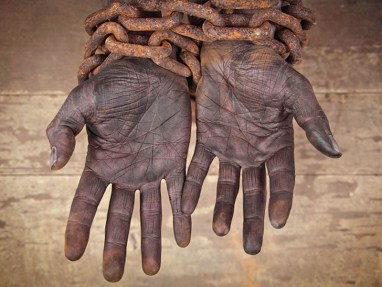
Paul turns to the issue of Onesimus a slave who had run away from Philemon’s household and had since become a christian under Paul’s ministry. Paul urges Philemon to receive Onesimus not as a slave but a brother. Paul promises to make up any financial loss Philemon might have incurred.
Application
Some people say that Paul tacitly excused slavery because he did not write against it. In a society that was economically dependent on human labour, slavery was a given fact of life. In a situation where christians had no power, writing against slavery would not have changed anything.
Here in the short letter to Philemon we see how the gospel works to transform society one person at a time. Paul’s argument is that Philemon should treat Onesimus as a brother for whom Christ had died not as property.
Our situation is different but the principle is the same. We share the gospel and act for righteousness, and lives are changed one at a time. We cannot easily end abortion but we can offer alternatives to people considering a termination, changing one life at a time. We may not be able to remove tensions between ethnic groups but we can build bridges of friendship and help individuals to find reconciliation and peace in Christ.
When christians all work on their little piece of the puzzle we find that together the Body of Christ is able to have a big influence.
Prayer
Lord, where are you asking me to bring change today? Show me the one person I can share my faith with today. Amen.

Passage: https://www.biblegateway.com/passage/?search=Luke+14.7-14
Scripture
“All who exalt themselves will be humbled, and those who humble themselves will be exalted.”
Observation
At a banquet Jesus notices that people are jockeying for the best places. He tells them that it is better to choose a lower place so that the host promotes you than to choose an honoured place and have the host move you to make space for another.
It is better to give a banquet for the poor, the crippled and the lame who cannot repay you than to only invite your friends. Jesus assures us that we will receive our reward in heaven.
Application
In a culture that relentlessly encourages self-promotion, Jesus’ teaching seems crazy. Why not put yourself out there and make people take notice of you?
The pathway of humility- being realistic about ourselves and others- is actually more productive in the long term, and certainly in the Kingdom of God.
We live not for the glory of men but for the affirmation of God. At least we should live for the affirmation of God.
Is it better to have the “Well done!” of creatures of limited senses or to have our heavenly Father who created the cosmos with a word say “Great effort!”?
It is too easy to have our goals and desires shaped by sinful people. God wants us to keep our our eyes on the goal of eternity.
Prayer
Lord I understand that you are training me for an everlasting Kingdom. Please help me to set my eyes and my heart on what pleases you. Amen.
When Governments step in to “regulate” or “help” certain industries in the interests of consumers, the effects are always bad for consumers. You can see from the graph below which services are regulated by the U.S. Government.


Is this not brilliant? It is Daniel in the Lion’s Den, painted in 1872 by British artist, Briton Riviere. Not the most British name is it? Riviere was descended from the French Huguenots, the Protestants slaughtered by the French regime, a massacre that started on this very evening, 23rd August, way back in 1572 and which peaked over the following weeks.
It’s become known as the St Bartholomew’s Day Massacre, and the spark that set it ablaze was fierce political rivalry in the French court, stirred up by Catherine de Medicis, who loathed the Huguenot influence over her son.
The sheer, but impotent, rage on the faces of the lions in the face of the humble servant Daniel, thrown to his death for showing nothing but an allegiance to his God above all else, mirrors the terrible rage of the French court during that bloody time doesn’t it?
St Bartholomew had another name of course, Nathaniel, the Israelite and disciples of Jesus in whom Jesus memorably states “there is no guile” (John1:47).
His guilelessness did not stop him being martyred however. History reports that Bartholomew/Nathaniel had the skin stripped from his body, much as a lion might do to a human.
That lack of guile links Daniel with Bartholomew, and of course links both men with the true Israelite who trusted God above all else in the face of his jealous enemies – the Lord Jesus.
Daniel was hated by his enemies not for his royal court guile, but for his guilelessness and his excellent spirit before King Darius, who sought to promote him because of it.
Any charge against Daniel would have to be conjured up. And it was clear to his enemies that nothing would stick unless it was to do with the worship of his God.
So too with the Lord Jesus. Pilate knew it was for jealousy that the religious leaders of the Jews had handed him over. Not that his more excellent spirit would save him from the jaws of the lion on the cross. Just like Daniel he had to go.
But just like Daniel – only in an even more spectacular way -, God brought Jesus up of that stone-covered mausoleum, not simply to be showered with honour and glory by a relieved King Darius, but to be given the glorious rule of the universe by His Father.
So here we are in our own time of exile. The culture rages against the people of God as it has always done. And it’s tempting to respond in any way except in the one way Daniel did.
When the jealous officials tricked Darius into signing a decree that only the king should be petitioned for a period of thirty days, we are told that:
10 When Daniel knew that the document had been signed, he went to his house where he had windows in his upper chamber open toward Jerusalem. He got down on his knees three times a day and prayed and gave thanks before his God, as he had done previously.
Notice that last clause: “as he had done previously”. The culture has turned hard against him. The lions are looming. But he does not panic. He does not start to pray like he’s never prayed before. He does not give up on thankfulness and descend into grumbling about how the culture has turned against him, and used fair means or foul to sideline him. He does what he had always done in his time of exile: puts his hope in the covenant God of Israel.
He turned his face towards the place of his future hope – the new Jerusalem that would be coming – and thanked God. This was no moan about how good the old Jerusalem was, and how it would be good to get back to those days. No! It was a prayer of certain hope that God would bring in a new Jerusalem even if he never lived to see it.
Christian, even the new Jerusalem ushered in by God after the return from exile was merely a shadow of the true new Jerusalem that is coming down from heaven, and from whence is our hope. And we may not live to see it. We may live during an increasing time of cultural hatred towards the gospel that is both licensed and litigious.
Yet in the midst of all of that we don’t need to moan and complain about how the culture has turned against us and how the old Jerusalem worked so well. We can get on with a guileless, excellent-spirited servant-hearted life in our exile, even if the culture conspires all sorts of ways to make us look like the baddies.
Even if the only charge that can be levelled against us concerns our relationship with our God.
Especially if the only charge that can levelled against us concerns our relationship with our God.
The lions may roar, the culture may desire to pick over our bones and mock our eclipse. But we will open the windows of our hearts towards the new Jerusalem and give our God the praise and honour due to His name.


 New Life Narrabri