Egypt offers a telling example of Christian persistence. Partly, the Egyptian church retained such a mass following because of its enthusiastic adoption of the native Coptic language. At least the Gospels and Psalter were already available in Coptic by around 300. Elsewhere in North Africa, the church’s insistence on speaking Latin meant that it never evangelized far beyond the cities, so that Christianity did not long survive the Muslim conquests. Philip Jenkins
The Spectator has some great news coming out of Canada!
Good news out of Canada!
I’m a native-born Canadian. When it comes to politics I virtually never say, ‘Look at the good news coming out of Canada!’
The left-wing Liberal Party has dominated Canadian federal politics for most of the last century. Recent national Conservative (nickname ‘Tory’) party leaders have been inept; they’ve been afraid of being conservatives or of voicing any conservative policies; they have seemed to function without any value-based anchors (think Scott Morrison); they have regularly adopted the Textor approach to politics for conservatives, which is to park your party a centimetre to the right of the left-wing main party.
All up it has been a disaster electorally as the left side of politics in Canada wins and wins and wins again.
Last weekend, the Conservative party selected a new leader in Pierre Poilievre. This MP would have had zero chance of winning the leadership in Australia because many of his fellow MPs (mostly ‘moderates’) would rather have eaten broken glass than vote for him. But some time ago, the decision of who would be party leader was wholly taken out of the hands of the partyroom and given to the paid-up party membership.
On Saturday, the party membership decision was announced and Poilievre received over two-thirds of the vote. His nearest rival, the establishment ‘moderate’ aka ‘don’t rock the boat’ candidate won just 16 percent of cast ballots.
The first thing Poilievre made clear is that he will not now pivot to the centre.
He has said the Governor of the Bank of Canada will be fired on the first day after he wins an election because of his money printing incompetence these past three years.
Poilievre then repeated his attacks on the bias of the CBC (which is actually a tad more balanced than our ABC). The new Tory leader said he would significantly defund the national broadcaster and that it is not remotely balanced (which is a true statement). Poilievre even went down into the detail of the sort of commentators the CBC brings in and noted they almost all just parrot the left-wing Liberal worldview. Half of the country that disagrees should not have to pay for this.
After winning a few days ago, Poilievre stated that he expected the CBC to come after him – for marching with the truckers whose civil liberties were taken away; for articulating clear conservative policies; and for making clear that the national broadcaster will face financial repercussions from a Conservative government led by him. The strategy is perfect if you believe that the national broadcaster is going to attack any real conservative party and leader anyway.
To quote Shakespeare, Poilievre is making a virtue of necessity.
His other policies include a promise to wind back the regulatory state, to get oil and gas pipelines finished, and to take real steps against politically correct, Woke bureaucracies and even companies.
To say that he has painted the biggest target imaginable on his chest is no exaggeration. And isn’t this splendid… As it happens, the Liberal Party is petrified of Poilievre. He is an adopted baby who grew up with no wealthy parents or any noticeable life advantages. His wife is an immigrant from South America (who has the political advantage of being extremely pulchritudinous).
So, he hates Woke cancel culture. He dislikes the regulatory state. And he is prepared to engage in a front-on battle with the public broadcaster, making that plain before the next election.
Poilievre, despite the name, grew up in Alberta (the most conservative of Canada’s provinces) and only learned French later in life. But his name and now excellent language skills make him a big threat to the Liberals in Quebec. His willingness to stand up against the lockdownistas is now starting to pay significant benefits – he does not concede that the welding people in their homes strategy was a good one.
Friends I know back in Canada who have despondently but correctly predicted a left-wing Liberal win, one after another after another, say that the Tories will win the next election. They are starting to make real inroads into the working class vote. This is the political realignment that benefited both Trump and Boris and that is happening throughout the anglosphere and democratic world.
Rich people now vote left, in general terms. The upper-middle-class, university graduate caste is about the most Woke and left-leaning part of the electorate there is. And another sign of how fighting on values works is that the Green party in Canada is now imploding. You can’t get better news than that.
Anyway, even though Justin Trudeau leads a minority government the other left-wing parties have pledged to prop him up so it could be over two years till the next election. No one knows what will be happening then or who will win. But the omens are good for Conservatives in Canada for seeing a real Conservative party led by a real Conservative win office at the next election. And I cannot remember when I last said that.
This hope is a strong and trustworthy anchor for our souls. It leads us through the curtain into God’s inner sanctuary.
Observation
God promised with an oath to bless Abraham with descendants beyond number. Abraham waited patiently to receive what God had promised.
When people take an oath, it is considered to be binding. So God bound himself with an oath so that the recipients of His promise can be sure that He will never change His mind.
We who have fled to God for refuge can have great confidence as we hold to the hope that lies before us. This hope is a strong anchor for our souls because it leads us into God’s presence.
Application
We use the word hope in a very weak sense – we hope things will happen without any great certainty or expectation that they will.
In the Bible, the word hope means a confident expectation based on God’s promise.
God has promised that everyone who calls on the name of Jesus will be saved. Because God is trustworthy and does not lie, we can be confident that we will go to heaven.
The promise and the hope are more than a future event. This hope leads us into the presence of God now. Jesus is with God, and we are with Jesus, so we are in God’s presence.
This is a hope that anchors the soul. I don’t have to be pushed to and fro by emotions or circumstances. No, my status with God is secure. He loves me and will not abandon me, ever.
I can walk with calm confidence in every situation, trusting in the power and grace of my heavenly Father.
Prayer
Thank you, Lord, for this strong hope that I have in you. You are my rock and my shield. Amen.
To imagine the early history of Christianity, we would do much better to use the standard map of the world that was regularly offered in medieval times. In these older pictures, the then-known continents of Europe, Africa, and Asia all appeared as more or less equal lobes conjoined at a central location, which was Palestine, with Jerusalem at its center. This image made splendid theological sense, in that Jesus’s sacrificial self-giving occurred at the very center of the world that he was saving.
Jo Nova reports the astounding find of corals way above current sea levels. Maybe we could restore those coal fired power stations, burn some fossil fuels and restore the reef.
Corals covered the Australian desert once – maybe they’ll grow back if we screw in the right light globes?
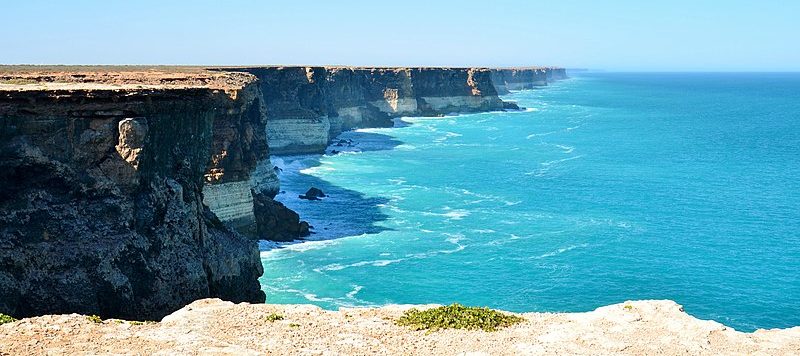
The remnants of a long gone coral reef are not in the water here, but on top of the cliff. This is what real climate change looks like:
The whole coral reef is now 100 m out of the water | Bahnfrend |
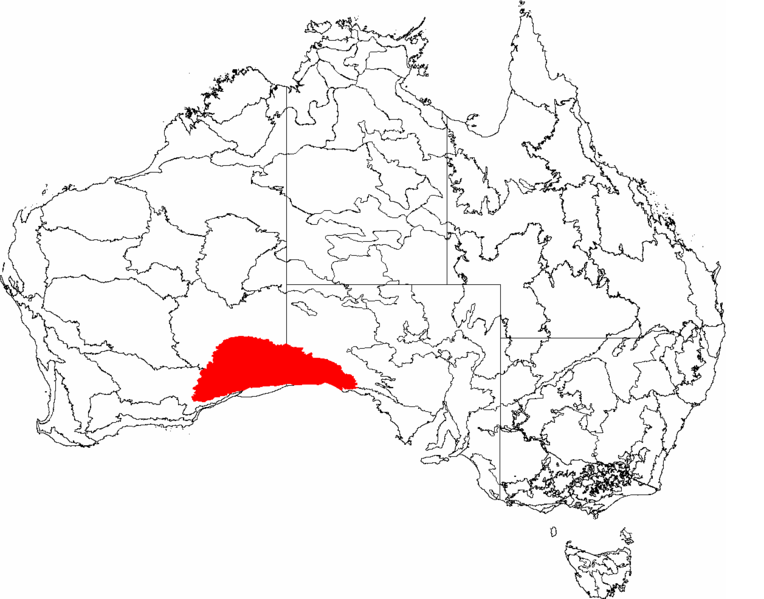
The Nullabor Plain.
It turns out the high plateau desert called the Nullarbor was once a coral reef. It’s a thousand kilometer stretch without a tree that’s now about 100m above sea level. Obviously it’s a wilderness that’s begging to be restored to its true Miocene glory. The question is whether we can put on enough solar panels to save this reef, or if we can melt the Antarctic and raise the oceans…
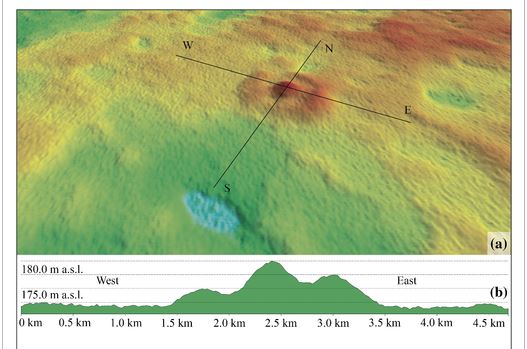
Researchers looking at satellite images spotted a suspicious looking dome and ring (below) . They figured out it was not a meteor crater but probably a former coral atoll. It’s about one kilometer across and corals built this (probably) 14 million years ago. Tectonic shifts lifted the land out of the ocean. If only the polyps had put in a carbon tax?
The Nullarbor is a bit special because the surface is well preserved. There is not a lot of rain, no rivers to speak of, humidity is low, storm surges don’t wash over it and sediments don’t settle on it. Plus the nearest glaciers are in New Zealand.
““So even though it’s exposed, it’s kind of like a land that time forgot … the erosion is so slow, [these features] get preserved for millions and millions of years, kind of capturing a snapshot of how environments were at different times.” —WA Today
Coral Dome, remnant, Nullabor Australia
Once fish frolicked in the afternoon sun among the anenome here. Now there is saltbush.
This is the kind of climate change we need to teach children at schools. Geological, not Gretalogical.
Imagine the effect if students knew almost nothing was permanent, life was adaptable, and the climate changed all the time.
Most of Australia is now arid and dry, with vast inland deserts. Millions of years ago, though, during the Miocene, the continent was teeming with life; not just dense, thriving forest ecosystems, but huge inland seas.
“Through high-resolution satellite imagery and fieldwork we have identified the clear remnant of an original sea-bed structure preserved for millions of years, which is the first of this kind of landform discovered on the Nullarbor Plain,” says geologist Milo Barham of Curtin University in Australia.
The ocean that covered the Nullarbor started to dry up around 14 million years ago, exposing the shallow-water limestones deposited during the middle Cenozoic.
That means the Nullarbor is effectively a clean record of geological processes and features dating back to the Miocene.
“Evidence of the channels of long-vanished rivers, as well as sand dune systems imprinted directly into limestone, preserve an archive of ancient landscapes and even a record of the prevailing winds,” Barham says.
“And it is not only landscapes. Isolated cave shafts punctuating the Nullarbor Plain preserve mummified remains of Tasmanian tigers and complete skeletons of long-extinct wonders such as Thylacoleo, the marsupial lion.”
That’s not all. “At the surface,” adds Barham, “due to the relatively stable conditions, the Nullarbor Plain has preserved large quantities of meteorites, allowing us to peer back through time to the origins of our Solar System.”
If we are to rely on e-vehicles to transport our soldiers through warzones, the Australian Defence Force is certainly doomed. Perhaps we should consider an even more environmentally-friendly, natural means of transport.
Last month, amid great fanfare, an electric version of the battle-tested Australian Bushmaster (a concept E-Protected Mobility Vehicle) was launched in Adelaide.
The original, diesel-powered Bushmasters built in Bendigo served in the Afghanistan theatre. So impressive were they that allied combatants including the Netherlands and Britain purchased 120-plus of them.
Currently, 20 Bushmasters are en route to active service with the Ukrainian Army. Other defence force customers of the Bushmasters include New Zealand, Fiji, Japan and Indonesia.
The diesel-powered vehicle has an operational range of 800 kilometres.
So, now, an all-singing all-dancing concept electric prototype is ready for Army trials. It is anticipated that these e-Bushmasters will be silent and not generate the heat signature of a diesel vehicle.
Limitations
According to your ABC News of August 11, it is anticipated that the e-vehicle will have an impressive operational range of 1,000 kilometres.
That is not yet the case, according to the Defence Department’s release of August 19, which says: “The first version has about a 100-kilometre range, but a planned larger battery should increase this to 350 kilometres. There’s also work to mount small external generators, increasing the range to about 1,000 kilometres.”
A small detail missed in the media hype was that the e-vehicle could not drive to the Adelaide launch. This was confirmed by the Minister’s office, which said the e-vehicle was transported from Newcastle (NSW) on the back of a motorised vehicle.
The lithium battery utilised in the e-vehicle features high-speed recharging; about three hours at an EV station; or, if the crew pull up outside a farmhouse and use the household plug, about seven hours.
An inconvenient feature of the large lithium battery is that if a bullet or shrapnel pierces its casing, the crew will probably be roasted alive. If it should happen in dense scrub, there is the possibility of a bushfire.
A convoy of E-Bushmasters rolling at 100 kilometres per hour from Melbourne to Sydney (870 km) would, with nine stops at EV points, take 36 hours (1½ days) to arrive; while the same 870-km trek in outback South Australia, Queensland, Western Australia or the Northern Territory stopping at farms to recharge would take 72 hours (three days). Diesel-powered Bushmasters can cover the same distance – with driver breaks every two hours – in about 11 hours (half a day).
But do not despair; Assistant Minister for Defence Matt Thistlethwaite said the electric Bushmaster is part of building a “future ready” Army.
Standard Operating Procedure for an army field-force convoy movement is to place the slowest vehicles in the lead. A worry for any convoy commander if he was moving a mixed convoy of motorised and e-vehicles would be the requirement to halt every 100 kilometres to recharge the electric units.
Moreover, not all e-vehicles would stop at the same location because some might “run out of puff” after 90 kms, others at 95 kms, or 98 kms, well short of the recharge point. A convoy with 20 e-vehicles would require a recharge point with 20 EV stations or 20 power points at a farm.
Missing in Action
A timely lesson for the Army comes from the Gloucestershire Constabulary, which boasts the largest full electric fleet in Britain, 91 vehicles. Its problem is simple: the force cannot respond to crime because the batteries “keep going flat”.
Police and Crime Commissioner Chris Nelson said officers had experienced problems finding recharging facilities in the county as the e-vehicles “run out of puff”, and staff needed to change police cars.
Police Scotland invested £20 million ($A34 million) providing 23 stations with e-vehicles but no EV charging points. When their vehicles were plugged into the station’s regular power point, the latter blew up. Now the e-vehicles are left at council car parks overnight with officers reverting to combustion-powered vehicles.
The e-Bushmasters engaged in a limited conflict in the remote outback or even in rural areas and “running out of puff” would certainly meet the Army’s “silent” criterion.
Natural Alternative
While it is easy to criticise a work in progress, any correspondent worth his salt should provide an interim workable solution that will work until the Army’s R&D e-vehicles are perfected before we face an invasion or shortage of liquid fuels.
Australia has (perhaps) a million feral camels roaming the Outback. Australian soldiers rode camels into battle during World War I in the Mesopotamia campaigns. Camel trains were used in remote Australia as each animal could carry 100 kilograms of stores, or be harnessed in teams to haul wagons.
In a military emergency, camel teams could haul “out-of-puff” e-vehicles to the nearest power point. A good camel will travel at five km/h; so, she’ll be right, no urgency; the troops can wait.
The Army’s use of camels would be an innovative carbon-reduction “work in progress” of Labor’s Climate Change Bill, now before the Senate, and would easily impress the UN’s climate barons and other assorted global-warming alarmists.
Even at the height of the missionary endeavour , non-Western converts very soon absorbed and adapted the religion according to their own cultural needs. Philip Jenkins






.jpg)